Overview
- Theropoda was the most ecologically varied dinosaur clade, encompassing hypercarnivores, herbivores, omnivores, and insectivores across a body-size range spanning five orders of magnitude, from sub-kilogram maniraptorans to multi-tonne tyrannosaurs.
- Feathers originated deep within the theropod lineage as simple filamentous structures used for insulation or display and were progressively elaborated through developmental stages into the asymmetrical flight feathers of modern birds, as documented by exceptionally preserved fossils from Liaoning, China.
- One theropod lineage — Avialae — survived the end-Cretaceous mass extinction, and its descendants, the approximately 10,000 species of living birds, make theropods the most species-rich clade of terrestrial vertebrates on Earth today.
Theropoda is the clade of bipedal, predominantly carnivorous dinosaurs that includes every predatory dinosaur from the two-metre Coelophysis of the Late Triassic to the twelve-tonne Tyrannosaurus rex of the latest Cretaceous — and, remarkably, the roughly 10,000 species of living birds. First defined by Jacques Gauthier in 1986 as part of a comprehensive phylogenetic analysis of Saurischia, Theropoda is united by features including hollow, thin-walled limb bones, a three-fingered hand with a grasping first digit, and a distinctive intramandibular joint in the lower jaw.3, 2 No other dinosaur clade achieved comparable ecological breadth: theropods occupied roles ranging from apex hypercarnivore to obligate herbivore, from pursuit predator to probable insectivore, across a body-mass range spanning five orders of magnitude.10 Their evolutionary history, stretching from the Carnian stage of the Late Triassic (approximately 231 million years ago) to the present day, encompasses the origin of feathers, the evolution of flight, and the only dinosaurian lineage to survive the end-Cretaceous mass extinction.1, 19
Late Triassic origins
The earliest unambiguous theropods appear in the fossil record of the Late Triassic, approximately 231 to 230 million years ago, in rift basins of southwestern Gondwana. The Ischigualasto Formation of northwestern Argentina has yielded Herrerasaurus ischigualastensis and the smaller Eoraptor lunensis, both of which preserve a mosaic of basal saurischian and theropod-like features.1 The phylogenetic position of Herrerasaurus has been debated: some analyses recover Herrerasauridae as the most basal theropods, while others place them outside the Theropoda + Sauropodomorpha dichotomy as stem saurischians. A 2017 analysis by Baron, Norman, and Barrett even proposed rearranging the traditional saurischian-ornithischian split entirely, though the monophyly of Theropoda itself was not challenged.24

In North America, the Upper Triassic Chinle Formation preserves Coelophysis bauri, a slender, gracile neotheropod known from an extraordinary mass-death assemblage at Ghost Ranch, New Mexico, where excavations have recovered the remains of at least 1,000 individuals from approximately 30 cubic metres of sediment.5 Taphonomic analysis suggests the carcasses were transported and concentrated by fluvial currents during a regional drought, and the virtual monospecificity of the assemblage indicates that Coelophysis was a numerically dominant component of its local ecosystem.5 A broader survey of Late Triassic dinosauromorph assemblages from New Mexico has demonstrated that dinosaurs, including early theropods, initially coexisted as relatively minor components of faunas still dominated by pseudosuchian archosaurs and other non-dinosaurian reptiles; their rise to ecological dominance was gradual and opportunistic rather than the result of competitive superiority.6
Theropod phylogeny and major clades
The internal phylogeny of Theropoda has been refined over four decades of cladistic analysis. Gauthier's foundational 1986 work established the framework of nested clades still in use: Theropoda contains Ceratosauria and Tetanurae, with Tetanurae further divided into Megalosauroidea, Allosauroidea, and Coelurosauria.3 The most comprehensive analysis of basal tetanuran relationships, by Carrano, Benson, and Sampson in 2012, incorporated 353 morphological characters across 61 tetanuran taxa and confirmed the monophyly of Megalosauroidea (including Spinosauridae) and Allosauroidea (including Carcharodontosauridae), while highlighting extensive homoplasy in the early radiation of these clades.4
Ceratosauria, the sister group of Tetanurae, includes the Jurassic Ceratosaurus and the predominantly Gondwanan Abelisauridae, medium-to-large predators characterised by deep skulls, reduced forelimbs, and elaborate cranial ornamentation. Abelisaurids such as Carnotaurus and Majungasaurus were the dominant large predators of Late Cretaceous South America, Africa, Madagascar, and India, filling the apex-predator niche that tyrannosaurids occupied in Laurasia.4, 2
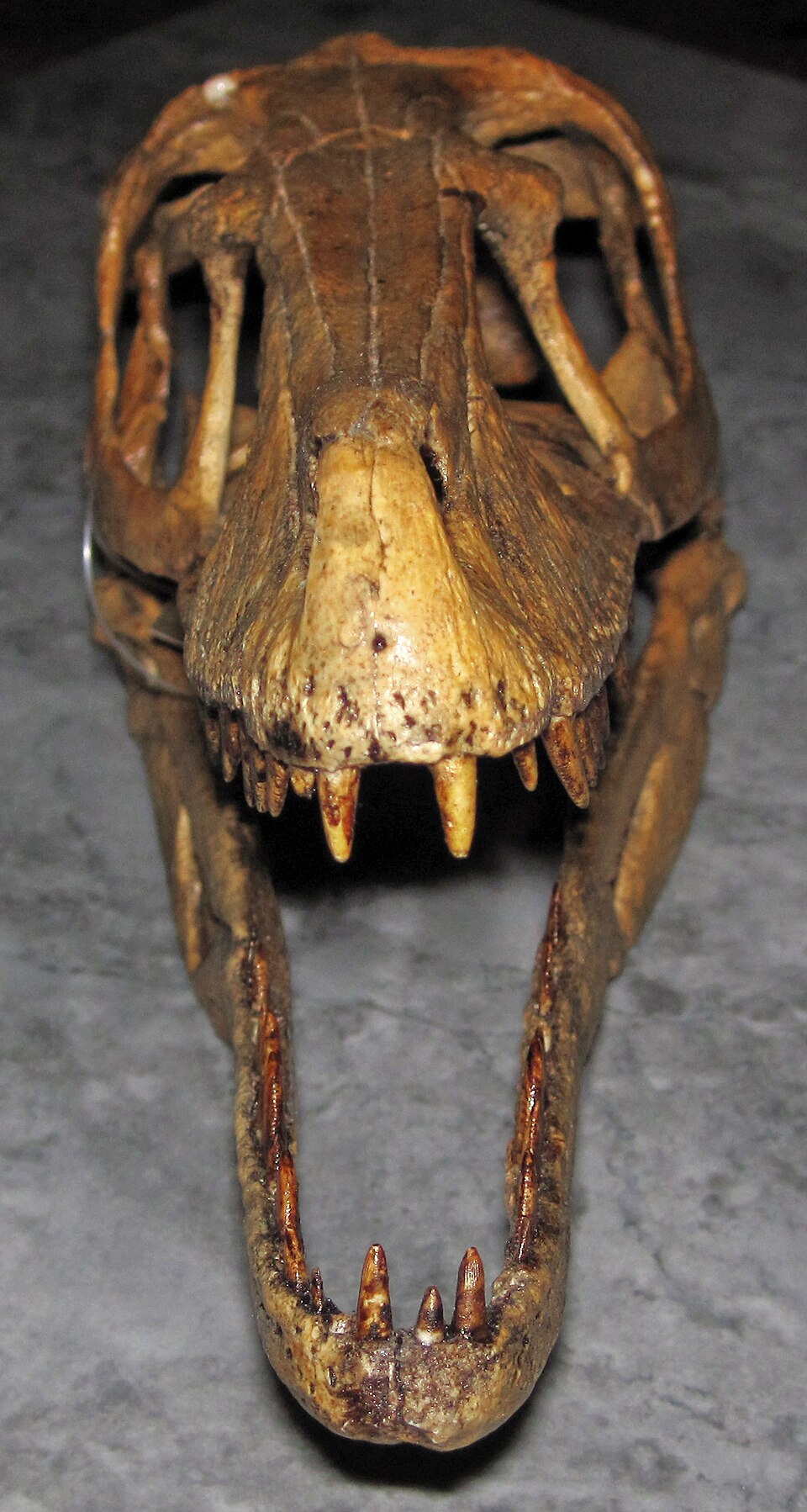
Tetanurae encompasses the vast majority of theropod diversity. Within this clade, Megalosauroidea includes the spinosaurids, remarkable for their elongated, crocodile-like snouts and evidence of piscivorous (fish-eating) habits. Allosauroidea includes the gigantic Carcharodontosauridae, whose members — Giganotosaurus, Carcharodontosaurus, Mapusaurus — rivalled or exceeded Tyrannosaurus in body length, though they were not closely related to it.4
Coelurosauria, the most species-rich tetanuran clade, contains Tyrannosauroidea, Ornithomimosauria, Therizinosauria, Alvarezsauroidea, Oviraptorosauria, Dromaeosauridae, Troodontidae, and Avialae (birds). Coelurosaurians are united by features of the hand, pelvis, and tail, and it is within this clade that feathered integument is most extensively documented.3, 18 Sereno's 1999 review of dinosaur evolution emphasised that the evolution of birds from small-bodied predatory coelurosaurians involved a dramatic decrease in body size and an acceleration of evolutionary rates unparalleled among other dinosaur lineages.2
_(Upper_Cretaceous;_Gobi_Desert,_Mongolia-China)_1_(33705450228).jpg)
Body-size range and gigantism
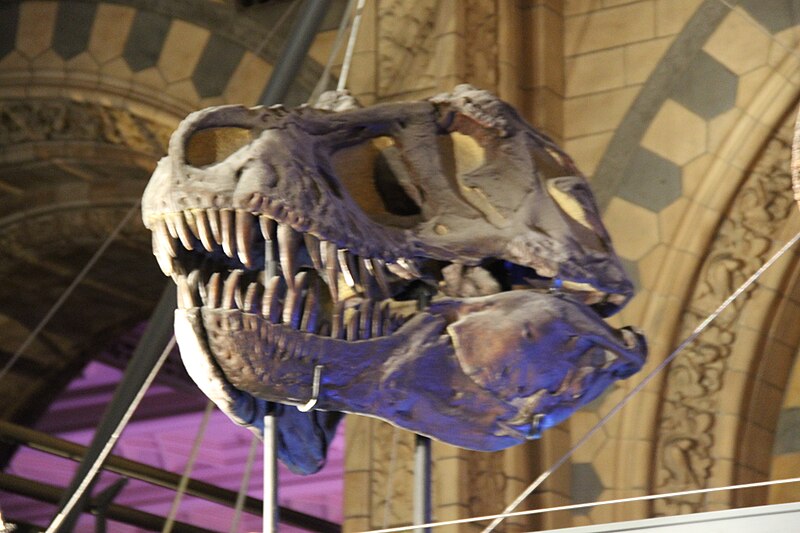
Theropods exhibit the widest body-size range of any dinosaur clade. The smallest known non-avialan theropods, such as Anchiornis huxleyi and Parvicursor remotus, weighed well under one kilogram, while the largest — Tyrannosaurus rex — attained adult body masses estimated at 8,400 kilograms or more based on three-dimensional computational models of the specimen known as "Sue."7
.jpg)
Osteohistological analysis has revealed that T. rex achieved this enormous size through an extraordinary adolescent growth spurt, gaining as much as 1,790 kilograms per year during its teenage period and reaching adult size in approximately two decades.8
Gigantism evolved independently in multiple theropod lineages. A phylogenetic analysis by Brusatte and colleagues revealed that tyrannosauroids originated by the Middle Jurassic but remained mostly small-bodied and ecologically marginal for approximately 80 million years; only in the latest Cretaceous did the derived Tyrannosauridae achieve truly colossal proportions.9 Among non-coelurosaurian tetanurans, the carcharodontosaurids independently evolved gigantism during the middle Cretaceous, with Giganotosaurus carolinii estimated at approximately 6,000 to 8,000 kilograms.4 A broad-scale analysis of dinosaur body-mass evolution by Benson and colleagues found that rapid size-class shifts were concentrated in the earliest phase of theropod evolution during the Triassic, followed by sustained ecological innovation along the maniraptoran lineage leading to birds across 170 million years.20
Representative theropod body masses across major clades7, 8, 20
| Taxon | Clade | Estimated mass | Age (Ma) |
|---|---|---|---|
| Anchiornis huxleyi | Troodontidae / Anchiornithidae | ~0.1–0.4 kg | ~160 |
| Parvicursor remotus | Alvarezsauridae | ~0.16 kg | ~72 |
| Microraptor zhaoianus | Dromaeosauridae | ~1 kg | ~120 |
| Coelophysis bauri | Coelophysoidea | ~15–20 kg | ~216 |
| Velociraptor mongoliensis | Dromaeosauridae | ~15–20 kg | ~75 |
| Allosaurus fragilis | Allosauroidea | ~1,500 kg | ~155 |
| Yutyrannus huali | Tyrannosauroidea | ~1,400 kg | ~125 |
| Giganotosaurus carolinii | Carcharodontosauridae | ~6,000–8,000 kg | ~98 |
| Tyrannosaurus rex | Tyrannosauridae | ~8,400 kg | ~68 |
Feeding ecology and dietary diversity
Although theropods are popularly associated with carnivory, a landmark study by Zanno and Makovicky in 2011 demonstrated that herbivory evolved independently in at least six coelurosaurian lineages: Ornithomimosauria, Therizinosauria, Oviraptorosauria, Alvarezsauroidea, several early avialans, and the troodontid Jinfengopteryx. Their analysis identified 44 coelurosaurian species with positive evidence for herbivorous or omnivorous diets, establishing that dietary diversification, not strictly carnivory, was a hallmark of coelurosaurian evolution.10
Therizinosauria represents the most striking departure from the ancestral theropod body plan. These bulky, large-gutted animals bore enormous manual claws, a retroverted pubis convergent on that of ornithischian dinosaurs, a small head with a keratinous beak, and leaf-shaped teeth consistent with foliage processing. The therizinosaurid body plan is so divergent from that of other theropods that for decades these animals were classified outside Theropoda entirely; only phylogenetic analyses incorporating newly discovered taxa confirmed their coelurosaurian affinities.10
Ornithomimosauria, the "ostrich-mimic" dinosaurs, were long-limbed, cursorial animals with edentulous (toothless) beaks in their derived forms. Barrett's 2005 reassessment of ornithomimosaur diet, incorporating calculations of the minimum daily energy budgets of Gallimimus, concluded that strict carnivory and filter-feeding were unlikely to meet the caloric requirements of animals of that size, and that an omnivorous or herbivorous habitus, supported by the presence of a keratinous rhamphotheca and gastric mill, was far more plausible.11
Alvarezsauroidea represents another extreme of dietary specialisation. These small-bodied coelurosaurians possessed bizarre forelimbs bearing a single hypertrophied claw on a massively reinforced thumb, while the other digits were vestigial. Longrich and Currie's 2009 analysis of the alvarezsaurid Albertonykus borealis noted a suite of features consistent with myrmecophagy (ant and termite eating): simplified teeth reduced in size, long narrow jaws with weak mandibles, and powerful digging forelimbs comparable to those of modern anteaters and pangolins.12
Among the large-bodied hypercarnivores, bite-force analyses and cranial mechanics have shown that derived tyrannosaurids possessed among the most powerful bite forces of any terrestrial animal, with Tyrannosaurus rex capable of bone-crushing forces that allowed it to exploit carcasses more thoroughly than any other theropod predator.9 By contrast, the elongated, dorsoventrally flattened rostra of spinosaurids suggest a specialised piscivorous or semi-aquatic feeding strategy, convergent in some respects with modern crocodilians and gharials.4
The evolution of feathers
The discovery of feathered non-avian theropods in the 1990s transformed understanding of both dinosaur biology and the origin of birds. The pivotal specimen was Sinosauropteryx prima, described in 1998 from the Early Cretaceous Yixian Formation of Liaoning Province, China — the first dinosaur found outside of Avialae to preserve integumentary structures interpreted as feathers. The structures were simple, unbranched filaments covering much of the body, consistent with a thermoregulatory or display function rather than an aerodynamic one.13
Prum and Brush's influential 2002 developmental model proposed that feathers evolved through a series of morphological innovations in the follicle and feather germ, proceeding from unbranched filaments (Stage I) through symmetrical vaned feathers (Stages II–III) to the asymmetrical pennaceous feathers (Stage V) that generate lift in modern birds. Critically, the authors predicted that fossils preserving each intermediate stage would be found on non-avian theropods, a prediction subsequently confirmed by discoveries in Liaoning and elsewhere.14
Among the most significant fossil discoveries is Yutyrannus huali, a basal tyrannosauroid from the Yixian Formation described by Xu and colleagues in 2012 on the basis of three nearly complete skeletons. At an estimated 1,400 kilograms, Yutyrannus is the largest known dinosaur preserving direct evidence of extensive filamentous feathering, approximately forty times heavier than the previous record holder, Beipiaosaurus. The discovery demonstrated that feathers were not confined to small-bodied coelurosaurians and raised the possibility that filamentous integument was far more widespread among theropods than the fossil record alone might suggest.15
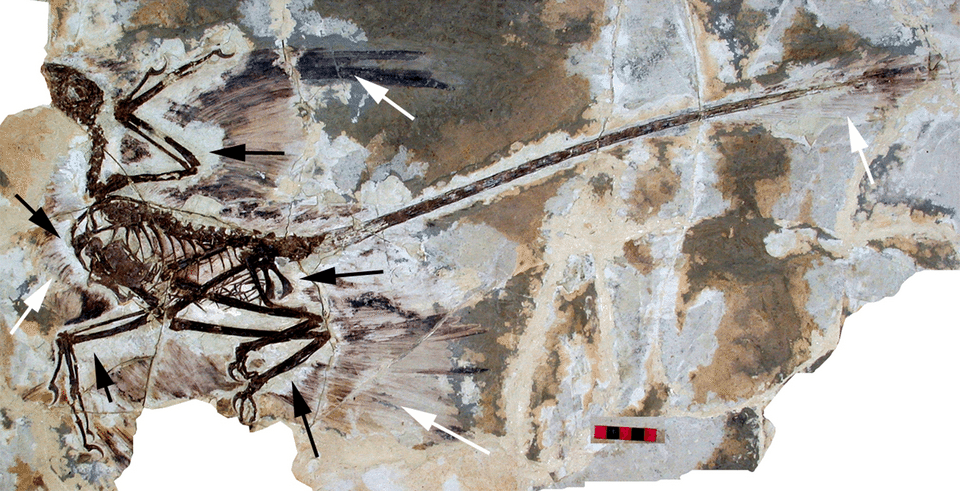
Microraptor gui, a small dromaeosaurid described in 2003, preserves long pennaceous feathers on both the forelimbs and the hindlimbs, creating a "four-winged" body plan that almost certainly conferred some aerodynamic capability, whether gliding or rudimentary powered flight. The Microraptor specimens provided compelling evidence that the evolution of flight feathers preceded the evolution of the modern avian flight apparatus and that experimenting with different aerodynamic configurations was common among paravian theropods.16
In 2010, Li and colleagues achieved a breakthrough in palaeocolour reconstruction by mapping melanosome morphology across the plumage of the Late Jurassic paravian Anchiornis huxleyi. Their analysis, comparing melanosome shape, size, and density to those of living birds, revealed a body that was predominantly grey and dark, a rufous (reddish-brown) crest on the crown, and white wing and leg feathers tipped with bold black spangles. This was the first full-body colour reconstruction of any dinosaur and demonstrated that the information content of exceptionally preserved feathered fossils extends beyond mere morphology to aspects of visual signalling and ecology.17
A comprehensive review by Norell and Xu in 2005 synthesised the rapidly growing record of feathered dinosaurs from China, concluding that feathered integument was ancestral to Coelurosauria and probably more widespread within Theropoda, and that feathers evolved and diversified in non-avian theropods well before the origin of either birds or flight.18
Brain evolution and sensory biology
The evolution of theropod brains followed a trajectory of progressive encephalisation along the lineage leading to modern birds. Larsson's 2001 study of the endocranial anatomy of Carcharodontosaurus saharicus, a large allosauroid, found that the ratio of cerebrum volume to total brain volume in this taxon and in Allosaurus fell within the 95-percent confidence limits of non-avian reptiles. By contrast, the endocast of Tyrannosaurus rex, a relatively basal coelurosaur, lay just outside the reptilian range in the direction of the avian condition, suggesting that the onset of brain enlargement coincided with the origin of Coelurosauria rather than with the origin of birds per se.22
Neuroanatomical analyses of derived tyrannosaurids have revealed enlarged olfactory bulbs consistent with a keen sense of smell, expanded optic lobes suggesting well-developed vision, and elongated cochlear ducts indicative of a broad auditory range — a sensory toolkit consistent with an active predatory lifestyle rather than obligate scavenging.9 Among maniraptorans, the trend toward increased encephalisation continued: troodontids possessed some of the largest relative brain sizes of any non-avian dinosaur, with encephalisation quotients approaching those of some modern birds, suggesting cognitive abilities substantially exceeding those of most other Mesozoic reptiles.22
The sustained increase in relative brain size along the avian stem lineage was quantified by Lee and colleagues in 2014 as part of a broader analysis of anatomical innovation rates. Their Bayesian analysis demonstrated that the lineage directly ancestral to birds experienced accelerated rates of skeletal evolution — approximately four times faster than other dinosaurs — over a period of at least 50 million years, and that miniaturisation was a prerequisite for the paedomorphic skulls with enlarged braincases, expanded eyes, and reduced snouts that characterise modern birds.19
Social behaviour and nesting
Direct evidence for theropod social behaviour is inherently rare in the fossil record, but several lines of evidence — monodominant bonebeds, trackway sites, and phylogenetic inference from living archosaurs — suggest that at least some theropods were gregarious. Currie's 1998 report of a bonebed in the Horseshoe Canyon Formation of Alberta, Canada, containing the remains of at least twelve individuals of Albertosaurus sarcophagus spanning a range of ontogenetic stages, provided the earliest strong evidence for gregarious behaviour in large tyrannosaurids. Currie argued that the co-occurrence of multiple age classes at a single locality was most parsimoniously explained by a social aggregation rather than by independent, repeated attritional mortality at a single site.21
Whether gregarious behaviour in tyrannosaurids extended to cooperative pack hunting, as Currie and others have proposed, remains contentious. Alternative taphonomic explanations for multi-individual bonebeds, including drought-induced mass mortality at waterholes and fluvial concentration of independently deposited carcasses, have been advanced. The consensus position in the literature is that while gregariousness in some form is plausible for certain theropod species, the leap from aggregation to coordinated cooperative hunting requires behavioral evidence that the fossil record cannot readily provide.21
Nesting behaviour is better constrained. Multiple oviraptorid specimens from the Late Cretaceous Djadokhta Formation of Mongolia have been preserved in an avian-like brooding posture over clutches of eggs, with the forelimbs spread laterally in a position strikingly reminiscent of modern ground-nesting birds. The most celebrated specimen, described by Clark, Norell, and Chiappe in 1999, preserves an articulated postcranial skeleton directly overlying a nest containing eggs of the same type that has yielded oviraptorid embryos from the same locality, providing unambiguous evidence that these theropods incubated their eggs through direct body contact.23 The irony of the name Oviraptor ("egg thief"), originally assigned under the mistaken assumption that the animal was raiding a Protoceratops nest, has become one of the most cited examples of a nomenclatural error in palaeontology.
Biogeography and Mesozoic distribution
Theropod biogeography was shaped by the progressive fragmentation of Pangaea throughout the Mesozoic. During the Late Triassic and Early Jurassic, when the supercontinent was still largely intact, theropod faunas were comparatively cosmopolitan: coelophysoid-grade neotheropods, for instance, are known from North America, Europe, Africa, and South America.1, 2 By the Middle and Late Jurassic, the opening of the central Atlantic and the Tethys Seaway began to separate Laurasian from Gondwanan faunas, though intermittent land bridges permitted periodic faunal interchange.
In the Cretaceous, this geographic divergence produced dramatically distinct predator guilds on different landmasses. Laurasian ecosystems were dominated by tyrannosaurids in the apex predator role, with ornithomimosaurs, dromaeosaurids, and troodontids filling smaller-bodied niches. Gondwanan ecosystems were instead dominated by abelisaurid ceratosaurs as large-bodied apex predators, often accompanied by carcharodontosaurid allosauroids in the early-to-mid Cretaceous and by noasaurid ceratosaurs in smaller-bodied roles.4, 2 The discovery of the Early Cretaceous Yixian and Jiufotang formations in Liaoning Province, China, revealed an astonishing diversity of small-bodied coelurosaurians — dromaeosaurids, troodontids, oviraptorosaurs, alvarezsaurids, and early birds — preserved in volcanic lake-margin sediments, establishing northeastern Asia as a key centre of maniraptoran diversification during the Early Cretaceous.18
The survival of theropods as birds
The end-Cretaceous mass extinction, triggered by the Chicxulub asteroid impact approximately 66 million years ago, eliminated all non-avian dinosaurs but spared one theropod lineage: Avialae, the clade containing modern birds and their closest extinct relatives. The phylogenetic nesting of birds within Maniraptora, itself deep within Coelurosauria, was first rigorously established by Gauthier in 1986 and has been confirmed by every subsequent large-scale phylogenetic analysis.3
Lee and colleagues' 2014 analysis provided a quantitative explanation for why birds, among all dinosaurs, were the lineage best positioned to survive the extinction. The avian stem lineage experienced 50 million years of sustained body-size miniaturisation and underwent anatomical innovation at rates approximately four times faster than other dinosaur lineages. This prolonged phase of miniaturisation facilitated the evolution of adaptations associated with small body size, including reoriented body mass, powered flight, increased metabolic efficiency, and paedomorphic skulls with enlarged braincases and eyes — traits that may have conferred survival advantages during the ecological collapse following the impact.19
Benson and colleagues' complementary 2014 analysis of body-mass evolution across 614 dinosaur taxa confirmed that feathered maniraptorans (including Mesozoic birds) sustained rapid evolutionary rates from at least the Middle Jurassic onward, suggesting that this lineage continually invaded new ecological niches in a way that other dinosaur clades did not. The avian radiation thus represents not a sudden post-extinction opportunism but the culmination of over 170 million years of ecological innovation within the theropod lineage.20 Today, with approximately 10,000 living species occupying every continent and virtually every terrestrial and many aquatic habitats, birds are both the most species-rich clade of land vertebrates and the living testament to theropod evolutionary success.2
References
Geology and taphonomy of the Coelophysis quarry, Upper Triassic Chinle Formation, Ghost Ranch, New Mexico
A computational analysis of limb and body dimensions in Tyrannosaurus rex with implications for locomotion, ontogeny, and growth
Albertonykus borealis, a new alvarezsaur (Dinosauria: Theropoda) from the Early Maastrichtian of Alberta, Canada: implications for the systematics and ecology of the Alvarezsauridae
Sustained miniaturization and anatomical innovation in the dinosaurian ancestors of birds
Rates of dinosaur body mass evolution indicate 170 million years of sustained ecological innovation on the avian stem lineage
Endocranial anatomy of Carcharodontosaurus saharicus (Theropoda: Allosauroidea) and its implications for theropod brain evolution
An oviraptorid skeleton from the Late Cretaceous of Ukhaa Tolgod, Mongolia, preserved in an avianlike brooding position over an oviraptorid nest