Overview
- Therizinosauria was a clade of bizarre maniraptoran theropod dinosaurs that secondarily evolved herbivory, characterized by long necks, leaf-shaped teeth, broad pelves, pot-bellied torsos, and enormous recurved hand claws — including the meter-long unguals of Therizinosaurus cheloniformis, the longest claws known from any animal.
- First described by Evgeny Maleev in 1954 from isolated claw bones that he interpreted as belonging to a giant marine turtle, therizinosaurs were progressively recognized as theropods through the discoveries of Segnosaurus (Perle 1979), Alxasaurus, Beipiaosaurus (Xu et al. 1999), and the basalmost member Falcarius utahensis (Kirkland et al. 2005), which together document the morphological transition from carnivorous coelurosaur to obligate plant-eater.
- Exceptionally preserved Liaoning specimens reveal that therizinosaurs were extensively feathered, including the elongated broad filamentous feathers of Beipiaosaurus, while gastroliths, leaf-shaped teeth, keratinous beaks, and biomechanical models of Erlikosaurus and Nothronychus jointly establish that herbivory was acquired early in the clade and elaborated through several independent lineages.
Therizinosauria is a clade of maniraptoran theropod dinosaurs that, despite being deeply nested within the predatory lineage that gave rise to dromaeosaurs and birds, secondarily evolved obligate herbivory and an extraordinarily aberrant body plan. Adult therizinosaurs combined long necks, small skulls with leaf-shaped teeth and keratinous beaks, broad and backward-tilted pelves, short stocky hindlimbs with four functional toes, voluminous "pot-bellied" torsos, and enormous recurved manual unguals reaching, in Therizinosaurus cheloniformis, lengths of approximately one metre — the longest claws known from any animal that has ever lived.2, 8 The clade ranges from the Early Cretaceous of Asia and North America to the latest Cretaceous of Mongolia, and it includes both small basal forms such as Falcarius utahensis and Beipiaosaurus inexpectus and the multi-tonne giant Therizinosaurus itself.6, 4
Therizinosaurs occupy a critical position in theropod evolution because they document, more clearly than any other coelurosaurian subclade, the morphological pathway by which a lineage of small carnivorous bipeds was reorganised for plant processing. The phylogenetic re-evaluation by Zanno (2010) and the herbivory ecomorphology analysis by Zanno and Makovicky (2011) jointly demonstrate that herbivory was widespread among coelurosaurians and that hypercarnivory in this radiation was relatively rare and frequently secondary, reframing therizinosaurs as one of several theropod experiments in plant-eating rather than as evolutionary anomalies.2, 3
Discovery and a turtle that was not a turtle
The history of therizinosaur research begins with one of the most famous misidentifications in vertebrate palaeontology. In 1948, a Soviet–Mongolian palaeontological expedition working in the Nemegt Formation of the Gobi Desert recovered three enormous, partial manual unguals together with rib fragments and a metacarpal element from Quarry V in southwestern Mongolia.
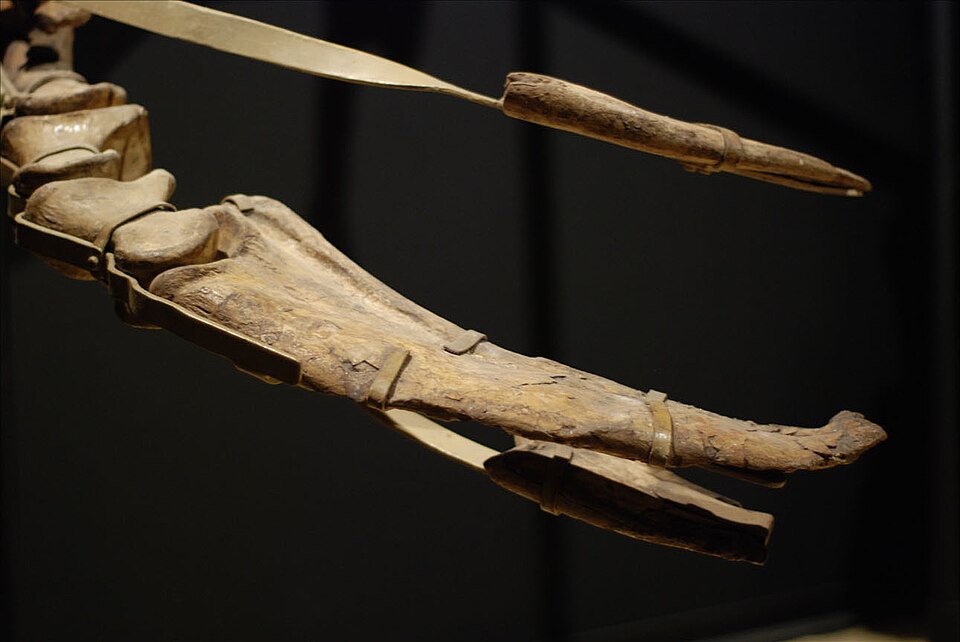

The first hint that Therizinosaurus was not a chelonian came in 1970, when Anatoly Rozhdestvensky proposed theropod affinities for the unguals on the basis of their internal structure and proportions. Rinchen Barsbold confirmed the theropod identification in the mid-1970s after additional Mongolian material from MPC-D 100/15 added articulated forelimbs with scapulocoracoids and humeri to the known anatomy of the genus.2 The taxonomic mystery deepened in 1979 when Altangerel Perle described Segnosaurus galbinensis from the Bayan Shireh Formation of southeastern Mongolia — a strange, partially articulated skeleton with a slender mandible bearing leaf-shaped teeth, a backward-tilted pubis, and a four-toed pes — and erected the new family Segnosauridae and infraorder Segnosauria for it, tentatively classifying it as an aberrant theropod while noting features that he could not easily reconcile with any known dinosaurian group.15
Through the 1980s, several authors, including Gregory S. Paul, argued that segnosaurs were instead late-surviving prosauropods or even ornithischian relatives, citing the wide opisthopubic pelvis, the leaf-shaped teeth, and the four-toed pes — all features more typical of plant-eating archosaurs than of carnivorous theropods.2 The competing interpretations — theropod, prosauropod, ornithischian — persisted in the literature for over a decade because the available material was fragmentary and emphasised exactly those skeletal regions in which therizinosaurs converged with herbivorous dinosaur clades while obscuring the diagnostic theropod features of the skull, manus, and ankle. The unification of segnosaurs and Therizinosaurus as a single coelurosaurian clade was achieved only in the 1990s, when newly discovered Asian taxa — including Alxasaurus elesitaiensis from the Bayingobi Formation of Inner Mongolia and especially Beipiaosaurus inexpectus from the feather-bearing Yixian Formation — preserved the missing skeletal regions linking these animals unambiguously to the maniraptoran theropod radiation. Alxasaurus, described by Russell and Dong in 1993, provided the first fairly complete therizinosaur skeleton with associated forelimbs, vertebral column, and pelvis, allowing direct comparison with the isolated Therizinosaurus unguals and the Segnosaurus material; Beipiaosaurus, four years later, added the integument and confirmed the coelurosaurian identity of the entire clade.4, 2
Phylogenetic position within Maniraptora
Therizinosauria is now confidently placed within Maniraptora, the coelurosaurian clade defined by Jacques Gauthier in 1986 as the group containing oviraptorosaurs, dromaeosaurs, troodontids, and birds together with their common ancestor.21 Within Maniraptora the precise position of therizinosaurs has shifted between analyses. Zanno's 2010 re-evaluation, the most comprehensive phylogenetic study of the clade conducted to date, recovered Therizinosauria as the basalmost maniraptoran lineage and excluded Falcarius from the more restricted Therizinosauroidea while retaining it within Therizinosauria as the earliest-diverging member.2 Other coelurosaurian analyses, including the cladistic work of Turner, Makovicky, and Norell, have instead recovered therizinosaurs as the sister group of Oviraptorosauria within an oviraptorosaur-plus-therizinosaur clade.2
The two competing topologies share several features. In both, therizinosaurs lie outside the Paraves — the clade containing dromaeosaurs, troodontids, and birds — and they retain a number of plesiomorphic theropod characters in the skull and forelimb that are reorganised in the more derived members of the clade. Zanno's revision also recognised three nested clades: Therizinosauria (including Falcarius), Therizinosauroidea (including Beipiaosaurus, Alxasaurus, and the more derived genera), and Therizinosauridae (the large-bodied, fully herbivorous Late Cretaceous taxa such as Segnosaurus, Erlikosaurus, Nothronychus, and Therizinosaurus).2
Time-calibrated relationships indicate that the deepest divergences within Therizinosauria occurred by the Early Cretaceous, with Falcarius at approximately 125 million years ago in the Cedar Mountain Formation of Utah and Beipiaosaurus at approximately 124.6 million years ago in the Yixian Formation of Liaoning, China.6, 4 Zanno's time calibration of the ingroup further suggests that at least one pre-Turonian dispersal event between Asia and North America is required to account for the presence of derived therizinosaurids on both continents during the Late Cretaceous.2
Falcarius and the carnivore-to-herbivore transition
Falcarius utahensis, described by James Kirkland and colleagues in 2005 from the Crystal Geyser quarry in the Lower Cretaceous Cedar Mountain Formation of east-central Utah, is the most informative single fossil for understanding how therizinosaurs evolved from the ancestral predatory coelurosaurian condition. The site has produced more than two thousand bones representing many individuals of all ontogenetic stages, providing a near-complete picture of basal therizinosaur anatomy.6, 7 Falcarius stood approximately 1.4 metres tall, measured roughly 4 metres in length, and combined the long and gracile hindlimbs of a cursorial coelurosaur with several features that anticipate the derived therizinosaur body plan.7
Most diagnostically, Falcarius retains numerous small, leaf-shaped, finely denticulate teeth that contrast sharply with the recurved, blade-like teeth of carnivorous theropods and that closely resemble the dentition of the herbivorous prosauropods, basal ornithischians, and modern lizard herbivores such as Iguana.6 The pelvis is narrower and the limbs more cursorial than in later therizinosaurs, but the wide gut cavity, slightly elongated cervical vertebrae, and tooth morphology together suggest that Falcarius had already shifted toward a substantially plant-based diet while retaining a body plan capable of relatively rapid bipedal locomotion.7 Kirkland and colleagues described Falcarius as a "missing link" in the most literal sense available in palaeontology: a transitional animal documenting the early stages of dietary reorganisation within a clade whose terminal members were unambiguously herbivorous.6
The Crystal Geyser bonebed itself is unusual in preserving large numbers of Falcarius in close stratigraphic association, raising questions about gregarious behaviour or repeated mass mortality. Detailed taphonomic analysis is consistent with episodic accumulation around a long-lived water source rather than a single catastrophic death event, but the sheer numerical dominance of one species in the assemblage indicates that basal therizinosaurs could be locally abundant components of Early Cretaceous faunas.7 The combined skull, vertebral, and limb anatomy of Falcarius establishes that the earliest therizinosaurs were already neither typical predators nor fully developed herbivores, but transitional animals occupying a dietary intermediate state — a configuration that closely matches the omnivorous condition Zanno and Makovicky have argued may represent the ancestral state for Maniraptora as a whole.3, 6
Beipiaosaurus and the feathered therizinosaurs
Beipiaosaurus inexpectus, described by Xu Xing, Tang Zhilu, and Wang Xiaolin in 1999, was the first therizinosaur recovered from the lacustrine deposits of the Yixian Formation of Liaoning, China — the same Lagerstätte that has yielded the feathered theropods Sinosauropteryx, Caudipteryx, and Microraptor.4, 20
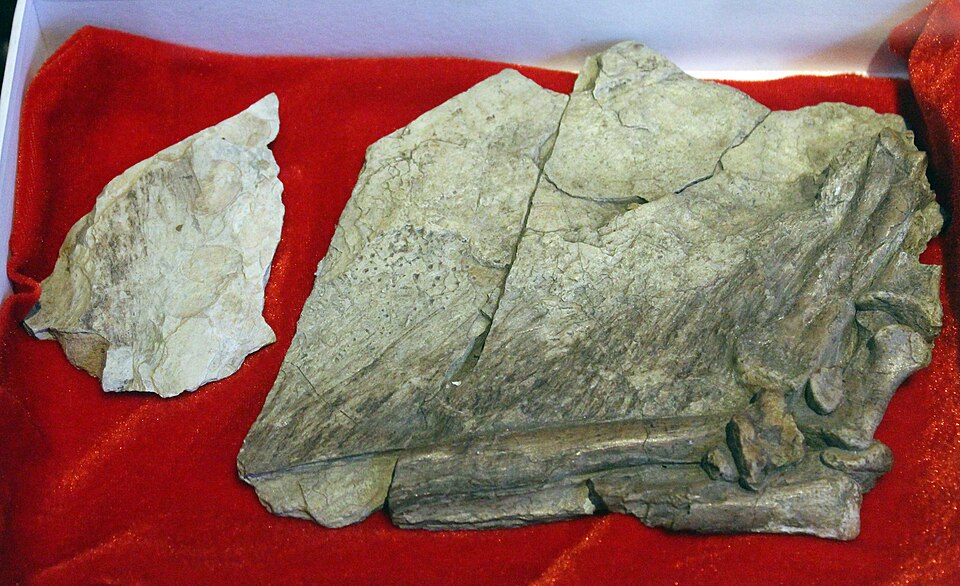

A second specimen of Beipiaosaurus, described by Xu, Zheng, and You in 2009, preserves a previously unknown feather type which the authors named "elongated broad filamentous feathers" or EBFFs. EBFFs are unbranched, single-shafted filaments roughly 100 to 150 millimetres long and up to 3 millimetres wide, more than half the length of the animal's neck, and concentrated on the head, neck, and tail.11 Their stiffness, large size, and restricted distribution led Xu and colleagues to interpret EBFFs as the earliest known feather morphology unambiguously specialised for visual display rather than insulation, providing direct evidence that some functions of feathers diverged from thermoregulation early in coelurosaurian evolution.11
Before the description of the gigantic tyrannosauroid Yutyrannus huali, Beipiaosaurus was among the largest dinosaurs known from direct evidence of feathered integument, and it remains one of the few therizinosaurs in which both downy contour feathers and display-type filaments are preserved on a single specimen.4, 11 The combination of these characters firmly establishes that the entire therizinosaur clade was almost certainly feathered, including the multi-tonne Late Cretaceous giants for which integument has not been preserved.2
Anatomy of a derived therizinosaur
The body plan of derived therizinosaurids — the clade containing Segnosaurus, Erlikosaurus, Nothronychus, and Therizinosaurus — departs more dramatically from the ancestral theropod morphology than that of any other coelurosaurian subclade except birds.
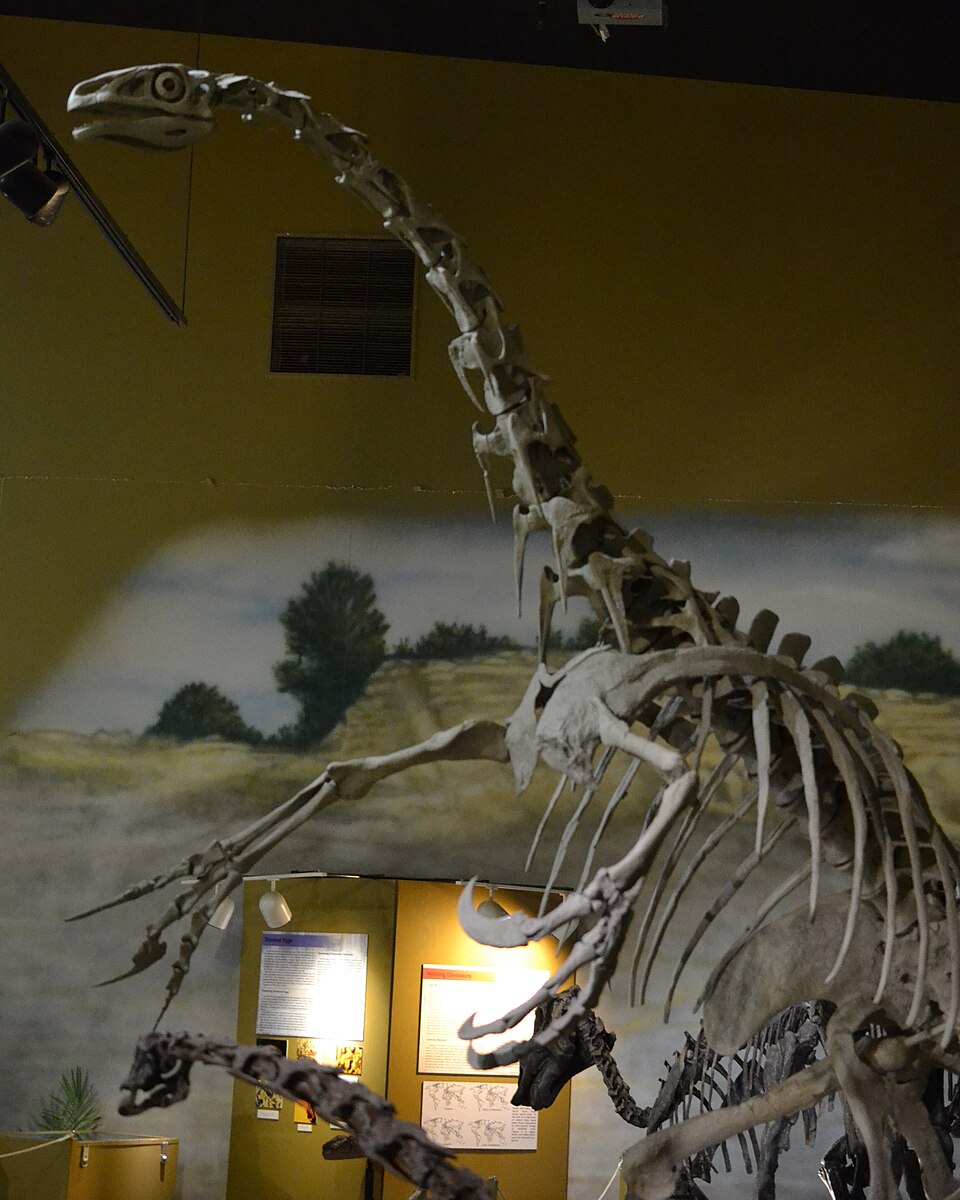

The torso is broad and short, with deep dorsal ribs creating a barrel-shaped abdomen sufficient to house a large fermenting hindgut. The pelvis — one of the most diagnostic features of the clade — is unusually wide, with backward-rotated pubic and ischial blades that converge on an opisthopubic configuration superficially resembling that of ornithischian dinosaurs, an arrangement Gregory S. Paul originally cited as evidence that segnosaurs were not theropods at all.2 The hindlimbs are short and stocky relative to the trunk, with a four-toed pes in which the first digit (hallux) is functional and reaches the ground — a striking contrast to the three-toed (tridactyl) condition typical of other theropods.2, 7
The forelimbs are long and powerful, with elongated humeri and a manus bearing three large recurved unguals that reach extreme proportions in Therizinosaurus. Smith and colleagues' 2021 study of Nothronychus documented extensive postcranial pneumaticity throughout the cervical and dorsal vertebral series, indicating a sophisticated avian-style air sac system inherited from earlier maniraptoran ancestors and retained in this large-bodied herbivorous lineage.17 Endocranial reconstructions by Lautenschlager and colleagues further showed that therizinosaurs possessed enlarged olfactory bulbs, well-developed cerebral hemispheres relative to other non-paravian theropods, and an inner ear morphology consistent with relatively slow head movements during browsing.14
Evidence for herbivory and dietary specialisation
Multiple independent lines of evidence indicate that therizinosaurs were obligate or near-obligate herbivores. The first is dental morphology: the leaf-shaped, finely denticulate teeth of Falcarius, Beipiaosaurus, Erlikosaurus, and Segnosaurus closely resemble those of extant herbivorous lizards and bear no resemblance to the recurved, ziphodont, knife-edged teeth of carnivorous coelurosaurians.6, 16 A 2016 reanalysis of the dentition of Segnosaurus by Zanno and colleagues identified previously unrecognised wear facets and an unusually complex tooth occlusion pattern, including dentary teeth offset by a shelf and labio-lingual asymmetry similar to ornithopod ornithischians, suggesting that some Late Cretaceous therizinosaurids had developed dietary specialisations beyond simple cropping.16
The basal Asian therizinosaur Jianchangosaurus yixianensis, described by Pu and colleagues in 2013 from the Yixian Formation, displays an even more elaborate dental specialisation: its dentary teeth are offset from the lateral surface of the dentary by a wide shelf, and the premaxilla and anterior tip of the dentary are edentulous, presumably covered in life by a keratinous beak. Pu and colleagues interpreted these features as further modifications for plant processing relative to the more generalised condition seen in Falcarius.12
A second line of evidence is the presence of gastroliths — ingested stones used to mechanically grind plant matter in a muscular gizzard — in association with several therizinosaurid skeletons.2 The widespread occurrence of gastric mills in coelurosaurians, identified by Zanno and Makovicky as one of 21 morphological correlates of herbivory, mirrors the use of gizzard stones in modern herbivorous birds and supports a fermentative or grinding strategy of plant digestion in the absence of complex grinding dentition.3
The third and most powerful line of evidence is comparative ecomorphology. Zanno and Makovicky's 2011 analysis of 21 herbivory-correlated characters across coelurosaurian theropods showed that six major subclades — Therizinosauria, Ornithomimosauria, Oviraptorosauria, Alvarezsauroidea, basal Avialae, and at least one troodontid lineage — independently acquired multiple herbivory indicators. Therizinosaurs scored highest in the analysis, exhibiting nearly all of the herbivory-correlated features and ranking as the most fully herbivorous non-avian theropod clade.3 The same analysis demonstrated that the early evolution of beaks in coelurosaurians correlates strongly with the acquisition of herbivory, undermining the older view that beaks evolved chiefly in connection with flight.3, 10
The Erlikosaurus skull, beaks, and bite mechanics
The skull of Erlikosaurus andrewsi, recovered from the Bayan Shireh Formation of Mongolia, is the only nearly complete, three-dimensionally preserved therizinosaurid skull known. Lautenschlager and colleagues' 2014 digital reconstruction of this specimen using high-resolution computed tomography reassembled the disarticulated cranial elements, restored the soft-tissue and pneumatic anatomy, and provided a foundation for biomechanical modelling of feeding in the clade.9 The reconstruction revealed an elongated snout with a substantial edentulous region anteriorly, leaf-shaped maxillary and dentary teeth posteriorly, large external nares, and well-developed olfactory passages.9
Lautenschlager, Witmer, Altangerel, and Rayfield used finite element analysis to estimate bite force and stress distribution in the Erlikosaurus skull. They reported maximum bite forces of approximately 90 to 134 newtons at the most posterior maxillary tooth position and only 43 to 65 newtons at the snout tip, values an order of magnitude lower than those of comparably sized carnivorous theropods and consistent with cropping soft plant material rather than bone-crushing or active prey capture.10 A subsequent analysis tested the mechanical consequences of adding a keratinous rhamphotheca to the FE model and found that the keratinous sheath significantly reduced von Mises stress and strain in the underlying bone of the snout, demonstrating one biomechanical advantage of beak evolution in herbivorous theropods.10 A 2017 follow-up analysis by Lautenschlager extended these methods across multiple therizinosaur taxa and found evidence of niche partitioning in jaw mechanics, with different genera exhibiting distinct stress distributions consistent with consumption of different vegetation types.13
Claw morphology and function
The defining popular image of therizinosaurs is the meter-long manual ungual of Therizinosaurus cheloniformis. The holotype unguals (PIN 551–483) are unusually straight relative to other therizinosaur claws, laterally compressed, and recurved only at the tip. Their reconstructed in-life length, including the keratinous sheath that would have extended well beyond the bony core, is approximately one metre, making them the largest claws known from any animal in the fossil record.8 Other therizinosaurs preserve more strongly recurved unguals: Nothronychus bears curved hand claws up to about 30 centimetres long, while Beipiaosaurus has proportionally smaller but still robust claws.5
The functional interpretation of these claws has been debated for decades, with hypotheses including defence against predators, intraspecific combat, slashing of prey, digging for tubers and insects, and hooking branches to draw foliage toward the mouth. Lautenschlager's 2014 finite element analysis tested these hypotheses biomechanically by comparing stress distributions across reconstructed loading regimes for different therizinosaur taxa. The analysis found that the elongated, weakly recurved unguals of Therizinosaurus would have failed under heavy compressive or impact loading, ruling out their use as digging implements or as primary weapons against large prey, while the more strongly recurved claws of taxa such as Alxasaurus and Nothronychus were biomechanically suited to hooking and grasping vegetation.8
Lautenschlager concluded that the most parsimonious functional interpretation for Therizinosaurus is that its claws served principally as foliage hooks for drawing branches and leaves within reach of the cropping beak — a behaviour comparable to the use of recurved claws by extant tree sloths and to the manipulative forelimb use of giant pandas, and structurally analogous to the long-armed, claw-bearing chalicotheres, an extinct group of perissodactyl mammals that converged on a similar high-browsing ecology in the Cenozoic.8 Defence against contemporary predators such as Tarbosaurus bataar may have been a secondary function, but the elongated geometry of the Therizinosaurus claws is poorly suited to active combat: the laterally compressed unguals would have failed in bending under the impact loads required to inflict a slashing wound on a large theropod, and their limited recurvature would have made them ineffective as gaffing weapons. The diversity of claw shapes across the clade — from the strongly recurved hooks of Alxasaurus and Nothronychus to the elongated, weakly curved blades of Therizinosaurus — indicates that, while all therizinosaurs were herbivorous, different lineages exploited their forelimbs in subtly different ways during foraging, with smaller-bodied forms using grasping claws to reach into shrub canopies and larger-bodied forms using elongate hooks to draw the highest branches downward.8, 13
Known genera and stratigraphic distribution
Approximately a dozen formally named therizinosaur genera are currently recognised, distributed across the Early and Late Cretaceous of Asia and North America. The basal Asian taxa Beipiaosaurus and Jianchangosaurus are nearly synchronous with the basal North American Falcarius, indicating that the clade had already attained an Asian–American distribution by the early Aptian. Derived therizinosaurids appear in both Asia and North America by the mid-Cretaceous (Cenomanian to Turonian) and persist in Asia until the latest Maastrichtian.2, 19
Selected therizinosaur genera, age, location, and notable traits2, 6, 4, 15, 5, 19, 12
| Genus | Age (Ma) | Formation / region | Notable traits |
|---|---|---|---|
| Falcarius utahensis | ~125 | Cedar Mountain Fm., Utah, USA | Basalmost therizinosaur; leaf-shaped teeth; cursorial limbs |
| Beipiaosaurus inexpectus | ~124.6 | Yixian Fm., Liaoning, China | Extensive feathers including elongated broad filamentous feathers (EBFFs) |
| Jianchangosaurus yixianensis | ~125 | Yixian Fm., Liaoning, China | Edentulous beak tip; ornithischian-like dental shelf |
| Alxasaurus elesitaiensis | ~112 | Bayingobi Fm., Inner Mongolia, China | Early therizinosauroid; elongated forelimbs; diagnostic of clade |
| Erliansaurus bellamanus | ~96 | Iren Dabasu Fm., Inner Mongolia, China | Intermediate-grade therizinosauroid forelimb anatomy |
| Nothronychus mckinleyi | ~91 | Moreno Hill Fm., New Mexico, USA | First definitively diagnosed North American therizinosaurid |
| Nothronychus graffami | ~92 | Tropic Shale, Utah, USA | Most complete therizinosaurid skeleton known; marine-deposit preservation |
| Segnosaurus galbinensis | ~96–89 | Bayan Shireh Fm., Mongolia | Type genus of former Segnosauridae; ornithopod-like tooth occlusion |
| Erlikosaurus andrewsi | ~96–89 | Bayan Shireh Fm., Mongolia | Only complete 3D therizinosaurid skull known; FEA-modelled bite |
| Enigmosaurus mongoliensis | ~96–89 | Bayan Shireh Fm., Mongolia | Distinctive opisthopubic pelvis; named for taxonomic uncertainty |
| Therizinosaurus cheloniformis | ~70 | Nemegt Fm., Mongolia | Largest therizinosaur; ~10 m long; longest claws of any animal |
The two species of Nothronychus are particularly important for North American therizinosaur palaeobiology because N. graffami, described from the Tropic Shale of southern Utah, is the most complete therizinosaurid skeleton ever recovered — lacking only the skull — and was preserved in marine sediments approximately 100 kilometres from the nearest contemporaneous shoreline, suggesting that the carcass was rafted out to sea.19 Nothronychus mckinleyi, originally described by Kirkland and Wolfe in 2001 from the Moreno Hill Formation of New Mexico, was the first therizinosaurid recognised in the Americas and demonstrated that the clade had a transcontinental Late Cretaceous distribution.5
Reproduction, nesting, and palaeoecology
Direct evidence of therizinosaur reproduction comes from the Late Cretaceous Javkhlant Formation of the eastern Gobi Desert, Mongolia, where Tanaka and colleagues described an exceptionally preserved dinosaur nesting site in 2019. The site preserves at least 15 egg clutches containing spherical eggs roughly 10 to 15 centimetres in diameter, distributed across a single bedding plane and assigned to therizinosaurs on the basis of egg shape, eggshell microstructure, and clutch geometry. The occurrence of multiple clutches at the top of a common paleosurface, together with a thin marker lithologic unit blanketing all of the clutches and a consistent two-layer sediment infill within the eggs, indicates that the eggs were laid and hatched during a single nesting season, providing the first strong evidence of colonial nesting behaviour in a non-avian theropod — a strategy previously documented in hadrosaurs and titanosaurs.18
The clutches at Javkhlant contained between three and 30 eggs each and were laid in what was a seasonally arid floodplain. The large body sizes of derived therizinosaurids and the partially open-air structure of the Javkhlant nests suggest that adult therizinosaurs probably did not contact-incubate their clutches in the manner of small oviraptorosaurs and troodontids, but instead relied on environmental warmth and mounded sediment cover, with parental defence of the colony as the principal form of nest care.18
Ecologically, therizinosaurs occupied the role of large- to mega-herbivores in Cretaceous Laurasian ecosystems, sharing landscapes with hadrosaurs, ceratopsians, sauropods, ankylosaurs, and pachycephalosaurs. Their long necks, ability to rear bipedally on robust hindlimbs, and elongated forelimbs suggest a high-browsing niche distinct from the lower browsing of most ornithischians, comparable in modern ecological terms to the feeding zone of giraffes or to the high-reaching posture inferred for extinct ground sloths such as Megatherium.8, 13 The pot-bellied torso, broad pelvis, and inferred large hindgut imply that therizinosaurs processed a high-volume, low-quality diet through fermentation rather than mechanical mastication, paralleling the digestive strategy of modern herbivorous birds and many large extant mammalian browsers. In the latest Cretaceous Nemegt Formation, Therizinosaurus coexisted with the apex predator Tarbosaurus bataar, the giant ornithomimosaur Deinocheirus mirificus, and a diverse assemblage of duck-billed and armoured dinosaurs, making this one of the best-documented Late Cretaceous Asian dinosaur communities and one in which several lineages of large herbivorous theropods coexisted alongside ornithischian and sauropod megaherbivores.2
Significance for theropod evolution
Therizinosaurs are important for theropod evolution beyond their own intrinsic strangeness because they reframe questions about the ancestral diet and ecology of the maniraptoran clade. The Zanno and Makovicky 2011 analysis showed that herbivory or omnivory was acquired independently at least six times within Coelurosauria and that hypercarnivory in this radiation was relatively rare and frequently secondary; on at least one reconstruction, omnivory may have been the ancestral condition for Maniraptora as a whole, with the carnivorous habit of dromaeosaurs and troodontids representing a specialised reversal rather than an ancestral retention.3 Therizinosaurs — as the most fully herbivorous coelurosaurian group — are central to this argument because they exhibit the largest number of herbivory-correlated morphological characters and the clearest sequence of transitional taxa from Falcarius through Beipiaosaurus to the derived therizinosaurids.2, 3
The clade also illustrates the morphological reach of the maniraptoran body plan. The same basic skeletal architecture that produced small, agile predators such as Velociraptor and the volant avialans was, in therizinosaurs, restructured into multi-tonne pot-bellied herbivores with leaf-shaped teeth, keratinous beaks, and meter-long claws. The biomechanical analyses of Lautenschlager and colleagues, the phylogenetic revisions of Zanno, the Liaoning feather discoveries of Xu and colleagues, and the Mongolian nesting site at Javkhlant together establish therizinosaurs as one of the best-documented case studies of dietary and ecological reorganisation in the entire dinosaur fossil record, demonstrating how thoroughly the conventional theropod body plan could be remodelled when natural selection favoured plant-eating over predation.8, 9, 13, 18
For more than half a century after Maleev's original description, therizinosaurs remained one of the most enigmatic dinosaur groups, classified at various times as turtles, prosauropods, ornithischians, and theropods. The accumulation of new specimens from Liaoning, Inner Mongolia, the Gobi Desert, the Cedar Mountain Formation, the Moreno Hill Formation, and the Tropic Shale, combined with the application of computed tomography, finite element analysis, and explicit phylogenetic methods, has transformed therizinosaurs from a taxonomic puzzle into one of the more thoroughly documented examples of major ecological transition in dinosaur evolution. The transition from Falcarius to Therizinosaurus — from a four-metre cursorial omnivore to a ten-metre, multi-tonne herbivore with the longest claws of any animal — took place over approximately 55 million years and involved coordinated changes in dentition, jaw mechanics, neck length, pelvic geometry, hindlimb proportion, manual ungual morphology, and digestive physiology. Few non-avian dinosaur clades preserve such a complete morphological narrative, and few illustrate as clearly the fact that the predatory bauplan of theropods was, throughout the Cretaceous, capable of being reshaped into something almost unrecognisable by the demands of a plant-based diet.2, 3, 13
References
A taxonomic and phylogenetic re-evaluation of Therizinosauria (Dinosauria: Maniraptora)
A new North American therizinosaurid and the role of herbivory in ‘predatory’ dinosaur evolution
A primitive therizinosauroid dinosaur from the Early Cretaceous of Utah, North America
Osteology of Falcarius utahensis (Dinosauria: Theropoda): characterizing the anatomy of basal therizinosaurs
Morphological and functional diversity in therizinosaur claws and the implications for theropod claw evolution
Cranial anatomy of Erlikosaurus andrewsi (Dinosauria, Therizinosauria): new insights based on digital reconstruction
Edentulism, beaks, and biomechanical innovations in the evolution of theropod dinosaurs
An unusual basal therizinosaur dinosaur with an ornithischian dental arrangement from northeastern China
Functional niche partitioning in Therizinosauria provides new insights into the evolution of theropod herbivory
The Endocranial Anatomy of Therizinosauria and Its Implications for Sensory and Cognitive Function
Reanalysis of the dentition of Segnosaurus galbinensis reveals dietary specializations within Therizinosauria
Exceptional preservation of a Late Cretaceous dinosaur nesting site from Mongolia reveals colonial nesting behavior in a non-avian theropod
A new therizinosaurid dinosaur from the marine Tropic Shale (Turonian) of southern Utah, USA