Overview
- Basilosaurus is a genus of fully aquatic archaeocete whale that lived during the late Eocene (approximately 41 to 34 million years ago) and was originally described in 1834 by Richard Harlan from a single Louisiana vertebra under the mistaken assumption that it represented a giant marine reptile, a misidentification preserved by zoological nomenclature even after Richard Owen recognized its mammalian affinities in 1839.
- The two recognized species, Basilosaurus cetoides from the southeastern United States and Basilosaurus isis from the late Eocene of Egypt and Jordan, reached lengths of 15 to 20 metres with serpentine bodies built from extremely elongated vertebrae, and Gingerich, Smith, and Simons (1990) demonstrated that B. isis retained complete but tiny hind limbs, a key piece of skeletal evidence for the descent of cetaceans from terrestrial mammals.
- Stomach contents preserved in an adult B. isis from Wadi Al-Hitan, Egypt, show that the genus actively preyed on juvenile Dorudon atrox and large bony fishes, and finite-element analysis of its skull yields the highest bite force estimated for any mammal, identifying Basilosaurus as the apex marine predator of the late Eocene.
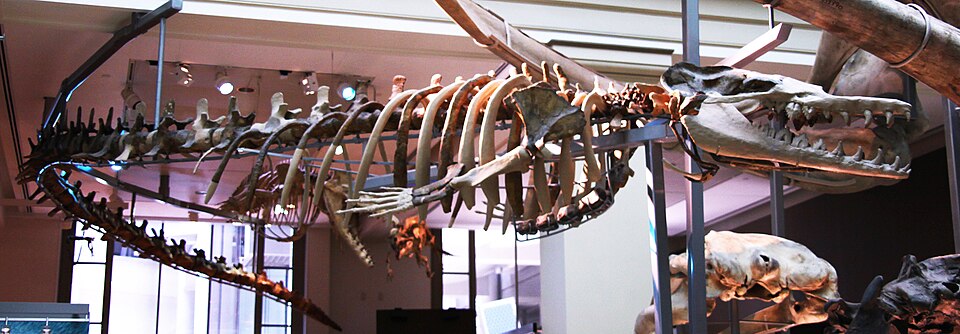
Basilosaurus is a genus of large, fully aquatic archaeocete whale that lived during the late Eocene epoch, approximately 41 to 34 million years ago. The genus contains two well-supported species: B. cetoides, described in 1834 from Louisiana and now known from extensive material across the Gulf Coastal Plain of the southeastern United States, and B. isis, described in 1904 from the Fayum Depression of Egypt and represented by spectacularly complete skeletons recovered from the late Eocene strata of Wadi Al-Hitan.6, 15, 17 Together with the contemporaneous and somewhat smaller Dorudon atrox, Basilosaurus is the iconic representative of the family Basilosauridae, the first cetaceans whose anatomy indicates an obligately aquatic existence with no remaining capacity for locomotion on land.7, 14
The genus occupies an unusually visible position in both the history of paleontology and the modern evolutionary literature. Its name — literally "king lizard" — preserves a nineteenth-century misidentification, the genus was the centerpiece of one of the most notorious museum hoaxes of the 1840s, and a 1990 paper documenting the discovery of complete miniature hind limbs in B. isis is one of the most frequently cited illustrations of a vestigial structure in any vertebrate. More recent work has established Basilosaurus as the apex predator of late Eocene seas, with stomach contents preserving juvenile Dorudon bones and a finite-element-derived bite force exceeding any mammal yet measured.3, 4, 5
Discovery and naming
.jpg)
The history of Basilosaurus begins in 1832, when a single large vertebra recovered from the Tertiary formations of Ouachita Parish, Louisiana, was forwarded to the American Philosophical Society in Philadelphia. The natural historian and physician Richard Harlan published a formal description of this and additional material in 1834, including teeth and partial jaw fragments supplied by Judge John G. Creagh from Clarke County, Alabama.1, 19 Harlan compared the vertebra with those of the marine reptiles Plesiosaurus and Mosasaurus and with the terrestrial dinosaurs Megalosaurus and Iguanodon, and concluded that the new animal exceeded all of them in size. He coined the genus Basilosaurus, from the Greek basileus ("king") and sauros ("lizard"), under the assumption that the serpentine vertebrae represented a gigantic marine reptile.1
In 1839 Harlan travelled to London with additional specimens, including teeth, jaw fragments, a humerus, and ribs, and presented them for examination by the comparative anatomist Richard Owen at the Royal College of Surgeons. Owen observed that the cheek teeth bore two well-developed roots, a configuration unknown in any fish or reptile but characteristic of mammals, and he further noted that the molar crowns were more morphologically complex and varied along the tooth row than the dentition of any reptile.2 On these grounds Owen reassigned the animal to the Mammalia and proposed the new generic name Zeuglodon ("yoked tooth"), in reference to the double-rooted molars. Harlan accepted Owen's mammalian assignment, but the rules of zoological priority that eventually crystallized in the International Code of Zoological Nomenclature required retention of the earlier name. Basilosaurus Harlan, 1834 therefore remains the valid genus, with Zeuglodon Owen, 1839 a junior synonym.2, 15
Through the 1840s the German showman Albert Koch toured Europe and the United States with a "sea serpent" he called Hydrarchos, exhibited as a reconstructed skeleton more than 35 metres long. Koch had collected genuine Basilosaurus cetoides bones from Alabama but had assembled them with material from at least three or four separate individuals, padding the vertebral column to produce a sensational length and orientation. Owen and other anatomists denounced the composite, and the specimen, after passing through several owners, was eventually destroyed in fires during the nineteenth and twentieth centuries. The episode established Basilosaurus in the popular imagination as a "sea monster" decades before its true biological significance was understood, and it left a lasting cautionary lesson about composite mounts that paleontologists still invoke when evaluating museum specimens of articulated fossil vertebrates.15, 19
The progress of the genus from Harlan's misidentified "king lizard" through Owen's mammalian reassignment to Koch's commercial sea-serpent illustrates a recurring pattern in nineteenth-century vertebrate paleontology: large, fragmentary fossils from poorly known formations were initially interpreted within the comparative framework of living animals, then revised as anatomy accumulated, and only much later placed correctly within an evolutionary context that did not yet exist when the type specimens were named. By the time the first reasonably complete Basilosaurus skeletons were assembled at the Smithsonian and the British Museum (Natural History) in the late nineteenth and early twentieth centuries, the basic mammalian and cetacean character of the genus was no longer in dispute, but its precise relationship to modern whales and to the broader history of mammalian aquatic adaptation would require nearly another century of fossil discovery, beginning with Andrews's Egyptian material in 1904 and culminating in the Wadi Al-Hitan hind-limb specimens of 1990.3, 6, 15
Species and distribution
Two species of Basilosaurus are widely accepted today. Basilosaurus cetoides, the type species, is restricted to the late Eocene marine deposits of the Gulf Coastal Plain of the southeastern United States. Its remains are recovered from the Jackson Group — principally the Moodys Branch Formation, the Yazoo Clay, the Pachuta Marl, and the Shubuta Clay — in a belt extending from Louisiana through Mississippi and into western Alabama, with additional material from the Ocala Limestone of eastern Alabama and Florida.19, 20 These strata accumulated in a warm shallow Gulf sea between approximately 38 and 34 million years ago. B. cetoides is the official state fossil of both Alabama and Mississippi, and a composite skeleton recovered for the Smithsonian Institution by Charles Schuchert in the mid-1890s from Choctaw County, Alabama, has been on display in Washington since 1910.19
Basilosaurus isis was named by Charles W. Andrews in 1904, on the basis of a partial mandible and several vertebrae collected by Hugh Beadnell of the Geological Survey of Egypt from middle to late Eocene strata in the Fayum Depression. Andrews initially placed the species in Zeuglodon, and only later was the priority of Basilosaurus applied.6, 15 The species is now known from many tens of skeletons recovered from the Birket Qarun Formation and the overlying Gehannam Formation in the area now protected as Wadi Al-Hitan, with additional material reported from late Eocene deposits in Jordan and elsewhere along the southern margin of the former Tethys Sea.17, 18 The Egyptian fossils are mineralogically and geometrically superb, frequently preserving complete or nearly complete vertebral columns, intact crania, and articulated limb bones in their original anatomical positions.
The two species differ in size and proportions. B. cetoides is the larger form, with adults reaching estimated total lengths of 17 to 20 metres and body masses on the order of 12 to 15 tonnes. B. isis is somewhat smaller, with reconstructed lengths of 15 to 18 metres, but its remains are far better preserved and provide most of the available information on basilosaurid postcranial anatomy.13, 18 Both species share the extreme vertebral elongation, reduced hind limbs, and powerful crushing dentition that distinguish the genus from all other basilosaurids.
Vertebral column and body proportions
The most striking feature of Basilosaurus, and the source of Harlan's original misidentification, is its extraordinarily elongate, serpentine body. The vertebral column reconstructed from three overlapping skeletons of B. isis contains approximately 70 vertebrae, with a formula of seven cervical, eighteen thoracic, twenty lumbar and sacral, and twenty-five caudal elements.15, 18 Within this column the thoracic, lumbar, and anterior caudal centra are dramatically elongated — on the order of three times the length-to-width ratio of equivalent vertebrae in Dorudon or any other basilosaurid — producing a torso and tail proportionally more drawn out than in any other known cetacean, living or extinct.9, 13 The cervical vertebrae are short and unfused, allowing modest neck mobility, while the elongation is concentrated in the trunk and proximal tail.
This unique morphology has made the locomotor reconstruction of Basilosaurus a long-running problem. Emily Buchholtz and other workers have argued from comparative vertebral osteology that the elongated centra cannot have functioned in the high-frequency, tail-driven oscillation characteristic of modern cetaceans, and that the animal probably swam by low-amplitude dorsoventral undulation of nearly the entire trunk — an "anguilliform" mode unusual among mammals and not seen in any modern whale.9 Philip Gingerich, drawing on the same vertebral evidence and on the geometry of the rib cage, has proposed that Basilosaurus was largely confined to surface or near-surface waters and that its locomotion was effectively two-dimensional. The smaller and more conventionally proportioned Dorudon atrox, in contrast, appears to have been a competent three-dimensional diver.7, 18
Bone microstructural studies provide an independent constraint on this picture. Histological sectioning of Basilosaurus ribs and vertebrae reveals pronounced pachyosteosclerosis — a combination of pachyostosis (hyperplasy of the periosteal cortex) and osteosclerosis (inner bone compaction) — that increases the density of the axial skeleton and acts as biological ballast.10 Pachyosteosclerosis is widespread among slow-moving, shallow-water aquatic tetrapods (sirenians, early mosasaurs, some pinnipeds), where it counteracts the buoyancy provided by lungs and blubber and helps maintain trim near the water surface. Its presence in Basilosaurus, but not in the more pelagic Dorudon, supports the reconstruction of Basilosaurus as a slow, near-surface predator rather than a deep diver.10
The vestigial hind limbs
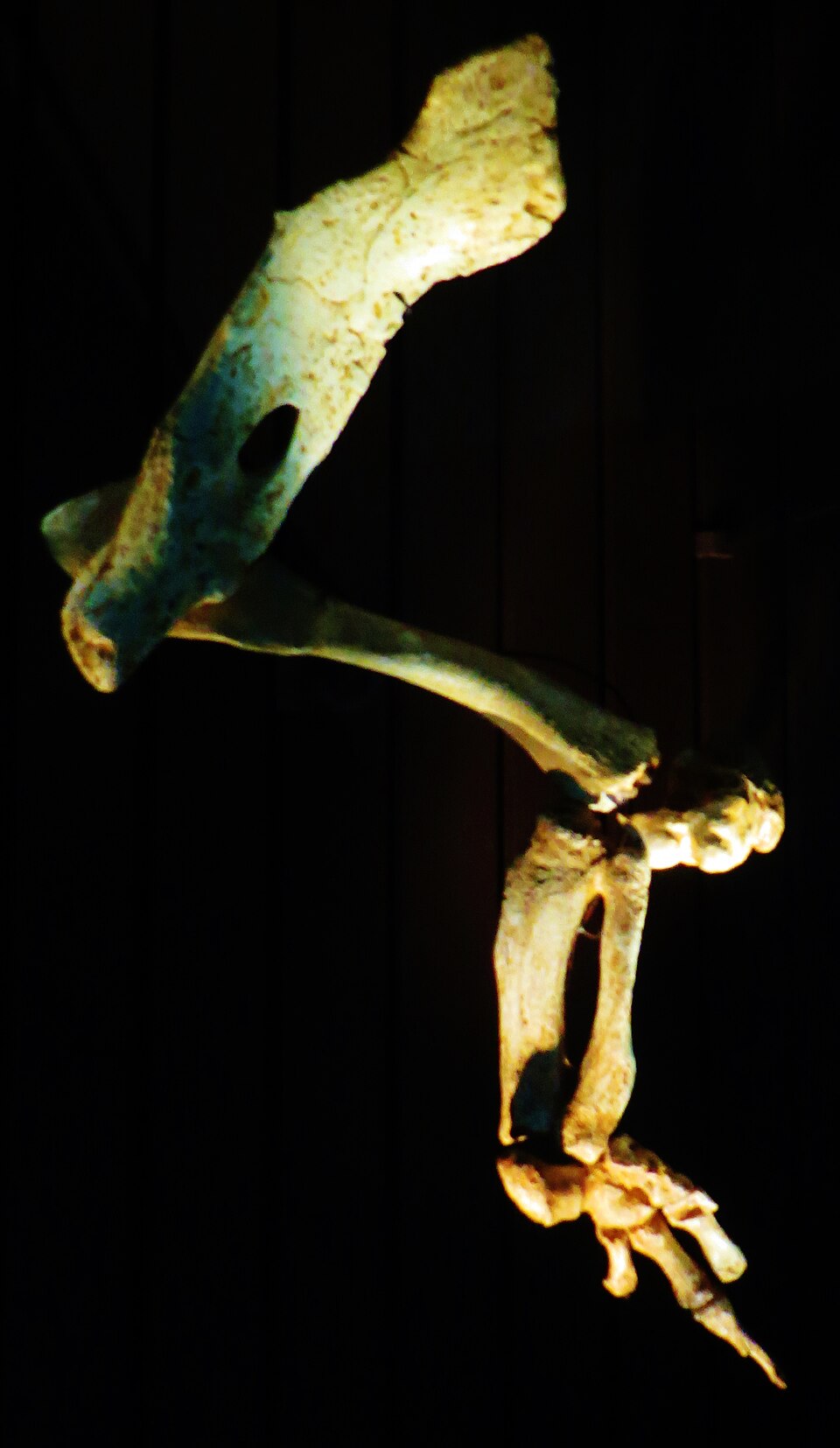

The single most influential paper on Basilosaurus in the modern literature is the 1990 Science report by Philip Gingerich, B. Holly Smith, and Elwyn Simons describing the first complete pelvic limb and foot of an Eocene whale.3 Working in the Fayum Depression of Egypt, the authors recovered, in articulation with vertebrae of B. isis, an innominate (hip bone), femur, patella, tibia, fibula, and a paraxonic three-toed foot complete with tarsals, metatarsals, and phalanges. The bones bore well-formed articular surfaces at every joint — hip, knee, and ankle were all preserved as functional, mobile articulations.3
The dimensions, however, are remarkable. The entire hind limb, from acetabulum to the tip of the third digit, measured only about 60 centimetres in an animal exceeding 15 metres in total length. The femur was approximately 35 centimetres long, the tibia and fibula even shorter, and the foot bones diminutive in absolute terms.3 Gingerich and colleagues calculated that even with maximum muscular force the limb could not have supported any appreciable fraction of the body weight of an adult Basilosaurus, and the unfused, mobile sacrum would have provided no skeletal pathway for transmitting body weight to the ground at all. Whatever function the limbs served in life, terrestrial locomotion was anatomically impossible.
The authors offered two main observations on the evolutionary and functional significance of the discovery. First, the foot retains the paraxonic configuration — symmetry between the third and fourth digits — that is the diagnostic synapomorphy of the mammalian order Artiodactyla, providing morphological support for what later molecular and ankle-bone studies would confirm: that whales are nested within the even-toed ungulates.3, 16 Second, given the functional impossibility of locomotion, the authors suggested that the hind limbs may have served as copulatory guides or claspers, helping to align the body axes of mating individuals in three-dimensional space — a function speculatively, but not implausibly, assigned to a small structure with full joint mobility but no weight-bearing role.3
The broader importance of the find is that the hind limbs of Basilosaurus are textbook vestigial organs in the strict morphological sense: they are small, functionally negligible relative to their ancestral role, and yet retain the complete bone-by-bone organization of a tetrapod limb. They demonstrate that the cetacean lineage at this stage had not merely shifted into a new ecological niche but had structurally inherited — and was carrying along, increasingly miniaturized — the architecture of its terrestrial four-legged ancestors. Subsequent discoveries of even more reduced hindlimb elements in Dorudon and a partial pelvis in modern whales reinforce the picture of progressive, but not absolute, loss.13, 14
Skull and dentition
The skull of Basilosaurus is long, narrow, and dorsoventrally low, with a much-elongated rostrum that gives the cranium a length on the order of 1.5 metres in B. isis. The braincase is small relative to overall skull size, in keeping with the modest cranial capacities of all archaeocetes, and the external nares (nostrils) are positioned on the dorsal surface of the snout but have not yet migrated to the high apex of the skull as in modern cetaceans. The dentition is the diagnostic feature of the genus and was the morphological basis for Owen's recognition that the animal was a mammal.2, 15 The dental formula of B. isis is 3.1.4.2–3 / 3.1.4.3 — three incisors, one canine, four premolars, and two to three molars per quadrant — with the upper and lower molars and the second through fourth premolars being double-rooted and high-crowned. Heterodonty (differentiation of teeth along the row) is retained, in contrast to the homodont, single-rooted dentition of most modern toothed whales.
The cheek teeth of Basilosaurus show a distinctive pattern of macroscopic wear unlike that seen in any other archaeocete or modern cetacean. The crowns develop large shearing facets along their cutting edges, and many specimens preserve spalled flakes of enamel and exposed dentin that indicate forceful crushing of hard objects. Microwear studies have linked these patterns to macrophagy — the consumption of large prey items including the bones of other vertebrates — and biomechanical work on the jaws has shown that the dentition was capable of both shearing and crushing in a single, orthoretractional bite movement reminiscent of large terrestrial carnivores.5, 13
Cranial asymmetry, a feature of all modern cetaceans related to directional underwater hearing, is already present in Basilosaurus. Fahlke and colleagues used computed tomography of B. isis skulls and a comparative dataset of basilosaurids and modern whales to demonstrate that the directional bilateral asymmetry of the rostrum and cranial vault evolved before the divergence of the modern odontocete and mysticete lineages, and is therefore an ancestral cetacean adaptation for underwater sound localization rather than a later acquisition tied to echolocation.12 The petrosal and tympanic bullae of Basilosaurus are dense, isolated from the rest of the skull by cranial sinuses, and connected to a large mandibular fat pad through a thinned acoustic fenestra ("pan bone") on the mandible — the same suite of features that channels waterborne sound to the inner ear in modern whales.
Bite force and predation
The most direct evidence for the predatory ecology of Basilosaurus comes from a single extraordinary specimen excavated by Mohammed Sameh Antar, Iyad Zalmout, and Philip Gingerich in 2010 at Wadi Al-Hitan and reported in detail by Voss and colleagues in 2019. The fossil, catalogued as WH 10001, is a nearly complete adult B. isis skeleton approximately 15 metres long, recovered from the Gehannam Formation and dated to roughly 37 million years before present.4, 18 Concentrated within the body cavity, in the region of the lower thoracic and upper abdominal cavity, the excavators recovered an unusual assemblage of disarticulated bones and tooth fragments that did not belong to Basilosaurus: cranial elements (frontals, a squamosal, a tympanic bulla) and postcranial bones from at least one juvenile Dorudon atrox, together with a prearticular tooth row of the large bony fish Pycnodus mokattamensis.4
Voss and colleagues argued that this assemblage represents true gut contents rather than a chance association of unrelated carcasses. The bones are concentrated in a small volume corresponding to the position of the stomach in modern cetaceans, the Dorudon elements show breakage patterns consistent with biting rather than transport, and bite marks on other Dorudon skulls from Wadi Al-Hitan target the cranium in a manner characteristic of active predation rather than scavenging. The juvenile Dorudon in WH 10001 is among the youngest individuals known of its species, consistent with the hypothesis that Wadi Al-Hitan preserves a calving and nursery ground for Dorudon that Basilosaurus exploited as a hunting site.4
An independent biomechanical line of evidence converges on the same conclusion. Snively, Fahlke, and Welsh applied finite-element analysis to a digitally reconstructed adult B. isis cranium, modelling the major adductor muscles in two loadcases corresponding to the initial closing phase and a subsequent shearing phase of the bite. Under the closing scenario the model produced a maximum bite force of approximately 16,400 newtons at the upper third premolar; under the shearing scenario, with reduced condylar reaction force, tooth reaction forces could exceed 20,000 newtons.5 These values exceed every previously published bite-force estimate for any mammal, fall well above the reaction forces calculated for large extant alligators, and indicate that Basilosaurus was mechanically capable of crushing the skulls of other cetaceans — precisely the predation pattern preserved in the WH 10001 stomach contents.
Comparative anatomy of Basilosaurus isis and Dorudon atrox7, 13, 14, 18
| Trait | Basilosaurus isis | Dorudon atrox |
|---|---|---|
| Total length | 15–18 m | ~5 m |
| Vertebral count (approx.) | 70 | ~60 |
| Trunk vertebra elongation | Extreme (centra ~3× wider taxa) | Conventional |
| Rib and vertebral histology | Pachyosteosclerotic (ballasted) | Compact, not pachyostotic |
| Inferred swimming mode | Anguilliform, near-surface | Three-dimensional diver |
| Hind limb size relative to body | ~3% of body length, non-locomotor | Even smaller, non-locomotor |
| Estimated bite force at P3 | ~16,400 N (max) | Not estimated |
| Ecological role at Wadi Al-Hitan | Apex predator | Prey species (juveniles) |
Wadi Al-Hitan, the Valley of the Whales

_Panorama.jpg)
Wadi Al-Hitan, the "Valley of the Whales," is a desert basin in the Western Desert of Egypt approximately 150 kilometres southwest of Cairo, on the western edge of the Fayum Depression. UNESCO inscribed the area on the World Heritage List in July 2005 under natural criterion (viii) for its outstanding fossil record of the late Eocene transition from semi-aquatic to fully aquatic whales. The protected zone covers approximately 200 square kilometres and contains the remains of more than 400 individual archaeocete cetaceans — principally Basilosaurus isis and Dorudon atrox — together with sirenians (sea cows), sharks, bony fishes, sea turtles, crocodylians, and an early proboscidean.8, 17
The fossils are preserved in the Birket Qarun and Gehannam formations, which together represent shallow marine to lagoonal sediments laid down on the southern margin of the Tethys Ocean approximately 41 to 37 million years ago. Many of the skeletons are essentially complete, weathered out of soft mudstones and sandstones in their original anatomical positions, with limb bones and even small foot elements articulated. This preservation has allowed researchers to reconstruct vertebral counts, body proportions, and details of joint mobility that are unavailable from any other archaeocete locality.17, 18
The history of paleontological work at the site spans more than a century. Hugh Beadnell of the Geological Survey of Egypt collected the first archaeocete material from the area in the 1890s, and Charles Andrews described B. isis on Beadnell's specimens in 1904. The German paleontologist Eberhard Stromer von Reichenbach and others worked the locality intermittently in the early twentieth century, but the most intensive field campaigns date from the 1980s onward, when teams led by Elwyn Simons of Duke University, Philip Gingerich of the University of Michigan, and Egyptian colleagues including Mohammed Sameh Antar of the Egyptian Mineral Resources Authority began the systematic excavation that has produced most of the diagnostic material now in museums in Cairo, Ann Arbor, and elsewhere.3, 17 Field seasons since 2005, conducted under the protection of the World Heritage designation, continue to yield new specimens and have transformed Wadi Al-Hitan into the single most informative locality on Earth for the late Eocene whale transition.
Phylogenetic position within Basilosauridae
The Basilosauridae are a paraphyletic or grade-level family of late middle to late Eocene archaeocetes, encompassing the first cetaceans to lose all functional ties to the land. They include Basilosaurus itself, the smaller and more dolphin-shaped Dorudon, the South American Cynthiacetus, the closely related Zygorhiza and Saghacetus from North America and Egypt respectively, and a growing list of other taxa from Eocene marine deposits of Europe, Africa, North America, South America, and most recently Antarctica.13, 15, 20 Phylogenetic analyses of basilosaurids using parsimony recover the family as monophyletic only with difficulty, and several authors treat it as a stem grade leading directly to the modern Neoceti (the clade comprising all living odontocetes and mysticetes).
Within this assemblage, Basilosaurus is anatomically distinctive. Its extreme vertebral elongation is not shared with any other basilosaurid, and recent comparative work by Martínez-Cáceres and colleagues on Cynthiacetus peruvianus and other large dorudontines suggests that great body size and vertebral elongation can evolve convergently among basilosaurids and are consequently poor phylogenetic markers.13 The clade containing Basilosaurus sensu stricto is supported by features of the rostrum, the periotic, and the proportions of the cervical region; Basiloterus husseini, named from material in Pakistan, is the closest known relative of Basilosaurus. Most other elongate basilosaurids assigned in the older literature to Basilosaurus on the basis of size alone have been transferred to other genera.13, 15
Importantly, Basilosaurus itself is not regarded as the direct ancestor of modern whales. The body plan of the smaller Dorudon atrox — with conventional vertebral proportions, three-dimensional diving capability, and a more dolphin-like skull — is much closer to the morphology that would be expected of the common ancestor of odontocetes and mysticetes, and most current phylogenies place Dorudon or a Dorudon-like dorudontine, rather than Basilosaurus, on the line leading to crown Cetacea.14, 15 Basilosaurus is therefore best understood as a specialized side branch of the basilosaurid radiation rather than a node along the trunk of cetacean evolution.
Paleoecology and extinction
The late Eocene oceans inhabited by Basilosaurus were warm, shallow, and productive, with extensive shelf seas covering parts of what are now the Sahara, the Arabian Peninsula, and the southeastern United States. Sediments associated with B. isis at Wadi Al-Hitan preserve abundant remains of seagrasses such as Thalassodendron, Thalassia, and Halodule, indicating well-lit, shallow neritic environments with high primary productivity.17 The associated vertebrate fauna includes the sirenian Protosiren, the early proboscidean Moeritherium, the sea turtle Puppigerus, multiple shark genera, and a diverse assemblage of bony fishes, providing a complete trophic context within which Basilosaurus functioned as the largest macropredator.
Combining the lines of evidence reviewed above — gut contents, bite marks on prey, finite-element bite-force estimates, tooth wear patterns, ballasted axial skeleton, and the apparent calving-ground hypothesis for Dorudon at Wadi Al-Hitan — Basilosaurus emerges as a slow, near-surface, ambush-and-pursuit apex predator analogous in ecological role, though not in body shape, to large modern killer whales.4, 5, 10 Stable isotope analyses of basilosaurid tooth enamel are consistent with a diet centred on marine vertebrates, and there is no evidence that Basilosaurus ever returned to land for any part of its life cycle. The complete unfusing of the sacrum from the pelvis, and the trivially small hind limbs, indicate that — unlike protocetids such as Maiacetus, which appear to have given birth on shore — basilosaurids almost certainly bore their young at sea, in the manner of all modern cetaceans.11, 18
The fossil record of Basilosaurus ends near the close of the Eocene, around 34 million years ago, coincident with the Eocene–Oligocene boundary and the extinction event known informally as the Grande Coupure. This interval is associated with the onset of permanent Antarctic glaciation, a global drop in sea level, the cooling of the world ocean, and the disappearance of the warm, shallow Tethyan shelf seas in which the basilosaurids thrived. Basilosaurus and most other archaeocetes vanish from the rock record during this transition, while their dorudontine relatives, or close offshoots, give rise during the early Oligocene to the first members of the modern cetacean suborders Odontoceti and Mysticeti.14, 15 The disappearance of Basilosaurus therefore marks the end of the archaeocete grade and the beginning of the radiation of crown-group whales that continues to the present day.
Legacy in paleontology and evolutionary biology
Few extinct vertebrates have played as conspicuous a role in the public understanding of evolution as Basilosaurus. The 1990 description of its hind limbs by Gingerich, Smith, and Simons is routinely cited in textbooks, museum exhibits, and popular accounts as one of the clearest morphological illustrations of macroevolutionary descent — an animal carrying, in functionless miniature, the structural inheritance of its land-dwelling ancestors.3, 15 The recognition of paraxonic foot symmetry in those hind limbs further linked Basilosaurus to the artiodactyl ancestry of whales that was eventually corroborated independently by molecular phylogenetics, retroposon insertions, and the double-pulley astragalus of Pakicetus and Rodhocetus.16
The protection of Wadi Al-Hitan as a UNESCO World Heritage Site and the continuing field programs there have transformed the genus from a curiosity assembled from fragments in the nineteenth century into the best-known archaeocete on Earth. Each new B. isis skeleton recovered from the Gehannam Formation refines a picture in which morphology, biomechanics, geology, paleoecology, and the testimony of preserved gut contents all converge: an enormous, slow-swimming, bone-crushing whale, hunting smaller cetaceans on the southern margin of the Tethys, born at sea but built from the same skeletal architecture as the four-legged mammals from which its lineage descended only fifteen million years before.4, 8, 17 In its combination of evolutionary intermediacy and apex-predator ecology, Basilosaurus remains one of the most informative single genera in the entire vertebrate fossil record.
References
Stomach contents of the archaeocete Basilosaurus isis: apex predator in oceans of the late Eocene
Bone-breaking bite force of Basilosaurus isis (Mammalia, Cetacea) from the late Eocene of Egypt estimated by finite element analysis
Land-to-sea transition in early whales: evolution of Eocene Archaeoceti (Cetacea) in relation to skeletal proportions and locomotion of living semiaquatic mammals
New protocetid whale from the middle Eocene of Pakistan: birth on land, precocial development, and sexual dimorphism
Cranial asymmetry in Eocene archaeocete whales and the evolution of directional hearing in water
The anatomy and phylogenetic affinities of Cynthiacetus peruvianus, a large Dorudon-like basilosaurid (Cetacea, Mammalia) from the late Eocene of Peru
Form, function, and anatomy of Dorudon atrox (Mammalia, Cetacea): an archaeocete from the middle to late Eocene of Egypt
Wadi Al-Hitan or 'Valley of Whales' – an Eocene World Heritage Site in the Western Desert of Egypt
New skeleton of Basilosaurus isis (Mammalia, Archaeoceti) from the middle-to-late Eocene of Wadi Hitan, Egypt