Overview
- Brachiopods are a phylum of marine invertebrates with two-valved shells that superficially resemble bivalve molluscs but are fundamentally distinct in anatomy, with a unique feeding organ called the lophophore and shells oriented along a dorsal-ventral axis rather than left-right, having originated in the early Cambrian and diversified into more than 12,000 described fossil species across the Paleozoic.
- During the Ordovician radiation, brachiopods became the dominant shelly fauna on Paleozoic seafloors, occupying ecological roles later filled by bivalve molluscs, before suffering catastrophic losses in the end-Permian mass extinction approximately 252 million years ago that eliminated roughly 90 percent of brachiopod genera and permanently ended their ecological dominance.
- The inarticulate brachiopod Lingula has persisted with remarkably conserved shell morphology for over 450 million years, making it one of the most frequently cited examples of a living fossil, though molecular studies reveal ongoing genetic evolution beneath its morphological stasis.
Brachiopods are a phylum of marine invertebrates whose two-valved shells have made them among the most abundant and ecologically important animals in the fossil record. Though superficially resembling bivalve molluscs such as clams and mussels, brachiopods are an entirely separate evolutionary lineage with a fundamentally different body plan: their shells are oriented along a dorsal-ventral axis rather than left-right, and they feed using a distinctive tentacle-bearing organ called the lophophore rather than filtering water through gills.1, 4 First appearing in the early Cambrian as part of the Cambrian explosion, brachiopods diversified explosively during the Ordovician radiation to become the dominant shelly organisms on Paleozoic seafloors, producing more than 12,000 described fossil species in over 5,000 genera across roughly 450 million years of evolutionary history.1, 11 Their catastrophic decline during the end-Permian mass extinction permanently ended their reign as the primary occupants of shallow marine habitats, a role subsequently filled by bivalve molluscs in a replacement that stands as one of the most dramatic ecological transitions in the history of life.9, 10
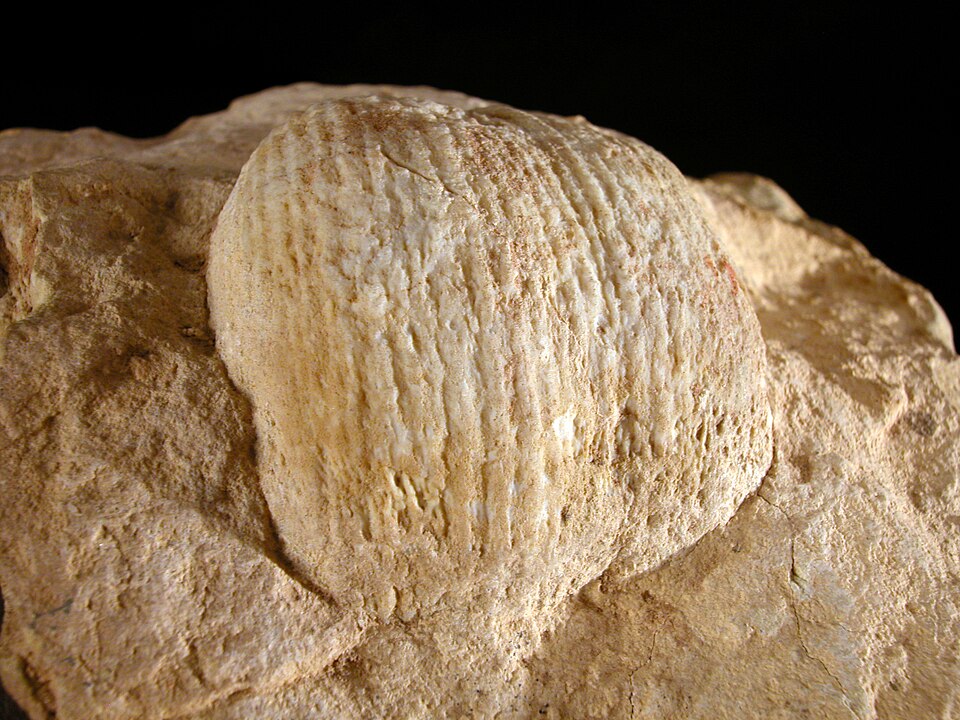
.jpg)
Anatomy and body plan
The brachiopod body is enclosed within two shells, or valves, secreted by a tissue layer called the mantle. Unlike bivalve molluscs, whose two valves are mirror images of each other (left and right), brachiopod valves differ from one another: the ventral (pedicle) valve is typically larger and bears a hole or notch through which a fleshy stalk called the pedicle emerges, anchoring the animal to the substrate, while the dorsal (brachial) valve is smaller and supports the lophophore internally.1, 4 Each valve is individually bilaterally symmetrical about its midline, a plane of symmetry that runs perpendicular to the commissure (the junction between the two valves) — the opposite orientation from bivalves, whose plane of symmetry runs along the commissure between the two valves.4
The lophophore is the defining anatomical feature of the phylum and the primary feeding organ. It consists of a pair of tentacle-bearing arms arranged in loops, spirals, or complex three-dimensional configurations depending on the species, and it generates water currents that draw food particles — primarily phytoplankton and dissolved organic matter — toward the mouth.14 The lophophore is ciliated, and its beating cilia create a one-way flow of water through the mantle cavity, filtering suspended particles from the water column. In articulate brachiopods, the lophophore is often supported by a calcareous skeleton called the brachidium, whose shape is taxonomically diagnostic and ranges from simple loops to elaborate spiralia.1, 14 Lophophore morphology became increasingly complex through brachiopod evolutionary history, with Williams suggesting that the elaboration of the lophophore into progressively more efficient feeding structures was a major driver of brachiopod diversification.14
Articulate and inarticulate brachiopods
Brachiopods have traditionally been divided into two major groups based on their shell articulation. Articulate brachiopods (subphylum Rhynchonelliformea) possess a hinge mechanism consisting of teeth on the ventral valve that interlock with sockets on the dorsal valve, creating a secure but flexible connection that allows the valves to open and close in a controlled manner. Their shells are composed of calcium carbonate, either calcite or a combination of calcite and organic layers, and they typically bear well-developed pedicles for attachment to hard substrates.1, 8 Articulate brachiopods were overwhelmingly dominant during the Paleozoic, producing the great radiations of orthids, strophomenids, pentamerids, spiriferids, and rhynchonellids that characterized successive periods.1, 17
Inarticulate brachiopods (subphyla Linguliformea and Craniiformea) lack a tooth-and-socket hinge; instead, their valves are held together solely by muscles and connective tissue. Linguliforms have shells composed of calcium phosphate (the mineral francolite) mixed with organic material, giving them a distinctive chitinous appearance, while craniiforms have calcitic shells cemented directly to the substrate.1, 15 Inarticulate brachiopods appeared first in the fossil record, with the earliest linguliforms and craniiforms known from the early Cambrian, predating the diversification of articulate forms.15 Molecular phylogenetic analyses have confirmed that the traditional articulate-inarticulate division corresponds broadly to deep evolutionary splits within the phylum, though the precise relationships among the three subphyla remain debated, with some studies suggesting that Craniiformea may be more closely related to Rhynchonelliformea than to Linguliformea.8
Ordovician radiation and Paleozoic dominance
Although brachiopods originated in the Cambrian, their great diversification occurred during the Ordovician radiation, the sustained burst of marine biodiversification that unfolded between approximately 485 and 445 million years ago. During this interval, brachiopod generic diversity increased roughly fourfold, and the phylum came to dominate shallow marine benthic communities across virtually every continent.3, 7 Harper and colleagues documented that brachiopods were the most conspicuous component of the Ordovician biodiversification, with new orders and superfamilies appearing rapidly across a range of shelf environments from tropical carbonate platforms to high-latitude siliciclastic settings.17
The ecological success of brachiopods during the Ordovician was facilitated by several factors. The proliferation of hard substrates on carbonate-rich seafloors provided abundant attachment surfaces for pedicle-bearing forms. Rising sea levels created extensive epicontinental seas with broad, shallow shelves ideal for suspension-feeding organisms. And the diversification of phytoplankton provided an expanding food base for lophophore-bearing filter feeders.3, 7 By the Late Ordovician, brachiopods had become so abundant that their shells formed significant components of limestone formations worldwide, and they remained the dominant shelly fossils in most Paleozoic marine assemblages through the Silurian, Devonian, Carboniferous, and Permian periods.1, 11
The Late Ordovician mass extinction — the first of the “Big Five” Phanerozoic extinction events — significantly reduced brachiopod diversity, eliminating many families that had dominated earlier Ordovician faunas. However, brachiopods recovered rapidly, and the post-extinction recovery saw the rise of new dominant groups including the pentamerids and the atrypids that would characterize Silurian and Devonian faunas.2, 16 Rasmussen and Harper demonstrated that the post-extinction recovery involved not merely the replacement of lost lineages but a fundamental reorganization of brachiopod biogeography, with surviving taxa expanding into regions previously occupied by extinct forms.16
End-Permian devastation and the bivalve replacement
The end-Permian mass extinction approximately 252 million years ago was catastrophic for brachiopods. Roughly 90 percent of brachiopod genera were eliminated, including entire orders that had been dominant for tens of millions of years — the productids, the spiriferids, and the richthofeniids among them.9, 12 Chen and Shi documented that the extinction was particularly severe among the specialized reef-dwelling and large-bodied forms that had characterized late Paleozoic brachiopod faunas, while smaller, generalist taxa in deeper-water or marginal environments were more likely to survive.12
The mechanisms behind the disproportionate vulnerability of brachiopods to the end-Permian crisis likely include their low metabolic rates, limited mobility, and dependence on well-oxygenated waters for lophophore-based filter feeding. The widespread ocean anoxia, hypercapnia (elevated carbon dioxide), and acidification that accompanied the Siberian Traps volcanic eruptions would have been especially lethal for organisms that could neither flee unfavorable conditions nor tolerate reduced oxygen levels.9, 10 Bivalve molluscs, which possess gills capable of functioning in lower-oxygen conditions and are generally more mobile, survived the crisis in greater numbers and subsequently diversified to fill the ecological niches vacated by brachiopods.10
Carlson emphasized that the brachiopod-to-bivalve transition was not a simple competitive replacement but rather a contingent outcome of the end-Permian catastrophe. Throughout the entire Paleozoic, brachiopods and bivalves had coexisted for over 250 million years with brachiopods numerically dominant. It was the selective severity of the extinction, not inherent competitive superiority, that allowed bivalves to assume dominance in the Mesozoic and Cenozoic.10, 6
Lingula: the "living fossil"
No discussion of brachiopods is complete without the genus Lingula, an inarticulate brachiopod frequently cited as one of the most striking examples of morphological stasis in the history of life. Fossils assigned to Lingula or closely related forms appear in rocks as old as the Early Ordovician, roughly 480 million years ago, and the living species Lingula anatina bears a shell shape virtually indistinguishable from these ancient relatives — an apparent morphological conservatism spanning nearly half a billion years.5, 13
Living Lingula inhabits shallow, intertidal to subtidal soft sediments in the western Pacific and Indian Oceans, where it lives in vertical burrows with its elongated pedicle anchoring it in the substrate. Unlike most other brachiopods, which attach to hard surfaces, Lingula is an infaunal burrower that can retract rapidly into its burrow when disturbed.5 Emig documented that Lingula tolerates a remarkably wide range of environmental conditions, including reduced salinity, low oxygen levels, and elevated turbidity — a generalist ecology that may partly explain its extraordinary longevity as a lineage.5
However, the concept of Lingula as an unchanging “living fossil” requires important caveats. Biernat and Emig argued that the apparent morphological stasis of the lingulid shell may reflect the constraints of a simple shell form — a thin, elongate, phosphatic valve — rather than genuine evolutionary standstill.13 Molecular phylogenetic studies have revealed substantial genetic divergence among living lingulid species, indicating that the lineage has been actively evolving at the molecular level despite its conservative outward appearance. The designation of ancient fossils as Lingula sensu stricto has also been challenged on the grounds that shell morphology alone is insufficient to establish generic identity across hundreds of millions of years, and many Paleozoic “Lingula” may belong to related but distinct genera within the family Lingulidae.8, 13
Modern brachiopods
Approximately 400 species of brachiopods survive today, a fraction of their Paleozoic diversity but still enough to make the phylum a living, if reduced, component of marine ecosystems.11 Modern brachiopods are most diverse and abundant in cold, deep-water habitats — on continental slopes, in polar seas, and in submarine caves — environments where competition from bivalves and other molluscs is reduced.11 In New Zealand’s Fiordland, Antarctic shelf waters, and the deep Mediterranean, brachiopods can be locally abundant, forming dense populations reminiscent of their Paleozoic heyday, though they no longer dominate any major marine ecosystem.1, 11
The living orders include the Rhynchonellida and the Terebratulida (both articulate) and the Lingulida, Discinida, and Craniida (inarticulate). Terebratulids are the most diverse living group, comprising roughly two-thirds of extant species, while rhynchonellids and lingulids account for much of the remainder.1, 11 Modern brachiopods are studied both as living representatives of an ancient phylum — providing insights into soft-tissue anatomy, physiology, and ecology that cannot be obtained from fossils alone — and as model organisms for understanding macroevolutionary patterns of diversification, extinction, and recovery across deep time. Their evolutionary trajectory, from Cambrian origins through Paleozoic dominance to post-Permian marginalization, encapsulates one of the most compelling narratives of rise, fall, and persistence in the history of animal life.10, 4
References
Survival and recovery of brachiopod faunas during and after the end-Ordovician mass extinction
Environmental and biotic controls on the evolutionary history of insular dwarfism and gigantism in brachiopods
End-Permian mass extinction in the oceans: an ancient analog for the twenty-first century?
Evolutionary and biogeographical shifts in response to the Late Ordovician mass extinction