Overview
- Deinocheirus mirificus, meaning “terrible hand,” was an enormous ornithomimosaur from the Late Cretaceous of Mongolia that reached body lengths of approximately 11 meters and weighed an estimated 6,400 kilograms, making it the largest known member of its clade by a wide margin.
- Known only from a pair of massive 2.4-meter-long arms discovered in 1965, the full body plan of Deinocheirus remained one of paleontology’s great mysteries for nearly 50 years until two nearly complete skeletons were described in 2014, revealing a bizarre animal with a humped back, a duck-like bill, and a deep, sail-like neural spine profile.
- Stomach contents preserved in the 2014 specimens, including fish remains and gastroliths, along with the animal’s broad, edentulous bill, indicate that Deinocheirus was an omnivore that fed in wetland environments, a radically different ecological role from the cursorial, insectivorous lifestyle typical of smaller ornithomimosaurs.
Deinocheirus mirificus is an extinct species of giant ornithomimosaur theropod dinosaur from the Late Cretaceous Nemegt Formation of Mongolia, approximately 70 million years old.1, 2 First described in 1970 from a single pair of enormous forelimbs measuring 2.4 meters in length, Deinocheirus ("terrible hand") spent nearly five decades as one of the most tantalizing enigmas in paleontology, its full body plan a subject of persistent speculation.2, 4 The mystery was resolved in 2014 when Yuong-Nam Lee and colleagues described two nearly complete skeletons that revealed an animal radically different from anything that had been predicted: a hump-backed, duck-billed giant approximately 11 meters long and weighing an estimated 6,400 kilograms, the largest ornithomimosaur by an enormous margin and one of the most unusual theropod dinosaurs ever discovered.1

Discovery and the 50-year mystery
The original specimen of Deinocheirus mirificus was collected in 1965 during the Polish-Mongolian Palaeontological Expedition to the Gobi Desert, led by Zofia Kielan-Jaworowska, from the Nemegt locality in the Ömnögovi Province of southern Mongolia.2 The specimen consisted of a pair of complete forelimbs with shoulder girdles, a few vertebrae, and fragmentary ribs. Halszka Osmólska and Ewa Roniewicz formally described the material in 1970, naming it Deinocheirus mirificus ("unusual terrible hand") and recognizing it as a theropod dinosaur, but its precise affinities remained unclear because the forelimbs, while superficially similar to those of ornithomimosaurs, were vastly larger than those of any known member of that group.2
The arms of Deinocheirus were immediately iconic. Each arm was longer than an adult human is tall, with three-fingered hands bearing robust, moderately curved claws up to 25 centimeters long.2 For decades, the only known material inspired a parade of speculative reconstructions: some researchers envisioned a colossal predator, others a giant sloth-like browser, and still others a bizarre, long-armed creature unlike any known dinosaur.4, 7 The absence of any postcranial material beyond the arms made definitive classification impossible, and Deinocheirus became a staple of "mystery dinosaur" lists in both scientific and popular literature.4
The 2014 revelation
The resolution came from two additional specimens recovered from the Nemegt Formation in 2006 and 2009 by Korean-Mongolian expeditions. Although parts of both skeletons had been poached before scientific recovery, enough material survived, supplemented by skull and hand elements repatriated from private collections, to reconstruct the complete body plan.1 Lee and colleagues published the description in 2014 in Nature, and the results were startling. Deinocheirus was confirmed as an ornithomimosaur, but it bore almost no resemblance to its smaller, gracile, cursorial relatives such as Gallimimus and Struthiomimus.1, 7
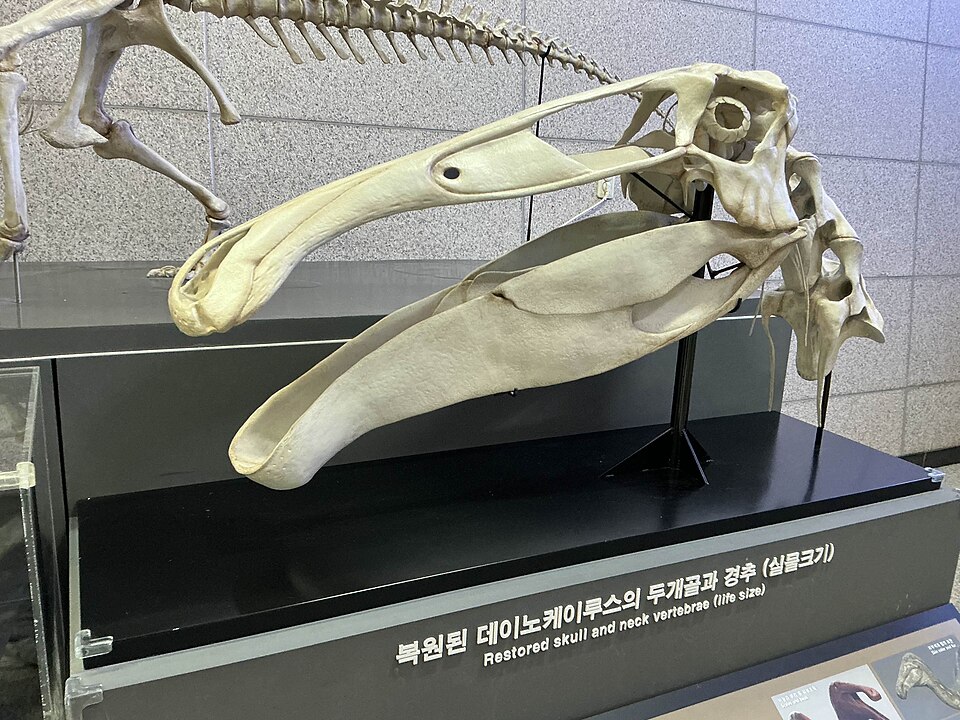
The skull was approximately one meter long, with a broad, dorsoventrally deep rostrum that expanded anteriorly into a spatulate, duck-like bill, edentulous like all ornithomimosaurs but far wider and more robust than expected.1 The vertebral column bore a series of enormously elongated neural spines over the hips, reaching heights exceeding one meter above the centra, which would have supported a prominent dorsal hump or sail in life, superficially convergent on the dorsal sails of Spinosaurus and the humps of some hadrosaurs but structurally distinct.1 The hind limbs were massive but relatively short and robust for an ornithomimosaur, with broad, blunt-clawed feet more suited to weight-bearing in soft substrates than to the cursorial locomotion characteristic of the group.1, 7
Ecology and diet
The stomach region of one of the 2014 specimens preserved a remarkable assemblage of contents including fish remains and over 1,400 gastroliths (deliberately ingested stones used for grinding food in the digestive tract), providing direct evidence of diet.1 The combination of fish bones and gastroliths, together with the broad, spatulate bill adapted for scooping or sieving, indicates that Deinocheirus was an omnivore that fed in wetland or riverine environments, likely consuming a mix of aquatic prey, plant material, and perhaps invertebrates from shallow water and soft sediment.1 This dietary reconstruction is consistent with the palaeoenvironment of the Nemegt Formation, which preserves evidence of river systems, floodplains, and seasonal wetlands during the Late Cretaceous.8, 11
The ecological role of Deinocheirus has no precise modern analogue but has been compared to that of large, omnivorous ground birds or to the ecological space occupied by some large suids or bears. The robust hind limbs and broad feet suggest that the animal was well-adapted for locomotion on soft, waterlogged substrates, and the enormous forelimbs, while their exact function remains debated, may have been used for pulling down vegetation, raking through sediment, or even defense against predators such as Tarbosaurus, the dominant large theropod of the Nemegt ecosystem.1, 8 Bite marks matching the tooth morphology of Tarbosaurus were found on the original 1965 specimen, indicating that Deinocheirus was at least occasionally preyed upon or scavenged by the Nemegt tyrannosaurid.1
Ornithomimosaur context
The placement of Deinocheirus within Ornithomimosauria was confirmed by phylogenetic analysis of the complete skeletal material, which recovered it as the sister taxon to a clade containing Garudimimus and the Ornithomimidae proper, within the broader Ornithomimosauria.1 This phylogenetic position implies that the extreme morphological modifications of Deinocheirus, including the enormous body size, the humped back, the broad bill, and the robust limbs, are derived features that evolved within Ornithomimosauria from an ancestor that was smaller, more gracile, and more conventionally ornithomimid-like.1, 7 The contrast between Deinocheirus and typical ornithomimosaurs underscores the morphological and ecological plasticity of theropod dinosaurs, which repeatedly produced lineages that diverged dramatically from the ancestral body plan to exploit new ecological opportunities.4, 10
Other ornithomimosaurs from the Nemegt Formation, including Gallimimus bullatus and Garudimimus brevipes, were contemporaries of Deinocheirus but occupied very different ecological niches, with Gallimimus being a fast, cursorial omnivore and Garudimimus a smaller, more robustly built form.5, 6, 12 The coexistence of multiple ornithomimosaur species in a single formation, spanning a body mass range from roughly 50 kilograms to over 6,000 kilograms, demonstrates niche partitioning within this clade and illustrates the ecological diversity that Late Cretaceous ecosystems could support even within a single theropod lineage.1, 8, 9
Significance
The story of Deinocheirus encapsulates several broader themes in paleontology. The five-decade gap between the discovery of the arms and the description of the complete animal illustrates both the frustrations and the rewards of working with an incomplete fossil record, and the profound difficulty of predicting the body plan of an extinct animal from a single anatomical region.2, 4 The eventual resolution was made possible not only by new fieldwork but also by the repatriation of commercially collected fossils, a process that highlights the ongoing tension between scientific paleontology and the commercial fossil trade.1 Scientifically, Deinocheirus is a vivid demonstration of the ecological and morphological versatility of theropod dinosaurs, a clade that produced not only the familiar predatory archetypes but also an astonishing range of herbivores, omnivores, and ecological specialists that defy easy categorization.1, 4
References
Giant ornithomimosaur Deinocheirus mirificus: new material from the Upper Cretaceous of Mongolia
Arms of the enigmatic Deinocheirus mirificus: new discoveries from the Upper Cretaceous of Mongolia
A new giant ornithomimid dinosaur with gastroliths from the Upper Cretaceous Nemegt Formation of Mongolia
A new ornithomimid dinosaur with North American affinities from the Late Cretaceous of Mongolia