Overview
- The Zachelmie trackways from Poland, dated to approximately 395 million years ago (Eifelian Stage, Middle Devonian), preserve footprints of tetrapods with distinct digit impressions that predate the oldest known tetrapod body fossils by roughly 18 million years, fundamentally revising the timeline of the fish-to-tetrapod transition.
- Additional trackway sites from Australia, Ireland, and elsewhere confirm that limbed vertebrates were present in multiple environments during the Middle to Late Devonian, suggesting that the transition from fins to limbs occurred earlier and in more diverse settings than body fossils alone indicate.
- The trackways challenge the traditional narrative that tetrapods evolved in freshwater deltaic environments, as the Zachelmie tracks were made in a shallow marine tidal flat or lagoonal setting, implying a more complex ecological context for the origin of terrestrial locomotion.
Discovery at Zachelmie
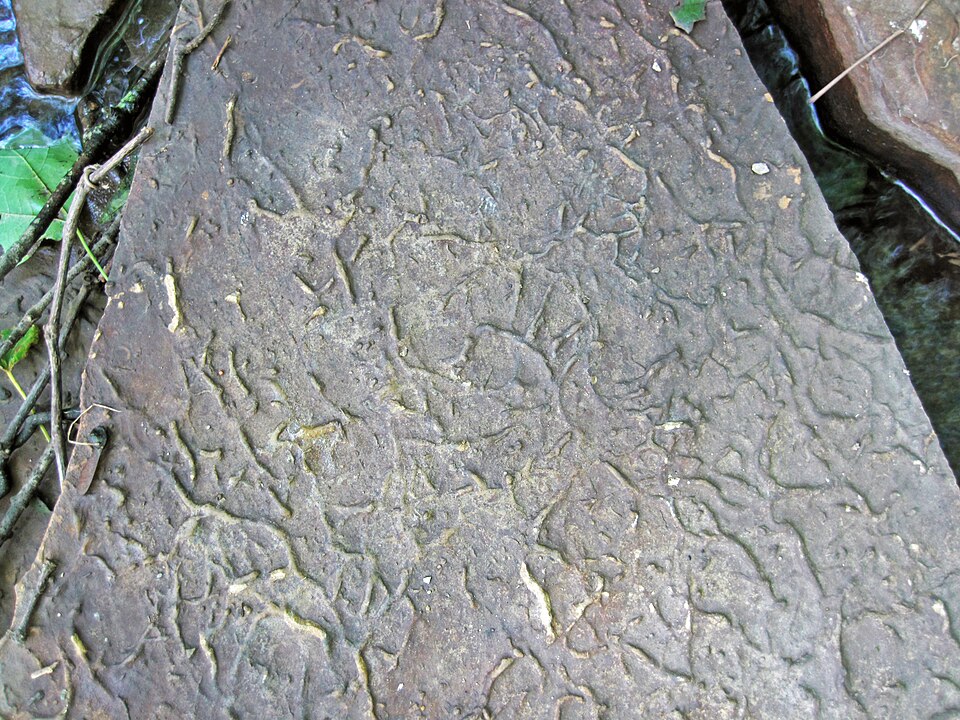
In 2010, Grzegorz Niedzwiedzki and colleagues reported the discovery of tetrapod trackways from the Zachelmie quarry in the Holy Cross Mountains of southeastern Poland, dated to the Eifelian Stage of the Middle Devonian, approximately 395 million years ago.1 The tracks include well-defined imprints of individual digits, body drag marks, and sequences of footfalls that demonstrate a quadrupedal gait, with the largest trackmaker estimated to have been roughly 2.5 meters in body length.1, 2 The significance of this discovery lies in its age: the Zachelmie trackways predate the oldest previously known tetrapod body fossils by approximately 18 million years, pushing the minimum date for the origin of limbed vertebrates deep into the Middle Devonian.1, 3
_(35455655570).jpg)
Implications for the tetrapod timeline
Prior to the Zachelmie discovery, the oldest known tetrapod body fossils dated to the Frasnian Stage of the Late Devonian (approximately 377–375 Ma), represented by fragmentary remains of genera such as Elginerpeton and Obruchevichthys.3, 13 The celebrated transitional fossil Tiktaalik, a “fishapod” with fin-like limbs possessing a wrist joint and flexible digits, comes from strata dated to approximately 375 Ma.6, 7 The Zachelmie tracks, however, demand that fully limbed tetrapods capable of walking were already present at 395 Ma, meaning the entire fish-to-tetrapod transition must have occurred significantly earlier than the body fossil record alone suggests.1
This revelation has important consequences for interpreting transitional forms like Tiktaalik. Rather than representing the very cusp of the transition to tetrapod limbs, Tiktaalik and similar elpistostegalian fish are now understood to document a grade of organization that persisted alongside true tetrapods for at least 18 million years.3, 11 The fish-to-tetrapod transition was evidently a more protracted and overlapping process than previously envisioned, with fin-bearing and limb-bearing vertebrates coexisting for an extended interval.
The trackway evidence in detail
The Zachelmie trackways occur in dolomitic mudstones that were deposited in a shallow marine to marginal marine environment, most likely a tidal flat or coastal lagoon.1, 15 The tracks are preserved as natural casts on the undersides of beds and include several distinct morphotypes, suggesting more than one species of trackmaker. The best-preserved tracks show clear digit impressions without fin-ray marks, indicating that the appendages had differentiated digits rather than the lobed fins of elpistostegalian fish.1
Some trackways show a pattern of alternating, diagonal-sequence gaits, consistent with the lateral-sequence walking used by modern salamanders and other tetrapods. Others include wider, more sprawling strides and occasional body or tail drag marks, suggesting animals that were not fully terrestrial but moved through very shallow water or across briefly emergent substrates.1, 2 The diversity of gait patterns implies behavioral flexibility and adaptation to the marginal marine niche.15
Other Devonian trackway sites
The Zachelmie tracks are the oldest, but they are not the only Devonian tetrapod trackways. The Valentia Island trackway from southwestern Ireland, dated to the late Givetian or early Frasnian (approximately 385 Ma), preserves a series of paired impressions interpreted as the footprints of a tetrapod walking on a muddy substrate in a nearshore or estuarine environment.10 Additional trackway evidence has been reported from the Genoa River region of southeastern Australia, where Middle to Late Devonian sediments preserve impressions consistent with tetrapod locomotion, though the interpretation of some of these tracks remains debated.9
These geographically dispersed occurrences indicate that by the Middle to Late Devonian, limbed vertebrates had achieved a global distribution, inhabiting a variety of marginal marine and nearshore environments across multiple continents.3, 4
Challenging the freshwater hypothesis
The traditional narrative of tetrapod origins, shaped heavily by body fossil localities such as the freshwater deltaic environments of East Greenland (where Ichthyostega and Acanthostega were found), long emphasized freshwater settings as the cradle of terrestrial vertebrate evolution.4, 14 The Zachelmie trackways fundamentally complicate this picture. The sedimentological context indicates that the earliest known tetrapod tracks were made in a marine-influenced environment — a tidal flat or lagoon with periodic marine inundation, evaporite formation, and microbial mat development.1, 15
This finding does not necessarily mean that tetrapods originated in marine environments, but it demonstrates that early tetrapods were not restricted to freshwater habitats and were capable of exploiting marine marginal settings. The ecological context of the fish-to-tetrapod transition may thus have been more diverse than previously recognized, with early limbed vertebrates moving through a patchwork of marine, brackish, and freshwater environments along Devonian coastlines.3, 15
Body fossils and the ghost lineage
The 18-million-year gap between the Zachelmie trackways (395 Ma) and the oldest tetrapod body fossils (approximately 377 Ma) represents a substantial “ghost lineage” — a period during which tetrapods must have existed based on trace fossil evidence but left no known skeletal remains.1, 3 Ghost lineages are common in paleontology and reflect the incompleteness of the fossil record, but the Zachelmie ghost lineage is notable for its duration and for the degree to which it revises the known tetrapod timeline.
The Late Devonian body fossil record, once it begins, is relatively rich. Ventastega curonica from Latvia preserves cranial and postcranial elements revealing an animal intermediate between Tiktaalik-grade elpistostegalians and more derived tetrapods like Acanthostega.12 Acanthostega gunnari from East Greenland (approximately 365 Ma) possessed fully formed limbs with eight digits but retained many fish-like features including internal gills, a lateral line system, and a tail fin, indicating an aquatic lifestyle despite its limbed morphology.4, 5, 8 Ichthyostega, from the same deposits, had a more robust build with seven digits on the hind limb and a specialized vertebral column that recent biomechanical analysis suggests was adapted for a form of “crutching” locomotion rather than conventional quadrupedal walking.14
Taphonomy and preservation of the trackways
The preservation of Devonian tetrapod trackways depends on specific sedimentological conditions that are themselves informative about the paleoenvironment. At Zachelmie, tracks are preserved as natural casts (convex hyporeliefs) on the undersides of dolomitic beds that were deposited over soft, microbially stabilized mudflats. The cohesive microbial mats that covered the substrate provided a firm but plastic surface capable of recording fine details such as individual digit impressions and skin texture, while the overlying dolomitic sediment infilled the impressions before they could be eroded.16, 15 Periodic desiccation cracks and evaporite pseudomorphs in the same beds indicate that the substrate was intermittently exposed, consistent with a tidal flat regime in which animals moved across briefly emergent surfaces between inundation cycles.16
The Valentia Island trackways were preserved under broadly similar conditions: paired footprints impressed into fine-grained siltstones in a marginal marine or estuarine setting, with preservation enhanced by rapid burial under a subsequent depositional event.10, 19 The quality of trackway preservation at both sites exceeds that typical of subaerial environments, likely because saturated or semi-saturated substrates in marginal marine settings retain impressions more faithfully than fully terrestrial soils, which are subject to bioturbation, root growth, and weathering.19
Locomotion and gait analysis
Detailed analysis of trackway geometry provides insights into the locomotor capabilities of the earliest tetrapods. Stride length, pace angulation, and digit splay can be measured from well-preserved trackways and compared with locomotor models based on living amphibians and reptiles. The Zachelmie trackways exhibit relatively short stride lengths relative to estimated body size, wide gauge (the lateral distance between left and right prints), and low pace angulation, all consistent with a slow, sprawling gait similar to that of modern salamanders.1, 17 King and colleagues have used three-dimensional kinematic modeling to show that the trackway patterns are most consistent with a lateral-sequence walk in which the body undulated from side to side, driven primarily by axial musculature rather than limb-based propulsion alone.17 Some trackways at Zachelmie also show paired manus-pes sets with the manus placed lateral to the pes, a pattern observed in some additional Middle Devonian trackway sites from the Holy Cross Mountains and interpreted as evidence of animals walking partially submerged with the forelimbs bearing a greater share of the body weight in buoyant conditions.18, 1
Significance for evolutionary biology
The Devonian tetrapod trackways collectively demonstrate that trace fossils can provide temporal and ecological information unavailable from the body fossil record alone. The Zachelmie tracks established that the fish-to-tetrapod transition was complete by the Middle Devonian, far earlier than body fossils suggest, and that early tetrapods inhabited environments not represented in the skeletal record.1, 11 This case illustrates a broader principle in paleontology: the absence of body fossils does not necessarily indicate the absence of organisms, and trace fossils can extend known ranges, reveal behaviors, and document the presence of lineages in settings where body preservation is unlikely.3, 4 The Zachelmie discovery has also prompted renewed field efforts targeting Middle Devonian marginal marine deposits worldwide, on the expectation that additional trackway sites and potentially contemporaneous body fossils may await discovery in strata that were previously considered too old to yield tetrapod evidence.11, 15