Overview
- The evolutionary transition from lobe-finned fishes to limbed tetrapods is one of the best-documented major transitions in the fossil record, preserved in a series of intermediate forms spanning roughly 385 to 360 million years ago during the Late Devonian period.
- Key transitional genera including Eusthenopteron, Panderichthys, Tiktaalik, Acanthostega, and Ichthyostega document the stepwise acquisition of tetrapod features such as limbs with digits, a mobile neck, weight-bearing girdles, and air-breathing lungs from ancestral fin-bearing, gill-breathing sarcopterygian fishes.
- Early tetrapods were polydactylous, with six to eight digits per limb rather than the five that later became standard, and many retained aquatic adaptations including internal gills and tail fins, indicating that limbs with digits initially evolved for life in shallow water rather than for terrestrial locomotion.
The evolutionary transition from fish to tetrapod — from aquatic, fin-bearing vertebrates to four-limbed animals capable of navigating land — is one of the most thoroughly documented major transitions in the history of life. Over the past century, and especially since the 1980s, a remarkable series of fossil discoveries has revealed the stepwise sequence by which lobe-finned fishes of the class Sarcopterygii gave rise to the first limbed vertebrates during the Late Devonian period, roughly 385 to 360 million years ago.4, 5 The transition involved profound modifications to nearly every organ system: fins were reshaped into limbs bearing digits, the skull was freed from the shoulder girdle to create a mobile neck, the gill-driven respiratory system was supplemented and eventually supplanted by lungs, and the axial skeleton was restructured to bear weight against gravity. These changes did not occur all at once but accumulated over tens of millions of years across a continuum of intermediate forms, many of which are now known from exceptionally preserved fossils found on four continents.5, 12
The fish-to-tetrapod transition is significant not only as a case study in macroevolution but also for what it reveals about the ecological forces that drive anatomical innovation. The earliest limbed vertebrates were not terrestrial pioneers striding onto dry land; they were aquatic or semi-aquatic animals living in shallow, vegetation-choked waterways, and many of the features traditionally associated with land life — including limbs with digits — appear to have evolved first for locomotion in water.4, 7
Sarcopterygian ancestry
Tetrapods are members of Sarcopterygii, the clade of lobe-finned fishes that diverged from the ray-finned fishes (Actinopterygii) during the Silurian or Early Devonian period, more than 400 million years ago. Unlike the thin, fan-shaped fins of ray-finned fishes, the paired fins of sarcopterygians are supported by a robust internal skeleton of endochondral bone arranged in a pattern that prefigures the limb bones of tetrapods: a single proximal element (corresponding to the humerus or femur), followed by two elements (corresponding to the radius and ulna, or tibia and fibula), and then a series of smaller distal bones.6, 19 This internal fin architecture provided the structural foundation upon which the tetrapod limb was built.
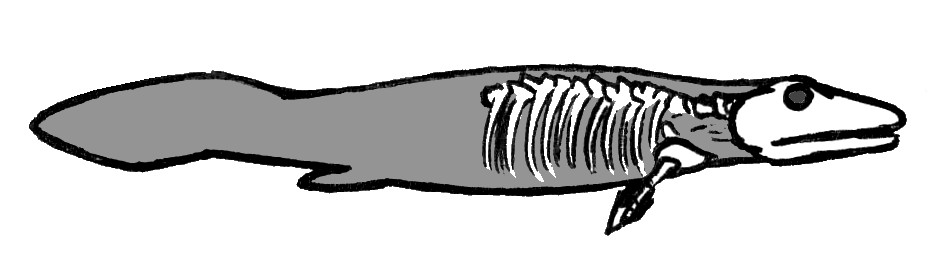

Among living sarcopterygians, molecular phylogenetic analyses have established that lungfishes (Dipnoi) are the closest extant relatives of tetrapods, with coelacanths (Actinistia) forming a more distant outgroup. The sequencing of the coelacanth genome in 2013 confirmed this arrangement through a phylogenomic analysis of 251 nuclear genes, resolving a question that had persisted for decades because the three lineages — lungfishes, coelacanths, and tetrapods — diverged within a narrow window of roughly 20 million years during the Early Devonian, making their branching order difficult to resolve with limited molecular data.18 The lungfish-tetrapod relationship is further supported by shared derived features including the presence of true lungs, internal nostrils (choanae), and similar tooth structures.4
The fossil record of the tetrapod stem group — the sequence of extinct sarcopterygian fishes more closely related to tetrapods than to lungfishes — is remarkably detailed. Molecular clock analyses and fossil evidence together suggest that the tetrapod lineage began to diverge from other sarcopterygians in the Early Devonian, with the earliest body fossils of tetrapodomorph fishes (the broader group containing tetrapods and their closest fish relatives) appearing in deposits roughly 385 million years old.5, 22 However, the discovery in 2010 of tetrapod trackways from the Eifelian stage of Poland, dated to approximately 390 million years ago, suggests that the divergence may have occurred even earlier than the body fossil record indicates, potentially pushing back the origin of limbed forms by at least 10 million years relative to the oldest known body fossils of elpistostegalian fishes.17
Key transitional genera
The fossil record preserves a graded series of forms that document the transformation from fish to tetrapod in remarkable anatomical detail. These genera are not a direct ancestor-descendant lineage but rather a series of related organisms that bracket the morphological space between fully aquatic lobe-finned fishes and the earliest limbed tetrapods, illustrating the sequence in which tetrapod characteristics were acquired.5, 12
.jpg)
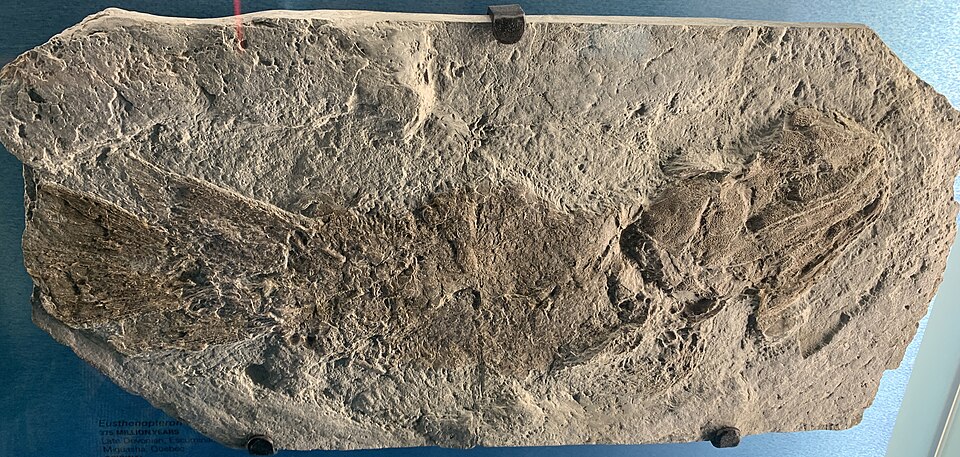
Eusthenopteron foordi, from the Late Devonian of Quebec (approximately 385 million years ago), was one of the first sarcopterygian fishes to be studied in anatomical detail and has long served as the baseline for understanding the fish end of the transition. Its pectoral fin contains an internal skeleton with a humerus, radius, and ulna — the same proximal elements found in a tetrapod forelimb — though the fin terminates in bony rays rather than digits. Its shoulder girdle was still attached to the skull, it possessed a full opercular series (the bony gill cover), and it had a laterally compressed tail fin. Andrews and Westoll's 1970 monograph on its postcranial skeleton remains a foundational reference for comparative studies of the fin-to-limb transition.6
Panderichthys rhombolepis, from the Late Devonian of Latvia (approximately 380 million years ago), represents a more derived stage. It had a dorsoventrally flattened skull resembling that of early tetrapods, with dorsally placed eyes, a reduced opercular series, and a spiracular region that was radically transformed toward a tetrapod-like middle ear architecture. CT scanning of its pectoral fin revealed the presence of distal radial bones that had been obscured in earlier preparations, demonstrating that the elaboration of the distal fin skeleton — a prerequisite for digit formation — was already underway in fish more primitive than Tiktaalik.11, 20, 21
Tiktaalik roseae, discovered in 2004 in Late Devonian sediments of Ellesmere Island in Arctic Canada (approximately 375 million years ago), is perhaps the most celebrated transitional form in the entire series. Described by Daeschler, Shubin, and Jenkins in two companion papers in 2006, Tiktaalik possesses a striking mosaic of fish and tetrapod features: it retains fish-like scales, fin rays, and a lower jaw, but also has a flattened, crocodile-like skull, a mobile neck freed from the shoulder girdle, and a pectoral fin with an expanded endoskeletal complement including functional wrist-like joints capable of supporting the body in a substrate-supported stance.1, 2 The subsequent discovery and description of its pelvic girdle in 2014 revealed that the hind fins were also substantially enlarged relative to those of other finned tetrapodomorphs, with a deep acetabulum (hip socket) rimmed by a robust lip of bone — a pelvic architecture intermediate between that of fishes and tetrapods, indicating that hind limb enlargement began before the origin of digits.3
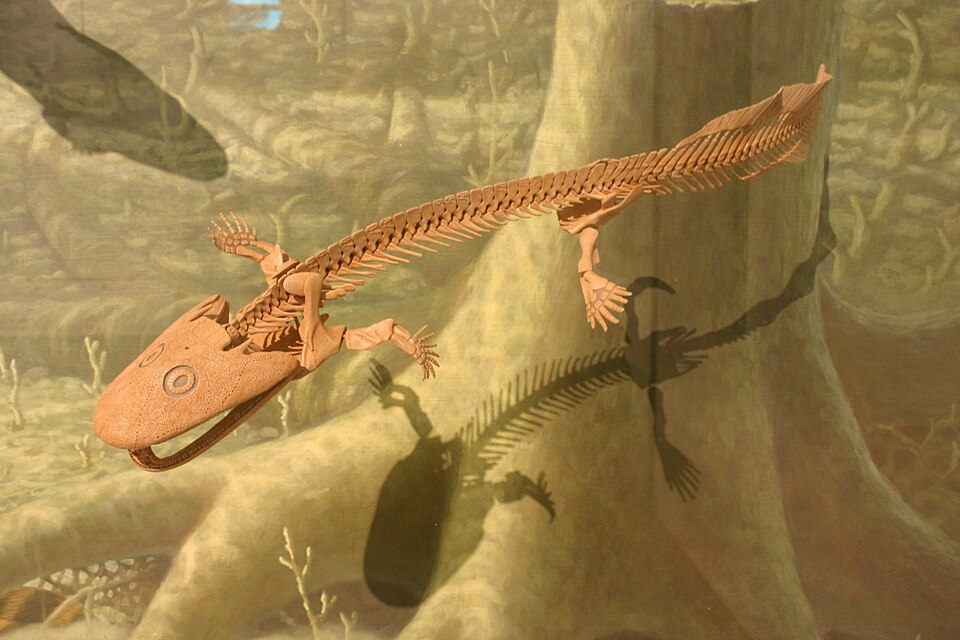
Acanthostega gunnari, from the Late Devonian of East Greenland (approximately 365 million years ago), was the first early tetrapod for which a complete limb with digits was known in detail. Specimens collected by Jennifer Clack in 1987 revealed that each forelimb bore eight digits linked by webbing, while the animal retained a fish-like tail fin supported by lepidotrichia (bony fin rays), a lateral line system, and — crucially — well-ossified ceratobranchial bones with vascular grooves indicating the presence of functional internal gills for aquatic respiration.7, 8, 9 Acanthostega demonstrated that limbs with digits evolved in animals that were still primarily aquatic, overturning the long-held assumption that digits were an adaptation for walking on land.
Ichthyostega stensioei, also from the Late Devonian of East Greenland and roughly contemporary with Acanthostega, was the first Devonian tetrapod ever described (by Gunnar Save-Soderbergh in 1932 and later studied extensively by Erik Jarvik). Reanalysis in the 1990s and 2000s revealed that Ichthyostega had seven digits on its hind limb, broadly flanged and overlapping ribs that would have severely restricted lateral flexion of the trunk, and a regionalized vertebral column with a lumbar region adapted for dorsoventral bending. Its mode of locomotion was probably more like a seal's shuffling gait than the lateral undulation of a salamander.7, 10
Anatomical transformations
The conversion of a lobe-finned fish into a limbed tetrapod required coordinated changes across virtually every organ system. Comparative analysis of the transitional series reveals that these changes occurred in a broadly cranio-caudal sequence: modifications to the skull and pectoral apparatus preceded equivalent changes in the pelvic region and hindquarters.5, 19
The skull and neck underwent dramatic restructuring. In sarcopterygian fishes such as Eusthenopteron, the skull was joined to the shoulder girdle by a series of opercular and extrascapular bones, meaning the head could not move independently of the body. In the transitional forms, the opercular series was progressively reduced: Panderichthys retained a reduced operculum, Tiktaalik lost the opercular connection entirely, and the earliest tetrapods had a fully mobile neck.1, 4, 21 The braincase was also transformed. In fishes, the braincase contained an intracranial joint that allowed the front and back halves of the skull to flex relative to each other. This joint was present in Panderichthys but lost in the earliest tetrapods, producing the rigid, single-unit braincase characteristic of all land vertebrates.21
The fin-to-limb transition is the defining anatomical change of the series. In Eusthenopteron, the proximal fin skeleton (humerus, radius, ulna) was well developed but the distal portion ended in an array of bony rays. In Panderichthys, CT scanning revealed rudimentary distal radials prefiguring the digit region.11 In Tiktaalik, the distal endoskeletal complement was expanded and included functional joints analogous to a wrist, allowing the fin to adopt a limb-like posture capable of bearing weight.2 In Acanthostega and Ichthyostega, the distal elements had become true digits — elongated, segmented, and individually articulated — though in numbers exceeding the five that would later become the tetrapod standard. A phylogenetic review of fins and limbs across the stem and crown group has confirmed that digits are not evolutionary novelties but rather elaborations of pre-existing distal radial elements in the sarcopterygian fin.19
Changes in respiration paralleled the skeletal transformations. Sarcopterygian fishes possessed both gills for aquatic gas exchange and lungs (or lung-like swim bladders) for aerial respiration, a dual system retained by modern lungfishes. The transitional series documents the progressive shift in emphasis from gills to lungs. Acanthostega retained well-developed internal gills with grooved ceratobranchials, indicating that aquatic respiration was still important even after limbs with digits had evolved.9 The loss of the operculum in forms more derived than Panderichthys would have eliminated the opercular pump, the primary mechanism by which bony fishes ventilate their gills with a unidirectional water flow, forcing greater reliance on buccal pumping of air into the lungs — a breathing mechanism still used by modern frogs.4, 5
The spiracle — a modified gill opening between the mandibular and hyoid arches — was progressively enlarged and repositioned during the transition. In Panderichthys, the spiracular region had already acquired a tetrapod-like architecture, with the hyomandibular bone (which would become the stapes of the middle ear in tetrapods) shortened and reoriented. In early tetrapods, the enlarged spiracle became the otic notch, housing a tympanic membrane for airborne sound detection.20 This transformation illustrates how structures serving one function in aquatic ancestors were repurposed for entirely different functions in their terrestrial descendants.
Digit count and early tetrapod polydactyly
One of the most striking discoveries in the study of early tetrapods was the revelation that the earliest limbed vertebrates did not have five digits per limb. The assumption that pentadactyly (five digits) was the ancestral condition for tetrapods was deeply embedded in vertebrate zoology until Coates and Clack's landmark 1990 paper demonstrated that Acanthostega had eight digits on its forelimb and Ichthyostega had seven on its hind limb.7 Tulerpeton curtum, a Late Devonian tetrapod from Russia approximately contemporaneous with Acanthostega and Ichthyostega, possessed six digits on both its fore and hind limbs.13

Digit counts in Devonian tetrapods7, 10, 13
| Genus | Age (Ma) | Location | Forelimb digits | Hindlimb digits |
|---|---|---|---|---|
| Acanthostega | ~365 | East Greenland | 8 | 8 (inferred) |
| Ichthyostega | ~365 | East Greenland | Unknown | 7 |
| Tulerpeton | ~365 | Tula, Russia | 6 | 6 |
| Pederpes | ~348 | Scotland | ~5 | 5 |
The morphology of these polydactylous limbs suggested that they were adapted for paddling in water rather than for walking on land. In Acanthostega, the eight digits were connected by webbing and the wrist lacked the robust ossification needed for effective weight bearing, consistent with an animal that used its limbs primarily as paddles or for pushing through dense aquatic vegetation.7, 8 The variation in digit number among Devonian tetrapods — six, seven, and eight in the three genera for which complete limbs are known — indicates that the developmental programme controlling digit formation was initially flexible, with the pentadactyl condition becoming fixed only after the Devonian, during or after the period known as Romer's Gap.7, 14 The emergence of the five-digit standard appears to have coincided with the evolution of more effective terrestrial locomotion in crown-group tetrapods during the Early Carboniferous.
Ecological context of the transition
The fish-to-tetrapod transition took place during the Late Devonian, a period of dramatic environmental change. The continents were arranged in a configuration very different from the present: Laurussia (comprising modern North America, Greenland, and northern Europe) straddled the equator, while the southern supercontinent Gondwana extended from equatorial to high polar latitudes. Most of the key transitional fossils have been found in deposits from Laurussia, particularly in the equatorial regions where warm, humid conditions supported extensive lowland floodplains and river systems.5, 12
The Late Devonian was also the age when vascular land plants first achieved tree-sized stature, with forests of the progymnosperm Archaeopteris colonising river margins and floodplains. The expansion of rooted vegetation would have profoundly altered freshwater habitats by stabilising riverbanks, increasing the input of organic matter into waterways, and creating dense, shallow-water environments choked with fallen wood and decaying plant material.4 These shallow, vegetated waterways may have provided the selective pressure that favoured the evolution of limbs and air breathing: an animal capable of propping itself up on robust pectoral fins and gulping air would have had a significant advantage in oxygen-poor, weed-choked shallows where swimming was impractical and dissolved oxygen levels were periodically depleted.4, 5
This ecological interpretation represents a fundamental revision of the classic narrative, which portrayed the fish-to-tetrapod transition as a response to drought — fishes dragging themselves across dry land between shrinking pools. The fossil evidence now indicates that early tetrapods were not refugees from drying ponds but rather inhabitants of lush, humid wetland ecosystems. The transition to land was not driven by necessity but by ecological opportunity, as limbed vertebrates gradually expanded their use of marginal habitats at the water's edge before eventually colonising fully terrestrial environments.4, 5 The discovery of Late Devonian tetrapods in high-latitude Gondwanan settings, including Tutusius and Umzantsia from the Famennian of South Africa, further indicates that tetrapods had achieved a global distribution by the end of the Devonian, occupying a diversity of aquatic and marginal habitats across a wide latitudinal range.22
Romer's Gap
Following the diverse Late Devonian tetrapod assemblages, the fossil record of tetrapods becomes strikingly sparse for approximately 15 to 20 million years, spanning from the end of the Devonian (approximately 359 million years ago) through the Tournaisian stage of the Early Carboniferous (to roughly 345 million years ago). This interval was identified by the American palaeontologist Alfred Sherwood Romer in the mid-twentieth century and has become known as Romer's Gap. When tetrapod fossils reappear in abundance in the mid-Visean stage of the Carboniferous, the fauna has been transformed: the polydactylous, aquatic-to-semi-aquatic Devonian forms have been replaced by animals with five digits, more effective terrestrial locomotion, and recognisable affinities to the major lineages of later tetrapods, including the stem groups of amphibians and amniotes.12, 14
The cause of Romer's Gap has been debated. One influential hypothesis, supported by geochemical evidence from sulfur isotope records and charcoal abundance data, proposes that atmospheric oxygen levels dropped significantly during the earliest Carboniferous, falling to levels as low as 13 to 15 percent compared to the present-day 21 percent. Ward and colleagues argued in 2006 that this low-oxygen interval constrained the terrestrialization of both vertebrates and arthropods, because air-breathing animals dependent on relatively inefficient buccal pumping or cutaneous respiration would have been physiologically limited in a hypoxic atmosphere.15
However, the gap has been progressively filled by new fossil discoveries. In 2002, Clack described Pederpes finneyae from the Tournaisian of Scotland — the first articulated tetrapod skeleton from Romer's Gap. Pederpes was functionally pentadactyl and showed the earliest evidence of forward-facing feet adapted for terrestrial locomotion, bridging the morphological and temporal gap between Devonian and mid-Carboniferous tetrapod faunas.14 A decade later, Smithson and colleagues reported diverse tetrapod and arthropod assemblages from multiple Tournaisian localities in Scotland, demonstrating that the gap was at least partly a sampling artefact reflecting the scarcity of suitable terrestrial sedimentary deposits rather than a genuine absence of tetrapods.16 These discoveries suggest that the critical innovations enabling fully terrestrial life — including the consolidation of the pentadactyl limb, improved lung ventilation, and waterproof integument — were acquired during this poorly sampled but pivotal interval.
Trackway evidence and the ghost lineage
While the body fossil record provides detailed anatomical snapshots of individual organisms, trace fossils in the form of trackways offer a complementary line of evidence about the timing and behaviour of early tetrapods. The most significant trackway discovery came in 2010, when Niedzwiedzki and colleagues reported well-preserved tetrapod tracks from the Eifelian stage of the Middle Devonian at the Zachelmie quarry in Poland, dated to approximately 390 million years ago.17
These tracks are approximately 18 million years older than the earliest tetrapod body fossils and roughly 10 million years older than the oldest known elpistostegalian fishes such as Panderichthys. The trackways were preserved in marine tidal flat sediments, indicating that the trackmakers inhabited intertidal or shallow marine environments rather than the freshwater habitats traditionally associated with early tetrapods. The largest prints measure up to 26 centimetres wide, indicating animals substantially larger than any of the known Devonian tetrapod body fossils and implying the existence of a long ghost lineage of tetrapods or tetrapod-like organisms for which no body fossils have yet been found.17
The Zachelmie trackways forced a significant reassessment of the timing and environmental context of the fish-to-tetrapod transition. They imply that limbed vertebrates originated considerably earlier than the Late Devonian body fossil record suggests, that the earliest tetrapods may have inhabited marine or marginal marine environments rather than exclusively freshwater settings, and that the body fossil record of the transition, impressive as it is, still contains substantial gaps.17, 22 The tracks remain controversial — some workers have questioned whether they were truly made by tetrapods rather than by large fish using their fins to walk along the substrate — but the presence of clear digit impressions in many of the prints supports their attribution to limbed animals.
Molecular and developmental evidence
The fossil record of the fish-to-tetrapod transition is complemented by molecular and developmental data that illuminate the genetic mechanisms underlying the anatomical transformations. Phylogenomic analyses, including the landmark sequencing of the coelacanth genome in 2013, have firmly established that lungfishes are the closest living relatives of tetrapods, with coelacanths as the outgroup to the lungfish-tetrapod clade. This phylogenetic arrangement, long debated because of the rapid divergence of the three lineages in the Early Devonian, was resolved through the analysis of hundreds of nuclear genes using sophisticated models of molecular evolution.18
Comparative genomic studies between fish and tetrapods have identified specific genetic changes associated with the transition to land. Analysis of the coelacanth genome revealed accelerated evolution in genes and regulatory elements involved in limb development, olfaction, nitrogen excretion (the shift from ammonia to urea as the primary nitrogenous waste product), and immune function — all systems that would have been under strong selection during the adaptation to terrestrial life.18 Studies of the developmental genetics of fins and limbs have shown that the same Hox gene regulatory networks that pattern the digits of tetrapod limbs are also active in the distal regions of fish fins, supporting the palaeontological evidence that digits are not evolutionary novelties but modifications of pre-existing fin structures.19
Molecular clock estimates for the divergence of the tetrapod lineage from other sarcopterygians vary depending on the calibration points and methods used, but most analyses place the split between 400 and 385 million years ago, broadly consistent with the body fossil record but predating the earliest known tetrapod body fossils by several million years.12, 22 This discordance between molecular and morphological estimates of divergence time is consistent with the existence of a substantial ghost lineage, as independently suggested by the Middle Devonian Zachelmie trackways.
Significance of the transition
The fish-to-tetrapod transition holds a distinctive place in evolutionary biology for several reasons. It is among the most complete sequences of intermediate forms in the vertebrate fossil record, spanning a morphological continuum from fully aquatic fishes to limbed, digit-bearing animals with the hallmarks of terrestriality. The density of the transitional series — with multiple genera occupying finely spaced positions along the fish-to-tetrapod morphological gradient — provides a compelling empirical test of the prediction, central to evolutionary theory, that large-scale anatomical transformations occur through the gradual accumulation of small changes rather than through sudden saltatory leaps.4, 5
The transition also illustrates the phenomenon of exaptation, in which features evolve in one functional context and are later co-opted for a different use. Limbs with digits evolved in aquatic environments for navigating shallow, vegetated waterways, not for walking on land. Lungs evolved in fishes for supplementary aerial respiration in oxygen-poor waters, not as primary respiratory organs for terrestrial life. The spiracle, a gill-related structure, was transformed into the middle ear of land vertebrates. In each case, the ancestral function was aquatic, and the derived terrestrial function emerged later as animals began to exploit marginal and eventually fully terrestrial habitats.4, 9, 20
Perhaps most importantly, the fish-to-tetrapod transition set the stage for the subsequent diversification of land vertebrates. Every amphibian, reptile, bird, and mammal alive today — including humans — descends from the limbed aquatic animals that first hauled themselves through the shallow waterways of the Devonian world. The anatomical groundplan established during this transition, including the pentadactyl limb, the robust pelvic and pectoral girdles, and the lung-based respiratory system, has been modified in countless ways over the subsequent 360 million years but never fundamentally abandoned.4, 12
References
The Devonian tetrapod Acanthostega gunnari Jarvik: postcranial anatomy, basal tetrapod interrelationships and patterns of skeletal evolution
Confirmation of Romer’s Gap as a low oxygen interval constraining the timing of initial arthropod and vertebrate terrestrialization
Earliest Carboniferous tetrapod and arthropod faunas from Scotland populate Romer’s Gap