Overview
- Coelacanths are lobe-finned fishes of the order Coelacanthiformes that first appeared in the Middle Devonian approximately 410 million years ago and were presumed extinct since the Late Cretaceous until a living specimen of Latimeria chalumnae was discovered off South Africa in 1938.
- Despite superficial morphological similarity to Mesozoic relatives, genomic studies reveal that living coelacanths have continued to evolve at the molecular level, accumulating substitutions in protein-coding and regulatory sequences, contradicting the popular characterization of the coelacanth as an unchanged living fossil.
- As the closest living fish relatives of tetrapods alongside lungfishes, coelacanths provide critical comparative data for understanding the genetic and anatomical changes that accompanied the transition from water to land during the Late Devonian.
Coelacanths are an ancient order of lobe-finned fishes (Coelacanthiformes) whose fossil record extends back approximately 410 million years to the Middle Devonian period.7 For over a century after the last known fossil coelacanths disappeared from the geological record at the end of the Cretaceous, roughly 66 million years ago, paleontologists classified the entire lineage as extinct. The dramatic discovery of a living specimen in 1938 off the coast of South Africa made the coelacanth one of the most celebrated zoological finds of the twentieth century and established it as the most iconic example of what is popularly called a "living fossil."2
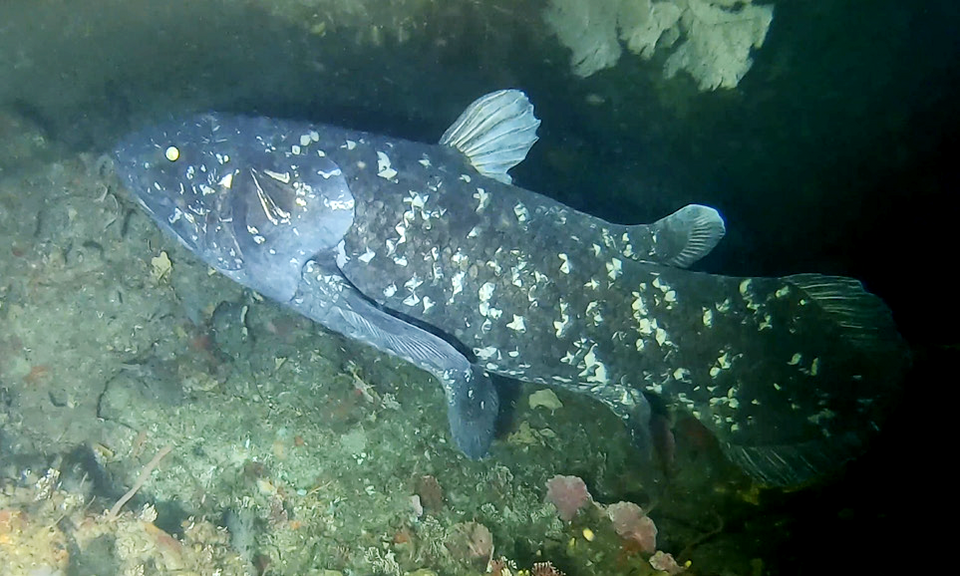
The living genus Latimeria comprises two recognized species: Latimeria chalumnae from the western Indian Ocean and Latimeria menadoensis from the waters off Sulawesi, Indonesia.3 Both are large, deep-water predatory fishes that inhabit submarine caves and steep volcanic slopes at depths typically between 150 and 700 meters. Their distinctive lobed pectoral and pelvic fins, which move in an alternating pattern resembling tetrapod limb movement, along with a unique intracranial joint that divides the skull into anterior and posterior halves, make them anatomically unlike any other living fish.4, 5, 12

Fossil record and evolutionary history
The oldest known coelacanths appear in Middle Devonian deposits approximately 410 million years ago.7 Throughout the Paleozoic and Mesozoic eras, coelacanths diversified into at least 130 described species spanning a wide range of body sizes and ecological niches. Some Devonian and Carboniferous forms were small freshwater fishes, while Mesozoic coelacanths occupied both marine and freshwater environments and ranged from small benthic forms to large open-water predators.4, 13
A key finding from the fossil record is that coelacanth body plan evolution was not uniformly slow. Early coelacanths showed considerable morphological diversity, with Devonian forms already exhibiting the characteristic intracranial joint and trilobed tail fin that define the group.10 Matt Friedman and Michael Coates described a Devonian actinistian with a skull configuration remarkably similar to modern Latimeria, suggesting that the basic coelacanth body plan was established early in the group's history.10 The apparent morphological conservatism since the Late Devonian reflects the early attainment of a successful functional design rather than an absence of evolutionary change.
Coelacanths disappeared from the fossil record after the Late Cretaceous, leading to the assumption that they went extinct alongside the non-avian dinosaurs. The 80-million-year gap between the youngest known fossil coelacanth and the living species represents one of the longest Lazarus intervals in the vertebrate fossil record.4
Discovery of living coelacanths
On 22 December 1938, Marjorie Courtenay-Latimer, curator of the East London Museum in South Africa, noticed an unusual fish among a trawler's catch landed at the mouth of the Chalumna River. She recognized it as unlike any species she had seen and contacted the ichthyologist J. L. B. Smith of Rhodes University, who identified it as a coelacanth and named it Latimeria chalumnae in her honor.2 Smith described the specimen as the most important zoological discovery of the century, calling it "a living fossil" that bridged an enormous gap in the evolutionary record of fishes.
A second specimen was not obtained until 1952, when a coelacanth was caught off the Comoro Islands between Madagascar and the African mainland. Subsequent surveys revealed a small population inhabiting submarine caves along the volcanic slopes of Grande Comore and Anjouan islands.6 In 1997, a second species, Latimeria menadoensis, was discovered in the waters off Manado Tua in northern Sulawesi, Indonesia, approximately 10,000 kilometers east of the Comorian population.3 Genetic analysis confirmed that the Indonesian population represents a distinct species that diverged from L. chalumnae between 30 and 40 million years ago.11, 15
Anatomy and functional morphology
Living coelacanths possess several anatomical features that are unique among extant fishes and illuminate the evolutionary history of lobe-finned vertebrates. The intracranial joint, located between the frontal and parietal shield of the skull, allows the anterior portion of the head to rotate upward relative to the posterior, amplifying gape during prey capture.4 This joint is shared with fossil coelacanths and with some early tetrapodomorphs, but is absent in all other living vertebrates.
The paired fins of coelacanths are supported by a fleshy, muscular lobe containing an internal skeleton of endochondral bone that articulates with the pectoral and pelvic girdles.4 Submersible observations by Hans Fricke and colleagues revealed that coelacanths move their paired fins in a slow, alternating pattern analogous to the gait of terrestrial tetrapods, with the ipsilateral pectoral and contralateral pelvic fin moving in synchrony.12 While this locomotor pattern was once taken as evidence that coelacanths might represent the closest living fish relative of tetrapods, molecular phylogenetics has since demonstrated that lungfishes hold that position.8
Other distinctive features include a hollow notochord that persists throughout life in place of a fully ossified vertebral column, a rostral organ in the snout that may function as an electroreceptor, and a fat-filled gas bladder that has lost its respiratory function.4, 14
Genomic insights
The sequencing of the Latimeria chalumnae genome, published in 2013, provided the first comprehensive molecular portrait of a coelacanth and yielded several unexpected findings.1 The genome is approximately 2.86 billion base pairs and contains roughly 19,033 protein-coding genes, a count broadly similar to other vertebrates. Protein-coding sequences in Latimeria evolve at a rate significantly slower than that of tetrapods, consistent with the observation of morphological conservatism, though the genome is far from static.1, 9
Comparative analysis identified genes and regulatory elements relevant to the water-to-land transition. Several genes involved in limb development, including those in the HoxD cluster and the Shh limb enhancer, showed patterns of conservation in Latimeria that provided insight into how regulatory changes facilitated the evolution of digits in tetrapods.1 The genome also revealed the loss of genes related to urea cycle enzymes and the gain of immunity-related genes consistent with adaptation to a deep-marine environment.1
Crucially, while protein evolution is slow in coelacanths, transposable element activity and noncoding sequence divergence indicate that the genome has continued to evolve considerably since the lineage diverged from tetrapods.9 The term "living fossil" thus mischaracterizes the actual evolutionary dynamics of the lineage: the coelacanth is morphologically conservative but genetically active.
Phylogenetic position
Coelacanths belong to the Sarcopterygii, the clade of lobe-finned fishes that also includes lungfishes and all tetrapods. The question of whether coelacanths or lungfishes are the closest living fish relatives of tetrapods was debated for decades, but molecular phylogenetic analyses have consistently resolved lungfishes as the sister group of tetrapods, with coelacanths occupying a more basal position within the Sarcopterygii.8 This topology has been supported by analyses of mitochondrial genomes, nuclear genes, and whole-genome comparisons.1, 8
Despite not being the closest fish relative of tetrapods, coelacanths remain invaluable for comparative biology because they preserve ancestral features that have been modified or lost in both lungfishes and tetrapods. Comparisons among coelacanths, lungfishes, and tetrapods allow researchers to reconstruct the sequence of morphological and genomic changes that accompanied the colonization of land during the Late Devonian.1, 4
Ecology and behavior
Submersible observations at the Comoro Islands revealed that Latimeria chalumnae is a nocturnal predator that shelters in submarine caves during the day at depths of 150 to 250 meters and descends to feeding grounds as deep as 700 meters at night.6 Individual coelacanths show strong site fidelity, returning to the same cave day after day, and populations at individual sites typically number fewer than a few dozen individuals.6, 16
Coelacanths are ovoviviparous, retaining eggs internally until they hatch and giving birth to fully developed young. Gestation is estimated at 13 months or longer, and females produce relatively few offspring, making the species especially vulnerable to population decline.14 Their diet consists primarily of cephalopods, small fishes, and other deep-water organisms encountered during slow drift-hunting along steep volcanic slopes.6, 12
The "living fossil" concept
The coelacanth is often cited as the quintessential living fossil, a term coined by Charles Darwin for organisms whose modern representatives closely resemble ancient fossil forms. However, this characterization requires significant qualification. While the external body plan of Latimeria is broadly similar to Mesozoic coelacanths, detailed anatomical study reveals numerous differences in skull proportions, fin structure, and vertebral development.4, 10
At the molecular level, the coelacanth genome shows clear evidence of continued evolution. Protein-coding genes evolve more slowly than in most tetrapods, but noncoding regulatory regions, transposable elements, and immune system genes have undergone substantial change.1, 9 The slow rate of protein evolution may reflect the stable deep-water habitat of living coelacanths, which has experienced relatively little environmental change compared to the dynamic shallow-water and terrestrial environments inhabited by most tetrapods. Morphological stasis, where it occurs, reflects stabilizing selection rather than an absence of genetic variation or evolutionary potential.9
Conservation status
Both living coelacanth species face conservation concerns. Latimeria chalumnae is classified as Critically Endangered by the IUCN, with a global population estimated at only a few hundred individuals distributed across a handful of sites in the western Indian Ocean.16 Latimeria menadoensis is listed as Vulnerable, though its population size is poorly known due to the difficulty of surveying its deep-water habitat.3
Threats to coelacanth populations include bycatch from deep-water gillnet and longline fisheries, disturbance of cave habitats, and the inherently low reproductive rate of the species.14, 16 Conservation efforts have focused on establishing marine protected areas around known coelacanth habitats in the Comoro Islands and South Africa, as well as raising awareness among local fishing communities to reduce accidental capture.
References
A living fossil in the truest sense? Latimeria genome analysis reveals slow rates of protein evolution
The coelacanth Latimeria chalumnae: a living fossil discovered by Marjorie Courtenay-Latimer