Overview
- The transition from the Ediacaran to the Cambrian, spanning approximately 575 to 530 million years ago, witnessed the disappearance of the enigmatic Ediacaran biota and the emergence of recognizable animal body plans, including the first biomineralized skeletons, complex trace fossils, and the earliest members of most modern animal phyla.
- Whether the Ediacaran biota were ancestral to Cambrian animals, were an evolutionary dead end replaced by an unrelated radiation, or included a mix of both remains one of the most debated questions in paleontology, with molecular clock evidence suggesting that many animal lineages diverged during the Ediacaran even though their body fossils appear only in the Cambrian.
- The small shelly fauna of the earliest Cambrian (Terreneuvian), a diverse assemblage of tubes, caps, spines, and sclerites composed of calcium carbonate and calcium phosphate, represent the first wave of biomineralized animal skeletons and bridge the gap between the soft-bodied Ediacaran world and the fully skeletonized Cambrian fauna.
The transition from the Ediacaran period to the Cambrian, spanning roughly 575 to 530 million years ago, represents one of the most profound biological reorganizations in the history of life. During this interval, the enigmatic soft-bodied organisms of the Ediacaran biota disappeared from the fossil record and were replaced by the recognizable ancestors of modern animal phyla, bearing biomineralized skeletons, complex burrowing behaviors, and the first evidence of predator-prey interactions.1, 6, 16 Whether this transition represents ecological replacement, in which Cambrian animals outcompeted or consumed Ediacaran organisms, evolutionary continuity, in which at least some Ediacaran forms were ancestral to Cambrian animals, or an environmental catastrophe that wiped the slate clean remains one of the central debates in evolutionary paleontology.2, 8, 9
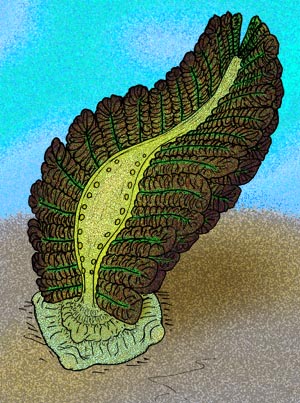

The Ediacaran biota and their disappearance
The Ediacaran biota, preserved in fine-grained siliciclastic and carbonate rocks from approximately 575 to 539 million years ago, include a wide range of morphologically distinctive organisms, many of which have no clear relationship to any modern animal group. Iconic forms such as Dickinsonia, Charnia, Rangea, and Tribrachidium display body plans with no obvious head, gut, or appendages, and their mode of life, whether as animals, protists, fungi, or an entirely extinct kingdom, has been debated since their discovery.2, 3 Adolf Seilacher's "Vendobionta" hypothesis proposed that the Ediacaran organisms were a separate, extinct kingdom of life unrelated to any modern group, while others have argued for affinities with cnidarians, bilaterians, or stem-group animals.3 The recovery of cholesteroid biomarkers from Dickinsonia fossils by Ilya Bobrovskiy and colleagues in 2018 confirmed that at least this organism was an animal, producing cholesterol rather than the ergosterol characteristic of fungi or the phytosterols of plants.10
The disappearance of the classic Ediacaran biota from the fossil record occurs in the latest Ediacaran, prior to the Ediacaran-Cambrian boundary at 538.8 million years ago. Simon Darroch and colleagues documented the progressive ecological decline of Ediacaran communities in the Nama Group of Namibia, where the latest Ediacaran assemblages show reduced diversity and ecological complexity compared to earlier ones, a pattern consistent with competitive displacement by newly evolving metazoan communities rather than a sudden catastrophic extinction.7, 8 However, the incomplete preservation potential of soft-bodied organisms makes it difficult to determine whether Ediacaran organisms truly went extinct or simply became unpreservable as the taphonomic window that captured them, namely the distinctive Ediacaran-style preservation in microbial mat surfaces, closed with changing environmental conditions.2, 9
Continuity versus replacement
The question of biological continuity across the Ediacaran-Cambrian boundary remains deeply contested. The replacement model holds that the Ediacaran biota were a failed evolutionary experiment, ecologically displaced by the more mobile, predatory, and skeletonized animals of the Cambrian, with little or no phylogenetic continuity between the two faunas.3, 9 Under this view, the Cambrian explosion was a genuinely new beginning, with animal body plans assembling largely independently of whatever the Ediacaran organisms were. The continuity model, by contrast, proposes that many Ediacaran organisms were stem-group or crown-group animals whose descendants diversified into the Cambrian, and that the apparent discontinuity is an artifact of preservational bias and our inability to recognize Ediacaran precursors in the hard-shelled Cambrian fauna.1, 15
Molecular clock analyses consistently place the divergence of major animal phyla, including Cnidaria, Bilateria, and many bilaterian subgroups, in the Ediacaran or even the Cryogenian, tens of millions of years before the first skeletal fossils of these groups appear in the Cambrian.1, 6, 14 Douglas Erwin and colleagues argued that the Cambrian explosion involved two distinct phases: an Ediacaran diversification of genetic toolkits and body plan potential (the "developmental revolution"), followed by a Cambrian ecological diversification in which these preexisting lineages acquired skeletons, complex behaviors, and new ecological interactions.6 Some Ediacaran organisms appear to bridge the gap: Cloudina, a tube-dwelling organism from the latest Ediacaran, produced a calcified exoskeleton and has been interpreted as a possible ancestor of Cambrian reef-building organisms.7, 13 Similarly, recent analyses of Dickinsonia and related forms by Scott Evans and colleagues have strengthened the case for bilaterian affinities, suggesting that at least some elements of the Ediacaran biota were part of the animal evolutionary tree.15
Small shelly fauna and the skeletal revolution
The earliest Cambrian, the Terreneuvian Series (approximately 538.8 to 521 million years ago), is characterized by the small shelly fauna (SSF), a diverse and taxonomically heterogeneous assemblage of small (typically 1 to 10 millimeters) biomineralized fossils including tubes, caps, hollow spines, composite sclerites, and various problematic forms.4, 5 The SSF represent the first major pulse of biomineralization in the animal kingdom, and they appear abruptly in the basal Cambrian, in strata immediately above the last Ediacaran assemblages, although some skeletal forms such as Cloudina predate the boundary.4, 7 Stefan Bengtson and others have interpreted the SSF as the disarticulated skeletal elements of animals that were often larger and more complex than the individual sclerites would suggest, including early mollusks, brachiopods, chancelloriids, and organisms of uncertain affinity.4, 5
The SSF assemblages show a progressive increase in diversity and complexity through the Terreneuvian, with the earliest faunas dominated by simple tubes and caps and later faunas including increasingly elaborate and taxonomically identifiable forms.4 This pattern has been interpreted as evidence of an initial, relatively slow phase of skeletal evolution, driven by the independent acquisition of biomineralization in multiple animal lineages, followed by the more dramatic diversification of larger, fully skeletonized animals in Cambrian Stages 3 and 4, when trilobites, echinoderms, and other groups with complex, multi-element skeletons first appear in abundance.4, 5, 6 The SSF thus serve as a crucial bridge between the soft-bodied Ediacaran world and the fully skeletonized Cambrian, documenting the stepwise assembly of the mineralized animal biosphere.4
Environmental context
The Ediacaran-to-Cambrian transition occurred against a backdrop of profound environmental change. Atmospheric and oceanic oxygen levels rose significantly during the late Neoproterozoic, with multiple lines of geochemical evidence indicating that the deep oceans became oxygenated, at least intermittently, during the late Ediacaran and early Cambrian.11, 16 Andrew Knoll and Sean Carroll proposed that rising oxygen was a necessary precondition for the evolution of large, metabolically active animals, enabling the aerobic metabolism required to sustain active locomotion, predation, and biomineralization.16 Nicholas Butterfield has argued, however, that oxygen levels may have been a consequence rather than a cause of animal diversification, with the bioturbation and fecal pellet production of early animals altering ocean chemistry in ways that increased oxygen availability.11
The Cambrian substrate revolution, the transition from firm, microbially bound seafloors to thoroughly bioturbated sediments, was both a consequence and a driver of the Ediacaran-to-Cambrian ecological transition.12 Many Ediacaran organisms appear to have lived on or within microbial mats that stabilized the seafloor surface, and the disruption of these mats by burrowing Cambrian animals would have eliminated the substrate conditions on which Ediacaran communities depended.8, 12 At the same time, the opening of infaunal habitats created new ecological niches for burrowers, deposit feeders, and their predators, driving the expansion of ecological complexity that characterizes the Cambrian.12 The Ediacaran-to-Cambrian transition thus represents not merely a taxonomic turnover but a fundamental reorganization of how organisms interacted with each other and with the physical environment, establishing the ecological ground rules that have governed marine ecosystems for the past 500 million years.1, 6, 16
References
The Ediacaran emergence of bilaterians: congruence between the genetic and the geological fossil records
The Cambrian conundrum: early divergence and later ecological success in the early history of animals