Overview
- Feathers evolved through a series of morphological stages, from simple hollow filaments found in non-avian dinosaurs to the complex, asymmetric flight feathers of modern birds, with fossil evidence documenting at least five distinct structural grades.
- The discovery of filamentous integumentary structures in Sinosauropteryx (1996) and fully pennaceous feathers in Microraptor, Anchiornis, and other non-avian theropods demonstrated that feathers preceded powered flight and initially served functions such as insulation, display, and brooding.
- Developmental biology reveals that feather morphogenesis is controlled by hierarchical branching regulated by signaling molecules including Shh, BMP, and Wnt, and that each evolutionary stage corresponds to a distinct developmental module that can be independently modified.
Origin and significance
Feathers are the defining integumentary structure of birds, yet their evolutionary origin predates the origin of flight and even the origin of the avian lineage itself. The discovery of feathered non-avian dinosaurs in the 1990s, primarily from the Yixian and Jiufotang formations of northeastern China, revolutionized understanding of feather evolution and demonstrated that feathers arose in a theropod dinosaur lineage tens of millions of years before powered flight evolved.1, 2, 8 Integumentary filaments have also been found in ornithischian dinosaurs and pterosaurs, raising the possibility that some form of filamentous covering was ancestral to a broad clade of archosaurs, though the homology of these structures with true feathers remains debated.12, 13

Stages of feather evolution
Richard Prum proposed an influential developmental model of feather evolution that identifies five morphological stages, each corresponding to an additional level of structural complexity.5, 6 Stage I consists of a simple hollow cylinder — a filament arising from a tubular feather germ. Stage II features a tuft of unbranched barbs emerging from a shared base (calamus). Stage III introduces a central rachis with barbs branching from it, producing a pennaceous structure. Stage IV adds barbules — secondary branches from the barbs — that in Stage V become differentiated into hooklets and grooves, enabling the interlocking mechanism (the “velcro” of feather vanes) that gives modern flight feathers their aerodynamic integrity.5, 7
This model is not strictly linear — some feather types represent modifications or combinations of these stages — but it provides a framework for interpreting the diversity of feather structures found in the fossil record.7
Fossil evidence: filaments to flight feathers
The earliest evidence of feather-like structures in dinosaurs comes from Sinosauropteryx prima, described in 1996 from the Early Cretaceous Yixian Formation of Liaoning Province, China. Sinosauropteryx preserved simple, unbranched filaments covering the body, consistent with Stage I or II of the Prum model.1, 11 Analysis of preserved melanosomes within these filaments revealed that Sinosauropteryx bore a banded reddish-brown and white tail pattern, providing the first direct evidence of color patterning in a non-avian dinosaur.11
More complex feathers appear in coelurosaurs closer to the avian lineage. Caudipteryx, described in 1998, possessed symmetrical pennaceous feathers on its arms and tail — true feathers with a rachis and vanes, but without the asymmetry needed for aerodynamic function, indicating a non-flight role.2 Anchiornis huxleyi, a troodontid from the Late Jurassic (approximately 160 million years ago), preserves contour feathers across the body and long pennaceous feathers on all four limbs, predating Archaeopteryx by roughly 10 million years.3 Melanosomes in Anchiornis feathers reveal a complex color pattern of black, white, and russet, consistent with a display function.9
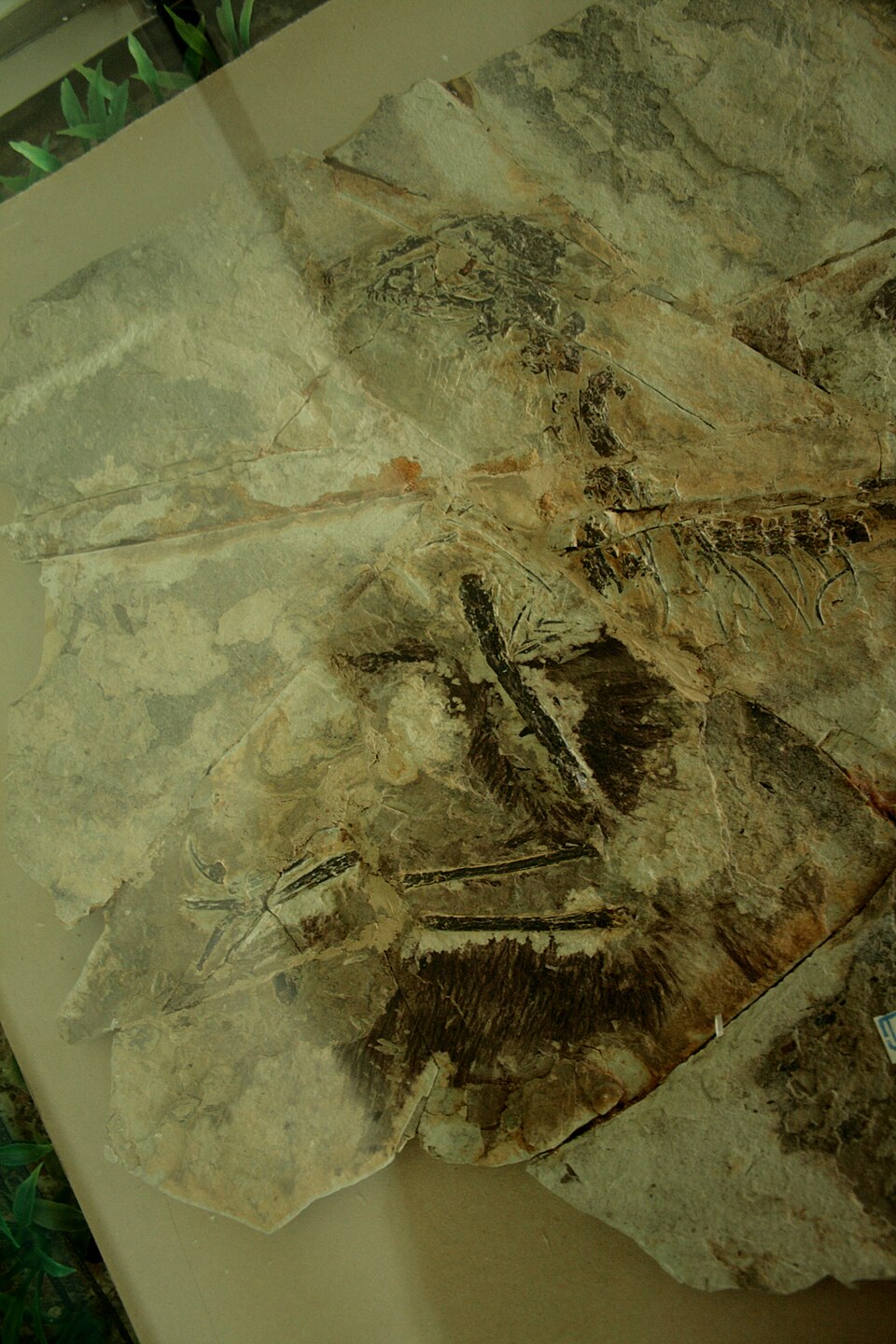
The dromaeosaurid Microraptor gui from the Early Cretaceous possessed asymmetric flight feathers on both the forelimbs and hindlimbs, forming a “four-winged” configuration that may have enabled gliding or parachuting locomotion.4 Remarkably, Microraptor feathers preserved melanosome structures consistent with iridescent black plumage, similar to that of modern grackles and starlings, suggesting visually complex display behavior.10
Beyond theropods
Filamentous integumentary structures are not confined to theropod dinosaurs. Kulindadromeus, a small ornithischian dinosaur from the Middle Jurassic of Siberia (approximately 169–144 million years ago), preserved three distinct types of integumentary coverings: scales on the tail, simple monofilaments on the head and body, and more complex compound structures around the legs that resemble feather-like appendages.12 The ceratopsian Psittacosaurus bore elongated bristle-like structures on the tail, though whether these are homologous to theropod feathers or represent convergent evolution is unresolved.13 If filamentous integument was present in the common ancestor of ornithischians and saurischians, some form of proto-feather may have been ancestral to Dinosauria as a whole, pushing the origin of feather-like structures back to the Middle Triassic or earlier.12 The case for an even deeper origin gained support when Yang and colleagues reported branching integumentary filaments in two pterosaur species from the Middle to Late Jurassic of China, with structures resembling stages I through IV of the Prum feather model. If these pterosaur filaments are homologous to dinosaurian feathers rather than convergent, the origin of feather-like integument would extend back to the common ancestor of Avemetatarsalia — the clade encompassing both pterosaurs and dinosaurs — in the Middle Triassic, roughly 250 million years ago.20
Original functions
Because feathers evolved well before the origin of flight, paleontologists have proposed several pre-flight functions that drove their initial evolution. Insulation is the most frequently cited original function, as simple filaments would have provided thermal regulation for small-bodied, potentially endothermic dinosaurs.5, 8 The discovery of complex color patterns, including possible iridescence, in non-avian theropods strongly supports a role for visual display and species recognition.9, 10 Brooding behavior has been inferred from fossils of oviraptorosaurs preserved in a posture covering their nests with outstretched feathered arms, paralleling the brooding behavior of modern birds.8
The aerodynamic function of feathers likely evolved secondarily, building upon structures that already existed for other purposes. Asymmetric feather vanes — the hallmark of flight feathers — first appear in paravian theropods such as Microraptor and Anchiornis, lineages that may have used feathered limbs for gliding, stability during running, or wing-assisted incline running before true powered flight evolved in the avian lineage.4, 14, 17
Developmental biology
The evolutionary model of feather stages finds strong support in developmental biology. Feather morphogenesis in modern bird embryos proceeds through a hierarchical sequence of signaling events that can be mapped onto the evolutionary stages.6, 15 The Sonic hedgehog (Shh), bone morphogenetic protein (BMP), and Wnt signaling pathways regulate the branching pattern of feather barbs, and experimental modulation of these pathways can produce feathers that arrest at different evolutionary stages — for example, inhibiting BMP signaling can produce unbranched filaments resembling the earliest fossil feathers.15, 16
The modular nature of feather development means that individual evolutionary stages can be independently modified, explaining the enormous diversity of feather types in living birds (down, contour, flight, filoplume, and bristle feathers) as variations on the same developmental theme.5, 16 This modularity also explains why complex feathers can be produced on body regions where they were previously absent, as in the hindlimb feathers of Microraptor and Anchiornis.4, 3
Feather color and melanosome paleobiology
The study of fossilized melanosomes — subcellular organelles that produce and store melanin pigments — has opened an entirely new dimension in understanding feather evolution. Melanosomes are geometrically distinctive: eumelanosomes (producing black and gray tones) are elongated, while phaeomelanosomes (producing reddish-brown tones) are spherical. Because melanosomes are resistant to diagenetic alteration, their shapes can be identified in exceptionally preserved fossil feathers and compared to those of living birds to infer plumage coloration.9, 11
The first application of this approach to a non-avian dinosaur was the reconstruction of Sinosauropteryx plumage, which revealed alternating bands of reddish-brown and white along the tail, likely functioning in camouflage or conspecific signaling.11 Anchiornis huxleyi was reconstructed with a largely gray body, black-and-white banded wings, and a rufous crown, a complex pattern consistent with display or species recognition.9 Most remarkably, the melanosomes in Microraptor feathers were found to be narrow, elongated, and arranged in stacked layers, a configuration that in modern birds produces structural iridescence, suggesting the animal bore glossy black plumage similar to that of crows or starlings.10 Even the isolated Archaeopteryx feather has been subjected to melanosome analysis, revealing that it was originally black rather than the light color sometimes assumed in reconstructions.19
Feathers preserved in amber
Burmese amber deposits (approximately 99 million years old, mid-Cretaceous) have yielded feathers preserved in extraordinary three-dimensional detail, including microscopic structures that are flattened or lost in compression fossils. In 2016, Xing and colleagues reported a small section of dinosaur tail trapped in amber, preserving feathers with a central rachis, barbs, and barbules still attached to the vertebrae of a small coelurosaur. The feathers lacked the interlocking barbule hooklets characteristic of flight feathers, indicating they served a non-aerodynamic function, likely display or thermoregulation.21 Amber-preserved feathers also retain chemical signatures of original pigments and structural colors that cannot be studied in compression fossils, providing a complementary source of data on feather evolution. The pterosaur Tupandactylus and related forms have also been shown to bear branching integumentary filaments resembling feather stages I through III, raising the possibility that feather-like structures have a deeper origin within Avemetatarsalia, the clade including pterosaurs and dinosaurs.20
Feathers and the dinosaur-to-bird transition
The fossil record of feather evolution is now one of the most complete morphological transitions in paleontology, spanning from simple filaments in basal coelurosaurs through pennaceous display feathers in oviraptorosaurs and dromaeosaurids to the fully asymmetric flight feathers of early birds. This progression is integral to understanding the broader dinosaur-to-bird transition, which involved not only feather evolution but also skeletal modifications including the furcula, keeled sternum, and reduced tail.14, 18 The convergence of fossil, developmental, and molecular evidence has firmly established feathers as structures that evolved incrementally for diverse functions long before they were co-opted for the most dramatic adaptation they are known for: powered flight.5, 7, 8
References
A pre-Archaeopteryx troodontid theropod from China with long feathers on the metatarsus
Bristle-like integumentary structures at the tail of the horned dinosaur Psittacosaurus
A new feathered maniraptoran dinosaur fossil that fills a morphological gap in avian origin