Overview
- Birds are living theropod dinosaurs, descended from small feathered maniraptorans through one of the best-documented macroevolutionary transitions in the fossil record, supported by hundreds of specimens preserving feathers, transitional skeletal features, and intermediate body plans.
- Feathers originated long before flight, first appearing as simple filamentous structures used for insulation or display in non-avian coelurosaurs, and were subsequently co-opted through successive evolutionary stages into the asymmetrical flight feathers of modern birds.
- A sustained trend of body-size miniaturization along the direct lineage leading to birds, spanning at least 50 million years, was accompanied by accelerated rates of skeletal innovation and was likely a prerequisite for the evolution of powered flight.
The evolutionary transition from non-avian theropod dinosaurs to birds is one of the most thoroughly documented macroevolutionary transformations in the history of life. Over approximately 100 million years, a lineage of bipedal predatory dinosaurs underwent progressive changes in body size, skeletal architecture, integumentary covering, and locomotor strategy that ultimately produced the clade Avialae, the group containing Archaeopteryx and all modern birds. The evidence for this transition rests on hundreds of fossil specimens, many exquisitely preserved in the fine-grained lake sediments of northeastern China, which reveal feathered non-avian dinosaurs, four-winged gliders, and toothed birds with long bony tails occupying intermediate positions along a continuous morphological gradient from earthbound predator to powered flier.8, 10
The recognition that birds are living dinosaurs, a conclusion first proposed on anatomical grounds in the nineteenth century and rigorously established through cladistic analysis in the 1980s, ranks among the most transformative insights in evolutionary biology. It demonstrates that a major extant vertebrate group arose not by sudden saltation but through the gradual, mosaic accumulation of features over deep time, with familiar avian characteristics such as feathers, hollow bones, a wishbone, and a keeled sternum each appearing at different points along the theropod family tree long before the origin of flight itself.1, 11
Theropod ancestry and phylogenetic framework
The hypothesis that birds are descended from theropod dinosaurs was first articulated by Thomas Henry Huxley in the 1860s, based on skeletal similarities between Archaeopteryx and small carnivorous dinosaurs. This idea fell out of favour for much of the twentieth century but was revived in 1969 when John Ostrom described Deinonychus antirrhopus, a highly agile dromaeosaurid from the Early Cretaceous of Montana whose anatomy bore striking resemblances to birds in the structure of the wrist, hand, and shoulder girdle.2 In 1986, Jacques Gauthier conducted the first comprehensive cladistic analysis of theropod relationships and demonstrated that birds are nested within the saurischian dinosaurs as a subgroup of Maniraptora, a clade of small-bodied coelurosaurs characterised by elongated arms, a swivel wrist joint, and a semilunate carpal bone that permits the folding motion essential to the avian wing stroke.1

Subsequent phylogenetic analyses have consistently recovered the same hierarchical arrangement. Within Theropoda, birds belong to Coelurosauria, a diverse group that also includes tyrannosauroids, ornithomimosaurs, and therizinosaurs.25 Within Coelurosauria, birds are placed in Maniraptora alongside oviraptorosaurs, dromaeosaurids, and troodontids. The clade Paraves unites dromaeosaurids, troodontids, and avialans as closest relatives, sharing features such as an enlarged and recurved second pedal ungual (the "sickle claw"), a stiffened tail, and feathered forelimbs.18 The boundary between "non-avian dinosaur" and "bird" is thus not a sharp divide but an arbitrary line drawn across a continuously graded series of forms, each differing from its predecessor by only a few characters.11
The precise branching order within Paraves has been debated, with some analyses recovering dromaeosaurids as the closest relatives of Avialae (forming the clade Eumaniraptora) and others placing troodontids in that position. Regardless of which topology is preferred, the implication is the same: the anatomical features considered diagnostic of birds were assembled piecemeal over tens of millions of years across multiple nodes of the theropod tree, with no single evolutionary "moment" at which a dinosaur became a bird.10, 18
Feathered dinosaurs from China
The most dramatic confirmation of the theropod origin of birds came in 1996 with the discovery of Sinosauropteryx prima in the Early Cretaceous Yixian Formation of Liaoning Province, northeastern China. This small compsognathid theropod preserved a coat of filamentous integumentary structures running along its back, neck, and tail, interpreted as simple, unbranched protofeathers representing the earliest evolutionary stage of feather development.3 Because Sinosauropteryx sits phylogenetically outside Maniraptora, its filamentous covering demonstrated that feather-like structures were present in coelurosaurs far more distantly related to birds than dromaeosaurids or troodontids, indicating a deep evolutionary origin for feathers within Dinosauria.8
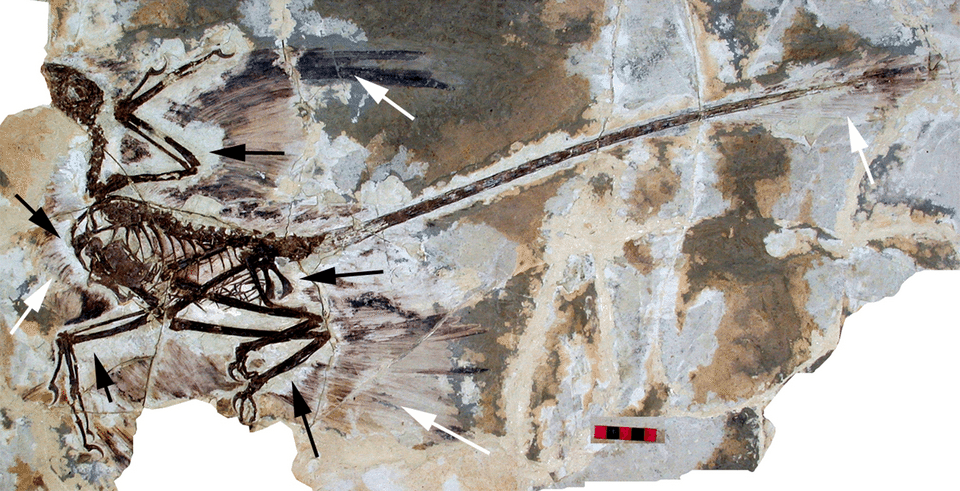
In the years following, dozens of feathered theropod species were recovered from the exceptionally fine-grained lacustrine deposits of the Jehol Biota in Liaoning and neighbouring provinces. In 2000, Xu and colleagues described Microraptor zhaoianus, a tiny dromaeosaurid less than 80 centimetres long and among the smallest known non-avian dinosaurs, whose size overlapped with that of Archaeopteryx and eliminated the supposed size gap between birds and their closest dinosaurian relatives.22 In 2003, the same team described Microraptor gui, a closely related species that bore asymmetrical pennaceous flight feathers not only on its forelimbs but also on its hindlimbs and feet, producing a remarkable four-winged body plan without parallel among living birds.4
In 2009, Anchiornis huxleyi, a small troodontid from the Late Jurassic of Liaoning, was described with extensive plumage covering its head, arms, legs, tail, and feet, making it the oldest known feathered dinosaur and demonstrating that complex feather morphologies predated Archaeopteryx itself.5 At the opposite end of the body-size spectrum, three nearly complete skeletons of Yutyrannus huali, a basal tyrannosauroid weighing an estimated 1,400 kilograms, were recovered from the Yixian Formation in 2012 bearing filamentous feathers up to 20 centimetres long, providing direct evidence that even gigantic theropods could be feathered.6 The small basal tyrannosauroid Dilong paradoxus, also from the Yixian Formation, similarly preserved filamentous protofeathers, confirming that integumentary covering was widespread among coelurosaurs and not restricted to the small-bodied lineage leading to birds.24
Collectively, these discoveries established that feathers were ancestral to Coelurosauria as a whole and were present across a taxonomically and ecologically diverse range of theropods, from tiny four-winged gliders to multi-tonne predators. The distribution of feather types across the theropod phylogeny implies that the earliest feathers were simple filaments, with more complex morphologies arising progressively closer to the avian lineage.8, 10

Archaeopteryx and the classical transition
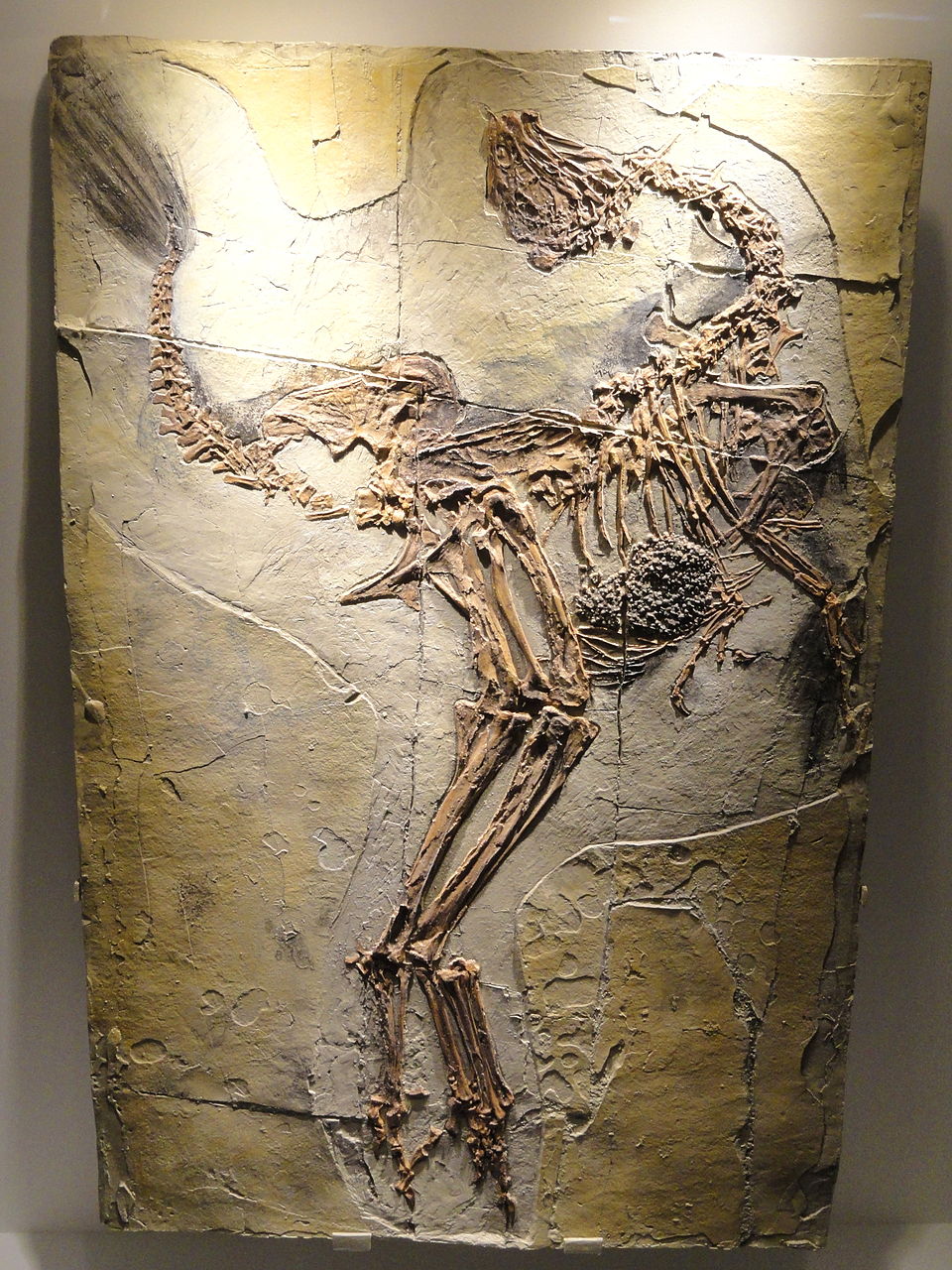
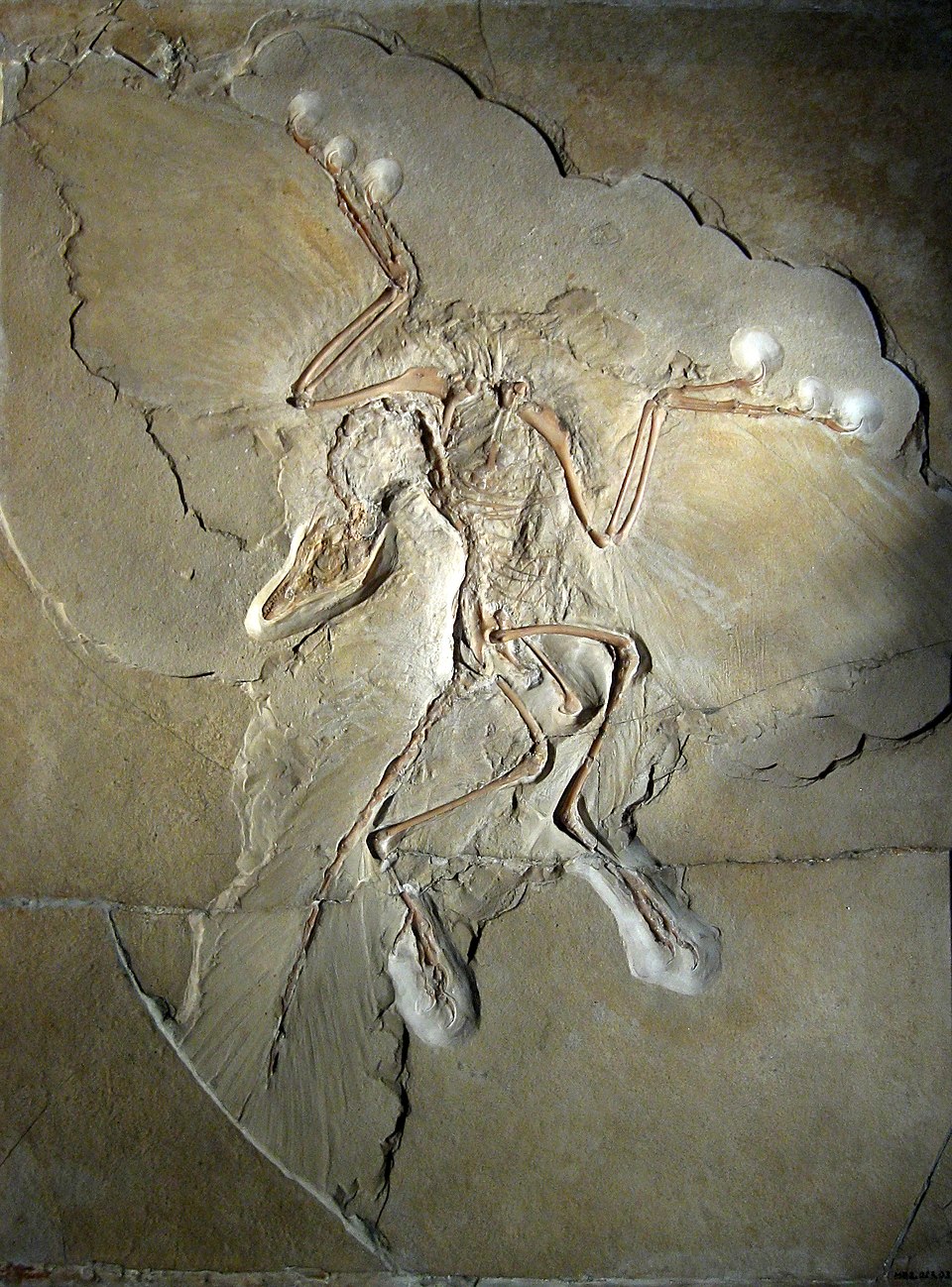
Archaeopteryx lithographica, discovered in the Late Jurassic limestone quarries of Solnhofen, Bavaria, in 1861, remains the most iconic transitional fossil in paleontology. Thirteen skeletal specimens are now known, the best-preserved of which clearly display a mosaic of avian and non-avian theropod features: well-developed asymmetrical flight feathers and a furcula (wishbone) alongside a toothed jaw, clawed fingers, and a long bony tail composed of more than twenty vertebrae.7 The Thermopolis specimen, described by Mayr and colleagues in 2005, revealed theropod features of the skull and foot with exceptional clarity, including a hyperextensible second toe reminiscent of the sickle claw in dromaeosaurids, further cementing the phylogenetic placement of Archaeopteryx at the base of Avialae within Paraves.7
.jpg)
For over a century, Archaeopteryx occupied a unique position as the sole known intermediate between dinosaurs and modern birds. The Chinese feathered dinosaur discoveries of the late 1990s and 2000s fundamentally changed this picture by populating the phylogenetic space around Archaeopteryx with dozens of species exhibiting various combinations of avian and non-avian features. Some non-avian dromaeosaurids and troodontids proved more bird-like than Archaeopteryx in certain features, while Archaeopteryx retained some features more primitive than those of certain non-avian maniraptorans. This pattern underscores that the dinosaur-to-bird transition was not a linear march of progress but a broad evolutionary radiation in which multiple lineages independently acquired bird-like traits.10, 11
Despite the proliferation of transitional forms, Archaeopteryx retains its importance as one of the oldest known avialans, dated to approximately 150 million years ago (Tithonian stage of the Late Jurassic). Its well-developed flight feathers indicate that some degree of aerial locomotion had already evolved by this time, while its retention of a long bony tail, unfused hand bones, and a relatively small sternum suggest that its flight capabilities were more limited than those of modern birds.7, 17
Skeletal transformations
The transformation of the theropod skeleton into the avian body plan involved coordinated changes across virtually every region of the skeleton, occurring gradually over tens of millions of years. Comparative analyses of more than 850 anatomical characters across 150 coelurosaur species have demonstrated that these changes did not occur simultaneously but were acquired in a mosaic fashion across successive nodes of the phylogenetic tree, with the rate of skeletal evolution accelerating dramatically along the lineage leading to Avialae.11
One of the most conspicuous transformations was the progressive reduction and eventual fusion of the bony tail. Basal theropods possessed long, muscular tails composed of 40 or more caudal vertebrae that served as dynamic counterbalances during bipedal locomotion. Along the avian stem lineage, the tail shortened progressively: Archaeopteryx retained approximately 20 caudal vertebrae forming a long, frond-like tail fringed with feathers, while more derived early birds such as Jeholornis from the Early Cretaceous of China still possessed a long skeletal tail with elongated processes resembling those of dromaeosaurids.17 In the lineage leading to Ornithuromorpha (the clade containing modern birds), the distal caudal vertebrae fused into a compact structure called the pygostyle, a bony knob that serves as the attachment point for the fan-shaped tail feathers (rectrices) used in braking, steering, and display. Gatesy and Dial demonstrated that this transformation decoupled the ancestral caudal locomotor module from the pelvis, freeing the shortened tail to develop a new functional association with the forelimb during flight.17
The hand and wrist underwent equally profound restructuring. Theropod dinosaurs typically possessed three functional digits (interpreted as digits I, II, and III), but along the avian lineage these became progressively elongated to support the wing, their bones eventually fusing in modern birds into a rigid structure called the carpometacarpus. Developmental studies by Botelho and colleagues demonstrated that the wrist bones of modern birds can be homologised with specific elements in the non-avian theropod wrist and that the evolutionary transition involved a complex sequence of bone loss, fusion, and in one case the re-evolution of a previously lost element.16 The semilunate carpal bone, a key maniraptoran innovation, permitted the folding of the hand against the forearm in the same manner as the wing-folding motion of modern birds, a functional prerequisite for the evolution of the flight stroke.1, 10
The sternum also underwent significant modification. Non-avian theropods possessed a relatively small, flat sternum or in some cases lacked an ossified sternum entirely. Along the avian lineage, the sternum enlarged progressively, and in ornithothoracine birds (the clade containing Enantiornithes and Ornithuromorpha) it developed a prominent ventral keel that provides the expanded attachment surface for the massive pectoral flight muscles. The presence of a keeled sternum is strongly correlated with powered flight capability and is absent in secondarily flightless birds such as ratites.10 The skull, too, was transformed: geometric morphometric analyses have shown that avian skulls are paedomorphic relative to those of non-avian theropods, retaining into adulthood the proportions characteristic of juvenile dinosaurs, including an enlarged braincase, shortened snout, and enlarged orbits.15
Key skeletal changes in the dinosaur-to-bird transition10, 11, 16
| Feature | Non-avian theropod condition | Avian condition | Approximate phylogenetic origin |
|---|---|---|---|
| Furcula (wishbone) | Absent or unfused clavicles | Fused V-shaped furcula | Tetanurae |
| Semilunate carpal | Separate wrist elements | Fused block enabling wrist folding | Maniraptora |
| Tail | Long bony tail (20–40+ vertebrae) | Pygostyle (fused distal caudals) | Pygostylia (within Avialae) |
| Sternum | Small, flat, or unossified | Large with ventral keel | Ornithothoraces |
| Hand bones | Three separate clawed digits | Fused carpometacarpus | Ornithuromorpha |
| Teeth | Toothed jaws | Toothless keratinous beak | Multiple origins within Avialae |
| Skull proportions | Adult archosaur proportions | Paedomorphic (juvenile-like) | Eumaniraptora to Avialae |
Origin and evolution of feathers
Feathers are the most complex integumentary structures found in any vertebrate, and understanding their evolutionary origin has been one of the central challenges in the study of the dinosaur-to-bird transition. Prum and Brush proposed an influential developmental model in which feathers evolved through a series of hierarchical stages, each corresponding to the addition of a new morphogenetic mechanism in the feather follicle.9 In this model, Stage I represents the origin of an undifferentiated tubular collar, producing a simple hollow filament. Stage II introduces barb ridges, yielding a tuft of unbranched barbs. Stage IIIa adds helical displacement and a barb locus, producing a central rachis with branches. Stage IIIb introduces barbule plates, and subsequent stages generate interlocking barbules and the bilaterally asymmetrical vane structure of the modern flight feather.9
The fossil record of feathered dinosaurs provides striking empirical support for this developmental sequence. The filamentous structures of Sinosauropteryx correspond to Stage I or II, consisting of unbranched or sparsely branched filaments without a central rachis.3, 8 More derived maniraptorans such as the oviraptorosaur Caudipteryx bear symmetrical pennaceous feathers with a central rachis and interlocking barbs, corresponding to advanced stages of the Prum model. Dromaeosaurids and troodontids close to the base of Avialae, including Microraptor and Anchiornis, possess asymmetrical pennaceous feathers on the forelimbs and hindlimbs, the hallmark of aerodynamic function.4, 5 This phylogenetic distribution indicates that feathers evolved initially for purposes unrelated to flight — most likely thermoregulation, display, or brooding — and were only later co-opted as aerodynamic surfaces in the maniraptoran lineage leading to birds.9, 10
The discovery of Yutyrannus huali, a 9-metre-long tyrannosauroid covered in filamentous feathers, and the small basal tyrannosauroid Dilong paradoxus, also bearing protofeathers, demonstrated that feathered integument was present even in lineages that were far from the avian stem and that evidently never developed flight.6, 24 The implication is that feathers were ancestral to Coelurosauria and possibly to an even more inclusive group within Dinosauria, with the transition from insulating or display structures to aerodynamic flight feathers occurring as a derived specialisation of the maniraptoran lineage alone.8, 10
The origin of flight
How powered flight evolved in the avian lineage has been debated for more than a century, with three principal hypotheses competing for support. The cursorial (ground-up) hypothesis proposes that flight evolved in fast-running bipedal theropods whose proto-wings initially provided thrust or stability during terrestrial locomotion and were progressively elaborated into true flight surfaces. The arboreal (trees-down) hypothesis proposes that flight evolved from gliding in small, tree-dwelling maniraptorans that used feathered limbs to parachute or glide between elevated perches before developing the powered downstroke. The wing-assisted incline running (WAIR) hypothesis, proposed by Kenneth Dial in 2003, offers a synthesis: observations of extant galliform birds (such as chukar partridges) demonstrated that even chicks with incompletely developed wings use flapping motions to generate downward force against inclined surfaces, enabling them to run up steep slopes, tree trunks, and other obstacles. Dial suggested that this ontogenetic behaviour recapitulates the evolutionary trajectory by which proto-wings were first used for substrate-assisted locomotion before achieving free flight.13
The four-winged morphology of Microraptor gui provided support for an arboreal component in the evolution of flight. Aerodynamic modelling by Chatterjee and Templin indicated that Microraptor could have used its four feathered limbs in a staggered biplane configuration to perform undulatory phugoid gliding between trees, with the feathered tail providing additional lift and pitch control.14 The discovery that early avialans such as Sapeornis and Confuciusornis also possessed feathered hindlimbs, as documented by Zheng and colleagues in 2013, suggested that a four-winged stage may have been ancestral to the avian lineage, with the subsequent loss of hindlimb flight feathers reflecting a transition from four-surface to two-surface aerodynamics as the forelimbs became increasingly dominant in generating lift and thrust.21
Current consensus, informed by the full spectrum of fossil evidence and biomechanical modelling, increasingly favours a multiphasic model in which no single hypothesis fully explains the origin of flight. The earliest feathered maniraptorans were likely ground-dwelling or capable of limited climbing, using proto-wings for WAIR-like substrate locomotion, display, or brooding. As body size decreased and forelimb proportions increased in the lineage leading to Paraves, certain taxa such as Microraptor achieved gliding capability, while others exploited wing-assisted locomotion in terrestrial or arboreal contexts. Full powered flight, characterised by a continuous wing-beat cycle and the ability to generate sustained lift, appears to have evolved convergently in at least some non-avian paravians and more completely in the avian stem lineage.10, 13, 14
Miniaturization and the path to birds
One of the most striking patterns in the dinosaur-to-bird transition is the sustained reduction in body size along the lineage leading to Avialae. Lee and colleagues, using Bayesian phylogenetic methods applied to a large dataset of theropod body-mass estimates, demonstrated that the direct ancestral lineage of birds underwent sustained miniaturization across at least 50 million years and 12 consecutive phylogenetic branches, evolving new skeletal adaptations at approximately four times the rate of other dinosaur lineages.12 While basal tetanuran theropods such as Allosaurus weighed hundreds of kilograms and large tyrannosaurids exceeded several tonnes, the lineage leading to Paraves and Avialae progressively decreased in body mass through the coelurosaur, maniraptoran, and paravian nodes, arriving at body sizes of 1 kilogram or less by the origin of Avialae.12
This miniaturization trend was not a passive drift but appears to have been directional, with smaller body sizes selectively favoured along the avian stem lineage even as other theropod lineages maintained or increased their body mass. Small body size is a prerequisite for powered flight in vertebrates, as the power required for sustained flapping scales unfavourably with increasing mass. Miniaturization also facilitated a suite of correlated changes: the paedomorphic skull proportions of birds, with enlarged brains and eyes relative to body size, are a predictable consequence of scaling effects in a lineage undergoing heterochronic reduction.12, 15
Estimated body mass along the theropod-to-bird lineage12, 25
The uncoupling of forelimb and body-size allometry was a key innovation in this process. As overall body size decreased, the forelimbs of the avian stem lineage became proportionally longer relative to the body, a necessary condition for generating sufficient lift for aerial locomotion. Meanwhile, hindlimb proportions also shifted, reflecting a decreasing reliance on cursorial speed and an increasing investment in perching, climbing, or wing-assisted locomotion.10, 12
Survival through the end-Cretaceous extinction
By the end of the Cretaceous period, roughly 66 million years ago, the avian radiation had produced a diverse array of bird lineages. These included the Enantiornithes, the most species-rich group of Cretaceous birds, which were predominantly arboreal and dominated avian communities in forested environments worldwide, as well as the Ornithuromorpha, the more derived clade that includes the crown group Neornithes (modern birds) alongside various stem-group relatives such as the toothed seabird Ichthyornis and the diving Hesperornithes.19
The Chicxulub asteroid impact at the Cretaceous–Paleogene (K–Pg) boundary triggered a mass extinction that eliminated all non-avian dinosaurs and devastated global ecosystems. Among birds, the extinction was severe but selective. Longrich, Tokaryk, and Field documented a diverse avifauna of at least 17 species from the latest Maastrichtian of western North America, including representatives of Enantiornithes, Ichthyornithes, and Hesperornithes, none of which survived into the Paleogene.19 The only avian lineage to persist through the extinction was the Neornithes, the crown group of modern birds, whose presence in the latest Cretaceous is confirmed by the discovery of Vegavis iaai, a waterfowl relative from the Maastrichtian of Antarctica that is phylogenetically placed within the modern order Anseriformes.23
The ecological selectivity of the avian extinction at the K–Pg boundary has been the subject of intensive investigation. Field and colleagues proposed that the global destruction of forests caused by the impact, evidenced by paleobotanical and palynological data showing the abrupt disappearance of arboreal pollen and the dominance of fern spores in earliest Paleogene sediments, selectively eliminated bird lineages dependent on forested habitats. The Enantiornithes, predominantly arboreal birds, were catastrophically affected, while ground-dwelling neornithine lineages, which could survive in open habitats during the period of ecological collapse, preferentially endured.20 This hypothesis explains the observation that the earliest post-extinction bird faunas were dominated by ground-dwelling and water-associated lineages, and that the subsequent re-radiation of arboreal birds occurred only after the recovery of global forest ecosystems over the succeeding millions of years.20
The survival of neornithine birds through the K–Pg extinction thus represents the final chapter of the dinosaur-to-bird transition: of the vast theropod radiation that once spanned body sizes from hundreds of grams to several tonnes and ecologies from pursuit predation to herbivory, only a single lineage of small, volant, and ecologically flexible descendants persists today. With more than 10,000 living species, birds are the most species-rich group of terrestrial vertebrates, a testament to the evolutionary success of the body plan assembled over more than 100 million years of theropod evolution.10, 20
References
Osteology of Deinonychus antirrhopus, an unusual theropod from the Lower Cretaceous of Montana
A pre-Archaeopteryx troodontid theropod from China with long feathers on the metatarsus
Gradual assembly of avian body plan culminated in rapid rates of evolution across the dinosaur-bird transition
Sustained miniaturization and anatomical innovation in the dinosaurian ancestors of birds
Biplane wing planform and flight performance of the feathered dinosaur Microraptor gui
New developmental evidence clarifies the evolution of wrist bones in the dinosaur–bird transition
Early evolution of modern birds structured by global forest collapse at the end-Cretaceous mass extinction