Overview
- Graptolites were colonial hemichordate animals that thrived in the world's oceans from the Middle Cambrian through the Early Devonian, producing organic-walled colonial skeletons (rhabdosomes) composed of interconnected tubular chambers (thecae) that housed individual zooids linked by a common stolon system.
- Planktonic graptoloids, which dominated Ordovician and Silurian oceans, evolved so rapidly and dispersed so widely that they serve as the premier index fossils for subdividing and correlating Lower Paleozoic marine strata — with over 300 graptolite biozones recognized worldwide, providing finer temporal resolution than any other biostratigraphic tool for this interval.
- The evolutionary transition from sessile, bushy dendroid graptolites to streamlined, free-floating graptoloids represents one of the most dramatic ecological shifts in the invertebrate fossil record, driven by adaptations for planktonic life including colony reduction, symmetrical branching, and the development of buoyancy structures.
Graptolites are an extinct group of colonial hemichordate animals whose organic-walled skeletons rank among the most important fossils in Lower Paleozoic stratigraphy. From their first appearance in the Middle Cambrian through their extinction in the Early Devonian, graptolites populated the world's oceans for approximately 170 million years, evolving through an extraordinary diversity of colonial forms and achieving a global distribution that makes them indispensable for dating and correlating Ordovician and Silurian rocks worldwide.4, 3 The name "graptolite" derives from the Greek graptos (written) and lithos (stone), a reference to the fossil colonies' resemblance to pencil marks on rock surfaces — an apt description of the flattened, saw-blade-like impressions that are the most common mode of graptolite preservation.5 Although graptolites were once of uncertain biological affinity, ultrastructural studies of their periderm and comparisons with living pterobranchs have firmly established them as members of the phylum Hemichordata, relatives of the tiny colonial animals Rhabdopleura and Cephalodiscus that inhabit modern ocean floors.2, 14
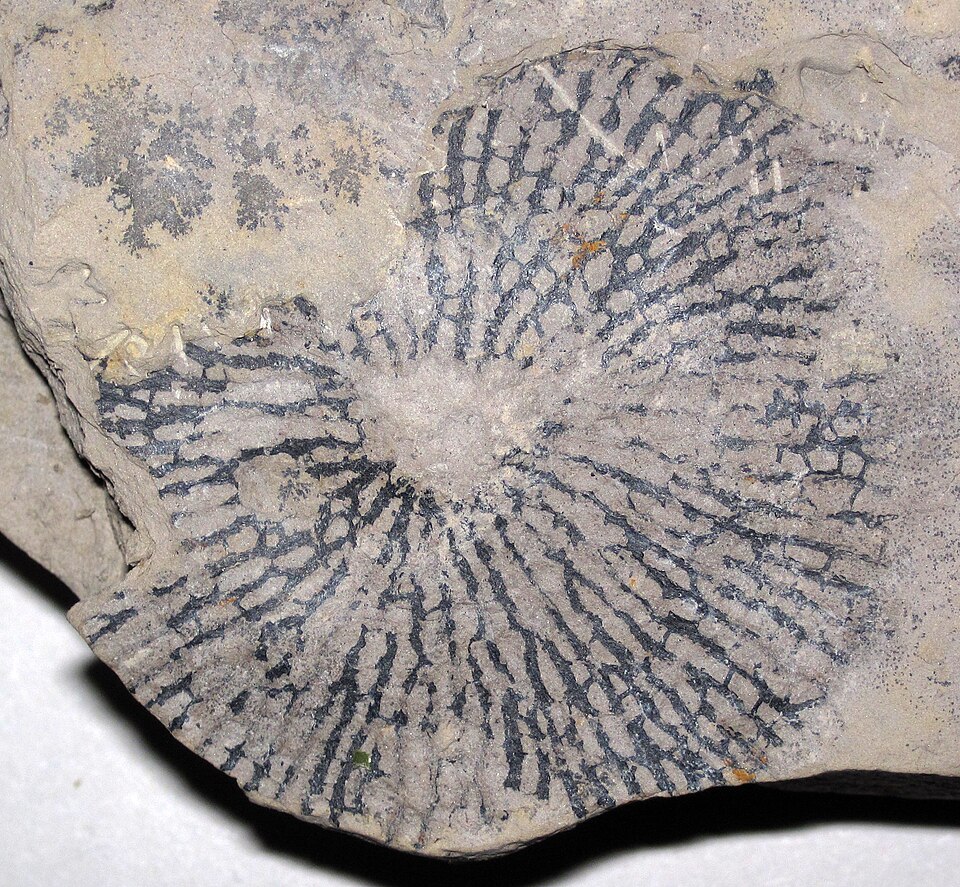
_(Rochester_Shale,_Middle_Silurian;_Middleport_Quarry,_Middleport,_New_York_State,_USA).jpg)
Rhabdosome morphology and ultrastructure
The graptolite colony, termed the rhabdosome, consists of one or more branches (stipes) composed of a series of tubular chambers (thecae) arranged along a common supporting structure. Each theca housed an individual zooid, and the zooids were connected to one another by a stolon — a thread-like organic tube running through the colony — in an arrangement closely paralleling the colonial organization of living pterobranchs.4, 1 The colony grew from an initial conical chamber called the sicula, which was secreted by the founding zooid (the siculozooid) and from which subsequent thecae budded in a genetically determined branching pattern. The shape, number, and arrangement of the stipes, as well as the form and spacing of the individual thecae, provide the primary characters for graptolite taxonomy.5, 10
The rhabdosome wall, or periderm, is composed of a proteinaceous material secreted as a series of half-rings (fuselli) that are stacked and fused together, producing a layered structure visible under electron microscopy.11 Crowther's ultrastructural studies demonstrated that graptolite periderm is constructed from two types of tissue: fusellar tissue, made up of the individual half-ring secretions of each zooid, and cortical tissue, a secondary thickening laid down over the fusellar framework by the colony as a whole.11 This mode of construction is directly comparable to the tube-building secretions of living Rhabdopleura, providing the strongest evidence for the hemichordate affinities of graptolites.2, 11 The composition and layered architecture of the periderm gave graptolite rhabdosomes sufficient rigidity to maintain their shape in ocean currents while remaining light enough for planktonic flotation — a functional compromise between structural integrity and buoyancy that was critical to the success of the planktonic graptoloid lineages.4
Benthic dendroids and planktonic graptoloids
Graptolites are divided into two major ecological and morphological groups: the benthic dendroids and the planktonic graptoloids. Dendroid graptolites (order Dendroidea) appeared first, in the Middle Cambrian, and persisted through the Carboniferous. They were sessile, benthic organisms that attached to the seafloor or to hard substrates by a basal disc or holdfast, growing as bushy, tree-like colonies with numerous irregularly branching stipes.4, 14 Dendroid colonies contained two or three types of thecae — autothecae, bithecae, and sometimes stolothecae — reflecting a division of labour among zooids within the colony, analogous to the polymorphism seen in some modern colonial invertebrates.5, 1
The graptoloids (order Graptoloidea), which appeared in the Early Ordovician and dominated the plankton through the Silurian, represent a dramatic departure from the dendroid body plan. Graptoloid colonies were free-floating, suspended in the water column either by their own buoyancy or attached to floating objects, and they evolved a streamlined colonial architecture adapted for life in open water.8, 10 Early Ordovician graptoloids bore numerous pendent stipes radiating from a central point, producing multi-branched colonies. Through the Ordovician, graptoloid evolution showed a persistent trend toward reduction in the number of stipes, from many-stiped forms through four-stiped (tetragraptid), two-stiped (didymograptid), and ultimately single-stiped (monograptid) configurations.10, 4 This progressive simplification of colony form is one of the clearest directional trends in the invertebrate fossil record and has been interpreted as an adaptation for improved hydrodynamic stability and feeding efficiency in the planktonic realm, where a streamlined colony with minimal drag could maintain its orientation in currents more effectively than a sprawling, multi-branched one.8
Biostratigraphic importance
Graptoloids are unsurpassed as [index fossils](/geology/biostratigraphy-and-index-fossils) for the Ordovician and Silurian periods, providing temporal resolution finer than that achievable with any other fossil group for this interval of geological time.3, 7 Their effectiveness as biostratigraphic tools stems from a convergence of favourable biological and taphonomic properties: graptoloid species evolved rapidly, producing morphologically distinct successors at intervals of one to three million years; they were distributed globally by ocean currents, occurring on every continent; they inhabited the open water column, making them independent of bottom substrate and thus recoverable from a wide range of sedimentary facies; and their organic periderm preserved readily in fine-grained mudrocks and shales, the most common marine sedimentary rocks of the Lower Paleozoic.3, 7
Over 300 graptolite biozones have been established for the Ordovician and Silurian worldwide, each defined by the first or last appearance of one or more diagnostic species.3 In Britain, where the graptolite biostratigraphic framework was first developed in the nineteenth and early twentieth centuries, graptolite zones have been refined to a resolution of approximately 0.5 to 1.5 million years — a remarkable level of precision for rocks deposited over 400 million years ago.3, 12 Zalasiewicz and colleagues demonstrated that the British graptolite zonation can be correlated with graptolite successions on every continent, enabling precise intercontinental correlation of Ordovician and Silurian strata and providing the chronological framework upon which the formal stages of the Ordovician and Silurian systems are defined.3 Several Global Boundary Stratotype Sections and Points (GSSPs) for Ordovician and Silurian stage boundaries are defined by the first appearance of specific graptolite species, underscoring the primacy of graptolites in Lower Paleozoic chronostratigraphy.12
Sadler, Cooper, and Melchin applied quantitative methods to measure the tempo of graptolite speciation and extinction, finding that graptoloid species had average durations of approximately 1.5 to 2 million years, with some lineages showing much faster turnover rates.7 This rapid evolutionary tempo, combined with the global distribution of planktonic graptoloids, explains why graptolite biostratigraphy achieves temporal resolution comparable to or exceeding that of [ammonite](/paleontology/ammonites) biostratigraphy for the Mesozoic — the other great interval of invertebrate-based biostratigraphic precision in the geological record.7, 3
Evolutionary history and the Ordovician radiation
The evolutionary history of graptolites is inextricably linked to the [Great Ordovician Biodiversification Event](/paleontology/ordovician-radiation), the sustained diversification of marine life that transformed Paleozoic oceans between approximately 485 and 445 million years ago.9 Dendroid graptolites originated in the Middle Cambrian and diversified modestly through the Late Cambrian and earliest Ordovician, but it was the evolution of the planktonic graptoloids in the Early Ordovician (Tremadocian stage) that launched the group's most spectacular radiation.4, 9 By the Middle Ordovician, graptoloids had diversified into dozens of genera occupying the planktonic zone of the world's oceans, and they constituted a major component of the Paleozoic zooplankton throughout the Ordovician and Silurian.8
Graptoloid evolution was punctuated by several episodes of crisis and recovery. The end-Ordovician mass extinction, associated with the Hirnantian glaciation approximately 444 million years ago, devastated graptoloid diversity, eliminating the majority of species.4, 9 However, the surviving lineages reradiated rapidly in the early Silurian, producing the great monograptid radiation that dominated Silurian oceans. Monograptids — single-stiped graptoloids of enormous morphological variety — evolved into hundreds of species with diverse thecal forms, colony shapes, and ornamental features, and they provide the basis for the detailed Silurian biostratigraphic zonation.10, 3 A second major crisis struck in the early Silurian (Aeronian stage), when a combination of oceanographic changes and carbon cycle perturbations caused widespread graptoloid extinction, followed by yet another rapid recovery.15
Extinction and legacy
Graptoloid diversity declined through the Late Silurian, and the last graptoloids disappeared in the Early Devonian (Pragian or Emsian stage), approximately 410 to 400 million years ago.4, 10 The causes of their final extinction remain incompletely understood, but may include competition with other planktonic organisms, changes in ocean circulation and productivity patterns associated with the closing of the Iapetus Ocean, and the restructuring of marine food webs that accompanied the Silurian-Devonian transition.4 The benthic dendroids survived somewhat longer than the planktonic graptoloids, persisting into the Carboniferous in reduced diversity, but they too eventually disappeared, leaving no direct descendants in modern oceans.14
The hemichordate affinities of graptolites, once controversial, are now firmly established through multiple lines of evidence: the ultrastructural similarity of graptolite periderm to the tubes of living Rhabdopleura, the shared colonial organization with stolon-linked zooids, and molecular phylogenetic analyses that place pterobranchs within Hemichordata as close relatives of the acorn worms (Enteropneusta).2, 13 Mitchell and colleagues argued that the living pterobranch Rhabdopleura represents the closest modern analogue to ancestral graptolites, sharing fundamental features of colonial organization, budding pattern, and tube construction, though graptolites evolved colonial architectures of far greater complexity and diversity than anything seen in living pterobranchs.2 The graptolite fossil record thus provides a uniquely detailed window into the evolutionary potential of the hemichordate body plan — a phylum that in the modern ocean is represented by only a few inconspicuous genera of pterobranchs and acorn worms but that during the Ordovician and Silurian produced one of the most abundant, widespread, and evolutionarily dynamic groups of marine organisms on Earth.4, 9