Overview
- Ichthyosaurs were a diverse order of marine reptiles that evolved from land-dwelling ancestors in the Early Triassic (approximately 250 million years ago) and independently evolved a streamlined, fish-like body plan strikingly convergent with modern dolphins and tuna, making them one of the most frequently cited examples of convergent evolution in the fossil record.
- At their peak diversity during the Jurassic period, ichthyosaurs occupied ecological niches from small fish-eaters to apex predators exceeding 20 metres in length, and exceptional fossil preservation including soft tissue outlines, stomach contents, and embryos in the birth canal has provided unusually detailed evidence of their biology, diet, and live-bearing reproductive strategy.
- Ichthyosaurs declined through the Cretaceous and went extinct approximately 94 million years ago during the Cenomanian-Turonian oceanic anoxic event, well before the end-Cretaceous mass extinction, and their disappearance may reflect ecological restructuring of marine food webs and competition from other marine predators.
Ichthyosaurs (order Ichthyosauria, from the Greek ichthys, "fish," and sauros, "lizard") were a highly successful group of marine reptiles that dominated the world's oceans from the Early Triassic to the mid-Cretaceous, a span of approximately 160 million years. Evolving from terrestrial ancestors shortly after the Permian-Triassic mass extinction, ichthyosaurs rapidly adapted to a fully aquatic existence and independently evolved a body plan — streamlined fusiform torso, dorsal fin, lunate tail, and paddle-like limbs — that is strikingly convergent with modern dolphins, tuna, and lamnid sharks, despite having no close evolutionary relationship to any of these groups.1, 2 This convergence, driven by the shared hydrodynamic demands of fast sustained swimming in open water, makes ichthyosaurs one of the most compelling case studies in the evolutionary biology of form and function.6
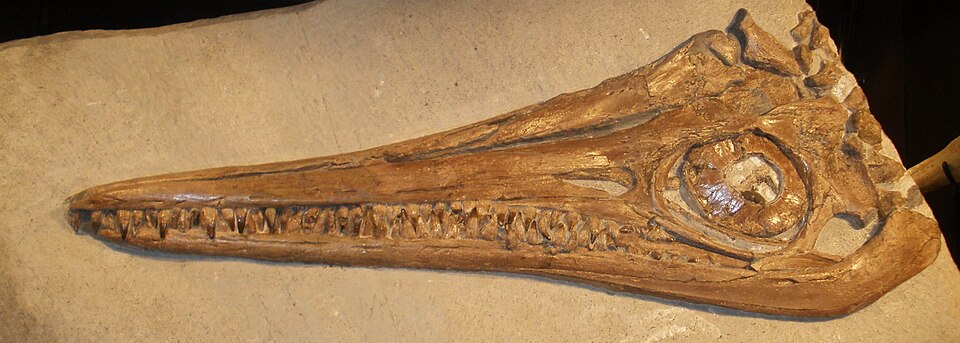

Origins and early evolution
The evolutionary origin of ichthyosaurs was long obscured by the absence of transitional forms connecting them to their terrestrial ancestors. This gap was substantially narrowed by the discovery of Cartorhynchus lenticarpus from the Lower Triassic of Anhui Province, China, dating to approximately 248 million years ago — only about 4 million years after the end-Permian extinction. Cartorhynchus is the most basal known ichthyosauriform: it was less than 40 centimetres long, had a short snout (unlike the elongated rostra of later ichthyosaurs), flexible wrists suggesting amphibious capability, and a body plan intermediate between terrestrial reptiles and fully aquatic ichthyosaurs.3
The transition from terrestrial to fully marine life occurred with remarkable speed in geological terms. By the Middle Triassic (approximately 240 million years ago), ichthyosaurs had evolved the key features of their aquatic body plan: elongated jaws, limbs modified into hydrofoil-shaped paddles through hyperphalangy (the addition of extra finger bones) and hyperdactyly (the addition of extra digits), and increasingly streamlined body proportions. The Triassic also saw the first appearance of giant ichthyosaurs, including Cymbospondylus youngorum from Nevada, which exceeded 17 metres in length and represents one of the first giant animals of any kind in the Mesozoic seas.4, 14
The Triassic-Jurassic extinction at 201 million years ago reduced ichthyosaur diversity, but the surviving lineages radiated extensively during the Jurassic into the clade Parvipelvia, which includes the dolphin-like forms most familiar from museum displays. Some Late Triassic ichthyosaurs, including fragmentary remains from Aust Cliff in England, may have reached lengths exceeding 20 metres, rivalling the largest modern whales.7
Body plan and convergence
The body plan of derived ichthyosaurs represents one of the most striking examples of convergent evolution in the history of life. The fusiform (torpedo-shaped) body, with its largest cross-section approximately one-third of the way back from the snout, is the hydrodynamically optimal shape for minimising drag during sustained high-speed swimming, and has evolved independently in ichthyosaurs, dolphins, tuna, lamnid sharks, and penguins.2, 6
Ichthyosaurs propelled themselves primarily by oscillation of the tail, which in derived forms bore a crescent-shaped (lunate) caudal fin supported by a downward bend in the vertebral column — a feature initially inferred from exceptionally preserved specimens showing soft tissue outlines and confirmed by numerous Jurassic fossils from Holzmaden, Germany, and elsewhere. A dorsal fin, lacking any skeletal support and therefore visible only in soft-tissue impressions, further stabilised the body during locomotion. The forelimbs functioned as steering hydrofoils rather than propulsive paddles, while the hindlimbs were reduced in size and may have served primarily as stabilisers or played a role in mating.2, 4
Analysis of scleral ring bones (bony structures within the eye) indicates that ichthyosaurs had exceptionally large eyes — in some species the largest of any known vertebrate — an adaptation consistent with hunting in deep or dimly lit waters. Biomechanical modelling of the scleral rings suggests that some ichthyosaurs were capable of diving to depths of several hundred metres, comparable to modern sperm whales.12
Soft tissue preservation and physiology
Ichthyosaurs are among the best-known extinct marine reptiles in terms of soft-tissue biology, thanks to exceptional preservation at localities including Holzmaden (Germany), Strawberry Bank (England), and sites in southern Sweden. Holzmaden specimens preserve the outline of the body in dark carbonaceous film, clearly showing the dorsal fin, caudal fin, and streamlined body contour that would be invisible from skeletal remains alone.4
A landmark 2018 study by Lindgren and colleagues reported the discovery of preserved cellular and subcellular structures in a Jurassic Stenopterygius specimen from Holzmaden, including remnants of blubber (a thick subcutaneous fat layer), melanophores (pigment-bearing cells), and smooth muscle fibres. Chemical analysis confirmed the presence of original organic molecules including cholesterol and melanin pigments. The blubber provided evidence of endothermy (warm-bloodedness), as blubber serves as insulation in modern marine mammals. The melanin distribution suggested countershading — dark on top, light on the underside — a camouflage pattern common in modern marine vertebrates.5, 13
Reproduction and live birth
Ichthyosaurs were viviparous — they gave birth to live young in the water rather than returning to land to lay eggs. This is demonstrated conclusively by numerous fossils preserving embryos within the body cavity of adult females, and in several spectacular cases by specimens apparently captured in the act of giving birth, with a juvenile emerging tail-first from the birth canal.4, 11
The tail-first birth presentation, also characteristic of modern cetaceans, minimises the risk of the neonate drowning during delivery. Litter sizes were typically small, often one to three offspring, and the neonates were relatively large, suggesting a reproductive strategy emphasising parental investment over fecundity. The discovery of viviparity in the basal ichthyosauriform Chaohusaurus from the Early Triassic, with preserved embryos including one emerging head-first, suggests that live birth evolved very early in ichthyosaur evolution and that the head-first presentation is the ancestral condition for the group, with the tail-first delivery of more derived ichthyosaurs representing a secondary adaptation to obligate aquatic life.10
Diet and ecology
Ichthyosaurs occupied a wide range of ecological niches during their 160-million-year history. Dental morphology, jaw mechanics, and fossilised stomach contents reveal diets ranging from small fish and cephalopods to hard-shelled invertebrates and, in the largest species, other marine reptiles. Early Triassic forms such as Cartorhynchus had short, robust jaws suited to suction feeding on soft-bodied invertebrates. Middle Triassic forms diversified into long-snouted fish-catchers and broad-jawed durophages (shell-crushers).2, 3
Jurassic ichthyosaurs of the family Ophthalmosauridae were predominantly piscivorous and teuthophagous (squid-eating), as evidenced by fossilised stomach contents containing fish scales, cephalopod hooklets, and belemnite rostra. The largest Triassic forms, including Cymbospondylus and Thalattoarchon, were apex predators with large, robust teeth and jaw structures indicating they preyed on other marine reptiles and large fish, occupying an ecological role comparable to modern orcas.4, 14
Discovery and scientific history
Ichthyosaurs were among the first large fossil reptiles to be scientifically described. The most famous early discoveries were made along the Jurassic coast of Dorset, England, by Mary Anning (1799–1847), who in 1811 helped excavate a nearly complete Ichthyosaurus skeleton from the Blue Lias cliffs near Lyme Regis when she was twelve years old. Anning, a working-class woman without formal scientific training, went on to discover additional ichthyosaur specimens as well as the first plesiosaur and the first British pterosaur, making fundamental contributions to the emerging science of paleontology despite the social barriers that prevented her from publishing in her own name or joining scientific societies.15
The recognition that ichthyosaurs were marine reptiles rather than fish or crocodilians developed gradually during the early nineteenth century. The anatomist Everard Home described the first specimens as "fish-lizards" in 1814, and the name Ichthyosaurus was coined by Charles König in 1818. The subsequent discovery of soft-tissue preservation at Holzmaden in the late nineteenth century revealed the true body outline of ichthyosaurs, demonstrating the dorsal fin and caudal fin that had not been predicted from skeletal anatomy alone.4
Extinction
Ichthyosaurs did not survive to the end-Cretaceous mass extinction that eliminated the non-avian dinosaurs, plesiosaurs, and mosasaurs 66 million years ago. Instead, the last known ichthyosaurs disappeared approximately 94 million years ago, during the Cenomanian-Turonian boundary interval, a period marked by extreme oceanic warming, widespread marine anoxia (the Cenomanian-Turonian Oceanic Anoxic Event, OAE2), and significant restructuring of marine ecosystems.8, 9
Fischer and colleagues demonstrated that ichthyosaur diversity had been declining through the Early and mid-Cretaceous, with both species richness and morphological disparity (the range of body forms) decreasing steadily. By the Cenomanian, only a handful of species remained, all belonging to the family Ophthalmosauridae and occupying a narrow range of ecological niches. The final extinction was therefore not a sudden catastrophe but the culmination of a prolonged decline.9
The causes of ichthyosaur decline remain debated. Proposed factors include climate-driven changes in ocean circulation and productivity, competition from newly diversifying marine predators (including early mosasaurs and large predatory fish), and the ecological disruption caused by Cretaceous oceanic anoxic events, which may have reduced prey availability. Fischer and colleagues found that ichthyosaur extinction rates correlate with the timing of OAE2, suggesting that the loss of oxygenated marine habitats and the collapse of prey populations during this event delivered the final blow to an already declining group.9, 16
References
Evolution of fish-shaped reptiles (Reptilia: Ichthyopterygia) in their physical environments and constraints
Extreme convergence in the body plans of an early suchian (Archosauria) and stenopterygian ichthyosaur
A giant Late Triassic ichthyosaur from the UK and a reinterpretation of the Aust Cliff 'dinosaur' bones
Ichthyosaur embryos outside the mother body: not due to decomposition but to premature birth