Overview
- The end-Triassic extinction approximately 201.5 million years ago eliminated roughly 76 percent of all species, including about 80 percent of land quadrupeds and the majority of large crurotarsan archosaurs, making it one of the five most severe biotic crises in Earth's history.
- The primary cause was the eruption of the Central Atlantic Magmatic Province, the largest continental flood basalt province known, whose volcanic and thermogenic carbon dioxide emissions drove rapid greenhouse warming, ocean acidification, and a worldwide interruption of carbonate sedimentation.
- By eliminating the ecologically diverse crurotarsan archosaurs that had dominated Triassic terrestrial ecosystems, the extinction cleared the way for dinosaurs to diversify rapidly and achieve global ecological dominance throughout the Jurassic and Cretaceous periods.
The end-Triassic extinction, occurring approximately 201.5 million years ago at the boundary between the Triassic and Jurassic periods, was one of the five most severe mass extinctions in the Phanerozoic eon. It eliminated roughly 76 percent of all species, approximately 20 percent of marine families, and an estimated 48 percent of marine genera, devastated terrestrial vertebrate communities, and collapsed reef ecosystems worldwide.17, 18, 23 The extinction was first recognized as one of the "Big Five" mass extinctions through the statistical analyses of marine fossil diversity compiled by David Raup and Jack Sepkoski in the 1980s, and subsequent decades of research have established its cause as the eruption of the Central Atlantic Magmatic Province (CAMP), the largest known continental flood basalt province on Earth.2, 18
The end-Triassic extinction holds a singular place in the history of life because of what it enabled. By eliminating the crurotarsan archosaurs — the ecologically diverse group that included phytosaurs, aetosaurs, rauisuchians, and other large-bodied reptiles that had dominated Triassic terrestrial ecosystems — the extinction cleared ecological space for dinosaurs to diversify and achieve the global dominance they would maintain for the next 135 million years.14, 16
Timing and magnitude
High-precision uranium-lead (U-Pb) zircon geochronology has constrained the timing of the end-Triassic extinction with remarkable accuracy. Blackburn and colleagues dated the Triassic-Jurassic boundary at 201.36 ± 0.17 million years ago (Ma) and the carbon isotopic shift marking the onset of the extinction at 201.51 ± 0.15 Ma, using zircon crystals extracted from ash beds interbedded with CAMP basalt flows in eastern North America and Morocco.1 Earlier work by Schoene and colleagues had correlated the extinction and flood basalt volcanism to within approximately 100,000 years, and the Blackburn study refined this further by integrating astrochronological constraints from Milankovitch cycles preserved in lacustrine sediments of the Newark Supergroup.1, 12
The magnitude of the extinction varies by taxonomic level and by habitat. Among marine invertebrates, approximately 23 to 34 percent of genera disappeared, with losses concentrated among reef-building organisms, bivalves, brachiopods, ammonites, and conodonts — the last of which went completely extinct at the Triassic-Jurassic boundary after a long decline through the Late Triassic.11, 17 On land, the extinction was dominated by the wholesale loss of large crurotarsan archosaurs and several families of therapsids, along with severe turnover among amphibians and terrestrial plant communities. The palynological record from the Newark Supergroup documents an abrupt extinction of many pollen and spore taxa coinciding with a "fern spike" — a sudden proliferation of fern spores that indicates ecological devastation of established plant communities, a pattern also observed at other major extinction horizons.16, 20
Recent work has revealed that the extinction was not a single instantaneous event but rather unfolded in two distinct pulses separated by several hundred thousand years. Detailed collecting in the British Isles shows a first extinction pulse in the lower Cotham Member of the Lilstock Formation that eliminated many bivalves and ostracods, followed by a partial recovery interval, and then a second pulse at the top of the Langport Member that removed further bivalves, the last conodonts, and additional ostracod taxa.11 This two-phase pattern bears striking resemblance to the extinction structure observed during other major crises driven by large igneous province volcanism, including the end-Permian and end-Ordovician events.11, 23
The Central Atlantic Magmatic Province
The Central Atlantic Magmatic Province (CAMP) is the largest known continental flood basalt province, with remnants now distributed across four continents — North America, South America, Europe, and Africa — as a consequence of the subsequent breakup of the supercontinent Pangaea that the eruptions themselves heralded. When reconstructed to their original Pangaean configuration, the CAMP basalts and associated intrusions covered an area exceeding 10 million square kilometres, with a total magma volume estimated at more than 3 million cubic kilometres.2 The province was named by Andrea Marzoli and colleagues in 1999 following their synthesis of radiometric ages and geochemical data from tholeiitic basalts on all four continents, demonstrating that they belonged to a single, essentially contemporaneous magmatic event centred at approximately 200 Ma.2
CAMP magmatism comprised both extensive surface lava flows, preserved in eastern North America as the basalt formations of the Newark Supergroup and in Morocco as the Argana and Central High Atlas basalts, and voluminous intrusive bodies including dyke swarms and sills that penetrated sedimentary basins across the nascent Atlantic rift zone.1, 5 High-precision U-Pb dating has revealed that major intrusive activity began approximately 100,000 years before the oldest known surface eruptions, suggesting that the environmental disruption commenced with the subsurface emplacement of sills into organic-rich sedimentary rocks rather than with the extrusive volcanism itself.5 This finding has profound implications for understanding the kill mechanism, because thermogenic gases generated by contact metamorphism of organic matter around these sills may have contributed substantially to the carbon cycle perturbation that drove the extinction.5, 21
Mercury concentrations and mercury-to-total-organic-carbon ratios (Hg/TOC) measured across the Triassic-Jurassic boundary at six geographically widespread sites reveal multiple pulsed elevations in mercury deposition coinciding with the extinction interval. Because mercury is released in large quantities by volcanic eruptions and distributed globally through the atmosphere, these mercury anomalies provide a direct geochemical fingerprint of episodic CAMP volcanism synchronous with the biotic crisis.6 The pulsed nature of the mercury signal indicates that CAMP eruptions were not continuous but occurred in discrete episodes, each capable of injecting massive quantities of volcanic gases into the atmosphere.6
Carbon cycle disruption and greenhouse warming
The end-Triassic extinction is associated with one of the largest negative carbon isotope excursions (CIE) in the geological record — a sharp decrease in the ratio of carbon-13 to carbon-12 in both marine carbonates and terrestrial organic matter that indicates a massive injection of isotopically light carbon into the atmosphere-ocean system. Compound-specific carbon isotope analyses of leaf wax n-alkanes from sediments interbedded between CAMP lava flows in the Newark Basin document a negative excursion of approximately 8.5 per mil, directly linking the carbon cycle perturbation to CAMP activity.3, 4
The source of this isotopically light carbon was twofold. Volcanic degassing of CO2 from the basaltic magmas themselves constituted one major flux. Direct measurement of CO2 trapped in gas exsolution vesicles preserved within melt inclusions in CAMP basalts has demonstrated that these magmas contained substantial dissolved CO2, confirming that volcanic degassing was capable of releasing globally significant quantities of the greenhouse gas.8 The second, potentially larger source was thermogenic carbon generated when CAMP sills intruded into organic-rich sedimentary basins. Contact metamorphism of coals, shales, and evaporites surrounding these intrusions would have liberated enormous volumes of CO2 and methane (CH4), both potent greenhouse gases, with the methane being particularly isotopically depleted in carbon-13.5, 7, 21 Modelling of the volatile production from known CAMP sill-sediment contact aureoles in Brazil indicates that thermogenic methane fluxes alone may have been sufficient to account for a significant fraction of the observed carbon isotope excursion.21
The climatic consequences of this massive carbon release were severe. Stomatal density analysis of fossil plant leaves from Triassic-Jurassic boundary sections in East Greenland indicates that atmospheric CO2 concentrations approximately doubled across the boundary, rising from roughly 1,000 parts per million (ppm) to 2,000–2,500 ppm in the earliest Jurassic.9 Subsequent stomatal-proxy studies and pedogenic carbonate analyses have confirmed a more than twofold increase in atmospheric pCO2 associated with CAMP activity.19 The rate of CO2 injection has been estimated as comparable in magnitude, though not in rate, to projected twenty-first-century anthropogenic emissions, making the end-Triassic event a deep-time analogue for understanding the consequences of rapid carbon release.7
Ocean acidification and the carbonate crisis
The massive injection of CO2 into the end-Triassic atmosphere did not merely raise global temperatures; a substantial fraction of the gas dissolved into the oceans, lowering the pH of seawater and reducing the saturation state of calcium carbonate minerals. Correlation of stratigraphic sections from multiple continents reveals a worldwide interruption of carbonate sedimentation at the Triassic-Jurassic boundary, consistent with a global episode of ocean acidification that temporarily drove seawater below the saturation threshold for both aragonite and calcite.10
_(Jurassic;_Weymouth,_England)_(35396422650).jpg)
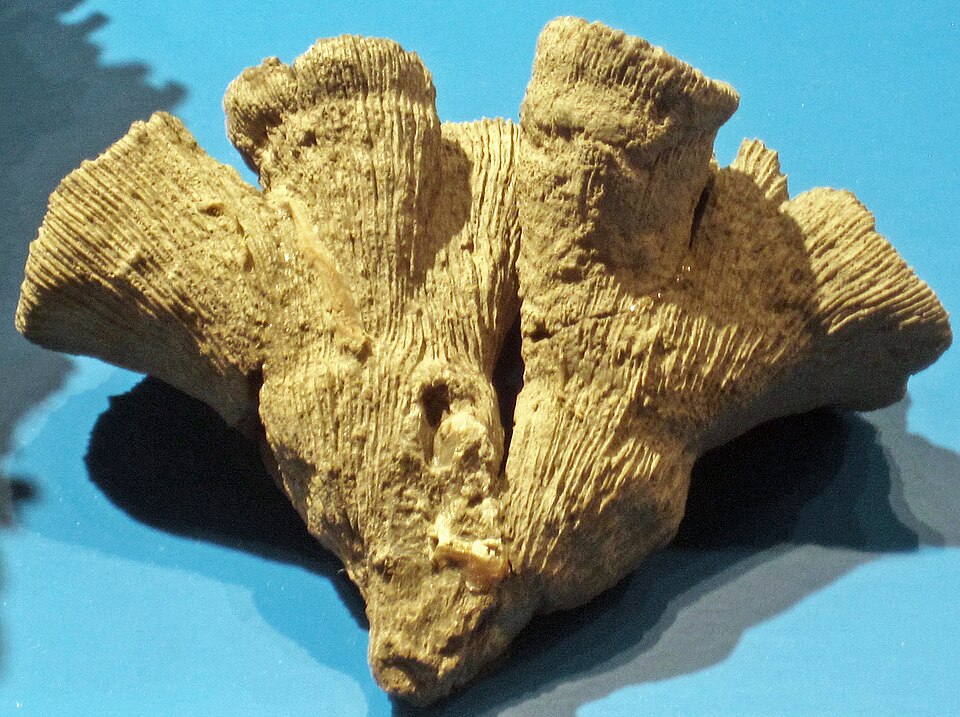
This carbonate crisis had devastating consequences for marine organisms that build skeletons or shells from calcium carbonate. Scleractinian corals, which had constructed extensive reef systems during the Late Triassic, suffered catastrophic losses, with an estimated 50 to 60 percent of coral genera going extinct at the boundary. The reef ecosystem collapsed essentially in its entirety, initiating a prolonged "reef gap" in the Early Jurassic during which no significant reef structures were built.13 Although locally diverse coral communities re-established themselves on a million-year timescale, a genuine global recovery of reef-building did not occur until the Middle Jurassic, approximately 10 to 15 million years after the extinction.13
The selectivity of the marine extinction strongly supports ocean acidification as a primary kill mechanism. Organisms with thick aragonitic or high-magnesium calcitic skeletons — the mineral forms most vulnerable to dissolution in acidified water — suffered disproportionately relative to those with low-magnesium calcitic or phosphatic shells.10 Bivalves and brachiopods with aragonitic shell mineralogy experienced significantly higher extinction rates than those with calcitic shells, and the evolutionary response in surviving lineages included a shift from aragonite toward calcite in shell construction among epifaunal bivalves.10 This mineralogical selectivity provides compelling evidence that the chemical state of the ocean, not merely temperature or anoxia, was a decisive factor in determining which marine lineages survived and which perished.
Terrestrial extinction patterns
On land, the end-Triassic extinction was characterised by the abrupt disappearance of many large-bodied vertebrates, particularly the crurotarsan archosaurs that had been the dominant terrestrial animals throughout the Late Triassic. Phytosaurs, semi-aquatic predators superficially resembling modern crocodilians; aetosaurs, heavily armoured herbivores; and rauisuchians, large apex predators that occupied the ecological niche later filled by theropod dinosaurs, all vanished at or near the boundary.16, 17
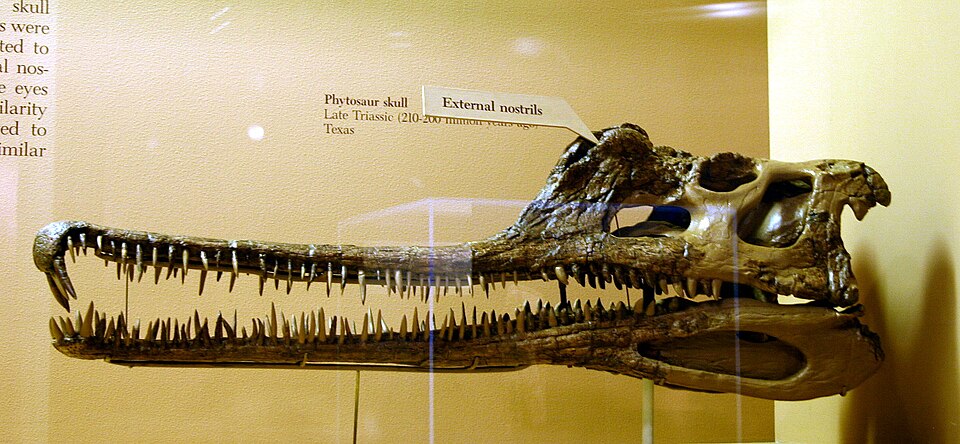

Of the once-diverse crurotarsan clade, only the lineage leading to modern crocodilians survived into the Jurassic. Multiple families of temnospondyl amphibians and several lineages of therapsids also disappeared.17
The palynological record documents equally profound changes in terrestrial plant communities. Across much of the Northern Hemisphere, the boundary is marked by the sudden disappearance of typical Late Triassic pollen assemblages — particularly the distinctive pollen of cheirolepidiaceous conifers and other gymnosperm groups — followed by a brief interval dominated by fern spores, the so-called "fern spike," before new Early Jurassic floral communities became established.16, 20 This vegetation crisis appears to have been driven by a combination of rapidly rising air temperatures, increased atmospheric SO2 from volcanic emissions, and disruption of coastal lowland habitats by sea-level changes associated with the onset of rifting.20
The terrestrial extinction exhibited a two-phase structure that parallels the marine record. An initial phase of floral decline, concentrated among upper-canopy gymnosperms, coincided with the first carbon isotope excursion and the earliest intrusive CAMP activity. A second, more severe phase followed the onset of major surface eruptions and was marked by the extirpation of additional plant taxa and the proliferation of disaster species — opportunistic ferns and other pioneer plants that colonised newly vacated ecological space.20 The concordance between the terrestrial and marine extinction phases strengthens the case for a common volcanic driver operating through multiple environmental pathways simultaneously.
Selective extinction patterns
One of the most striking features of the end-Triassic extinction is its pronounced selectivity. The event did not extinguish taxa at random; rather, certain ecological and physiological characteristics strongly predicted vulnerability. Understanding this selectivity has been central to identifying the kill mechanisms and to explaining the profound ecological reorganisation that followed.
Major taxonomic groups affected by the end-Triassic extinction11, 13, 17
| Group | Realm | Severity | Notes |
|---|---|---|---|
| Conodonts | Marine | Total extinction | Final disappearance after long Triassic decline |
| Scleractinian corals | Marine | ~50–60% genera lost | Near-total reef collapse; "reef gap" until Middle Jurassic |
| Ammonites (ceratitidans) | Marine | Total extinction of order | Other ammonite groups survived and diversified |
| Bivalves | Marine | Severe; aragonitic forms hardest hit | Mineralogical selectivity favouring calcitic shells |
| Brachiopods | Marine | Substantial losses | Never regained Triassic diversity levels |
| Crurotarsan archosaurs | Terrestrial | Near-total extinction | Only crocodylomorph lineage survived |
| Phytosaurs | Terrestrial | Total extinction | Large semi-aquatic predators |
| Aetosaurs | Terrestrial | Total extinction | Armoured herbivorous archosaurs |
| Rauisuchians | Terrestrial | Total extinction | Large apex predators |
| Dinosaurs | Terrestrial | Minor losses | Survived and diversified explosively |
In the marine realm, the pattern of selective extinction strongly implicates ocean acidification as a primary mechanism. Organisms dependent on carbonate skeletal construction, particularly those using the more soluble aragonite and high-magnesium calcite mineral forms, suffered far greater losses than those with more resistant low-magnesium calcite shells or non-mineralised body plans.10 Among the ammonites, the Ceratitida — the most prominent and diverse ammonite order of the Triassic — went entirely extinct, while the Ammonitina, Lytoceratina, and Phylloceratina survived and went on to diversify spectacularly in the Early Jurassic.11, 17
On land, the selectivity was oriented less by physiology than by body size and ecological role. The large crurotarsan archosaurs that occupied apex predator and large herbivore niches were annihilated nearly in their entirety, while smaller-bodied dinosaurs, crocodylomorphs, pterosaurs, and mammals passed through the boundary with comparatively minor losses.14, 16 Quantitative analyses of morphological disparity have shown that crurotarsans occupied a significantly larger morphospace than dinosaurs during the Late Triassic, meaning that the crurotarsans were exploiting a wider variety of body plans and ecological strategies. Their extinction was therefore not a consequence of competitive inferiority to dinosaurs but rather reflected the random or quasi-random removal of lineages during a catastrophic environmental crisis.14, 15
Recovery and dinosaur diversification
The ecological vacuum created by the end-Triassic extinction was filled with striking rapidity in certain groups, though the recovery was uneven across different taxa and environments. In the terrestrial realm, the most dramatic response was the explosive diversification of dinosaurs. Footprint evidence from the Newark Supergroup shows that large theropod dinosaurs appeared within approximately 30,000 years of the extinction horizon, with footprint size increasing dramatically and dinosaurian diversity reaching its peak in these rift basins within roughly 100,000 years of the boundary.16 This rapid size increase and diversification among theropods is consistent with ecological release into niches previously occupied by crurotarsan apex predators.
_(35319003864).jpg)
The broader pattern of dinosaurian diversification, however, was geographically variable and taxonomically complex. Sauropodomorph dinosaurs underwent a major evolutionary turnover, with the extinction of diverse basal families and the subsequent diversification of the derived Eusauropoda during the Early Jurassic across South America, Africa, and Asia.22 Ornithischian dinosaurs and armoured thyreophoran forms also diversified notably in the Early Jurassic, occupying herbivore niches that had been held by aetosaurs and other non-dinosaurian archosaurs during the Triassic.22 The protracted restructuring of Early Jurassic terrestrial ecosystems coincided with these dinosaurian radiations, suggesting that the ecological reorganisation following the extinction was not instantaneous but played out over several million years.20, 22
Critically, the rise of dinosaurs to ecological dominance appears to have been a matter of historical contingency rather than competitive superiority. Comparisons of evolutionary rates and morphological disparity between Triassic dinosaurs and crurotarsans show that dinosaurs exhibited lower morphological disparity and indistinguishable rates of character evolution relative to their crurotarsan contemporaries.14, 15 Dinosaurs did not outcompete crurotarsans over the course of the Late Triassic; rather, they survived a mass extinction that their competitors did not, and then radiated into the ecological space that was vacated. The end-Triassic extinction was, in this sense, the decisive event that made the subsequent 135-million-year "Age of Dinosaurs" possible.14, 15, 16
Estimated species-level extinction severity of the Big Five mass extinctions18, 23
Marine recovery and the reef gap
Marine recovery from the end-Triassic extinction proceeded at markedly different rates depending on the ecological group in question. Level-bottom benthic communities — assemblages of bivalves, gastropods, and other organisms living on or in the seafloor sediment — recovered relatively quickly, with diversity beginning to rebound within the first few million years of the Early Jurassic.11, 20 Ammonite diversity similarly rebounded rapidly: the surviving ammonite lineages diversified into a wide array of forms during the Hettangian and Sinemurian stages, re-establishing themselves as prominent components of Jurassic marine ecosystems.17
The recovery of reef ecosystems, by contrast, was extraordinarily protracted. The collapse of Late Triassic coral-sponge reef systems initiated a "reef gap" that persisted through most of the Early Jurassic. Although scattered, small coral buildups have been documented in Sinemurian-age strata, these were localised occurrences that did not represent a return to the large-scale reef construction of the Late Triassic.13 The slow pace of reef recovery likely reflects the severity of ocean acidification damage to the carbonate system, the loss of key reef-building taxa, and the time required for surviving scleractinian corals to re-evolve the symbiotic relationships with photosynthetic algae that underpin rapid reef growth. Genuinely extensive reef systems, comparable in scale and complexity to those of the Late Triassic, did not re-emerge until the Bajocian and Bathonian stages of the Middle Jurassic, some 10 to 15 million years after the extinction.13
The differential recovery rates among marine organisms provide insight into the relative importance of different environmental stressors. The rapid rebound of taxa less dependent on carbonate mineralisation, contrasted with the prolonged suppression of reef builders, is consistent with a scenario in which ocean chemistry disturbances — particularly reduced carbonate saturation and lingering acidification effects — persisted for millions of years after the initial volcanic perturbation had subsided.10, 13
Broader significance
The end-Triassic extinction occupies a pivotal position in Earth history for several reasons. It marked the final chapter in the breakup of Pangaea, with CAMP volcanism representing the initial magmatic expression of the rifting that would ultimately create the Atlantic Ocean.2, 20 It produced one of the clearest examples in the geological record of a mass extinction driven entirely by volcanic greenhouse gas emissions and their cascading environmental consequences, without any significant contribution from bolide impact.1, 3, 6 And it set the stage for the Mesozoic world as we understand it, transforming terrestrial ecosystems from ones dominated by a diverse array of archosaur clades into ones ruled by dinosaurs.14, 16
The event also offers a sobering deep-time perspective on the consequences of rapid carbon release. The estimated rate and magnitude of CO2 injection during CAMP volcanism fall within the same order of magnitude as projected anthropogenic carbon emissions over the coming centuries, and the environmental consequences — greenhouse warming, ocean acidification, reef collapse, and biodiversity loss — provide a geological precedent for understanding the potential trajectory of modern climate change.7, 9 The end-Triassic extinction demonstrates that when carbon is injected into the Earth system faster than geological processes can buffer it, the biological consequences can be catastrophic and the recovery prolonged over millions of years.7, 20
References
Zircon U-Pb geochronology links the end-Triassic extinction with the Central Atlantic Magmatic Province
Extensive 200-million-year-old continental flood basalts of the Central Atlantic Magmatic Province
Compound-specific carbon isotopes from Earth's largest flood basalt eruptions directly linked to the end-Triassic mass extinction
Thermogenic carbon release from the Central Atlantic magmatic province caused major end-Triassic carbon cycle perturbations
Effect of end-Triassic CO₂ maximum on carbonate sedimentation and marine mass extinction
Correlating the end-Triassic mass extinction and flood basalt volcanism at the 100 ka level
Extinction, survival and recovery of corals from the Triassic to Middle Jurassic time
The first 50 Myr of dinosaur evolution: macroevolutionary pattern and morphological disparity
The Triassic-Jurassic transition – A review of environmental change at the dawn of modern life
Massive methane fluxing from magma-sediment interaction in the end-Triassic Central Atlantic Magmatic Province