Overview
- Pterosaurs were the first vertebrates to achieve powered flight, evolving approximately 230 million years ago in the Late Triassic and diversifying into over 200 known species spanning wingspans from 25 centimetres to 10–11 metres before their extinction at the Cretaceous-Paleogene boundary 66 million years ago.
- Their wings were formed by a membrane of skin, muscle, and internal actinofibrils stretched from an enormously elongated fourth finger to the body, supported by a unique pteroid bone that controlled a leading-edge flap—a flight apparatus fundamentally different from that of birds or bats.
- Recent discoveries of branching pycnofibers structurally comparable to feathers, mass nesting sites with three-dimensional embryos, and dozens of new species from Lagerstätten in China, Brazil, and Germany have transformed understanding of pterosaur biology, growth, and evolutionary relationships.
Pterosaurs (order Pterosauria) were a diverse clade of flying reptiles that dominated the skies of the Mesozoic Era for over 160 million years, from their origin in the Late Triassic approximately 230 million years ago to their extinction at the Cretaceous-Paleogene boundary 66 million years ago.1, 3 They were the first vertebrates to evolve powered, flapping flight — preceding birds by at least 80 million years and bats by over 170 million years. Pterosaurs achieved this through a wing structure unlike any other flying animal: a membrane of skin, muscle fibre, and internal structural fibres called actinofibrils, stretched along a hyper-elongated fourth finger and attached to the body and hind limbs.7, 8
Over the course of their evolutionary history, pterosaurs diversified into more than 200 described species spanning an extraordinary range of sizes and ecological roles.3 The smallest known pterosaurs, such as the anurognathids, had wingspans of roughly 25 centimetres and likely hunted insects on the wing, while the largest — the azhdarchids Quetzalcoatlus and Hatzegopteryx — achieved wingspans of 10 to 11 metres and stood as tall as modern giraffes when on the ground.9, 10 Pterosaurs are not dinosaurs, though they are closely related: both groups belong to the clade Archosauria and share a common ancestor in the Triassic, but pterosaurs form their own distinct lineage within Avemetatarsalia, the branch of archosaurs that also gave rise to dinosaurs and birds.2, 20
Origins and evolutionary relationships
The evolutionary origin of pterosaurs has long been one of the most challenging problems in vertebrate palaeontology. Because even the earliest known pterosaurs already possess fully formed wings and a highly derived flight apparatus, their immediate ancestors and the steps leading to powered flight have been difficult to reconstruct from the fossil record.3 Phylogenetic analyses consistently place Pterosauria within Archosauria, on the avemetatarsalian stem lineage that also includes dinosaurs. More specifically, pterosaurs are ornithodirans — members of the archosaur clade that includes dinosaurs and their kin — rather than relatives of crocodylians.2, 20
A significant breakthrough came in 2020 with the description of lagerpetids, a group of small Triassic archosaurs previously considered enigmatic dinosaur precursors, as the closest known relatives of pterosaurs.1 Lagerpetids such as Ixalerpeton and Dromomeron share several cranial and inner-ear features with pterosaurs that are absent in other archosaurs, including an enlarged floccular lobe of the brain associated with balance and gaze stabilisation during flight. This discovery placed pterosaurs firmly within a broader clade called Pterosauromorpha and suggests that the neurological prerequisites for flight may have evolved before the wing membrane itself.1
The earliest unambiguous pterosaurs appear in the fossil record during the late Carnian to early Norian stages of the Late Triassic, approximately 228 to 215 million years ago. Eudimorphodon from the Italian Alps and Preondactylus from the same region already possess fully developed flight anatomy, including elongated fourth fingers, hollow pneumatic bones, and a keeled sternum for flight-muscle attachment.3 The absence of clear transitional forms between lagerpetids and these earliest pterosaurs represents a persistent gap in the fossil record, likely reflecting the poor fossilisation potential of small, lightly built animals in terrestrial environments.1, 3
Wing structure and the mechanics of flight
The pterosaur wing was a complex, multi-layered structure fundamentally different from the feathered wings of birds or the skin membranes of bats. The primary flight surface, called the brachiopatagium, consisted of a tough membrane of skin reinforced internally by closely packed structural fibres known as actinofibrils, which radiated outward from the wing finger and are thought to have stiffened the membrane and controlled its camber during flight.7, 8 Exceptionally preserved specimens, particularly Jeholopterus from the Jehol Biota of China, reveal that the wing membrane also contained layers of muscle fibre, blood vessels, and a thin outer integument, making it a dynamic, actively controlled aerofoil rather than a passive sail.7
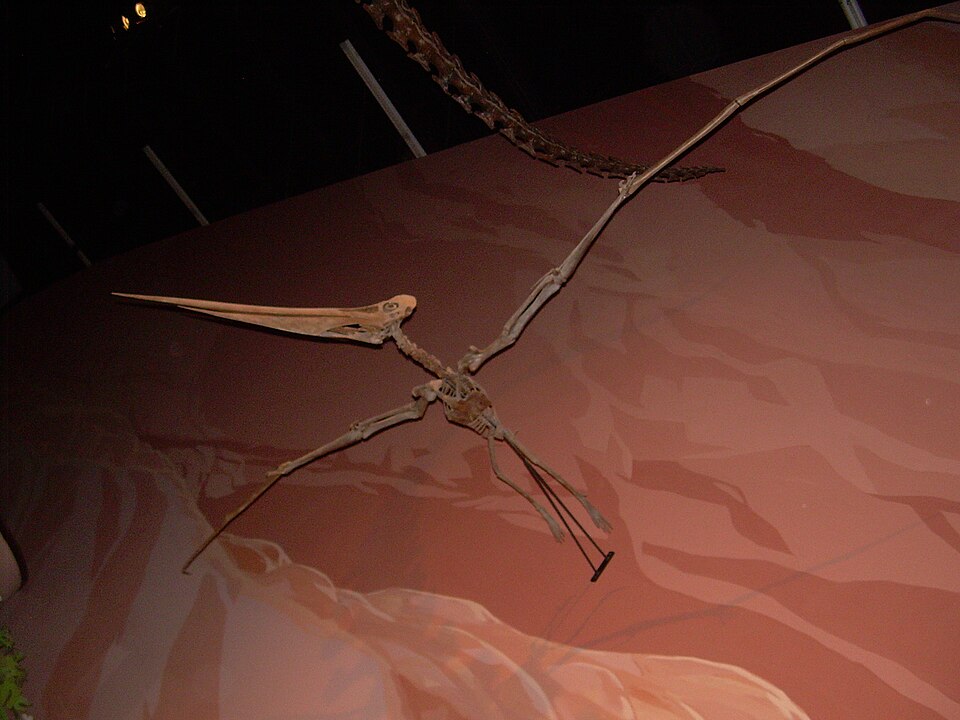

A unique skeletal element called the pteroid bone, found in no other vertebrate group, projected forward from the wrist and supported a smaller leading-edge membrane called the propatagium.5 Biomechanical analyses indicate that the pteroid could be actively repositioned to adjust the angle and tension of the propatagium, functioning as a biological leading-edge flap analogous to the slats on modern aircraft wings. This mechanism would have allowed pterosaurs to fly at low speeds without stalling — a critical capability for takeoff, landing, and soaring.5, 22 A third membrane, the cruropatagium, stretched between the hind limbs and may have contributed additional lift, though its exact extent — whether it connected to the ankle, the knee, or the tail — has been debated.8
Laser-stimulated fluorescence imaging of pterosaur fossils has revealed a muscular wing-body junction at the shoulder region, indicating that pterosaurs could finely control the shape and orientation of the proximal wing during different phases of the flight stroke.6 Aerodynamic modelling suggests that pterosaurs employed a flight style distinct from both birds and bats: their broad, high-aspect-ratio wings were well suited to soaring and slow, efficient flight, while the active control of membrane tension and camber via actinofibrils, the pteroid, and intrinsic musculature allowed considerable versatility across flight regimes.22 The largest pterosaurs, with wingspans exceeding 10 metres, likely relied heavily on thermal and slope soaring, analogous to modern albatrosses and frigatebirds, though biomechanical analyses indicate they were also capable of sustained flapping flight and quadrupedal launching from the ground.9
Major groups and diversity
Pterosaurs are traditionally divided into two broad groupings based on body plan: the "rhamphorhynchoids" (a paraphyletic grade of basal pterosaurs) and the Pterodactyloidea (a monophyletic derived clade).3, 4 Basal pterosaurs, which dominated during the Triassic and Jurassic, were generally small to medium-sized animals characterised by long tails often ending in a vane-like structure, short metacarpals, and relatively short skulls with prominent teeth. Iconic genera include Rhamphorhynchus from the Solnhofen Limestone of Germany, Dimorphodon from the Early Jurassic of England, and the tiny insectivorous anurognathids.3, 21
Pterodactyloids, which appeared in the Middle to Late Jurassic and radiated extensively through the Cretaceous, evolved a markedly different body plan: reduced or absent tails, elongated metacarpals, longer necks, and often elaborate cranial crests.4 The earliest known pterodactyloid, Kryptodrakon from the Middle–Upper Jurassic of China, dates to approximately 163 million years ago, establishing that the pterodactyloid lineage diverged from basal pterosaurs during the Jurassic.4 Pterodactyloids subsequently diversified into numerous families occupying a wide range of ecological niches. The ornithocheirids and anhanguerids were large, fish-eating pterosaurs with prominent teeth and wingspans of 4 to 7 metres. The ctenochasmatids, including Pterodaustro, evolved hundreds of fine, bristle-like teeth and fed by filter-feeding, convergently paralleling modern flamingos.18 The tapejarids bore elaborate sail-like cranial crests and are interpreted as frugivores or omnivores based on jaw and beak morphology.3
The azhdarchids, the final great radiation of pterosaurs, included the largest flying animals ever to live. Quetzalcoatlus northropi from the Late Cretaceous of Texas and Hatzegopteryx thambema from Romania had estimated wingspans of 10 to 11 metres, stood approximately 4.5 to 5 metres tall at the shoulder when walking quadrupedally, and may have weighed 200 to 250 kilograms.9, 10 Functional morphological analyses suggest that azhdarchids were terrestrial stalkers that foraged on land in a manner analogous to modern ground hornbills or marabou storks, using their long necks and large beaks to capture small vertebrates and invertebrates rather than feeding primarily on fish.10, 11
Wingspan ranges of major pterosaur groups3, 9, 21
Pycnofibers and integumentary structures
Pterosaurs were not scaly reptiles. Exceptionally preserved fossils reveal that their bodies were covered in filamentous integumentary structures called pycnofibers — hair-like coverings that would have provided insulation and are consistent with an endothermic or near-endothermic metabolism.7, 12 Pycnofibers were first recognised in the nineteenth century from Solnhofen specimens and have since been documented in multiple pterosaur lineages spanning both basal and derived groups, indicating that the filamentous body covering was ancestral to the entire order.12
A landmark study in 2019 by Yang and colleagues examined two anurognathid pterosaurs from the Middle Jurassic of China using high-resolution scanning electron microscopy and revealed that some pycnofibers possessed complex, branching architectures structurally comparable to the down feathers and branched filaments found in theropod dinosaurs and modern birds.12 Four distinct morphotypes were identified: simple monofilaments, bundles of filaments converging at a base, filaments with a central shaft and lateral branches, and tufted structures with multiple branches radiating from a single point. The presence of branching integumentary structures in both pterosaurs and dinosaurs, two groups that diverged in the Triassic, implies either that feather-like filaments evolved independently in both lineages or, more parsimoniously, that the common ancestor of all ornithodirans already bore some form of filamentous integument — pushing the origin of proto-feathery structures back to approximately 250 million years ago.12
Growth and reproduction
Pterosaur reproductive biology was largely mysterious until a series of discoveries in the early twenty-first century transformed the field. In 2011, a specimen of the pterodactyloid Darwinopterus from China was found preserved alongside a single egg, providing the first direct association between an adult pterosaur and its egg.14 The egg was small relative to the adult, had a soft, parchment-like shell similar to those of many modern reptiles, and was found in association with a female individual identified by her wider pelvis and absence of a cranial crest, providing the first direct evidence of sexual dimorphism in pterosaurs.14
An even more spectacular discovery came in 2017 from the Early Cretaceous Turpan-Hami Basin of northwestern China, where Wang and colleagues described a site containing over 200 eggs of the pterosaur Hamipterus tianshanensis, including 16 eggs with three-dimensionally preserved embryos.13 The embryonic bones showed well-developed hind limbs but relatively underdeveloped forelimbs and pectoral muscles, suggesting that hatchling pterosaurs could walk but were not immediately capable of sustained flight. This finding supported the "flapling" hypothesis, which proposes that juvenile pterosaurs went through a ground-based stage before developing full flight capability, and challenged an earlier competing hypothesis that pterosaur hatchlings were precocial fliers from birth.13, 15
Bone histology provides further insight into pterosaur growth. Studies of Rhamphorhynchus from the Solnhofen Limestone have identified growth rings (lines of arrested growth) in long bones, allowing reconstruction of growth curves.16, 21 These analyses indicate that basal pterosaurs grew relatively slowly compared to modern birds, reaching adult size over several years, with distinct size classes visible in population-level fossil samples from single localities.21 Pterodactyloid pterosaurs, by contrast, show more rapid growth rates based on bone tissue microstructure, with highly vascularised fibrolamellar bone — the same fast-growing bone type found in dinosaurs and birds — suggesting an evolutionary trend toward accelerated development in derived pterosaurs.16
Ecology and feeding strategies
Pterosaurs exploited a remarkable breadth of ecological niches across their 160-million-year evolutionary history, rivalling the ecological diversity of modern birds in many respects.3 Piscivory (fish-eating) was widespread, particularly among the ornithocheirids and anhanguerids of the Cretaceous, whose forward-pointing, interlocking teeth and elongated jaws were well suited to snatching fish from the water surface during low-altitude flight or surface skimming.3 The ctenochasmatids evolved an entirely different approach to aquatic feeding: genera such as Pterodaustro possessed lower jaws packed with hundreds of long, elastic teeth that functioned as a sieve, allowing these pterosaurs to filter small crustaceans and plankton from shallow water in the manner of modern flamingos.18
The tiny anurognathids, with their broad, short skulls and wide gapes, were almost certainly insectivores, analogous to modern nightjars or swifts.3, 7 At the opposite extreme, the giant azhdarchids are interpreted as generalist terrestrial predators that stalked floodplains and coastal environments on their long hind limbs and folded wings, picking up small dinosaurs, mammals, lizards, and large invertebrates with their elongated, stork-like beaks.10, 11 The Transylvanian azhdarchid Hatzegopteryx, with its unusually robust neck vertebrae and wide skull, may have been capable of consuming prey significantly larger than that taken by other azhdarchids, functioning as a top terrestrial predator on the island ecosystem of Hateg Island where large theropod dinosaurs were apparently absent.11
Limb proportions varied dramatically across pterosaur lineages and correlate with locomotor and foraging ecology.19 Basal pterosaurs with relatively long hind limbs and shorter forelimbs may have been more agile on the ground or while climbing, whereas pterodactyloids with their elongated metacarpals were committed quadrupedal walkers on land. The largest azhdarchids, with their extremely long forelimbs relative to hind limbs, adopted a distinctive quadrupedal gait in which the folded wings served as the primary anterior support — a locomotor mode confirmed by pterosaur trackways preserved in Cretaceous sediments from France, South Korea, and North America.10, 19
Key fossil sites
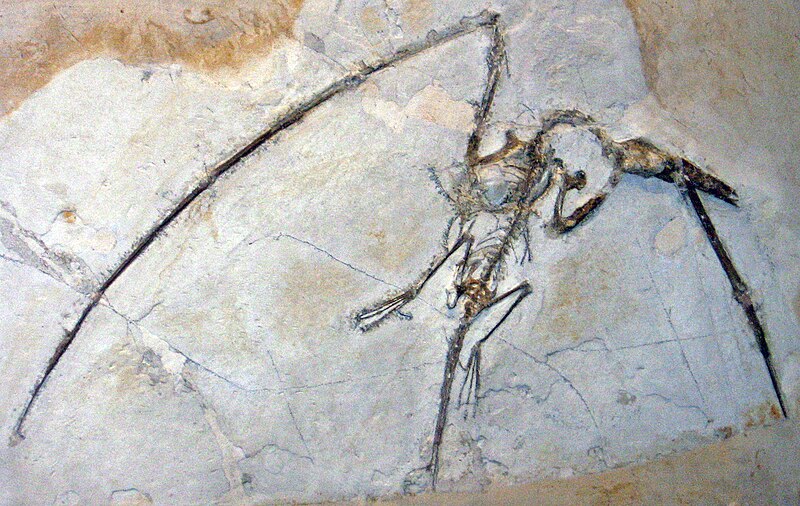
The pterosaur fossil record is concentrated at a handful of exceptional Lagerstätten that preserve not only bones but also soft tissues, wing membranes, and gut contents. The Solnhofen Limestone of Bavaria, Germany, a Late Jurassic (approximately 150 million years old) lagoon deposit famous for yielding Archaeopteryx, has produced some of the most complete pterosaur specimens ever found, including dozens of Rhamphorhynchus individuals spanning a growth series from juvenile to adult.21 The fine-grained lithographic limestone preserved wing membranes, pycnofibers, and even stomach contents (fish scales and cephalopod hooks) in extraordinary detail.21
_(Solnhofen_Limestone,_Upper_Jurassic;_Bavaria,_Germany)_(36543746860).jpg)
The Early Cretaceous Jehol Biota of Liaoning Province, northeastern China, has been equally transformative. Dozens of new pterosaur species have been described from these volcanic ash-bearing lake deposits, including critical specimens that preserve branching pycnofibers, wing membrane microstructure, and soft-tissue cranial crests.7, 12 The Jehol Biota has been particularly important for understanding the transition from basal pterosaurs to pterodactyloids, as it preserves representatives of both groups in the same depositional environment.4
The Crato and Romualdo formations of the Araripe Basin in northeastern Brazil have yielded a rich assemblage of Early Cretaceous pterodactyloids, many with exceptional three-dimensional preservation in carbonate nodules. Tapejarids, anhanguerids, and other pterosaurs from these deposits have provided crucial data on cranial crest diversity, dental morphology, and skeletal pneumaticity.3 The Turpan-Hami Basin of Xinjiang, China, produced the mass nesting site of Hamipterus with over 200 eggs, representing the most important single site for understanding pterosaur reproductive biology.13
Extinction at the Cretaceous-Paleogene boundary
Pterosaurs were once thought to have undergone a long, gradual decline through the Late Cretaceous, dwindling to just a few lineages before the end-Cretaceous mass extinction delivered the final blow. This narrative has been substantially revised by recent discoveries.17 A 2018 study by Longrich and colleagues described new pterosaur material from the latest Maastrichtian (the final stage of the Cretaceous) of Morocco, demonstrating that at least seven species of pterosaurs belonging to three distinct families — azhdarchids, nyctosaurids, and pteranodontids — were present in North Africa immediately before the extinction event.17
This evidence indicates that pterosaur diversity, while certainly reduced from its Cretaceous peak, was not in terminal decline at the time of the Chicxulub impact 66 million years ago. Pterosaurs of the latest Cretaceous spanned a range of body sizes from medium (3 to 4 metre wingspans) to gigantic (10+ metre wingspans) and occupied multiple ecological niches, from oceanic soarers to terrestrial stalkers.17 The extinction of all remaining pterosaur lineages was abrupt and coincident with the Cretaceous-Paleogene boundary, consistent with a catastrophic extinction event rather than a gradual displacement by birds or other competitors.17
The ecological niches occupied by pterosaurs were never reoccupied by a directly comparable group. While birds diversified rapidly in the aftermath of the end-Cretaceous extinction and eventually evolved very large soaring forms such as the pseudotooth birds (Pelagornithidae), no post-Mesozoic flying animal has matched the sheer size of the largest azhdarchids, and no bird has replicated the membrane-winged, quadrupedal-launching flight strategy that defined pterosaur aerial locomotion for 160 million years.9, 17
Pterosaur diversity through the Mesozoic3, 4, 17
| Period | Time (Ma) | Dominant groups | Notable genera |
|---|---|---|---|
| Late Triassic | 230–201 | Basal pterosaurs | Eudimorphodon, Preondactylus |
| Early–Middle Jurassic | 201–163 | Rhamphorhynchids, dimorphodontids | Rhamphorhynchus, Dimorphodon, Dorygnathus |
| Late Jurassic | 163–145 | Rhamphorhynchids + early pterodactyloids | Kryptodrakon, Pterodactylus |
| Early Cretaceous | 145–100 | Ornithocheirids, ctenochasmatids, tapejarids | Anhanguera, Pterodaustro, Tupuxuara |
| Late Cretaceous | 100–66 | Azhdarchids, nyctosaurids, pteranodontids | Quetzalcoatlus, Pteranodon, Hatzegopteryx |
References
Pterosaurs evolved a muscular wing–body junction providing multifaceted flight performance benefits
The soft tissue of Jeholopterus (Pterosauria, Anurognathidae) and the structure of the pterosaur wing membrane
On the size and flight diversity of giant pterosaurs, the use of birds as pterosaur analogues and comments on pterosaur flightlessness
Neck biomechanics indicate that giant Transylvanian azhdarchid pterosaurs were short-necked arch predators
Egg accumulation with 3D embryos provides insight into the life history of a pterosaur
Prenatal development in pterosaurs and its implications for their postnatal locomotory ability
Life history of Rhamphorhynchus inferred from bone histology and the diversity of pterosaurian growth strategies
Late Maastrichtian pterosaurs from North Africa and mass extinction of Pterosauria at the Cretaceous-Paleogene boundary
Earliest filter-feeding pterosaur from the Jurassic of China and ecological evolution of Pterodactyloidea
The phylogenetic relationships of basal archosauromorphs, with an emphasis on the systematics of proterosuchian archosauriforms
A statistical study of Rhamphorhynchus from the Solnhofen Limestone of Germany: year-classes of a single large species