Overview
- Mosasaurs were a diverse family of large marine lizards (Mosasauridae) that evolved from small, semi-aquatic squamate ancestors in the early Late Cretaceous (approximately 98 million years ago) and rapidly radiated to become the dominant apex predators of the world's oceans during the final 25 million years of the Mesozoic era.
- Ranging from one-metre coastal species to the 13-metre Mosasaurus hoffmannii, mosasaurs evolved paddle-like limbs, a laterally compressed tail with a bilobed fluke, and a uniquely flexible skull with an intramandibular joint that allowed them to swallow large prey whole, convergently paralleling the feeding mechanics of modern snakes.
- As close relatives of modern monitor lizards and snakes within Squamata, mosasaurs provide one of the best-documented examples of a terrestrial-to-marine evolutionary transition in the reptile fossil record, and their sudden extinction at the Cretaceous-Paleogene boundary 66 million years ago left marine apex predator niches vacant until filled by sharks and cetaceans tens of millions of years later.
Mosasaurs (family Mosasauridae) were a highly successful group of marine squamate reptiles that dominated the world's oceans during the Late Cretaceous period, from approximately 98 to 66 million years ago. Evolving from small, semi-aquatic lizards closely related to modern monitor lizards and snakes, mosasaurs underwent one of the most rapid and dramatic terrestrial-to-marine transitions in vertebrate history, developing paddle-like limbs, a laterally compressed tail bearing a crescent-shaped fluke, and a uniquely flexible skull that enabled them to consume prey approaching their own body size.1, 2 At their peak during the Maastrichtian stage (72–66 million years ago), mosasaurs occupied ecological niches from nearshore ambush predators to open-ocean pursuit hunters, with the largest species exceeding 13 metres in length.8
Unlike the ichthyosaurs, which had already gone extinct by the Cenomanian (approximately 94 million years ago), and the plesiosaurs, which were declining in diversity, mosasaurs filled the void left by these earlier marine reptile groups and became the unchallenged apex predators of Late Cretaceous seas worldwide.1, 14 Their abrupt disappearance at the Cretaceous-Paleogene boundary left marine apex predator niches vacant for millions of years, until they were eventually filled by sharks and early cetaceans.16
Evolutionary origins
Mosasaurs belong to Squamata, the order that includes all modern lizards and snakes, and their closest living relatives are monitor lizards (Varanidae) and possibly snakes (Serpentes). Morphological analyses have consistently placed mosasaurs within or adjacent to Varanoidea, the superfamily containing monitor lizards, based on shared features of the skull, dentition, and vertebral column.12 Molecular and morphological phylogenetic studies have debated whether mosasaurs are more closely related to monitors or to snakes, with some analyses suggesting that mosasaurs and snakes share a common ancestor that was already semi-aquatic, a hypothesis that would make mosasaurs relevant to understanding the evolutionary origin of snakes themselves.13
The earliest known mosasaurs appear in the fossil record during the Cenomanian stage of the Late Cretaceous, approximately 98 million years ago. These basal forms, including Dallasaurus turneri from Texas, were relatively small (less than one metre in length) and retained well-developed terrestrial-style limbs with functional digits, indicating that they were semi-aquatic animals still capable of locomotion on land.4 The existence of such transitional forms demonstrates that the mosasaur lineage underwent a gradual transition from land to sea, paralleling the evolutionary trajectories documented in early whales and early ichthyosaurs. By the Turonian (approximately 90 million years ago), fully aquatic mosasaurs with paddle-like limbs had appeared across multiple lineages, indicating rapid adaptation to marine environments once the transition began.2, 4
Skull and feeding mechanics
The mosasaur skull is one of the most distinctive features of the group and provides insight into their predatory ecology. Like snakes, mosasaurs possessed an intramandibular joint — a flexible hinge within the lower jaw itself, located between the dentary and surangular bones — that allowed each mandible to flex outward during feeding, greatly expanding the gape of the mouth.1, 5 Combined with loosely articulated jaw bones connected by flexible ligaments rather than rigid sutures, this system gave mosasaurs the capacity to swallow prey items larger than the resting diameter of their throat, a feeding strategy convergently evolved in snakes and several lineages of predatory fish.2
Mosasaur dentition varied considerably across the family, reflecting the wide range of ecological niches they occupied. The subfamily Mosasaurinae, which includes Mosasaurus itself, bore robust, conical teeth suited to crushing hard-shelled prey such as ammonites and sea turtles. Plioplatecarpines had more slender, pointed teeth adapted for grasping fish and squid. Globidens, a highly specialized genus, possessed spherical, button-like teeth clearly adapted for crushing the shells of bivalves, gastropods, and sea urchins, representing a durophagous niche rare among marine reptiles.5, 3 The pterygoid bones on the roof of the mouth also bore teeth in most mosasaurs, an ancestral squamate feature that provided additional grip on struggling prey.1
Body plan and locomotion
Mosasaurs evolved a body plan progressively adapted for efficient aquatic locomotion over their approximately 32-million-year evolutionary history. Basal forms like Dallasaurus retained a relatively generalized lizard-like body with functional limb girdles and digits, while derived forms such as Plotosaurus from the latest Cretaceous of California had evolved elongated bodies, reduced limbs transformed into narrow hydrofoil paddles, and a deep, laterally compressed tail that served as the primary propulsive organ.2, 6
Exceptionally preserved specimens from the Maastrichtian of Sweden and Jordan have revealed the presence of a bilobed tail fluke formed from soft tissue, structurally similar to the tail flukes of ichthyosaurs and modern sharks. This discovery, made possible by phosphatised soft tissue preservation, confirmed that derived mosasaurs were carangiform or sub-carangiform swimmers, generating thrust primarily from lateral undulation of the posterior body and tail rather than from anguilliform (eel-like) whole-body undulation as previously assumed.6 Some of these same specimens preserve evidence of a dorsal ridge or fin-like structure running along the back, suggesting a more hydrodynamically sophisticated body plan than the simple "lizard with paddles" model that dominated early reconstructions.6, 7
The limbs of derived mosasaurs were modified into flattened paddles through hyperphalangy (the addition of extra phalanges to each digit), convergently paralleling the limb modifications seen in ichthyosaurs and plesiosaurs. However, unlike ichthyosaurs, mosasaur paddles retained distinct individual digits encased in a fleshy flipper, and the forelimbs were generally larger than the hindlimbs, suggesting they functioned primarily as steering and stabilising organs rather than as propulsive surfaces.2
Diversity and classification
Mosasauridae is divided into several subfamilies, the exact boundaries of which have been debated as new discoveries and phylogenetic methods have refined the group's taxonomy. The major clades include Mosasaurinae (the most species-rich and ecologically diverse subfamily, including Mosasaurus, Clidastes, and Globidens), Plioplatecarpinae (medium-sized, fish-eating forms such as Platecarpus and Plioplatecarpus), Tylosaurinae (large apex predators including Tylosaurus, which reached 12–13 metres), and Halisaurinae (a basal, long-snouted group that persisted throughout the Late Cretaceous).5, 3
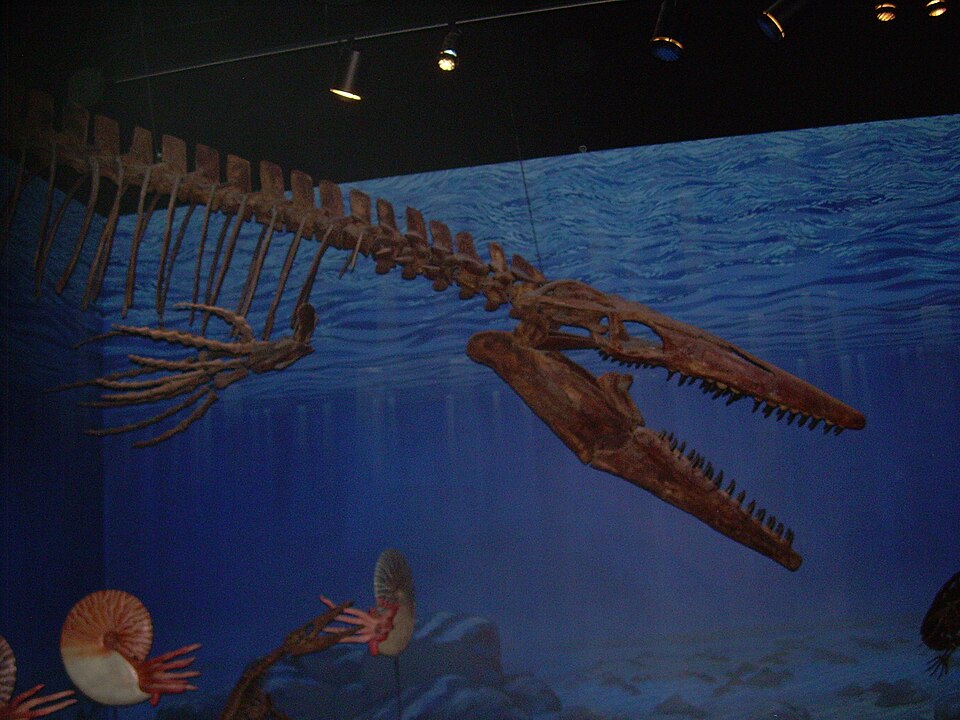

Over 40 genera and more than 80 species of mosasaur have been described from every continent, including Antarctica, demonstrating that these reptiles achieved a truly global distribution during the Late Cretaceous.9 The greatest diversity occurred during the Maastrichtian stage (72–66 million years ago), when multiple species often coexisted in the same marine ecosystems, partitioning resources through differences in body size, dentition, and habitat preference. Niche partitioning is well documented in the Western Interior Seaway of North America, where small coastal Clidastes, medium-sized pelagic Platecarpus, and enormous apex predatory Tylosaurus occupied distinct ecological roles within the same body of water.1, 5
Sensory systems
Mosasaurs possessed a suite of sensory adaptations that made them effective predators in a range of marine environments. Their large orbits indicate well-developed vision, and analysis of eye socket orientation in several genera has demonstrated that at least some mosasaurs had a degree of binocular overlap in their visual fields, providing stereoscopic depth perception useful for judging distance to prey.10 The eyes of mosasaurs were supported by a ring of sclerotic ossicles (scleral ring), a feature inherited from their lizard ancestors, which may have helped maintain eye shape during deep dives and suggests that some species were capable of hunting at significant depths.1
The elongated snout of many mosasaurs may have housed an extensive array of sensory foramina along the premaxillary and maxillary bones, potentially indicative of a pressure-sensing or electroreceptive system comparable to the lateral line system of fish, although direct evidence for such a system remains debated. Mosasaurs also retained the forked tongue and associated vomeronasal (Jacobson's) organ characteristic of squamates, which in an aquatic context would have functioned as a chemosensory system for detecting dissolved chemical cues from prey, predators, and potential mates.1, 2
Reproduction and life history
Mosasaurs were viviparous (live-bearing), as demonstrated by several fossil specimens preserving embryos within the body cavity of adult individuals. The most compelling evidence comes from a specimen of Carsosaurus marchesetti from the Cenomanian of Slovenia, which preserves several embryos in the pelvic region, and from neonatal mosasaur specimens found in open marine sediments far from any shoreline, indicating that birth occurred in open water rather than on beaches.2 Viviparity is a common adaptation among fully aquatic reptiles — it is also documented in ichthyosaurs and plesiosaurs11 — because egg-laying on land would require the retention of terrestrial locomotor capabilities, which derived mosasaurs had entirely lost.
The growth patterns of mosasaurs, reconstructed from bone histology, indicate rapid growth rates comparable to those of modern marine mammals and large pelagic fish, rather than the slower growth rates typical of most modern reptiles. This rapid growth would have allowed juvenile mosasaurs to pass quickly through the vulnerable size classes where they were susceptible to predation by sharks, other mosasaurs, and large fish, a life history strategy analogous to that observed in modern marine apex predators.14
Soft tissue preservation and colouration
Some of the most remarkable mosasaur discoveries of recent decades involve the preservation of soft tissues and original biomolecules. Phosphatised soft tissue outlines from specimens in Sweden and Jordan have revealed the external body shape of derived mosasaurs in extraordinary detail, including the caudal fluke, dorsal structures, and the shape of the flippers, fundamentally revising scientific understanding of mosasaur body plans.6, 7
Analysis of fossilised melanosomes — the subcellular organelles that contain melanin pigment — preserved in mosasaur skin impressions has provided evidence for the colouration of these animals. Specimens of Ectenosaurus and Tylosaurus preserve melanosomes consistent with dark dorsal colouration, suggesting that mosasaurs exhibited countershading: dark on top and lighter underneath, a pattern universal among modern marine vertebrates that provides camouflage from both above and below in the water column.15 Similar colouration has been inferred for ichthyosaurs, suggesting that countershading was a deeply conserved adaptation among marine tetrapods regardless of their phylogenetic origin.15
Paleoecology and global distribution
During the Late Cretaceous, global sea levels were among the highest in Earth's history, and extensive epicontinental seas — most notably the Western Interior Seaway that bisected North America from the Gulf of Mexico to the Arctic Ocean — provided vast habitats for marine life. Mosasaurs thrived in these environments and have been found in marine sediments from every continent, from the chalk deposits of Belgium and the Netherlands (where the first mosasaur specimen was discovered near Maastricht in the 1760s, giving the Maastrichtian stage its name) to the Antarctic Peninsula.8, 9
Stomach contents preserved in mosasaur specimens document a broad diet that included fish, sharks, cephalopods (particularly ammonites), sea turtles, seabirds, and even other mosasaurs, confirming their role as generalist apex predators.1 The presence of ammonite shells with mosasaur tooth puncture marks, and of mosasaur gut contents containing ammonite remains, provides direct evidence of predator-prey interactions that are otherwise difficult to document in the fossil record. The breadth of mosasaur diets suggests that they occupied ecological roles comparable to those of modern orcas and large sharks: top-level predators whose feeding activities structured entire marine ecosystems.5, 14
Extinction at the K-Pg boundary
Mosasaurs went extinct precisely at the Cretaceous-Paleogene (K-Pg) boundary 66 million years ago, victims of the same Chicxulub impact event that eliminated the non-avian dinosaurs, pterosaurs, ammonites, and many other groups. Unlike the ichthyosaurs, which had disappeared approximately 28 million years earlier, mosasaurs showed no signs of declining diversity in the final millions of years of the Cretaceous; if anything, the Maastrichtian represents a peak of mosasaur species richness and geographic range.14
The sudden disappearance of mosasaurs from a position of ecological dominance underscores the catastrophic nature of the K-Pg extinction for marine ecosystems. As apex predators dependent on complex food webs, mosasaurs would have been acutely vulnerable to the collapse of marine primary productivity that followed the Chicxulub impact, when dust and aerosols blocked sunlight and suppressed photosynthesis for months to years.16 The extinction of mosasaurs, alongside ammonites and many fish clades, created vacant ecological space that was not filled for tens of millions of years, until the radiation of sharks and early whales (Archaeoceti) during the Eocene epoch eventually restored apex predator guilds in the world's oceans.16
History of discovery
The first mosasaur specimen ever recognised by science was a partial skull discovered in a limestone quarry near Maastricht, Netherlands, in 1764. The specimen, now known as the "great animal of Maastricht," was initially interpreted as a crocodile, a whale, or a giant fish before Georges Cuvier correctly identified it as a marine lizard in 1808, making it one of the first fossil reptiles to be scientifically described and a landmark in the early history of paleontology.8 The name Mosasaurus (literally "Meuse lizard," after the river near which it was found) was formally established by William Daniel Conybeare in 1822.
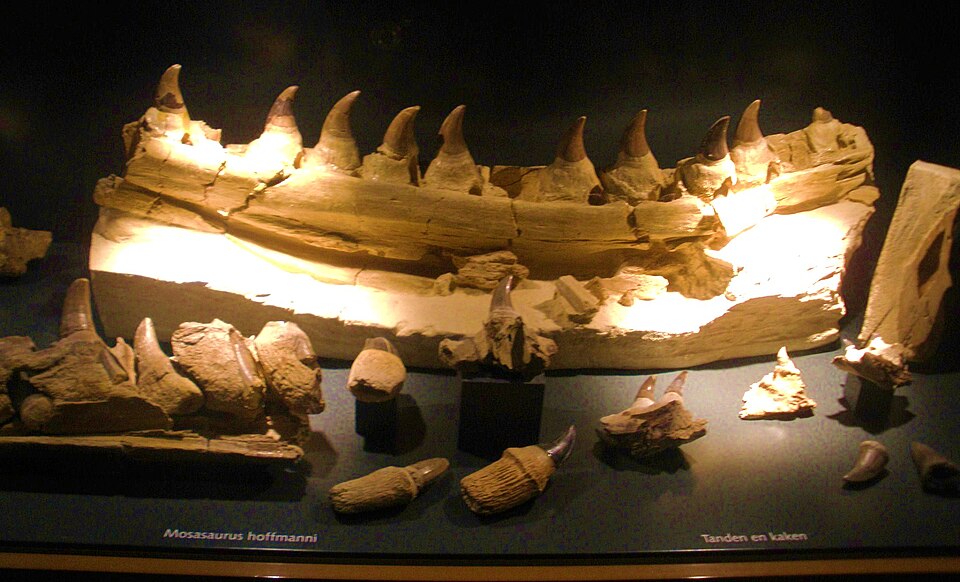

Since these initial discoveries, mosasaur fossils have been found on every continent and in marine sediments spanning the entire Late Cretaceous. Major fossil localities include the Niobrara Chalk of Kansas (which has yielded extensive collections of Tylosaurus and Platecarpus), the phosphatic deposits of Morocco and Jordan (sources of abundant and well-preserved Maastrichtian mosasaurs), and the chalk cliffs of England and Belgium.1, 9 The discovery of Antarctic mosasaurs in the 1990s confirmed that these animals had achieved a global distribution, inhabiting even the cooler waters near the Late Cretaceous South Pole.9
References
The evolution of the body plan of mosasaurs (Lepidosauria) as determined from the fossil record
A new small-bodied species of Mosasaurus from the Upper Cretaceous of North America and its implications for mosasaur evolution
The oldest known mosasaur (Squamata: Mosasauridae) from the Upper Cretaceous of North America
Convergent evolution in aquatic tetrapods: insights from an exceptional fossil mosasaur
Soft tissue and cellular preservation in vertebrate skeletal elements from the Cretaceous to the present
Viviparity and K-selected life history in a Mesozoic marine plesiosaur (Reptilia, Sauropterygia)