Overview
- Nothosaurs were a diverse group of semi-aquatic marine reptiles within the superorder Sauropterygia that flourished during the Triassic period (approximately 252–201 million years ago), occupying coastal and shallow marine environments across the Tethys Sea with an elongated body plan adapted for both swimming and terrestrial locomotion.
- Unlike the fully aquatic ichthyosaurs and later plesiosaurs, nothosaurs retained functional limbs with webbed feet rather than flippers, hunted fish and small prey using elongated skulls with interlocking needle-like teeth, and likely hauled out onto land in a manner analogous to modern seals and sea lions.
- Nothosaurs are of particular evolutionary significance as members of Sauropterygia, the broader clade that gave rise to the plesiosaurs through intermediate forms such as the pistosauroids, representing a key chapter in the repeated invasion of marine environments by terrestrial reptiles during the Mesozoic era.
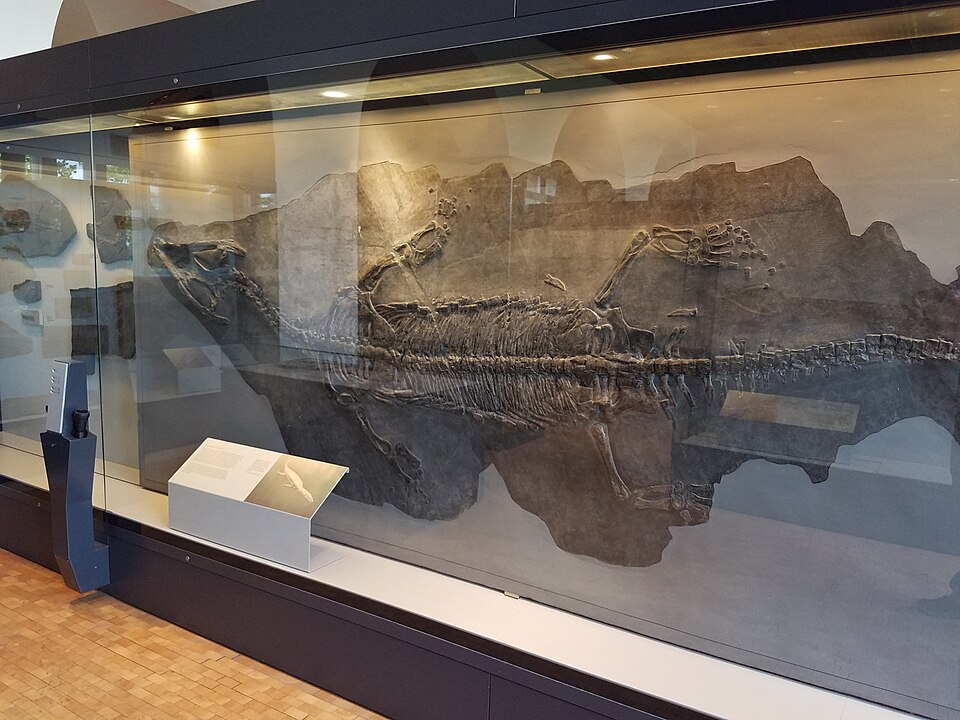
Nothosaurs (order Nothosauroidea, from the Greek nothos, "false," and sauros, "lizard") were a group of semi-aquatic marine reptiles that flourished throughout the Triassic period, from approximately 245 to 201 million years ago. As members of the superorder Sauropterygia — the most diverse and long-lived clade of Mesozoic marine reptiles — nothosaurs occupied a pivotal position in the evolutionary history of marine tetrapods, representing an intermediate grade of adaptation between fully terrestrial ancestors and the obligately aquatic plesiosaurs that would dominate Jurassic and Cretaceous oceans.1, 2 With their elongated bodies, webbed feet, and needle-like teeth adapted for catching fish, nothosaurs lived as coastal predators along the margins of the Tethys Sea, likely hauling out onto land in a manner analogous to modern pinnipeds.1, 7

Systematics and classification
Nothosaurs belong to the superorder Sauropterygia, which also includes the placodonts, pachypleurosaurs, pistosauroids, and plesiosaurs. The name Sauropterygia, meaning "lizard flippers," was coined by Richard Owen in 1860 to describe reptiles characterised by modified limb girdles and, in more derived forms, paddle-like limbs.1 Within this superorder, Nothosauroidea is generally recognised as a monophyletic group comprising the family Nothosauridae and several closely related smaller-bodied forms, though the internal phylogeny of the clade has been subject to considerable revision as new material from China and Europe has expanded the known diversity.2, 12
The relationship between nothosaurs and other sauropterygians has been clarified through a series of phylogenetic analyses beginning with the work of Olivier Rieppel, whose comprehensive anatomical studies of the group established the modern systematic framework. In most phylogenies, the basal sauropterygians include the small-bodied pachypleurosaurs and the shell-bearing placodonts, with nothosaurs occupying a more derived position but remaining outside the clade Pistosauria, which unites pistosauroids with plesiosaurs.2, 12 This arrangement implies that the transition to fully aquatic life occurred after the nothosaur lineage diverged, with pistosauroids such as Pistosaurus and Augustasaurus serving as structural and ecological intermediates between the semi-aquatic nothosaurs and the fully pelagic plesiosaurs.13
Body plan and anatomy
The nothosaur body plan reflects an animal adapted to both aquatic and terrestrial locomotion, though with a clear emphasis on swimming ability. The body was elongated and somewhat laterally compressed, with a long, flexible neck that in some species comprised more than twenty cervical vertebrae — a feature that foreshadowed the extreme neck elongation of plesiosaurs. The skull was flattened dorsoventrally with an elongated snout, and the orbits were positioned dorsally, suggesting that nothosaurs may have hunted by approaching prey from below, as do many modern semi-aquatic predators.1, 4
The limbs of nothosaurs retained the basic terrestrial tetrapod plan of distinct stylopodial, zeugopodial, and autopodial elements (upper limb, forearm/shin, and hand/foot), but with significant modifications for swimming. The feet were broad and almost certainly webbed, as indicated by the splayed phalanges and robust metapodials, providing propulsive surface area during aquatic locomotion. Unlike the fully transformed paddles of plesiosaurs and ichthyosaurs, nothosaur limbs retained functional elbow and knee joints, indicating that these animals could still move on land, though probably awkwardly.1, 7 The limb girdles, particularly the pelvic girdle, show a distinctive combination of features: the pubis and ischium formed a broad ventral plate that provided attachment for powerful limb retractor muscles used in the swimming stroke, while the ilium remained relatively small.7
Body size varied considerably across the group. The smallest nothosaurs, including some species of Lariosaurus, were less than one metre in total length, while the largest species of Nothosaurus exceeded four metres, with Nothosaurus giganteus from the Germanic Muschelkalk reaching an estimated length of five to six metres.6, 1 Bone histology studies have revealed that nothosaurs possessed pachyostotic (thickened) ribs and gastralia (belly ribs), which increased skeletal density and would have aided in buoyancy control during diving — a common adaptation in semi-aquatic tetrapods that facilitates submergence without excessive muscular effort.7
Diet and feeding ecology
The skull and dentition of nothosaurs are strongly indicative of piscivory (fish-eating). The elongated snout bore numerous slender, conical, and often recurved teeth that interlocked when the jaws closed, creating an effective fish trap comparable to the dentition of modern gharials and certain fish-eating crocodilians. In the genus Nothosaurus, the premaxillary teeth at the tip of the snout were particularly elongated and procumbent (forward-projecting), forming a terminal rosette that would have been effective for snatching fish and other small, fast-moving prey from the water.4, 14
Rieppel's biomechanical analysis of nothosaur skulls revealed that the jaw articulation and temporal fenestration were configured to produce a rapid lateral snapping motion rather than a powerful crushing bite, consistent with the capture of elusive aquatic prey rather than the consumption of hard-shelled organisms.14, 16 This contrasts sharply with the contemporary placodonts, which possessed broad, flat crushing teeth adapted for feeding on shellfish. The differing dental specialisations of nothosaurs and placodonts illustrate the ecological partitioning that allowed multiple sauropterygian lineages to coexist in the same Triassic marine environments.16
Some variation in feeding ecology existed within the group. Smaller-bodied nothosaurs such as Lariosaurus had more generalised dentition and may have supplemented their diet with invertebrates, while the largest species of Nothosaurus may have been capable of taking larger prey. Stomach contents are rarely preserved in nothosaur fossils, but associated fish remains and the overall cranial morphology leave little doubt that the group was primarily piscivorous.1, 16
Locomotion and swimming
The locomotor strategy of nothosaurs has been the subject of considerable debate, with competing hypotheses favouring either limb-based propulsion (rowing or underwater flying) or axial undulation (lateral body flexion) as the primary swimming mechanism. The elongated, flexible trunk and laterally compressed tail of nothosaurs suggest that axial undulation played an important role, and biomechanical reconstructions indicate that the long tail would have generated substantial thrust through lateral sweeping movements.8, 1
However, the robust limb girdles and powerful limb musculature inferred from skeletal attachments indicate that the limbs were also actively used during swimming. Klein's detailed analysis of the postcranial skeleton of Nothosaurus mirabilis demonstrated that the pelvic girdle was configured for powerful retraction of the hindlimbs, suggesting a rowing stroke in which the webbed hind feet provided significant propulsive force.7 The forelimbs, while also contributing to swimming, may have been used more for steering and manoeuvring than for primary propulsion. Three-dimensional biomechanical modelling by Zhang and colleagues supported a combined locomotor strategy in which body undulation and hindlimb rowing worked together, with the relative contribution of each mechanism varying with speed and behaviour.8
On land, nothosaurs would have been slow and ungainly, comparable to modern seals. The functional elbow and knee joints indicate that they could support their body weight for brief periods, but the modified limb proportions and the ventral position of the limb girdles would have limited terrestrial mobility to a shuffling or crawling gait. This semi-aquatic lifestyle, alternating between marine foraging and terrestrial resting or breeding, is consistent with the ecological analogy to modern pinnipeds that has long been drawn for nothosaurs.1, 7
Key genera and diversity
The genus Nothosaurus itself is the most species-rich and widely distributed member of the group, with more than a dozen named species known from the Middle and Upper Triassic of Europe, the Middle East, and China. Nothosaurus ranged in size from approximately two to six metres in length and displayed considerable variation in skull shape, dentition, and body proportions, reflecting ecological diversification within the genus.4, 6 Nothosaurus marchicus, known from detailed cranial material from the Germanic Muschelkalk, has served as the anatomical standard for the group and the basis for much of the phylogenetic work on nothosaur relationships.4
Lariosaurus, named for Lake Lario (the ancient name for Lake Como) in northern Italy, was a smaller-bodied nothosaur typically less than one metre long, known primarily from the Middle Triassic Besano Formation and equivalent deposits of the Monte San Giorgio area. Lariosaurus is notable for its relatively short neck and more robust forelimbs compared to Nothosaurus, features that may indicate a greater reliance on limb-based propulsion and a more nearshore habitat.3, 9
Ceresiosaurus, also from the Monte San Giorgio deposits, was a larger nothosaur reaching approximately three metres in length and is distinguished by its elongated digits with possible hyperphalangy (additional phalangeal elements), a feature that represents an incipient step toward the paddle-like limbs of more derived sauropterygians. The presence of hyperphalangy in Ceresiosaurus but not in other nothosaurs illustrates the mosaic nature of the aquatic adaptation within the group, with different lineages independently evolving features associated with more fully aquatic lifestyles.3, 1
Paleobiogeography and fossil sites
Nothosaurs were predominantly distributed around the margins of the Tethys Sea, the equatorial ocean that separated the northern supercontinent Laurasia from the southern supercontinent Gondwana during the Triassic. Their fossils are most abundant in what is now central and southern Europe, particularly the Germanic Basin (where Middle Triassic Muschelkalk limestones have yielded extensive nothosaur material from Germany, the Netherlands, and Poland) and the Alpine region of Switzerland and northern Italy.1, 5
The Monte San Giorgio World Heritage Site, located on the border between Switzerland and Italy at the southern edge of Lake Lugano, has produced some of the most complete and best-preserved nothosaur specimens known, alongside a rich assemblage of other Triassic marine reptiles including pachypleurosaurs, placodonts, and the tanystropheid Tanystropheus. The Monte San Giorgio fauna, preserved in fine-grained bituminous limestones and shales of the Besano Formation and Meride Limestone, provides a detailed snapshot of a Middle Triassic shallow marine ecosystem in which nothosaurs were among the dominant predators.9, 3
The discovery of diverse nothosaur faunas in southwestern China, particularly in the Guizhou and Yunnan provinces, beginning in the 1990s and accelerating in the 2000s, dramatically expanded the known geographic range and taxonomic diversity of the group. Chinese deposits of Middle Triassic age have yielded numerous new genera and species, demonstrating that the eastern Tethys harboured a nothosaur radiation at least as diverse as that of Europe.10, 11 The Chinese nothosaurs include forms that fill previously unrecognised ecological niches and have provided crucial new data for resolving phylogenetic relationships within Sauropterygia as a whole.11
Relationship to plesiosaurs
One of the most significant aspects of nothosaur biology is their position in the evolutionary lineage that ultimately produced the plesiosaurs, the dominant marine reptile group of the Jurassic and Cretaceous periods. While nothosaurs themselves are not directly ancestral to plesiosaurs, both groups are nested within Sauropterygia, and the transition from nothosaur-grade to plesiosaur-grade anatomy is bridged by the pistosauroids, a small group of Late Triassic sauropterygians that combine features of both groups.12, 13
Pistosaurus, from the Middle Triassic of Germany, and Augustasaurus, from the Middle Triassic of Nevada, possess skulls broadly similar to those of nothosaurs but with postcranial skeletons that approach the plesiosaur condition, including more rigid trunks, reduced tail length, and limbs that are further modified toward the paddle configuration seen in plesiosaurs. Rieppel and colleagues have argued that these pistosauroids represent the structural grade from which plesiosaurs evolved, with the critical innovations including the transformation of the limbs into rigid hydrofoils for underwater flight, the development of a rigid trunk for stable locomotion, and the further elongation of the neck.13
The evolutionary sequence from basal sauropterygians through nothosaurs and pistosauroids to plesiosaurs thus documents a progressive deepening of aquatic adaptation: from the amphibious pachypleurosaurs, through the semi-aquatic nothosaurs with their webbed feet and flexible limbs, to the pistosauroids with their increasingly rigid paddles, and finally to the fully pelagic plesiosaurs with their unique four-flipper locomotor system. This transition is one of the best-documented examples of a major ecological shift in the vertebrate fossil record.1, 12, 13
Extinction
Nothosaurs disappeared from the fossil record at the end of the Triassic period, approximately 201 million years ago, during the end-Triassic mass extinction event. This extinction, one of the five major mass extinctions in Earth's history, was associated with massive volcanism from the Central Atlantic Magmatic Province (CAMP), which produced extensive flood basalts and released enormous quantities of carbon dioxide and sulphur dioxide into the atmosphere, driving rapid climate change, ocean acidification, and marine anoxia.15
The end-Triassic extinction eliminated not only the nothosaurs but also the placodonts, several other marine reptile groups, and a substantial proportion of marine invertebrate diversity. The ecological niches vacated by nothosaurs were subsequently filled by the plesiosaurs, which radiated extensively during the Early Jurassic to become the dominant large marine predators alongside the ichthyosaurs. The fact that plesiosaurs survived the end-Triassic boundary while their nothosaur relatives did not may reflect the fully aquatic plesiosaurs' greater independence from coastal habitats, which were likely disproportionately affected by the environmental perturbations of the extinction event.15, 1
The disappearance of the nothosaurs after approximately 45 million years of evolutionary success illustrates a recurring pattern in the history of Mesozoic marine reptiles: successive radiations of marine tetrapods, each building on the ecological foundations laid by their predecessors, but each ultimately vulnerable to the environmental catastrophes that periodically restructured the world's marine ecosystems.15, 2
References
A new pachypleurosaur (Reptilia: Sauropterygia) from the Middle Triassic of Monte San Giorgio, Switzerland
The cranial anatomy of Nothosaurus marchicus and its implications for nothosaurian phylogeny
Nothosaur and pistosaur remains (Sauropterygia, Reptilia) from the Germanic Muschelkalk (Middle Triassic)
A new species of Nothosaurus (Sauropterygia) from the Upper Muschelkalk (Middle Triassic) of southwestern Germany
Postcranial morphology of Nothosaurus mirabilis (Sauropterygia) and its relevance to the functional morphology of the nothosaurian pelvic girdle
Swimming capabilities of Nothosaurus: a three-dimensional reconstruction of its palaeoecology
A pistosauroid (Sauropterygia, Reptilia) from the Middle Triassic of Nevada and its implications for the origin of the Plesiosauria