Overview
- Placodonts were a group of Triassic marine reptiles belonging to the Sauropterygia that evolved specialized crushing dentition for feeding on hard-shelled invertebrates (durophagy), with broad, flat teeth on the palate and jaws used to pulverize the shells of bivalves, brachiopods, and other benthic organisms.
- The group exhibited two dramatically different body plans: unarmored or lightly armored forms like Placodus that resembled stocky lizards, and heavily armored forms like Henodus, Psephoderma, and Placochelys that convergently evolved broad, turtle-like dorsal shells (carapaces), representing one of the most striking cases of convergent evolution among vertebrates.
- Placodonts were restricted to the shallow coastal waters of the Tethys Sea during the Triassic period (approximately 247–201 million years ago) and went extinct at the end-Triassic extinction event, leaving no descendants; their fossils are best known from Alpine Triassic localities including Monte San Giorgio in Switzerland and Italy.
The placodonts were a group of marine reptiles that thrived in the shallow coastal waters of the Tethys Sea during the Triassic period, approximately 247 to 201 million years ago. They are among the earliest reptiles to have returned to the sea, and they evolved a remarkable suite of adaptations for crushing hard-shelled prey—a feeding strategy known as durophagy—that included some of the most powerful dental apparatus of any reptile lineage.1, 2 Perhaps most strikingly, several lineages of placodonts independently evolved broad, bony dorsal shells superficially resembling the carapaces of turtles, despite being entirely unrelated to turtles, producing one of the most vivid examples of convergent evolution in the vertebrate fossil record.10, 11 Placodonts are classified within the Sauropterygia, the large clade of marine reptiles that also includes nothosaurs and plesiosaurs, and they represent the earliest-diverging major lineage within this group.1, 5

Systematics and relationships
Placodonts belong to the Sauropterygia, one of the most successful clades of Mesozoic marine reptiles. Olivier Rieppel's phylogenetic analyses, conducted over several decades of systematic revision, established that placodonts are the sister group to a clade comprising the pachypleurosaurs, nothosaurs, and pistosaurs (the latter being the lineage that gave rise to plesiosaurs).1, 5 This means that placodonts diverged early in sauropterygian history, prior to the diversification of the more familiar long-necked marine reptiles that would dominate Jurassic and Cretaceous oceans. The entire placodont radiation was confined to the Triassic, making them a strictly Triassic phenomenon with no descendants surviving the end-Triassic extinction.1, 12
Within Placodontia, two major groups are recognized. The Placodontoidea includes the unarmored or lightly armored basal forms such as Placodus and Paraplacodus. The Cyamodontoidea includes the heavily armored forms such as Cyamodus, Placochelys, Psephoderma, and the remarkable Henodus.1, 16 Neenan, Klein, and Scheyer's 2013 cladistic analysis of placodont interrelationships confirmed this basic division and demonstrated that the acquisition of extensive dorsal armor occurred progressively within the cyamodontoid lineage, with successive taxa adding ever more complete bony coverage.16
Unarmored placodonts: Placodus and allies
Placodus gigas, from the Middle Triassic (Anisian stage, approximately 242–247 million years ago) of central Europe, is the archetypal and best-known unarmored placodont. Rieppel's detailed cranial reconstruction revealed a robust, powerfully built skull with a distinctive dental arrangement: the front of the upper and lower jaws bore procumbent, spatulate teeth that projected forward and were used to pluck shellfish from rocks and the substrate, while the palate and the posterior portions of the jaws carried large, flat crushing teeth—the "Pflasterzahneidechsen" or "pavement-tooth lizards" of the German paleontological tradition—designed to pulverize hard shells.3
The body of Placodus was stocky and barrel-shaped, with relatively short limbs bearing broad, paddle-like feet suitable for swimming but also capable of supporting the animal on land or on the seafloor.2 The vertebral column bore a series of dorsal osteoderms (bony skin plates), but these were relatively small and widely spaced, providing nothing approaching the full shell coverage seen in later cyamodontoids. The tail was laterally compressed, suggesting it served as the primary propulsive organ during swimming, while the limbs may have functioned primarily for steering and bottom-walking.2, 3
Other unarmored or lightly armored placodonts include Paraplacodus from the Middle Triassic of Monte San Giorgio and Palatodonta, among the earliest known placodonts. These basal forms retained the characteristic durophagous dentition but lacked the extensive armor that evolved in the cyamodontoid lineage.1, 8
Armored placodonts and turtle-like shells
The cyamodontoid placodonts evolved progressively more extensive dorsal armor over the course of the Middle and Late Triassic, culminating in forms that bore remarkably turtle-like shells. Cyamodus, from the Middle Triassic of Europe, had a broad, flattened body covered by a mosaic of interlocking bony plates that formed a continuous dorsal shield, though it lacked a distinct ventral plastron.1, 10 Placochelys, from the Late Triassic (Carnian stage) of Hungary, carried this trend further, with a well-developed dorsal carapace composed of fused osteoderms and a distinct set of ventral plates approaching a plastron-like arrangement.1
Henodus chelyops, described by Friedrich von Huene in 1936 from the Late Triassic (Carnian) Gipskeuper of southern Germany, represents the most extreme development of the turtle-like body plan among placodonts.6 Rieppel's detailed restudy of Henodus revealed a nearly complete dorsal carapace composed of interlocking bony plates, a distinct ventral plastron, a squared-off skull with a broad, flat profile, and a remarkable feeding apparatus in which most of the marginal teeth had been lost and replaced by beak-like cutting edges at the front of the jaws.7 The overall body form of Henodus is so similar to that of a turtle that early descriptions explicitly compared it to modern sea turtles, despite the complete absence of any phylogenetic relationship between the two groups.6, 7
Psephoderma alpinum, from the Late Triassic (Norian stage) of the Alpine region, was another heavily armored cyamodontoid with a well-developed dorsal carapace. Pinna and Nosotti described specimens from Lombardy in northern Italy, documenting a carapace composed of numerous small, densely packed osteoderms arranged in a mosaic pattern distinct from the larger-plate construction of Henodus and Placochelys.13 Psephoderma represents one of the last surviving placodonts, persisting into the latest Triassic before the group's final extinction.1, 13
Convergent evolution with turtles
The resemblance between armored placodonts and turtles is one of the most frequently cited examples of convergent evolution among vertebrates. Torsten Scheyer's comparative analyses of armor microstructure in placodonts and turtles demonstrated that while the superficial morphology of the shell is strikingly similar, the histological structure of the bone differs fundamentally between the two groups.10 Turtle shell bone is formed through a combination of dermal ossification and fusion with underlying ribs and vertebrae, producing a composite structure intimately integrated with the axial skeleton. Placodont armor, by contrast, consists of osteoderms—bony plates that form within the skin (dermis) and are not fused to the ribs or vertebrae—overlying the body as an external shield without restructuring the underlying skeleton.10, 15
Scheyer, Desojo, and Cerda extended this analysis in 2014, arguing that the convergence between placodonts and turtles reflects parallel functional demands: both groups are (or were) slow-moving, heavily armored animals exploiting durophagous or herbivorous diets in aquatic or semi-aquatic environments, where predation pressure and low-speed locomotion favor the evolution of protective body armor at the expense of agility.11 The convergence extends beyond the shell to include the flattened body form, shortened limbs, and broad skulls seen in both groups, illustrating how similar ecological niches can drive similar morphological solutions in unrelated lineages.10, 11
Durophagous feeding
The dental apparatus of placodonts is their most distinctive anatomical feature and provides unambiguous evidence of their feeding ecology. The broad, flat crushing teeth on the palate (palatine and pterygoid teeth) and the posterior portion of the maxilla and dentary were designed to withstand enormous compressive forces, and their wear surfaces show patterns consistent with the repeated crushing of hard objects.3 The anterior teeth, which were procumbent and spatulate in forms like Placodus, functioned as tools for prying shellfish from the substrate before transferring them to the crushing battery at the back of the mouth.3
The prey of placodonts almost certainly included bivalve mollusks, brachiopods, gastropods, and possibly echinoderms—the hard-shelled benthic invertebrates that populated the shallow Tethyan carbonate platforms where placodonts lived.2, 14 Kelley and Pyenson's broad analysis of Triassic marine reptile paleoecology placed placodonts in the benthic durophage guild, occupying an ecological role roughly analogous to that of modern sea turtles (particularly the loggerhead, which also crushes shellfish) and some rays.14
The evolution of the dentition within Placodontia shows an interesting trend. Basal forms like Placodus retained both the anterior plucking teeth and the posterior crushing battery. In the cyamodontoid lineage, there was a progressive reduction of the anterior dentition: Cyamodus had reduced anterior teeth, and Henodus had lost nearly all marginal teeth entirely, replacing them with keratinous or bony beak-like jaw edges.7 This trend suggests a shift in feeding behavior from active plucking and crushing of individual shellfish to a more generalized processing of benthic material, possibly including filter-feeding or suction-feeding strategies in the most derived forms.7, 16
Paleoecology and distribution
Placodonts were geographically restricted to the margins of the Tethys Sea, the vast east-west tropical ocean that separated the northern supercontinent Laurasia from the southern supercontinent Gondwana during the Triassic. Their fossils are found primarily in the carbonate platform deposits of what is now central and southern Europe, including Germany, Switzerland, Italy, Austria, Hungary, Spain, and the eastern Mediterranean region.2, 8 Rare occurrences have been reported from the Middle East and China, extending the known range to the eastern Tethys, but placodonts were never a globally distributed group.1
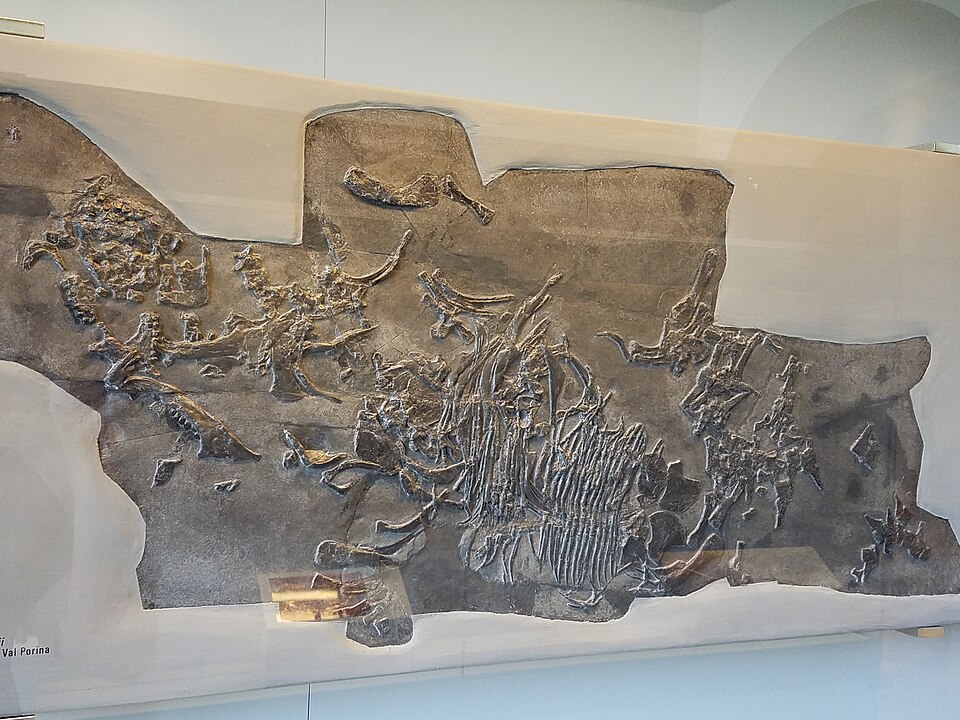
The Monte San Giorgio locality, a UNESCO World Heritage Site straddling the border between Switzerland and Italy, has produced an exceptionally rich Middle Triassic marine vertebrate fauna that includes multiple placodont genera alongside pachypleurosaurs, nothosaurs, and a diverse assemblage of fishes.8, 9 The fine-grained bituminous shales of Monte San Giorgio preserved these animals in exquisite detail, providing much of the anatomical data on which placodont systematics is based.8
The shallow-water, carbonate-platform habitat preferred by placodonts was characterized by warm, clear, tropical waters with abundant benthic invertebrate communities—an ideal environment for durophagous feeders. Bone histological analyses by Scheyer indicated that placodonts had relatively dense, pachyostotic (thickened) bone, a feature common in shallow-diving marine tetrapods that use increased bone density as ballast to counteract buoyancy and facilitate bottom-feeding.15 This adaptation is consistent with a lifestyle involving prolonged periods of slow swimming or walking along the seafloor while foraging for shellfish, rather than the active, open-water swimming of contemporaneous ichthyosaurs.14, 15
Extinction at the end-Triassic
Placodonts disappeared entirely at the end of the Triassic, approximately 201 million years ago, during the end-Triassic mass extinction—one of the five major mass extinction events in Earth history. This event, linked to massive volcanism associated with the Central Atlantic Magmatic Province and the resultant global environmental perturbations including warming, ocean acidification, and marine anoxia, eliminated an estimated 76 percent of all species.12
The extinction of placodonts was part of a broader collapse of Triassic marine reptile communities. Nothosaurs, which had been the dominant marine reptile group alongside placodonts during the Middle and early Late Triassic, also disappeared at or before the end-Triassic boundary. Only the plesiosaur lineage (descended from pistosaurs) and the ichthyosaurs survived into the Jurassic to continue the sauropterygian and marine reptile radiations.12, 14 The loss of placodonts left the durophagous marine reptile niche vacant for millions of years until it was eventually filled, in part, by certain lineages of turtles and, much later, by specialized teleost fishes.14
The restriction of placodonts to shallow Tethyan carbonate platforms may have made them particularly vulnerable to the end-Triassic environmental changes. Ocean acidification would have directly impacted the calcifying invertebrate communities on which placodonts depended for food, while the disruption of shallow marine ecosystems by anoxic events and temperature fluctuations would have further degraded their habitat.12 Their narrow geographic range and ecological specialization, which had sustained them throughout the Triassic, ultimately proved to be liabilities when the environmental conditions that supported their way of life were disrupted on a global scale.12, 14
References
The cranial anatomy of Placodus gigas and a model for the skull architecture of placodonts
A new pachypleurosaur (Reptilia: Sauropterygia) from the Middle Triassic of Monte San Giorgio, Switzerland
Psephoderma alpinum (Sauropterygia, Placodontia) from the Late Triassic of Lombardy, northern Italy
A new cyamodontoid placodont from the Late Triassic of Spain provides new insights on the acquisition of the armoured body plan in Placodontia