Overview
- Pachycephalosauria was a clade of bipedal ornithischian dinosaurs characterized by dramatically thickened skull roofs, ranging from a few centimeters in basal flat-headed forms like Homalocephale to over 20 centimeters of solid bone in the dome-headed Pachycephalosaurus wyomingensis, the largest known member at an estimated 4.5 meters in length.
- The long-assumed head-butting function of the pachycephalosaur dome has been challenged by biomechanical analyses showing the rounded dome would deflect direct impacts and by histological studies revealing that juveniles possessed flat skulls that developed domes only at maturity, suggesting the thickened cranium may have functioned primarily in species recognition or flank-butting rather than direct cranial combat.
- Pachycephalosaurs belonged to Marginocephalia alongside ceratopsians, were distributed across Late Cretaceous North America and Asia with rare occurrences elsewhere, and the genera Stygimoloch and Dracorex are now widely interpreted as juvenile and subadult growth stages of Pachycephalosaurus rather than distinct species, dramatically reducing the apparent diversity of the group.
Pachycephalosauria, the "thick-headed lizards," comprises a distinctive clade of bipedal ornithischian dinosaurs defined by their dramatically thickened skull roofs—a feature that has captivated paleontologists and the public alike since the first fragmentary remains were described in the late nineteenth century.3, 13 Ranging in size from small, turkey-sized forms to the approximately 4.5-meter-long Pachycephalosaurus wyomingensis, these herbivorous or possibly omnivorous dinosaurs are known almost exclusively from the Late Cretaceous of North America and Asia, with rare, fragmentary occurrences reported from Europe and possibly the Southern Hemisphere.9, 11 As members of Marginocephalia—the ornithischian group that also includes the ceratopsians—pachycephalosaurs share a common ancestor with the horned dinosaurs, united by a distinctive bony shelf at the posterior margin of the skull, though the two lineages diverged along radically different evolutionary trajectories.3, 15 The function of the pachycephalosaur dome, once confidently attributed to head-butting combat, has become one of the most vigorously debated topics in dinosaur paleobiology, with biomechanical, histological, and ontogenetic evidence yielding a far more nuanced picture than the simple "battering ram" hypothesis long favored in popular accounts.2, 4

Phylogenetic position and classification
Pachycephalosauria is nested within Ornithischia, specifically within the clade Marginocephalia, which unites pachycephalosaurs with ceratopsians based on the shared presence of a parietosquamosal shelf—a bony projection extending posteriorly from the skull roof over the occiput.3, 15 The monophyly of Marginocephalia has been supported by multiple phylogenetic analyses, though the exact interrelationships of basal members remain debated, with some studies recovering a polytomy near the base of the clade.3 Within Pachycephalosauria, a broad division exists between flat-headed (non-pachycephalosaurid) forms and the more derived Pachycephalosauridae, which possess the characteristic fully domed skull roof.11 However, ontogenetic studies have complicated this simple dichotomy, as several putatively flat-headed taxa may represent juveniles of dome-headed species rather than distinct lineages.2, 8
The internal phylogeny of Pachycephalosauria has proven difficult to resolve with confidence, partly because the group is known predominantly from cranial material, with postcranial skeletons being rare and often incomplete.11, 13 Paul Sereno's broad-scale dinosaur phylogenies placed Pachycephalosauria as the sister group to Ceratopsia within Marginocephalia, a relationship that remains the consensus view.13 Within Pachycephalosauridae, Stegoceras validum from the Campanian of Alberta has traditionally served as the reference taxon, with more derived North American forms such as Pachycephalosaurus and Sphaerotholus grouped in a more exclusive clade.1, 11
The thickened skull dome
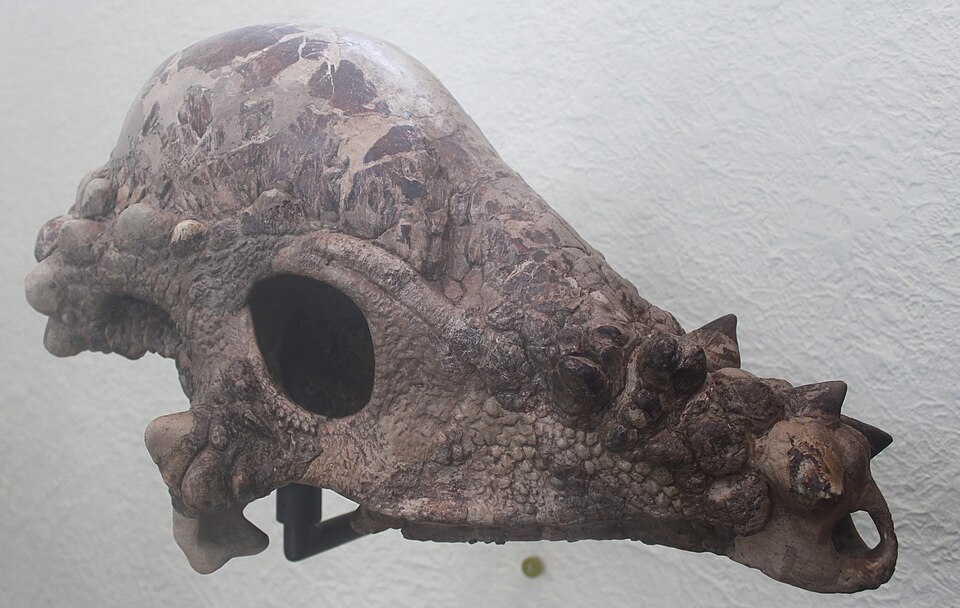
The defining feature of pachycephalosaurs is the frontoparietal dome—a massive thickening of the bones forming the skull roof that ranges from modest swelling in basal forms to an extraordinary mass of solid bone exceeding 20 centimeters in thickness in Pachycephalosaurus wyomingensis.2, 12 In fully domed taxa, the frontals and parietals are fused into a single continuous unit of dense, avascular bone, often surrounded by a peripheral ring of bony nodes and, in some species, prominent horn-like projections along the squamosal and posterior skull margin.2, 11 The dome surface is typically smooth and convex in adults, lacking the sutures visible in juvenile specimens, where the individual cranial bones remain distinguishable.2
Histological thin sections of pachycephalosaur domes have revealed a complex internal architecture. Goodwin and Horner's landmark 2009 study demonstrated that the dome is composed of metaplastic bone—tissue that forms directly within the dermis without a cartilaginous precursor—and that the internal structure changes dramatically through ontogeny.2 Juvenile pachycephalosaurs possess relatively flat, porous skull roofs with open vascular channels, while subadults show progressive infilling and thickening, and fully mature individuals exhibit dense, largely avascular bone throughout the dome.2, 8 This ontogenetic trajectory has profound implications for taxonomy, as it suggests that flat-headed specimens previously assigned to separate genera may simply represent immature growth stages of dome-headed species.8
The head-butting debate
For decades, the standard interpretation of the pachycephalosaur dome was that it served as a biological battering ram, enabling males to engage in head-to-head combat analogous to that of modern bighorn sheep or muskoxen.4 This hypothesis was intuitively appealing: the dome is composed of unusually dense bone, positioned at the apex of the skull, and in some species the neck vertebrae appear robust enough to transmit axial forces.4, 12 However, a series of biomechanical and histological investigations beginning in the early 2000s has substantially undermined the simple head-butting model.
Snively and Cox's 2008 biomechanical analysis, using finite element modeling and multibody dynamics simulations of the pachycephalosaur head and neck, demonstrated that while the dome could withstand substantial compressive loads, the rounded geometry of the dome would have caused skulls to glance off one another during direct head-on impacts, making sustained head-to-head combat mechanically problematic.4 Their models showed that the cervical musculature and vertebral anatomy were better suited to delivering lateral blows to the flanks of opponents—a "flank-butting" behavior analogous to that observed in modern giraffes, which swing their necks to strike rivals with their ossicone-bearing skulls.4
Goodwin and Horner's histological work further challenged the combat hypothesis by demonstrating that the dome's internal vasculature and bone remodeling patterns are inconsistent with tissue adapted to absorb repeated high-energy impacts.2 They proposed instead that the dome functioned primarily as a species-recognition structure, with its changing morphology through growth serving to signal maturity and taxonomic identity, much as the elaborate frills and horns of ceratopsians appear to have functioned.2, 7
Nevertheless, the debate is far from settled. Peterson, Dischler, and Longrich's 2013 survey of pachycephalosaur dome pathologies found a statistically significant frequency of lesions consistent with traumatic injury—including pitting, surface erosion, and reactive bone growth—on the domes of multiple specimens, which the authors interpreted as evidence that at least some form of agonistic head-contact behavior did occur.14 Similar pathological features were identified on the type specimen of Pachycephalosaurus wyomingensis itself, including osteomyelitic lesions that may have resulted from infected wounds sustained during cranial impacts.12 The emerging consensus appears to be that pachycephalosaurs likely did use their domes in intraspecific combat, but that the behavior was more complex than simple head-on ramming—perhaps involving lateral strikes, shoving matches, or impacts directed at the body rather than the skull of an opponent.4, 14
Pachycephalosaurus wyomingensis
Pachycephalosaurus wyomingensis is the largest and most derived member of the clade, known from the Maastrichtian-age Hell Creek and Lance Formations of Montana, South Dakota, and Wyoming, placing it among the very last non-avian dinosaurs before the end-Cretaceous extinction 66 million years ago.8, 12 Estimated at roughly 4.5 meters in total length and perhaps 450 kilograms in body mass, Pachycephalosaurus possessed the most extreme dome of any known pachycephalosaur, with the frontoparietal thickening reaching over 20 centimeters in the largest specimens.12 The skull is further ornamented with a ring of bony nodes along the posterior and lateral margins and small horn-like projections on the snout, giving the animal a formidable appearance despite its herbivorous or omnivorous habits.8, 11
Despite being the namesake of the entire group, Pachycephalosaurus is known almost entirely from cranial material. No complete postcranial skeleton has been recovered, and understanding of its body proportions relies heavily on comparison with better-known relatives such as Stegoceras.1, 11 This fragmentary record is typical of pachycephalosaurs generally, whose dense skull domes preserve well in fluvial depositional environments while the more delicate postcranial elements are rarely recovered.
The Stygimoloch and Dracorex synonymy debate
Few taxonomic controversies in recent dinosaur paleontology have attracted as much attention as the proposal that Stygimoloch spinifer and Dracorex hogwartsia—two apparently distinct pachycephalosaurs from the Hell Creek Formation—are in fact growth stages of Pachycephalosaurus wyomingensis rather than separate species.8 Dracorex, described in 2006 by Bakker and colleagues, was a striking animal with an essentially flat skull roof adorned with prominent spikes and horns, while Stygimoloch, named in 1983, possessed a partially domed skull with elongated horn clusters projecting from the squamosal region.5, 7
In a landmark 2009 study, Horner and Goodwin proposed that these three "genera" represent a single ontogenetic series: Dracorex as the juvenile stage, with a flat, ornamented skull; Stygimoloch as the subadult, with an incipient dome and resorbing horns; and Pachycephalosaurus as the fully mature adult, with a massive dome and reduced peripheral ornamentation.8 Their argument rested on histological evidence showing progressive bone remodeling patterns consistent with a single growth trajectory, the stratigraphic co-occurrence of all three morphotypes in the same formation, and the absence of adult-sized specimens referable to either Dracorex or Stygimoloch.2, 8
This hypothesis has not been universally accepted. Some researchers have pointed to differences in horn morphology and skull proportions that they argue are unlikely to result from ontogenetic variation alone, and the absence of intermediate specimens bridging the Stygimoloch–Pachycephalosaurus gap has been noted as a weakness.5, 11 Nevertheless, the synonymy hypothesis has gained broad support and is now the majority view among pachycephalosaur specialists, with the implication that the true diversity of latest Cretaceous pachycephalosaurs in North America was significantly lower than previously assumed.8, 14
Flat-headed forms
Not all pachycephalosaurs possessed the fully developed dome that defines the most derived members of the clade. Several taxa retained relatively flat or only modestly thickened skull roofs, and these flat-headed forms are critical for understanding the evolutionary origin and early diversification of the group.10, 11
Homalocephale calathocercos, described by Maryańska and Osmólska in 1974 from the Campanian–Maastrichtian Nemegt Formation of Mongolia, is the best-known flat-headed pachycephalosaur and one of the few members of the group represented by substantial postcranial material.10 Its broad, flat skull roof and relatively wide body have been interpreted as indicating a more generalized body plan closer to the ancestral pachycephalosaur condition.10, 15 However, the ontogenetic reinterpretation of Dracorex and Stygimoloch has raised the possibility that Homalocephale too may represent a juvenile of a dome-headed form, perhaps the contemporaneous Prenocephale prenes, though this remains unconfirmed.2
Stegoceras validum from the Campanian Dinosaur Park Formation of Alberta occupies an intermediate position, possessing a moderately domed skull that is neither fully flat nor as massively thickened as that of Pachycephalosaurus.1 Stegoceras is one of the most completely known pachycephalosaurs, with multiple specimens preserving both cranial and postcranial elements, and it has served as the primary reference taxon for understanding the basic body plan of the group.1, 11 At approximately 2 meters in length and an estimated 10–40 kilograms in body mass, it was a small, lightly built biped with relatively long hindlimbs, short forelimbs, and a stiffened tail that may have functioned as a counterbalance during locomotion.1
Body plan and locomotion
Beyond their remarkable skulls, pachycephalosaurs shared a broadly consistent body plan: small to medium-sized bipedal herbivores with relatively short forelimbs, long hindlimbs, and a stiffened tail reinforced by ossified tendons along the caudal vertebrae.10, 13 The torso was broad and barrel-shaped, suggesting a voluminous gut consistent with herbivorous habits, while the limb proportions indicate cursorial capability—these were animals built for running, not for slow, ponderous locomotion.10 The hands were small and apparently not used in locomotion, while the feet were robust, three-toed structures typical of bipedal ornithischians.10, 13
The vertebral column shows several specializations potentially related to dome function. The cervical vertebrae in dome-headed forms are relatively robust with well-developed neural spines, suggesting powerful neck musculature, while the anterior dorsal vertebrae show features consistent with transmitting axial loads from the head through the spine.4 Snively and Cox interpreted these features as adaptations for delivering powerful blows with the head, whether directed at rivals or predators, while Goodwin and Horner viewed them as consequences of supporting an increasingly heavy skull rather than evidence for impact behavior per se.2, 4
Feeding ecology
Pachycephalosaurs possessed small, leaf-shaped teeth with coarse denticles, set in relatively short jaws that suggest a selective feeding strategy rather than bulk processing of vegetation.10, 15 The dentition is heterodont to a modest degree, with slightly enlarged, sometimes caniniform premaxillary teeth in some species, leading to speculation that pachycephalosaurs may have been omnivorous, supplementing a primarily herbivorous diet with insects, small vertebrates, or eggs.15 The jaw mechanics were simple compared to the sophisticated chewing apparatus of contemporaneous hadrosaurs and ceratopsians, with a primarily orthal (up-and-down) jaw stroke and limited capacity for transverse grinding.10, 15
As bipedal animals of modest stature, pachycephalosaurs would have fed at a relatively low browsing height, occupying a distinct ecological niche in the rich herbivore communities of the Late Cretaceous.13 In formations such as the Hell Creek and Dinosaur Park, they coexisted with much larger herbivores including ceratopsids, hadrosaurids, and ankylosaurs, and their small body size and presumed selectivity would have minimized direct competition with these megaherbivores.1, 13
Geographic and temporal distribution
Pachycephalosaurs are known with certainty from the Late Cretaceous, with the vast majority of described species dating to the Campanian and Maastrichtian stages (approximately 84–66 million years ago).11, 13 Their geographic distribution is heavily concentrated in two regions: western North America (particularly the formations of Laramidia, the western subcontinent created by the Western Interior Seaway) and eastern Asia, primarily Mongolia and China.6, 10, 11 This biogeographic pattern is shared with ceratopsians, their marginocephalian sister group, and likely reflects the intermittent land connections between Asia and North America via Beringia during the Late Cretaceous.3, 13
A small number of putative pachycephalosaur occurrences have been reported from outside these core regions. Grigorescu described fragmentary material from the Maastrichtian of Romania's Hațeg Basin as the first European pachycephalosaur, though its referral to the clade has been questioned by some workers.9 Claims of pachycephalosaur material from the Southern Hemisphere remain even more tentative, and the group appears to have been fundamentally a Laurasian radiation.11 All known pachycephalosaurs perished in the end-Cretaceous mass extinction, with Pachycephalosaurus wyomingensis among the very last surviving members, found in the uppermost beds of the Hell Creek Formation just below the Chicxulub impact boundary.8, 12
Paleobiological significance
Pachycephalosaurs occupy an outsized place in paleobiological discourse relative to their modest diversity and fragmentary fossil record. The dome-function debate has served as a case study in the application of biomechanical modeling, bone histology, and ontogenetic analysis to questions of dinosaur behavior—demonstrating that superficially obvious functional interpretations often crumble under rigorous quantitative scrutiny.2, 4 The Stygimoloch–Dracorex–Pachycephalosaurus synonymy hypothesis has become a textbook example of how extreme ontogenetic change can inflate apparent taxonomic diversity, with implications extending far beyond Pachycephalosauria to the broader question of how many dinosaur "species" in the fossil record are actually growth stages of already-named taxa.8
As the sister group to Ceratopsia within Marginocephalia, pachycephalosaurs also provide a critical outgroup for understanding the explosive radiation of ceratopsians in the Late Cretaceous.3, 15 The contrast between the two clades is striking: while ceratopsians diversified into dozens of species spanning a vast range of body sizes and ecological roles, pachycephalosaurs remained a comparatively low-diversity lineage of small to medium-sized bipeds throughout their evolutionary history.11, 13 Understanding why these sister clades followed such divergent evolutionary trajectories remains an open question, and one that speaks to fundamental processes governing clade dynamics, niche partitioning, and the role of key innovations in driving adaptive radiation in the dinosaurian world.3, 13
References
A new pachycephalosaurid from the Upper Cretaceous of Montana, with comments on the genus Stegoceras
Cranial histology of Pachycephalosauria (Ornithischia: Marginocephalia) and the evolution of the pachycephalosaurid dome
Multibody dynamics model of head and neck function validates former function of pachycephalosaur skulls
Dracorex hogwartsia, n. gen., n. sp., a spiked, flat-headed pachycephalosaurid dinosaur from the Upper Cretaceous Hell Creek Formation of South Dakota
Texacephale langstoni, a new genus of pachycephalosaurid (Dinosauria: Ornithischia) from the upper Campanian Aguja Formation, southern Texas, USA
The first pachycephalosaur (Dinosauria: Ornithischia) from the Upper Cretaceous of Europe
A new pachycephalosaurine from the Upper Cretaceous of Asia and the phylogeny of Pachycephalosauria