Overview
- The Permian period (299–252 Ma) hosted the most ecologically sophisticated terrestrial ecosystems yet seen on Earth, dominated by synapsids — the mammal-line amniotes — which progressed from fin-backed pelycosaurs such as Dimetrodon in the early Permian to diverse therapsid communities of dicynodonts, gorgonopsians, and cynodonts in the late Permian, forming the first large-bodied herbivore–predator guilds on land.
- Permian marine ecosystems were structured around vast brachiopod beds, rugose and tabulate coral reefs, fusulinid foraminifera, crinoid meadows, and diverse sharks, while the southern supercontinent Gondwana supported a distinctive cold-adapted flora dominated by the seed fern Glossopteris whose distribution across separated continents would later become foundational evidence for plate tectonics.
- The end-Permian mass extinction approximately 251.9 million years ago erased roughly 90 percent of all species — the greatest biotic catastrophe in Earth’s history — collapsing both the marine and terrestrial ecosystems that had taken tens of millions of years to assemble.
The Permian period, spanning approximately 299 to 252 million years ago, represents a pivotal and deeply eventful chapter in the history of life. It opened in the aftermath of the Carboniferous coal forests’ collapse, inheriting a world in climatic transition, and it closed in the most catastrophic mass extinction the biosphere has ever endured. In between those two catastrophic bookends lay nearly 50 million years of ecological innovation: the rise of the first large-bodied terrestrial herbivore–carnivore guilds, the diversification of seed plants across every climate zone, the construction of rich marine reef and seafloor communities, and the radiation of synapsids — the mammal-line amniotes — into forms of extraordinary variety. Understanding Permian life means understanding both what evolution had already achieved by the late Paleozoic and how completely that achievement could be undone.1, 3

The Permian world: Pangaea, climate, and geography
By the start of the Permian, the long collision between the northern landmass Laurussia and the southern supercontinent Gondwana had effectively completed the assembly of Pangaea, a single landmass spanning from pole to pole and covering nearly one-third of Earth’s surface. The global ocean Panthalassa dominated the remaining two-thirds of the planet, with a large embayment — the Paleo-Tethys Sea — opening to the east and separating the northern (Laurasian) and southern (Gondwanan) portions of Pangaea at low to mid-latitudes. This geography had profound consequences for climate and for the distribution of life.3, 5
The assembly of a single supercontinent created an extreme continental climate across Pangaea’s vast interior. Moisture from the ocean could not penetrate far inland; the result was a belt of intense aridity across the equatorial and subtropical regions of the landmass, punctuated by seasonal monsoons of exceptional ferocity. Climate modelling by Tabor and Poulsen (2008) reconstructed the Pangaean megamonsoon — a system driven by the thermal contrast between the vast continental interior and the surrounding ocean — as producing wet summers and extreme dry seasons at low latitudes, with interior deserts receiving less than 200 millimetres of annual precipitation.5 Red beds (oxidised fluvial sediments), evaporites, and aeolian sandstones deposited across wide swaths of Permian Pangaea corroborate this picture of widespread aridity.
The early Permian, however, was not uniformly warm. The Late Paleozoic Ice Age, which had begun in the Carboniferous, persisted into the early Permian. Gondwana’s polar regions — comprising what are now Antarctica, southern South America, southern Africa, India, and Australia — bore continental ice sheets throughout the Cisuralian epoch (299–272 Ma), and glacial–interglacial cycles drove substantial sea-level fluctuations that structured both marine and coastal terrestrial environments.4, 11 Deglaciation accelerated through the middle Permian, and by the Lopingian epoch (259–252 Ma) Pangaea had transitioned to a broadly warmer, drier world, though latitudinal climate gradients remained strong. This progressive warming set the stage for the biological changes that would culminate at the period’s end.
Permian plants: conquest of a drying world
The plant communities of the Permian reflect the period’s strong climatic regionalism. In the tropical and subtropical zones of northern Pangaea (Euramerica), the coal swamp flora of the Carboniferous — dominated by arborescent lycopsids and tree ferns — had largely collapsed by the earliest Permian in response to increasing aridity, a transition documented by DiMichele, Pfefferkorn, and Gastaldo (2001) as one of the most abrupt vegetation turnovers in the plant fossil record.23 In its place arose a more drought-tolerant assemblage of seed ferns (pteridosperms), early conifers, and cycad-like plants (cycadeoids and true cycads) adapted to seasonal rainfall regimes. Conifers, which had appeared in the late Carboniferous, diversified markedly through the Permian and became dominant in many mid-latitude and upland habitats. Their needle-like leaves, thick waxy cuticles, and water-efficient wood anatomy were refinements well-suited to the increasingly arid Pangaean interior.21
The most ecologically and scientifically significant Permian flora was the Glossopteris flora of Gondwana. Glossopteris was a tongue-leaved seed fern whose fossils — broad, distinctive fronds with reticulate venation — are found in Permian strata across all five southern continents. The distribution of Glossopteris across landmasses now separated by thousands of kilometres of ocean was one of the observations that convinced Alfred Wegener of continental drift, and the flora remains a cornerstone of Gondwanan palaeobiogeography.12 Glossopteris trees grew at high southern latitudes, enduring months of polar darkness and seasonal cold. Growth rings in their fossil wood, preserved in Permian deposits of Antarctica and South Africa, indicate strong seasonal growth rhythms unlike anything in the tropical north. This flora supported a distinctive terrestrial fauna, including the dicynodont and therapsid communities of the Karoo Basin, discussed below.
In the northern equatorial region, the warm-temperate Cathaysian flora (of what is now China and southeast Asia, then a separate island continent) maintained a lush, humid flora with tree ferns and lycopsids persisting longer than elsewhere, forming a distinctive phytogeographic province separated from the Gondwanan and Euramerican floras by broad seaways. This tripartite division of Permian global vegetation into Euramerican, Gondwanan, and Cathaysian provinces reflects the palaeoclimatic zonation of Pangaea and demonstrates that even a single supercontinent harbours profound biogeographic structure.23, 3
Synapsid dominance: the first age of large terrestrial vertebrates
The Permian is the period in which vertebrate life on land first achieved the ecological structure familiar from later periods: large herbivores cropping vegetation, large predators hunting them, and a range of smaller insectivores and omnivores occupying the interstices. The architects of this structure were the synapsids — amniotes characterised by a single temporal fenestra (opening in the skull behind the eye socket) and distinguished from the other major amniote lineage, the reptiles, by features of their skull and postcranial skeleton. Every mammal alive today is a synapsid, and the Permian record of this group is the deep root of our own evolutionary history. The full story of their anatomical transformation into mammals is covered in Synapsid-to-mammal transition; here the focus is their ecological role in Permian ecosystems.7
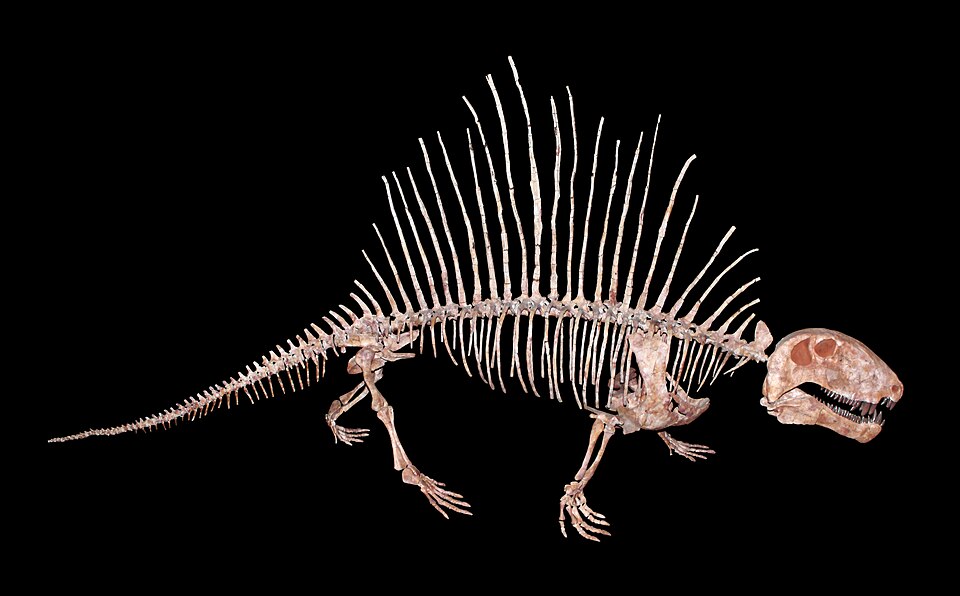
The early Permian (Cisuralian epoch, 299–272 Ma) was dominated by pelycosaurs — a paraphyletic grade of basal synapsids that retained a more sprawling gait and simpler dentition than their therapsid successors. The most iconic pelycosaur, Dimetrodon, is often mistakenly grouped with dinosaurs in popular culture, but it is in fact far more closely related to humans. Dimetrodon was an apex predator in its North American and European communities, reaching body lengths of up to 3.5 metres, and bore an elaborate dorsal sail formed by elongated neural spines from the vertebrae. The function of this sail has been debated for over a century; hypotheses include thermoregulation (as a heat-absorbing or heat-dissipating surface), intraspecific display, or a combination of both. The sail is well-vascularised in some interpretations of integumentary evidence, consistent with a circulatory thermoregulatory role.6, 7 Other pelycosaurs included the herbivorous edaphosaurids (which independently evolved a sail similar to that of Dimetrodon), representing one of the earliest large terrestrial herbivores, and smaller caseid herbivores with barrel-shaped torsos adapted for processing large volumes of low-quality plant material.
By the middle Permian (Guadalupian epoch, 272–259 Ma) the pelycosaur-grade synapsids had been replaced across most of Pangaea by the therapsids, a more advanced clade that includes the direct ancestors of mammals. Therapsids exhibited a more erect hindlimb posture than pelycosaurs, more differentiated teeth (incisors, canines, and postcanine teeth functionally analogous to molars), and a general trend toward more mammal-like cranial anatomy. Their ecological diversity was extraordinary.2
The dicynodonts — a group of herbivorous therapsids — became the dominant large plant-eaters of the late Permian, arguably the most successful large terrestrial herbivores of the entire Paleozoic era. Most dicynodonts bore a pair of enlarged upper canine tusks (from which the group takes its name, meaning “two dog-teeth”) and a horny, toothless beak covering much of the jaw, an arrangement that allowed efficient cropping and shearing of tough plant material including the fibrous stems of Glossopteris and related seed ferns. Dicynodonts ranged in size from rabbit-sized forms to large animals approaching cattle in bulk, and their fossils are found on every continent that bore the Gondwanan flora, making them one of the most geographically widespread vertebrate groups of the Paleozoic.8
Preying upon the dicynodonts and other herbivores were the gorgonopsians, a clade of large-bodied predatory therapsids with sabre-like canine teeth exceeding 10 centimetres in length in the largest genera such as Inostrancevia and Dinogorgon. Kammerer (2016) reviews the gorgonopsians as the dominant apex predators of the late Permian Pangaean landmass, filling the ecological role that would later be occupied by large theropod dinosaurs and ultimately by saber-toothed cats and other large mammalian predators.9 Gorgonopsians are known almost exclusively from late Permian (Lopingian) deposits of the Karoo Basin of South Africa and the Russian Cis-Uralian region, and their extinction at the Permian–Triassic boundary left the apex predator niche empty for millions of years.
A third major therapsid group, the cynodonts, appeared in the late Permian and would ultimately give rise to mammals. Early Permian cynodonts were modest-sized insectivores or small carnivores, but they already exhibited several features that distinguish mammals from other vertebrates: complex, multicusped postcanine teeth, a dentary bone greatly enlarged relative to the other lower jaw elements, and an inferred secondary palate separating the nasal and oral passages. Hopson (1994) emphasises that even the most primitive cynodonts show a constellation of features suggesting elevated metabolic rates, possibly including some degree of endothermy, which would have given them a thermoregulatory advantage in the cooler southern environments of Gondwana where many early cynodonts lived.10
Major synapsid groups and their Permian temporal ranges2, 7
The Karoo Basin of South Africa is the world’s premier window into late Permian terrestrial vertebrate life. Kilometres of red and green mudstones and fluvial sandstones, deposited by ancient river systems draining the interior of Gondwana, preserve fossils of dicynodonts, gorgonopsians, cynodonts, therocephalians, and early reptiles in extraordinary abundance and stratigraphic resolution. Rubidge (2006) summarises the Karoo as providing a nearly continuous record of vertebrate community composition through the late Permian and into the early Triassic, making it uniquely valuable for understanding how the end-Permian extinction unfolded on land and how communities recovered afterwards.24
Permian marine life: reefs, seafloors, and open water
While synapsids dominated the land, Permian seas harboured their own intricate web of life. The shallow shelves of the Paleo-Tethys and Panthalassa hosted some of the most productive marine ecosystems of the Paleozoic, structured around a diverse cast of invertebrates whose descendants would be almost entirely eliminated at the period’s end.
Among the most conspicuous members of Permian seafloor communities were the brachiopods, particularly the productids — a group of spiny, often cemented brachiopods that formed dense beds on carbonate platforms throughout the Tethys and Panthalassa. Productids achieved extraordinary diversity during the Permian, with some genera developing elongated spines that anchored them to soft sediments, effectively replacing bivalves as the dominant sedentary filter-feeders in many environments. Clapham and colleagues (2008) document peak brachiopod diversity during the Guadalupian, when several hundred genera inhabited Tethyan reefs and shelves, and note the strongly provincial nature of Permian brachiopod faunas, with distinct assemblages in the cool-water Gondwanan shelves and the warm Tethyan tropics.13
Permian reefs were built primarily by calcareous sponges (calcareous demosponges and sphinctozoan sponges) together with bryozoans, with rugose corals and tabulate corals contributing to reef frameworks in many localities. The Guadalupian reef systems of the Permian Basin of West Texas and New Mexico, now exposed in the Guadalupe Mountains, represent the best-studied example of a Permian reef complex: a fringing and barrier reef system extending for hundreds of kilometres around an evaporite basin, with back-reef, reef-crest, and fore-reef zones each supporting distinct biological communities. Kiessling and colleagues (2000) analysed global Permian reef distribution and noted that reef construction was vigorous through the Guadalupian but contracted sharply during the Lopingian, suggesting marine ecosystem stress preceded the final end-Permian crisis by several million years.15
Fusulinid foraminifera were among the most ecologically and stratigraphically significant Permian organisms. These single-celled protists constructed elaborate, elongated or spherical shells (tests) of calcite that could reach several centimetres in length — giant by foraminiferal standards — and accumulated in enormous numbers in Tethyan carbonates, often forming distinctive bioclastic limestones visible in outcrop. Fusulinids are among the most precise biostratigraphic tools available for the Permian: their rapid evolution and distinctive test morphologies allow geologists to correlate rock sequences across Tethyan regions with a resolution of hundreds of thousands of years.14 Their complete extinction at the Permian–Triassic boundary is one of the sharpest and most globally consistent signals of the end-Permian mass extinction in the marine record.
Crinoids — stalked echinoderms related to modern sea lilies — formed dense meadows on Permian seafloors in both the Tethys and Panthalassa, often in association with brachiopod beds. Their disarticulated columnals are among the most common macrofossils in Permian limestones. Sharks and other cartilaginous fishes diversified markedly during the Permian following the extinctions of the late Devonian, with hybodont sharks emerging as ecologically versatile predators found in marine, brackish, and freshwater settings. Grogan and Lund (2008) review Permian chondrichthyan diversity, highlighting the abundance of petalodont and edestid sharks, several of which achieved large body sizes and occupied apex-predator roles in open-water ecosystems.16
Permian insects and freshwater life
Insects had already achieved remarkable diversity during the Carboniferous, including the giant griffinflies (Meganeura and relatives) whose wingspans exceeded 70 centimetres in a hyperoxic atmosphere. The transition into the Permian brought changes: as atmospheric oxygen fell from its Carboniferous peak of approximately 35 percent toward values of roughly 23–24 percent by the mid-Permian, the largest flying insects declined in maximum body size. Clapham and Karr (2012) document this size reduction in the early Permian insect record as consistent with the oxygen hypothesis for insect size limitation, though they note that ecological factors — particularly the diversification of predatory flying insects — likely reinforced the trend.17
Despite this reduction in maximum size, Permian insects were far from depauperate. The period witnessed the continued diversification of Paleozoic orders including the blattodeans (cockroach-relatives), orthopterans (cricket and grasshopper relatives), and hemipterans (true bugs), as well as the appearance of wholly new lineages. Among the most consequential of these origins was the emergence of the Coleoptera — the beetles. Beutel and Haas (2000) place the origin of Coleoptera in the Permian, making them the oldest surviving holometabolous insect order with a confirmed Permian fossil record. Beetles would go on to become the most species-rich animal order on Earth, and their origin in the Permian marks the beginning of a radiation that would take tens of millions of years to reach its Mesozoic and Cenozoic peaks.18
Freshwater ecosystems of the Permian were populated by a mix of fishes (including palaeoniscoid ray-finned fishes and lungfishes), amphibians (the temnospondyls, large and small), aquatic insects, and early freshwater bivalves. Temnospondyl amphibians had been important components of aquatic ecosystems since the Carboniferous and remained ecologically significant in Permian freshwater environments, particularly in the wetter regions of Gondwana where large fluvial systems persisted year-round. These systems served as corridors along which terrestrial vertebrates dispersed across Pangaea, connecting the riverine environments of South Africa’s Karoo Basin with those of Russia’s Cis-Uralian region through shared drainage networks.22
The end of the Permian world
The Permian ecosystems described above — diverse, ecologically structured, the product of tens of millions of years of evolution — were nearly completely erased in geological terms. The Permian-Triassic extinction approximately 251.9 million years ago is the most severe biotic crisis in the history of complex animal life. Shen and colleagues (2011) calibrated the extinction horizon at the Meishan section in China to within a few tens of thousands of years, revealing a catastrophically rapid collapse that eliminated an estimated 90 percent of all marine species and 70 percent of terrestrial vertebrate species.19, 20
In the oceans, the productid brachiopods, fusulinid foraminifera, rugose corals, tabulate corals, and most crinoid lineages were wiped out entirely. The Permian reef ecosystems, built over millions of years by calcareous sponges and bryozoans, collapsed and were not replaced for some 10 million years into the Triassic. The selectivity of the extinction in marine invertebrates, analysed by Knoll and colleagues, was not random: taxa with limited ability to buffer body fluids against changes in seawater chemistry — such as brachiopods and echinoderms — suffered disproportionately, consistent with ocean acidification and deoxygenation as proximate kill mechanisms.20
On land, the gorgonopsians disappeared entirely. The dicynodonts, so dominant a few million years before, were reduced to a handful of survivor lineages that limped into the Triassic. The elaborate community structures of the Karoo — multiple trophic levels, diverse size classes, ecological specialisations accumulated over tens of millions of years — were replaced by low-diversity disaster assemblages dominated by a single small dicynodont, Lystrosaurus, whose abundance in basal Triassic Karoo sediments borders on the monotonous. The plants of the Glossopteris flora vanished; the entire phytogeographic province that had defined Gondwanan terrestrial ecosystems for 50 million years ceased to exist.24, 20
The primary driver of this catastrophe was the eruption of the Siberian Traps, a flood basalt province of continental scale, whose intrusion into organic-rich sedimentary basins released cascading volumes of carbon dioxide, methane, and halocarbons. The resulting greenhouse warming, ocean acidification, and widespread anoxia acted simultaneously on ecosystems already stressed by the progressive warming and aridification of late Permian Pangaea. What the Permian period ultimately teaches is that even the most ecologically sophisticated, widely distributed, and evolutionarily robust communities are not permanent fixtures — they are contingent assemblages, perpetually vulnerable to the deep-time forces of planetary-scale volcanism and climate disruption. The synapsids, the reefs, the Glossopteris forests, the fusulinid seas: all were built over geological epochs and unmade in what amounts, in Earth’s long calendar, to a moment.19, 20
References
Dimetrodon is not a dinosaur: using tree thinking to understand the ancient relatives of mammals and their evolution
Gondwana glaciation, clastic deposition and sea-level changes in the Permian of the Tethys
Fusulinid foraminifera as biostratigraphic and palaeobiogeographic tools in the Permian
The Karoo Basin of South Africa: a window on late Paleozoic–early Mesozoic vertebrate evolution