Overview
- The evolution of the amniotic egg during the Late Carboniferous, approximately 312 to 320 million years ago, freed vertebrates from dependence on water for reproduction and enabled the colonization of fully terrestrial environments.
- The earliest known reptiles, including Hylonomus lyelli and Paleothyris acadiana from the Carboniferous coal forests of Nova Scotia, were small insectivorous animals whose fossils preserve the oldest direct evidence of the amniote body plan.
- The rapid divergence of amniotes into synapsids and reptiles (including diapsids) during the Late Carboniferous and Permian established the two great lineages that would respectively give rise to mammals and to dinosaurs, birds, and modern reptiles.
The emergence of reptiles during the Late Carboniferous period, approximately 312 to 320 million years ago, represents one of the most consequential transitions in vertebrate history. While the earlier fish-to-tetrapod transition had brought vertebrates onto land, these early amphibian-grade tetrapods remained tied to water for reproduction, much as modern frogs and salamanders are today. The evolution of the amniotic egg — a self-contained reproductive structure with protective membranes and a shell that prevents desiccation — liberated vertebrates from this aquatic constraint and opened the vast interior of the Carboniferous continents to permanent terrestrial colonization.4, 8 From this innovation arose the two great amniote lineages: the synapsids, which would eventually give rise to mammals, and the reptiles (sauropsids), whose descendants include lizards, turtles, crocodilians, dinosaurs, and birds.
The amniotic egg and terrestrial reproduction
The defining feature of the Amniota — the clade that includes all reptiles, birds, and mammals — is the amniotic egg, a complex reproductive structure that permits embryonic development entirely on land. The amniotic egg contains several extraembryonic membranes: the amnion, which encloses the embryo in a fluid-filled cavity; the chorion, which surrounds the entire contents and facilitates gas exchange; the allantois, which stores metabolic waste and participates in respiration; and the yolk sac, which provides nutrients. Together, these membranes create a self-sustaining aquatic microenvironment for the developing embryo, eliminating the need for an external body of water.6, 4
The amniotic egg almost certainly evolved in a terrestrial context, as phylogenetic and ecological analyses indicate that the earliest amniotes were small, fully land-dwelling animals. Because egg membranes do not fossilize readily, the timing of this innovation must be inferred from the fossil record of animals that possessed other amniote characteristics — including skeletal features such as robust limb girdles, a consolidated braincase, and distinctive skull proportions — rather than from direct preservation of the egg itself.3, 6 Molecular clock estimates and the stratigraphic range of the earliest known amniote fossils together suggest that the amniotic egg evolved by approximately 320 to 310 million years ago, during the Bashkirian to Moscovian stages of the Pennsylvanian.8, 15
The earliest known reptiles
The oldest undisputed reptile fossils come from the famous Joggins Fossil Cliffs of Nova Scotia, Canada, a UNESCO World Heritage Site that preserves a remarkable record of Late Carboniferous terrestrial ecosystems.14 Hylonomus lyelli, described by John William Dawson in 1860 and later studied in detail by Robert Carroll, is widely regarded as the oldest known reptile, dating to approximately 312 million years ago. Multiple articulated skeletons of Hylonomus have been recovered from within the hollow stumps of fossilized lycopsid trees (Sigillaria), where the small animals apparently became trapped and died.1 Hylonomus was a gracile animal approximately 20 centimetres in total length, with a lightly built skull, small sharp teeth suited to an insectivorous diet, and slender limbs adapted for agile locomotion on land.1, 3
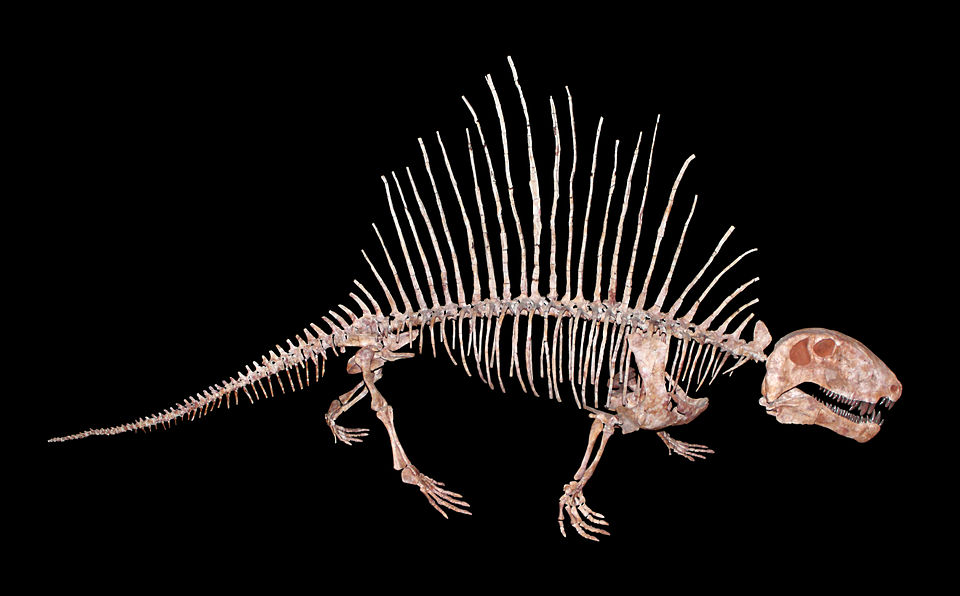

A second early reptile, Paleothyris acadiana, has been recovered from slightly younger Carboniferous deposits at the same Nova Scotian locality. Like Hylonomus, Paleothyris was a small, lizard-like animal found preserved inside hollow tree stumps. Its skull shows subtle differences in temporal region morphology that have been interpreted as representing an early stage in the diversification of reptilian skull architecture.5 Together, Hylonomus and Paleothyris demonstrate that by the middle Pennsylvanian, small amniotes had already established themselves in the coal-swamp forests that covered equatorial Pangaea, feeding on the abundant invertebrate fauna of the forest floor.1, 5, 14
The synapsid-sauropsid divergence
Phylogenetic analyses consistently place the divergence of Amniota into two major clades — Synapsida and Sauropsida (Reptilia) — very close to the origin of the group itself. Synapsids are distinguished by a single temporal fenestra (opening) in the skull behind each eye, while sauropsids primitively lack temporal fenestrae (the anapsid condition) or possess two (the diapsid condition).16, 10 This fundamental split in skull architecture reflects differences in jaw musculature and feeding mechanics that would have profound consequences for the subsequent evolution of both lineages.
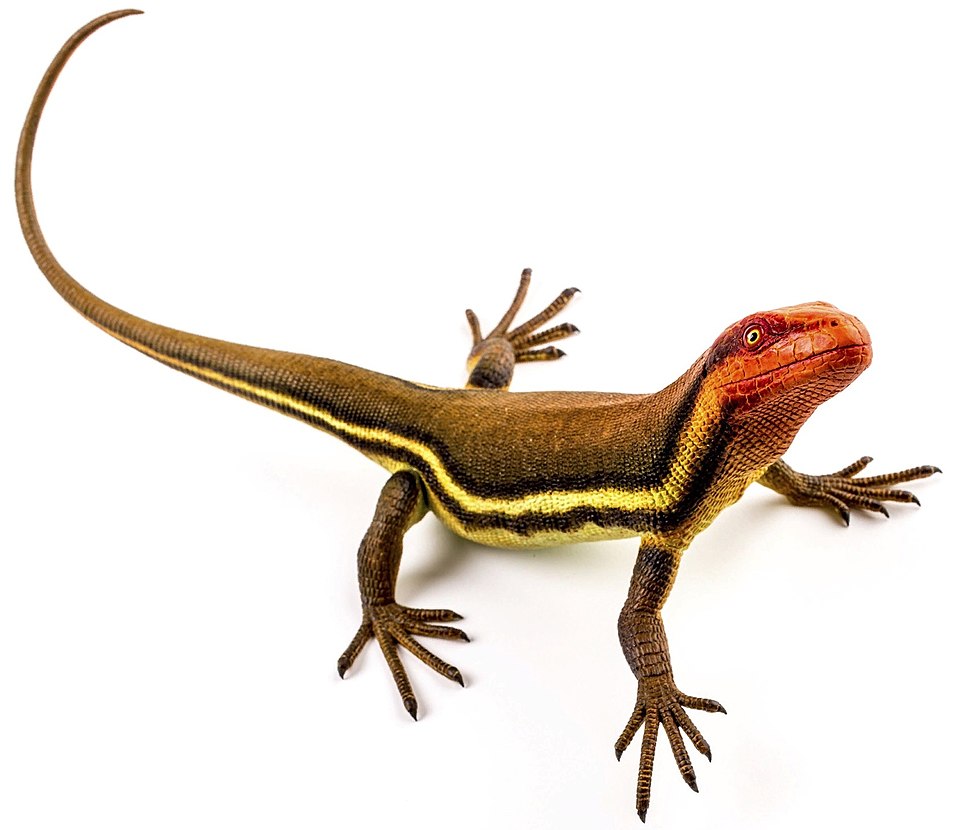
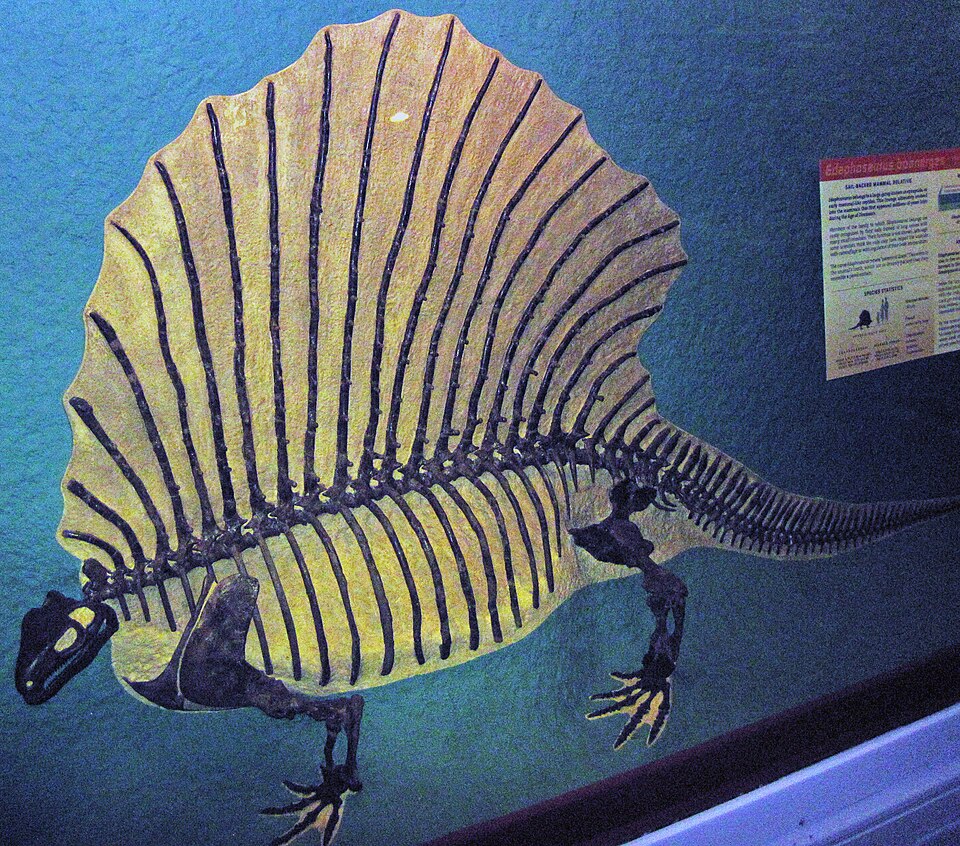
The earliest synapsids appeared in the Late Carboniferous and rapidly diversified during the Early Permian into the pelycosaurs — a paraphyletic assemblage that included the sail-backed Dimetrodon and the herbivorous Edaphosaurus. Pelycosaurs were the dominant large terrestrial vertebrates of the Early Permian, filling ecological roles as apex predators and primary consumers across the supercontinent Pangaea.9 By the Middle Permian, pelycosaurs had been largely replaced By the Middle Permian, pelycosaurs had been largely replaced by their descendants the therapsids, a more derived group of synapsids that would eventually give rise to the synapsid-to-mammal transition.12
On the sauropsid side, the earliest diapsid reptiles are known from the Late Carboniferous and Early Permian. Petrolacosaurus, from the Late Carboniferous of Kansas, is one of the oldest known diapsids, a slender, long-necked animal approximately 40 centimetres in length.9 The diapsid skull design, with its two temporal openings, proved extraordinarily successful: diapsids diversified explosively during the Permian and Triassic, giving rise to lepidosaurs (lizards and snakes), archosaurs (crocodilians, pterosaurs, dinosaurs, and birds), and numerous extinct lineages.10, 16
Permian reptile diversity
.jpg)
The Permian period (299 to 252 million years ago) witnessed a dramatic expansion of amniote diversity as both synapsids and sauropsids radiated into a wide range of body sizes and ecological niches. Terrestrial vertebrate ecosystems became increasingly complex, with multi-tiered food webs incorporating large herbivores, small insectivores, and apex predators for the first time in Earth history.13, 17 Among the sauropsids, the captorhinids — a group of anapsid reptiles — became widespread herbivores during the Early and Middle Permian, with some species developing multiple rows of crushing teeth adapted for processing tough plant material.7
Approximate body length of selected Carboniferous and Permian amniotes1, 9, 9
The Late Permian saw the rise of large-bodied therapsids, including the gorgonopsians — sabre-toothed predators that were the apex carnivores of their time — and the dicynodonts, barrel-bodied herbivores that became the most abundant terrestrial vertebrates on Earth before the end-Permian mass extinction.12, 11 This catastrophic event, approximately 252 million years ago, devastated both synapsid and sauropsid lineages, eliminating an estimated 70 percent of terrestrial vertebrate species and fundamentally reshaping the trajectory of amniote evolution.11, 17
Adaptive advantages of amniote reproduction
The success of early reptiles and their amniote relatives in colonizing terrestrial habitats rested on a suite of adaptations beyond the amniotic egg itself. The evolution of a relatively impermeable integument — thickened, keratinized skin that reduces evaporative water loss — allowed amniotes to maintain water balance in dry environments where amphibians would rapidly desiccate.6 Internal fertilization, a prerequisite for the production of a shelled egg, freed reproduction from any dependence on standing water. And modifications to the limb skeleton and musculature improved locomotor efficiency on land, enabling amniotes to exploit habitats far from the riverine and lacustrine environments to which early tetrapods had been largely confined.4, 6
These adaptations did not arise simultaneously as a single integrated package but rather accumulated over the stem lineage leading to Amniota during the Late Carboniferous. The result was a progressive decoupling of vertebrate life from aquatic habitats, a trend that continued through the Permian as amniotes spread into increasingly arid continental interiors.13, 8 The ecological release afforded by full terrestriality drove rapid diversification: by the end of the Carboniferous, amniotes had already diverged into multiple lineages occupying distinct dietary and locomotor niches, from small insectivores to larger omnivores and herbivores.13
_(Nocona_Formation,_Lower_Permian;_Archer_County,_Texas,_USA)_1.jpg)
Setting the stage for the age of dinosaurs
The evolutionary legacy of early reptiles extends far beyond the Paleozoic. The diapsid body plan that first appeared in animals like Petrolacosaurus during the Late Carboniferous provided the architectural foundation for the archosaurs — the group that would come to dominate terrestrial ecosystems during the Mesozoic era.9, 10 The end-Permian extinction cleared ecological space that archosaurs rapidly filled during the Early and Middle Triassic, and by the Late Triassic the first true dinosaurs had appeared.11, 17
The amniotic innovations that enabled small Carboniferous reptiles to survive in hollow tree stumps at Joggins — the shelled egg, keratinized skin, efficient terrestrial locomotion — were the same adaptations that, refined over 60 million years of subsequent evolution, underpinned the ecological dominance of dinosaurs, the evolution of flight in pterosaurs and birds, and the eventual radiation of mammals following the end-Cretaceous extinction. In this sense, the unassuming lizard-like animals of the Pennsylvanian coal forests represent the beginning of a lineage whose evolutionary consequences would reshape life on Earth for the next 300 million years.8, 16
References
The origin and early radiation of the therapsid mammal-like reptiles: a palaeobiological hypothesis