Overview
- Stegosauria was a clade of armored herbivorous dinosaurs within Thyreophora characterized by distinctive dorsal plates and tail spikes, ranging from the Middle Jurassic through the Early Cretaceous with peak diversity during the Late Jurassic, when they were among the dominant large herbivores across Laurasia and Gondwana.
- The function of the dorsal plates of Stegosaurus has been debated for over a century, with hypotheses ranging from thermoregulation and sexual display to species recognition, though vascular canal analysis and biomechanical modeling increasingly support a primarily thermoregulatory and display role rather than a defensive one, as the plates were too thin and poorly positioned to serve as effective armor.
- The terminal tail spikes, informally named the thagomizer, served as an active defensive weapon capable of inflicting lethal puncture wounds on predators, as evidenced by pathological specimens of both stegosaur tail spikes and theropod bones bearing injuries consistent with thagomizer strikes.
Stegosauria is a clade of armored herbivorous dinosaurs defined by their distinctive arrangement of parasagittal dorsal plates and terminal tail spikes, belonging to the larger group Thyreophora alongside their sister clade, the ankylosaurs.1, 2 First described by Othniel Charles Marsh in 1877 from specimens recovered in the Morrison Formation of Colorado, Stegosaurus quickly became one of the most recognizable dinosaurs in both scientific literature and popular culture, its alternating dorsal plates and spiked tail presenting a silhouette unlike any other vertebrate living or extinct.2, 3 The clade achieved its greatest diversity during the Late Jurassic, approximately 155–145 million years ago, when stegosaurs were among the dominant large herbivores across Laurasia and Gondwana, before declining sharply during the Early Cretaceous and disappearing entirely well before the end-Cretaceous mass extinction that claimed their ankylosaur relatives.1, 2, 13 Despite more than a century of study, fundamental questions about stegosaur biology—the function of the dorsal plates, the effectiveness of the tail spikes as weapons, and the neurological capacities implied by their remarkably small brains—continue to generate active research and debate.

Phylogenetic position within Thyreophora
Stegosauria belongs to Thyreophora, the clade of armored ornithischian dinosaurs united by the presence of parasagittal rows of osteoderms along the body.1, 12 Within Thyreophora, Stegosauria and Ankylosauria form a well-supported sister-group pair, meaning they share a more recent common ancestor with each other than either does with any other dinosaur clade. Their divergence is estimated to have occurred during the Early to Middle Jurassic, approximately 170–175 million years ago, based on the stratigraphic distribution of the earliest known representatives of each lineage.1, 12 Basal thyreophorans such as Scutellosaurus and Emausaurus from the Early Jurassic possessed simple rows of small osteoderms and exhibit a mix of features that presage the divergent evolutionary trajectories of the two armored clades: stegosaurs elaborated their osteoderms into tall plates and spikes arranged in dorsal rows, while ankylosaurs developed a more comprehensive covering of low-profile armor across the entire dorsal surface.1, 2
The internal phylogenetic relationships of Stegosauria have been revised repeatedly as new taxa have been described and analytical methods refined. Raven and Maidment's 2017 dedicated phylogenetic analysis of Stegosauria, incorporating 19 stegosaurian taxa scored for 75 characters, resolved two principal subclades: one containing the Chinese taxa Huayangosaurus and Chungkingosaurus as successive outgroups to all other stegosaurs, and a more derived clade (Stegosauridae) containing Stegosaurus, Kentrosaurus, Dacentrurus, and their relatives.13 Their comprehensive 2023 analysis of all Thyreophora further reinforced this topology, confirming that Huayangosaurus from the Middle Jurassic of Sichuan represents the most basal well-known stegosaur, retaining ancestral features lost in more derived members of the clade.1
Stegosaurus stenops and the type species
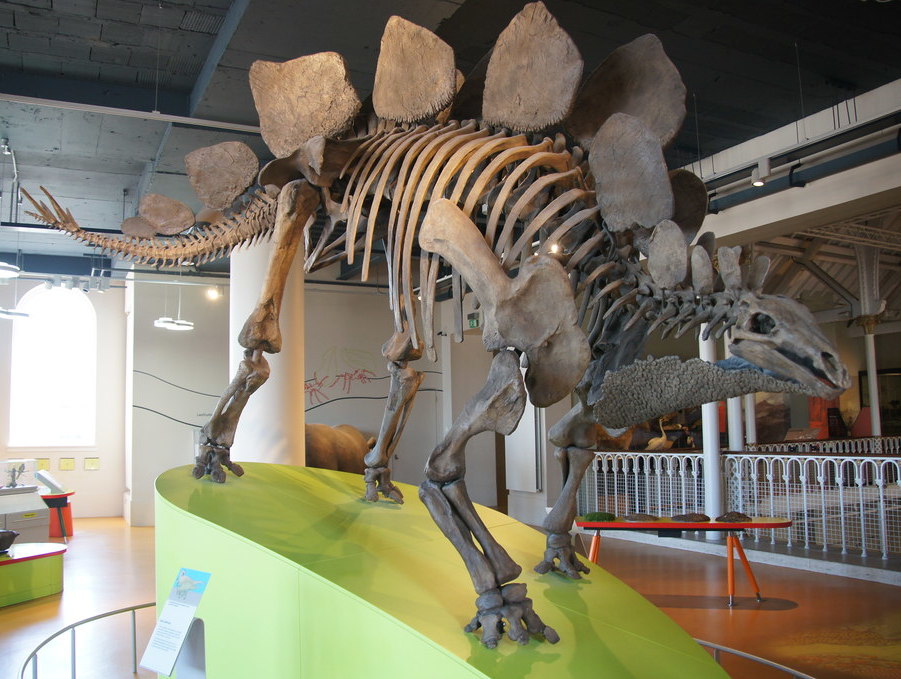
Stegosaurus stenops, the type species of both the genus Stegosaurus and the clade Stegosauria, was described by Marsh in 1887 from a nearly complete skeleton discovered in the Morrison Formation of Fremont County, Colorado.2, 3 It is among the most completely known of all stegosaurs, with multiple articulated specimens preserving the full arrangement of dorsal plates and tail spikes in life position. Adults reached approximately 7–9 metres in length and an estimated body mass of 3,500–4,500 kilograms, making Stegosaurus the largest known stegosaur.2, 14
The skull of Stegosaurus is proportionally tiny relative to its body, measuring roughly 40 centimetres in length in an animal that could exceed 8 metres from snout to tail tip. Galton's detailed 2001 description of stegosaur cranial anatomy revealed a narrow, elongated skull with a small, toothless premaxillary beak at the anterior end and rows of small, leaf-shaped cheek teeth set inward from the jaw margins, suggesting the presence of fleshy cheeks that aided in oral processing of vegetation.14 The braincase was correspondingly small, with an endocranial volume estimated at approximately 56 cubic centimetres—roughly the size of a walnut—giving Stegosaurus one of the lowest brain-to-body-mass ratios of any known dinosaur.2, 14 This minute brain size contributed to the persistent popular misconception that stegosaurs were exceptionally unintelligent, though encephalization quotient alone is a poor predictor of behavioral complexity in non-mammalian vertebrates.
Dorsal plates: function and debate
The dorsal plates of Stegosaurus are among the most debated structures in all of dinosaur paleobiology. Arranged in two parasagittal rows along the back from behind the skull to the base of the tail, the plates of S. stenops are roughly kite-shaped, laterally flattened, and arranged in an alternating pattern rather than in symmetrical pairs.3 The largest plates, positioned over the hip region, could exceed 60 centimetres in height and 60 centimetres in basal width, yet they were remarkably thin—in some cases only a few centimetres thick at their broadest point. Carpenter's 2001 revision of the plate arrangement, based on articulated specimens, confirmed the alternating configuration and documented 17 plates in the complete series, varying continuously in size from small rounded plates near the neck to the large median plates above the hips and back to smaller plates approaching the tail.3
Three principal hypotheses have been advanced for the function of these plates. The thermoregulatory hypothesis, proposed by Farlow, Thompson, and Rosner in 1976, argued that the plates functioned as forced-convection heat-loss fins, analogous to the radiator fins of industrial heat exchangers.4 Their analysis demonstrated that the plates' thin, broad profile and extensive vascularization—evidenced by deep grooves on the bone surface corresponding to major blood vessels—were ideally suited for dissipating excess metabolic heat when oriented perpendicular to a breeze. De Buffrénil, Farlow, and de Ricqlès subsequently examined the internal vascular architecture of the plates in thin section and confirmed the presence of an extraordinarily dense network of vascular canals, far exceeding what would be expected for a purely structural or protective element, further supporting a thermoregulatory interpretation.5
The display and species-recognition hypothesis holds that the plates served primarily as visual signals for intraspecific communication—attracting mates, establishing dominance hierarchies, or enabling individuals to recognize conspecifics at a distance. Main, de Ricqlès, Horner, and Padian's 2005 histological study provided crucial evidence for this interpretation by demonstrating that the plates grew rapidly and were covered in life by a keratinous sheath supplied by extensive vasculature, which would have given them a vivid, possibly colorful appearance that changed with blood flow.6 The alternating arrangement, unique plate shapes, and interspecific variation in plate morphology among different stegosaur species all point toward a signaling function. Saitta's 2015 analysis of Stegosaurus mjosi (now sometimes synonymized with S. stenops) identified two distinct plate morphotypes within a single population—tall, narrow plates and wide, oval plates—which Saitta interpreted as evidence of sexual dimorphism, with the more conspicuous plates belonging to one sex and serving a role in mate selection.7
The defensive hypothesis, though intuitive, has received the least support from detailed analysis. The plates were thin, fragile, and positioned laterally rather than directly above the spinal column, making them poorly suited to deflect the bite of a large theropod predator such as Allosaurus.3, 6 The current consensus, reflected in multiple reviews, is that the plates were multifunctional structures whose primary roles were thermoregulation and visual display, with any deterrent effect on predators being a secondary consequence of increased apparent body size rather than physical protection.4, 5, 6
The thagomizer: tail spikes as weapons
In contrast to the debated function of the dorsal plates, the terminal tail spikes of stegosaurs are widely accepted as active defensive weapons. Stegosaurus bore four elongate, conical spikes at the end of its tail, each up to 60–90 centimetres in length, arranged in two pairs that projected posterolaterally and dorsolaterally.2, 3 This arrangement, informally christened the "thagomizer" by cartoonist Gary Larson in a 1982 Far Side panel, has since been widely adopted in paleontological literature as a convenient shorthand for the stegosaurian tail-spike apparatus.2
Direct fossil evidence supports the use of the thagomizer in combat. Carpenter and colleagues documented a caudal vertebra of a large Allosaurus bearing a conical puncture wound whose dimensions precisely match the cross-section of a Stegosaurus tail spike, with the surrounding bone showing signs of infection indicating that the predator survived the initial wound but suffered a chronic, debilitating injury.9 Conversely, stegosaur tail spikes have been found with broken or remodeled tips, consistent with repeated high-energy impacts against hard surfaces such as bone.9 The tail of Stegosaurus lacked the stiffening tendons found in many ornithischian tails, giving it considerable lateral flexibility; biomechanical analyses suggest that a lateral sweep of the tail could deliver the spikes with substantial force over a wide arc behind and to the sides of the animal, making the thagomizer an effective deterrent against theropod predators attacking from the rear.2, 8, 9
The "second brain" myth
One of the most persistent misconceptions in popular paleontology is the notion that Stegosaurus possessed a "second brain" in its hip region to compensate for its tiny cranial brain. This idea originated with Marsh himself, who noted an enlarged cavity in the sacral vertebrae that he interpreted as housing a posterior nerve center. The sacral enlargement was subsequently compared to similar features in birds, where the lumbosacral organ (the glycogen body) occupies an expansion of the spinal canal but serves no neural processing function—it is a glycogen storage structure involved in balance.2, 14 Modern analyses of the sacral canal in Stegosaurus indicate that the enlargement likely housed a glycogen body analogous to that of birds, not a supplementary brain. The sacral swelling is present in many dinosaur groups and is simply more pronounced in stegosaurs due to the proportionally large hindquarters relative to the small head.2 The "second brain" narrative, though entertaining, has no basis in comparative neuroanatomy and has been thoroughly rejected by modern paleontologists.
Huayangosaurus and early stegosaurs
Huayangosaurus taibaii, described by Dong, Tang, and Zhou in 1982 from the Middle Jurassic Shaximiao Formation of Sichuan Province, China, is the most completely known basal stegosaur and provides critical information about the ancestral condition of the clade.10 At approximately 4 metres in length, Huayangosaurus was considerably smaller than the later Stegosaurus and retained several primitive features absent in more derived stegosaurs: premaxillary teeth (lost in Stegosauridae), a proportionally broader and shorter skull, and dorsal plates that were thicker, more spine-like, and less laterally flattened than the broad kite-shaped plates of Stegosaurus.10, 13 The plates of Huayangosaurus grade smoothly into pointed spines along the tail, suggesting that the ancestral condition for stegosaurs was a continuous series of conical osteoderms rather than the differentiated plate-and-spike arrangement seen in derived forms.10, 2
Other early and basal stegosaurs include Chungkingosaurus jiangbeiensis, also from the Middle Jurassic of Sichuan, and the fragmentary Lexovisaurus from the Middle Jurassic of England and France, which demonstrates that thyreophorans with stegosaurian affinities were already present on both sides of the closing Tethys Ocean by the Callovian stage, approximately 165 million years ago.2, 13 Phylogenetic analyses consistently recover these Middle Jurassic Chinese and European taxa as successive outgroups to the more derived Stegosauridae, indicating that stegosaur diversification was underway by the mid-Jurassic across a wide geographic range.1, 13
Kentrosaurus and African stegosaurs
Kentrosaurus aethiopicus, described by Hennig in 1915 from the famous Tendaguru beds of what is now Tanzania, is the best-known stegosaur from the Southern Hemisphere and provides an important comparison point with its contemporaneous North American relative Stegosaurus.11 At roughly 4–5 metres in length, Kentrosaurus was smaller than Stegosaurus and exhibited a markedly different plate-and-spike arrangement: the anterior dorsal plates were small and relatively flat, but they transitioned sharply into tall, narrow spikes over the hip region and along the tail, culminating in elongate terminal tail spikes.11, 2 A prominent parascapular spine projected laterally from each shoulder, adding to the animal's already formidable defensive armament. The Tendaguru deposits, which also yielded the iconic sauropod Giraffatitan (formerly Brachiosaurus brancai) and the theropod Elaphrosaurus, represent a Late Jurassic ecosystem broadly comparable to the Morrison Formation of western North America, and the presence of stegosaurs on both continents confirms that the clade had achieved a near-cosmopolitan distribution by the Kimmeridgian–Tithonian stages.11, 2
Global distribution and the Morrison Formation
Stegosaurs achieved their widest geographic distribution during the Late Jurassic, with confirmed occurrences on every continent except Antarctica and Australia (though fragmentary material from these regions may eventually expand the known range). The Morrison Formation of the western United States, spanning approximately 156–146 million years ago across a vast alluvial plain stretching from Montana to New Mexico, has produced the majority of known Stegosaurus specimens and remains the primary source of information about stegosaur paleoecology.2, 3 In this ecosystem, Stegosaurus coexisted with the giant sauropods Diplodocus, Apatosaurus, and Camarasaurus, the ornithischians Camptosaurus and Dryosaurus, and the predatory theropods Allosaurus and Ceratosaurus.2
Beyond North America, stegosaurs are well documented from the Late Jurassic of East Africa (Tendaguru), Europe (Portugal, England, France), and China (the Shaximiao and related formations).2, 11, 13 The European record includes Dacentrurus armatus from the Kimmeridgian of England and Portugal, one of the largest stegosaurs known, with an estimated length of 7–8 metres. The Chinese record is particularly rich, encompassing not only the basal Huayangosaurus and Chungkingosaurus but also the more derived Tuojiangosaurus multispinus, known from a nearly complete skeleton that preserves the full array of plates and spikes.2, 10 This broad Late Jurassic distribution contrasts sharply with the clade's near-total absence from well-sampled Late Cretaceous faunas, indicating a dramatic decline during the Early Cretaceous that left stegosaurs extinct long before the end-Cretaceous mass extinction event.1, 2
Feeding ecology
Stegosaurs were obligate herbivores occupying a low-browsing niche, with feeding heights constrained by their anatomy to vegetation below approximately one metre above ground level. The skull of Stegosaurus was held close to the ground due to the short forelimbs relative to the hindlimbs, the downward-flexed neck, and the anteriorly positioned jaw joint, all of which limited the animal's ability to raise its head significantly above shoulder height.14 The small, leaf-shaped teeth were poorly suited for processing tough, fibrous vegetation and instead appear adapted for cropping soft, low-growing plants such as ferns, horsetails, and the fronds of seed ferns and cycads that dominated Jurassic ground cover.2, 14
The narrow, pointed beak at the anterior end of the snout suggests selective feeding, with the animal choosing specific plant parts rather than indiscriminately harvesting large mouthfuls of vegetation as sauropods did with their broader muzzles.14 Dental wear patterns in stegosaurs are consistent with simple orthal (vertical) jaw movements without the complex grinding or shearing seen in ornithopods or ceratopsians, indicating that oral processing was minimal and that most mechanical breakdown of plant material occurred through fermentation in a capacious gut.2 The barrel-shaped torso of Stegosaurus, with its widely spaced ribs and broad pelvic region, is consistent with housing an extensive digestive system capable of fermenting large quantities of low-quality plant food over extended retention times, a strategy common among large herbivorous vertebrates with limited oral processing capabilities.2
Decline and extinction
Unlike the ankylosaurs, which diversified throughout the Cretaceous and survived until the end-Cretaceous mass extinction 66 million years ago, stegosaurs underwent a severe decline beginning in the Early Cretaceous and left virtually no fossil record after the Aptian–Albian stages, approximately 110–120 million years ago.1, 2 The causes of this decline remain poorly understood. One hypothesis implicates the rise of ankylosaurs, which diversified rapidly during the same interval and may have competitively displaced stegosaurs from the low-browsing herbivore niche they had occupied during the Jurassic.1 Another possibility involves ecological shifts associated with the radiation of angiosperms (flowering plants) during the Early Cretaceous, which fundamentally restructured terrestrial plant communities; stegosaurs may have been less capable than ankylosaurs or ornithopods of adapting to the changing flora.2
A handful of fragmentary Cretaceous stegosaur records exist, most notably Wuerhosaurus homheni from the Early Cretaceous of China, which demonstrates that at least some stegosaurs persisted into the Cretaceous in Asia.2 However, these late-surviving forms are rare and geographically restricted compared to the widespread Late Jurassic stegosaur fauna, and none are known from deposits younger than approximately 100 million years. By the time of the great Late Cretaceous dinosaur communities dominated by hadrosaurs, ceratopsians, and ankylosaurs, stegosaurs had been absent for tens of millions of years, their ecological roles long since filled by other armored and unarmored herbivore lineages.1, 2
References
The phylogenetic relationships and evolutionary history of the armoured dinosaurs (Ornithischia: Thyreophora)
Blood flow in the jugular vein and the carotid artery and the function of the dorsal plates of Stegosaurus
Sexual dimorphism in the plates of Stegosaurus mjosi (Dinosauria, Stegosauria) from the Upper Jurassic Morrison Formation of Montana