Overview
- Triceratops is one of the best-known ceratopsian dinosaurs, distinguished by three facial horns and a large bony frill, and is represented by two valid species — T. horridus and T. prorsus — from the latest Cretaceous Hell Creek and Lance formations of western North America.
- The longstanding debate over whether the genus Torosaurus represents the mature adult form of Triceratops remains unresolved, with recent histological and morphometric analyses providing evidence both for and against synonymy.
- Fossil evidence including bite marks attributable to Tyrannosaurus rex on Triceratops frill and horn bones demonstrates direct predatory or scavenging interactions between the two most iconic dinosaurs of the Late Cretaceous.
Triceratops is a genus of large chasmosaurine ceratopsian dinosaur that lived during the latest Cretaceous period, approximately 68 to 66 million years ago, in what is now western North America. First named by Othniel Charles Marsh in 1889 on the basis of a pair of horn cores initially misidentified as belonging to an extinct bison, Triceratops is one of the most recognisable and abundant dinosaurs in the fossil record, with dozens of skulls and partial skeletons recovered from the Hell Creek, Lance, Laramie, Scollard, and Frenchman formations.1, 2 The genus is characterised by three facial horns — a short nasal horn and two long supraorbital horns above the eyes — a massive bony frill extending posteriorly over the neck, and a large, parrot-like beak, features that have made it the quintessential horned dinosaur in both scientific literature and popular imagination.
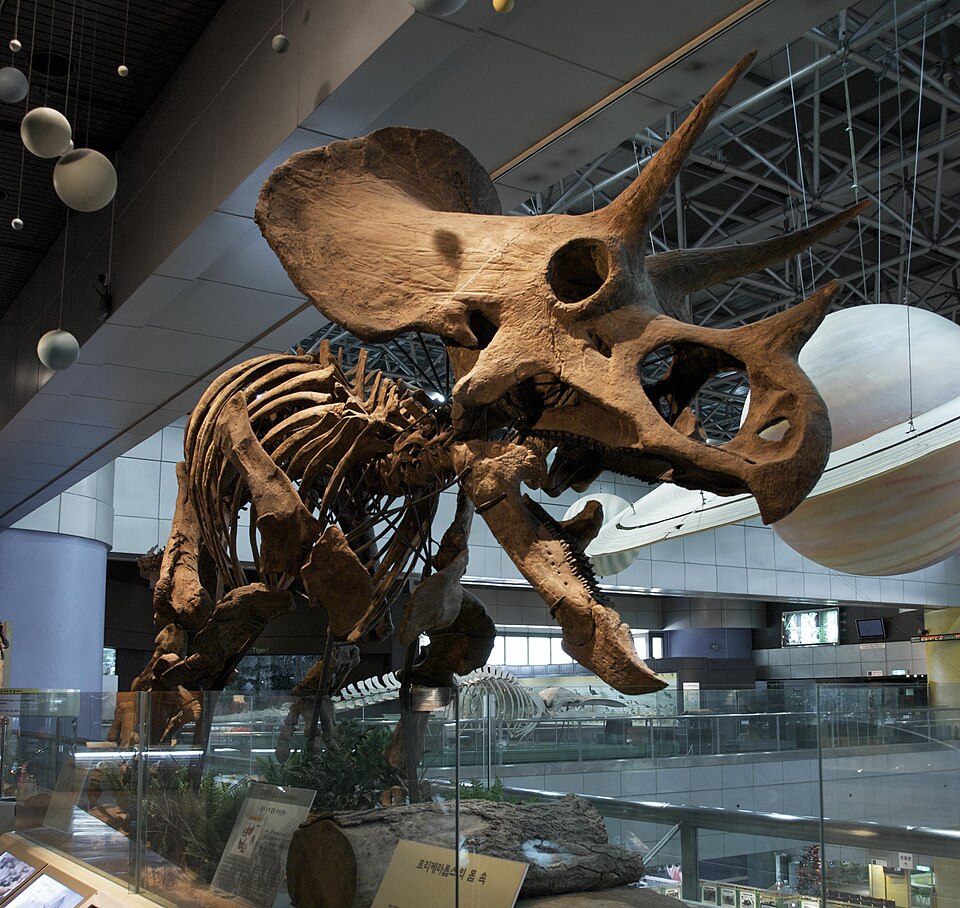

Two species are currently recognised as valid: Triceratops horridus, described by Marsh in 1889, and Triceratops prorsus, distinguished by differences in nasal horn shape, frill proportions, and facial horn orientation. Together with Tyrannosaurus rex, Triceratops dominated the large-dinosaur fauna of western North America during the final two million years of the Cretaceous, and the two genera represent the last great predator-prey pairing in the age of non-avian dinosaurs.2, 10
Discovery and taxonomy
The taxonomic history of Triceratops is entangled with the confusion that characterised much of Late Cretaceous dinosaur taxonomy in the nineteenth century. The first material now attributable to Triceratops was a pair of horn cores discovered near Denver, Colorado, in 1887. Marsh initially described these as Bison alticornis, believing them to be the horns of an unusually large Pliocene bison — a reasonable interpretation at the time, as ceratopsian dinosaurs were essentially unknown.1 It was not until the discovery of a more complete skull from the Lance Formation of Wyoming by John Bell Hatcher in 1888 that the true nature of the animal became apparent. Marsh formally named Triceratops horridus in 1889, establishing one of the most enduring generic names in palaeontology.1, 2
In the decades following the initial description, Marsh and subsequent workers named over a dozen species of Triceratops on the basis of minor variations in horn shape, frill size, and skull proportions. This taxonomic proliferation reflected both the extraordinary morphological variability within Triceratops and the nineteenth-century tendency to erect new species for every distinguishable specimen. Dodson's 1996 comprehensive review of the horned dinosaurs consolidated the taxonomy substantially, and by the early twenty-first century, most workers recognised only two valid species: T. horridus, characterised by a shorter, more upright nasal horn and relatively shorter supraorbital horns that curve forward, and T. prorsus, which possesses a longer, more anteriorly directed nasal horn, relatively longer supraorbital horns, and subtle differences in frill shape.2, 15
Scannella and colleagues' 2014 analysis of stratigraphic position within the Hell Creek Formation demonstrated that T. horridus and T. prorsus are separated temporally as well as morphologically, with T. horridus occurring in the lower and middle portions of the formation and T. prorsus in the upper portion. Transitional forms were identified in intermediate stratigraphic levels, leading the authors to propose that the two species represent an anagenetic evolutionary lineage rather than contemporaneous sister species — T. horridus gradually evolved into T. prorsus over the approximately two-million-year span of the Hell Creek Formation.15, 16
Horn and frill morphology
The skull of Triceratops is one of the largest and most elaborate of any terrestrial vertebrate, measuring up to 2.5 metres in length in the largest individuals and accounting for roughly one-third of the animal's total body length. The skull is dominated by three horns and a solid bony frill that together form the most recognisable silhouette in dinosaur palaeontology. The nasal horn, situated on the midline of the rostrum above the nares, is a rugose bony core that would have been sheathed in keratin in life, extending the functional horn to a length considerably greater than the bone core alone suggests. In T. horridus, the nasal horn is relatively short and blunt; in T. prorsus, it is longer and more pointed.2, 8
The paired supraorbital horns, situated above and behind the orbits, are the most prominent weapons in the Triceratops armoury. In mature individuals, these horn cores can exceed one metre in length, curving forward and slightly outward in a configuration that varies substantially among individuals and between the two species. The horns were also sheathed in keratin, and comparisons with the horn cores of modern bovids suggest that the keratinous sheath may have added 25 to 50 percent to the length of the bony core, giving functional horn lengths of over a metre in large adults.2, 18
The frill of Triceratops is a posterior expansion of the parietal and squamosal bones that extends over the neck region, forming a broad, roughly triangular shield. Unlike the frills of many other ceratopsians such as Chasmosaurus and Torosaurus, which are perforated by large parietal fenestrae that reduce their mass, the frill of Triceratops is solid bone without fenestrae, making it a genuinely robust defensive and display structure. The margin of the frill bears a series of low, triangular epoccipitals — bony projections arranged along the posterior and lateral edges — that increase in size toward the midline and may have been emphasised by keratinous coverings in life.2, 3
The function of the horns and frill has been the subject of extensive debate. Farke's 2008 analysis used scale models to test the mechanical feasibility of different horn-use scenarios, concluding that the supraorbital horns of Triceratops are well suited for both intraspecific combat (horn-locking and pushing contests between conspecifics) and anti-predator defence against large theropods. A subsequent study by Farke and colleagues in 2009 examined the distribution of bone lesions on Triceratops skulls and found that healed puncture wounds and fractures were concentrated in the squamosal region of the frill, consistent with damage from the horn tips of conspecifics during intraspecific combat. These lesions were ten times more frequent in Triceratops than in Centrosaurus, a ceratopsian with much shorter supraorbital horns, suggesting that horn length correlates with the frequency of intraspecific combat.13, 18
The Torosaurus synonymy debate
One of the most contentious taxonomic debates in recent ceratopsian palaeontology concerns the relationship between Triceratops and Torosaurus, a contemporaneous chasmosaurine known from several skulls from the Hell Creek, Lance, and equivalent formations. Torosaurus latus was named by Marsh in 1891 on the basis of a skull that differs from Triceratops most conspicuously in possessing a much longer, thinner frill perforated by two large parietal fenestrae, and in having proportionally shorter supraorbital horns with a more posterior orientation. For over a century, Torosaurus and Triceratops were treated as distinct genera without serious question.2
This consensus was upended in 2010 by Scannella and Horner, who proposed that Torosaurus is not a separate genus but rather the fully mature adult form of Triceratops. Their argument was based on several lines of evidence: first, that all known Torosaurus skulls are histologically more mature than the most mature Triceratops skulls, based on the degree of bone remodelling and the obliteration of cranial sutures; second, that the morphological differences between the two genera — frill length, fenestra development, horn orientation — follow a predicted ontogenetic trajectory in which the frill elongates and thins with age, eventually developing fenestrae as bone resorption outpaces deposition; and third, that no juvenile or subadult specimens attributable to Torosaurus have ever been found, consistent with the hypothesis that young Torosaurus are simply identified as Triceratops.5
The synonymy hypothesis provoked vigorous opposition. Longrich and Field's 2012 study challenged the ontogenetic interpretation on multiple grounds. They noted that several Torosaurus specimens exhibit bone histology indicating active growth rather than extreme maturity, that the fenestrae in Torosaurus frills show smooth, remodelled margins indicative of a stable feature rather than late-stage resorption, and that the stratigraphic ranges of Triceratops and Torosaurus overlap extensively, making it unlikely that one represents a growth stage of the other unless extremely old adults are systematically absent from lower stratigraphic levels. They concluded that Torosaurus is a valid genus distinct from Triceratops.4
The debate has stimulated broader discussions about the role of ontogenetic variation in dinosaur taxonomy and the extent to which morphological transformation during growth can obscure species boundaries. Horner and Goodwin's parallel work on Pachycephalosaurus, in which they proposed that the dome-headed Pachycephalosaurus, the flat-headed Stygimoloch, and the spiky Dracorex represent ontogenetic stages of a single genus, employed a similar methodological framework and raised similar objections from critics who favoured taxonomic splitting.6 The Triceratops-Torosaurus question remains open, and its resolution will likely require additional histological sampling of Torosaurus specimens and more refined stratigraphic data from the Hell Creek Formation.
Growth and ontogeny
The ontogenetic development of Triceratops is among the best documented of any dinosaur, thanks to the recovery of numerous skulls and postcranial elements representing a wide range of growth stages from hatchling to full adult. The smallest known Triceratops skulls measure approximately 30 centimetres in length and represent animals that were likely only a few months old. These juvenile skulls differ dramatically from those of adults: the horns are short, stubby, and directed posteriorly (backward) rather than anteriorly, the frill is proportionally small and rounded, and the overall skull proportions are more compact and rounded, with larger orbits relative to skull length.2, 3
As the animal grew, the skull underwent a remarkable series of transformations. During the juvenile and subadult stages, the supraorbital horns gradually shifted from a posterior to an anterior orientation, passing through a roughly vertical intermediate stage. The nasal horn became more prominent, the frill elongated and widened, and the epoccipitals along the frill margin changed in shape and number. Scannella and Horner documented this ontogenetic trajectory in detail, identifying a series of growth stages (baby, juvenile, subadult, young adult, adult) defined by specific combinations of horn orientation, frill size, sutural closure, and surface texture.5
Bone histology provides additional information about growth rates and longevity. Growth lines in long bones suggest that Triceratops reached skeletal maturity at approximately 20 to 25 years of age, with the most rapid growth occurring during a subadult growth spurt analogous to that observed in tyrannosaurids. The maximum body size of adult Triceratops is estimated at 8 to 9 metres in total length and 6,000 to 12,000 kilograms in body mass, making it one of the largest ceratopsians known, though not the absolute largest — a distinction that belongs to Eotriceratops or Titanoceratops, depending on the analysis.2, 8
The dramatic ontogenetic changes in Triceratops horn orientation have implications for the functional interpretation of the horns. If the horns of juveniles pointed backward and only rotated to a forward orientation in subadults and adults, then the horns could not have served the same function throughout the animal's life. Juvenile horns oriented posteriorly would have been ineffective as forward-directed weapons but might have functioned in species recognition or display, while the anteriorly directed horns of adults would have been effective both in intraspecific combat and in defence against predators. This ontogenetic shift may indicate that the selective pressures driving horn evolution changed as the animal matured, with visual signalling predominating in juveniles and physical combat becoming important only in reproductively mature individuals.3, 13
Interactions with Tyrannosaurus rex
The coexistence of Triceratops and Tyrannosaurus rex in the Hell Creek ecosystem has made the two genera the archetypal predator-prey pair of the Mesozoic, and direct fossil evidence confirms that interactions between them were indeed a regular feature of this Late Cretaceous community. Fowler and colleagues' 2012 study documented theropod feeding traces — tooth marks, tooth drag marks, and puncture wounds — on Triceratops bones from the Hell Creek Formation, providing some of the most detailed evidence for T. rex feeding on ceratopsian carcasses in the fossil record.11
The study identified bite marks on multiple skeletal elements of Triceratops, including the frill, the supraorbital horn cores, and postcranial bones. Particularly informative were a series of deep, parallel tooth marks on the frill of one specimen that matched the spacing and morphology of T. rex teeth. The orientation and position of these marks suggested that the tyrannosaurid had gripped the frill and pulled upward, possibly to detach the head from the neck in order to access the large muscles of the neck and shoulder region. This interpretation implies a deliberate feeding strategy rather than random scavenging, as the frill itself would have contained little edible material and appears to have been manipulated primarily to gain access to the meatier portions of the carcass.11
Whether the bite-marked specimens represent active predation or post-mortem scavenging cannot be determined with certainty from the trace evidence alone. However, the abundance of Triceratops in the Hell Creek fauna — it is the most common large dinosaur in the formation, representing approximately 40 percent of the large-dinosaur census — and the frequency of T. rex feeding traces on ceratopsian bones suggest that Triceratops was a primary food source for T. rex, whether killed by active predation, consumed as carrion, or both.10, 11
The defensive capabilities of Triceratops against a predator the size of Tyrannosaurus rex should not be underestimated. An adult Triceratops with forward-pointing supraorbital horns exceeding a metre in length, a solid bony frill protecting the neck, and a body mass of 6,000 kilograms or more would have been an extremely dangerous quarry. Several Tyrannosaurus specimens bear injuries consistent with horn wounds, and the frequency of facial injuries in Triceratops suggests that violent encounters — whether with conspecifics or predators — were a routine part of life in the Hell Creek ecosystem.13, 14
Social behaviour and herding evidence
The question of whether Triceratops was a social, herding animal or a predominantly solitary one has been debated for decades, and the available evidence remains equivocal. Unlike many other ceratopsians — particularly centrosaurines such as Centrosaurus and Styracosaurus, for which massive bonebeds containing hundreds or thousands of individuals provide strong evidence of gregarious behaviour — Triceratops is almost invariably found as isolated individuals rather than in multi-individual assemblages. The Hell Creek Formation has yielded hundreds of Triceratops specimens, but they are overwhelmingly scattered singletons, not concentrated bonebeds.2, 10
A notable exception is a site in southeastern Montana that yielded a small aggregation of three juvenile Triceratops found in close association, which has been interpreted as possible evidence for at least age-segregated grouping behaviour in young animals. However, whether this association reflects genuine social behaviour or merely the chance accumulation of carcasses in a localised depositional setting cannot be determined definitively from taphonomic evidence alone.3
The predominantly solitary taphonomic signal of Triceratops contrasts strikingly with the pattern observed in centrosaurine ceratopsians from slightly older formations (Dinosaur Park Formation, Campanian). This contrast may reflect genuine ecological or behavioural differences between chasmosaurines and centrosaurines, with the latter more prone to large-scale herding behaviour. Alternatively, the taphonomic conditions of the Hell Creek Formation — predominantly fluvial, with rapid lateral migration of river channels — may not be conducive to the preservation of large bonebeds even if herding behaviour was common. In modern African savannas, for example, large-bodied solitary herbivores such as rhinoceroses and elephants coexist with highly gregarious species such as wildebeest and zebras, and the taphonomic signal of each would differ dramatically despite sharing the same ecosystem.2, 14
The intraspecific combat evidence from frill lesions, documented by Farke and colleagues, does provide indirect evidence for at least some form of social interaction among adult Triceratops. Combat over territory, mates, or dominance would have required encounters between conspecifics, and the high frequency of healed squamosal injuries suggests that such encounters were common. Whether these interactions occurred within the context of a structured social group or represented chance encounters between otherwise solitary individuals remains uncertain.13
Ceratopsian evolutionary context
Triceratops represents the evolutionary culmination of Ceratopsia, a clade of marginocephalian ornithischian dinosaurs that originated in the Early Cretaceous as small, bipedal herbivores and diversified into one of the most successful and morphologically varied dinosaur groups of the Late Cretaceous. The earliest ceratopsians, such as Psittacosaurus from the Early Cretaceous of Asia and Leptoceratops from the Late Cretaceous of North America, were small animals (1 to 2 metres in length) with rudimentary frills and no horns, retaining many of the plesiomorphic features of basal marginocephalians.2, 7
The evolution of large-bodied, quadrupedal ceratopsians with elaborate horn and frill arrays occurred primarily within Ceratopsidae, the family to which Triceratops belongs. Ceratopsidae is divided into two major subfamilies: Centrosaurinae, characterised by elaborate nasal horns and fenestrated frills with prominent parietal ornamentation (e.g., Centrosaurus, Styracosaurus, Pachyrhinosaurus), and Chasmosaurinae, characterised by longer frills and more prominent supraorbital horns (e.g., Chasmosaurus, Pentaceratops, Triceratops). Phylogenetic analyses consistently place Triceratops within Chasmosaurinae, often as a relatively derived member alongside Torosaurus and Eotriceratops.3, 12
Body mass estimates across ceratopsian evolution2, 8
The ceratopsian radiation in North America during the Late Cretaceous produced an extraordinary diversity of horn and frill morphologies, with over 30 genera known from the Campanian and Maastrichtian stages alone. This proliferation of cranial ornamentation is widely interpreted as the product of sexual selection and species recognition, with horn and frill morphology serving as species-specific visual signals in environments where multiple ceratopsian species coexisted. Triceratops, as the latest-surviving and largest member of this radiation, represents both the apex of ceratopsian body size evolution and the endpoint of the entire ceratopsian lineage, which was terminated by the end-Cretaceous mass extinction 66 million years ago.2, 12
The Hell Creek ecosystem
The Hell Creek Formation of Montana, the Dakotas, and Wyoming preserves the final act of the age of dinosaurs in North America, recording the last approximately two million years of the Cretaceous period (68 to 66 Ma) in a mosaic of subtropical river floodplains, coastal swamps, and forested uplands. Triceratops is the most abundant large dinosaur in this formation, constituting roughly 40 percent of identifiable large-dinosaur specimens, a dominance that underscores its ecological importance as the primary megaherbivore of the latest Maastrichtian.10
The Hell Creek fauna included a remarkable array of dinosaurs alongside Triceratops and its principal predator Tyrannosaurus rex. The hadrosaur Edmontosaurus annectens was the second most abundant large herbivore, occupying a different ecological niche as a low-browsing or grazing specialist with a sophisticated dental battery adapted for processing tough vegetation. The ankylosaur Ankylosaurus magniventris, the pachycephalosaur Pachycephalosaurus wyomingensis, the ornithomimid Ornithomimus, and the dromaeosaurid Dakotaraptor steini completed the major dinosaurian components of the fauna. Non-dinosaurian elements included crocodilians, champsosaurs, turtles, and a diverse assemblage of mammals including multituberculates and early placentals that would diversify explosively after the end-Cretaceous extinction.10, 14
The feeding ecology of Triceratops within this ecosystem has been inferred from multiple lines of evidence. The large, robust beak was clearly adapted for cropping tough vegetation, and the dental battery — consisting of stacked columns of teeth arranged in a shearing surface — processed plant material through an orthal (vertical) jaw motion distinct from the propalinal (fore-aft) motion employed by hadrosaurs. Microwear analysis of ceratopsian teeth suggests that Triceratops fed on relatively hard, fibrous plant material such as cycads, palms, and woody angiosperms, rather than the softer foliage that characterized the diet of hadrosaurs.8, 17
Triceratops fossils are found throughout the Hell Creek Formation from bottom to top, indicating that the genus persisted until the very end of the Cretaceous. The evolutionary transition from T. horridus in the lower formation to T. prorsus in the upper formation documents evolutionary change occurring within the final two million years of the dinosaur era, making Triceratops one of the few dinosaur genera for which anagenetic species-level evolution can be tracked through a continuous sedimentary section. The genus shows no evidence of declining abundance or diversity before the end-Cretaceous boundary, consistent with the view that the extinction was a sudden catastrophe rather than a gradual decline.10, 15
References
Torosaurus is not Triceratops: ontogeny in chasmosaurine ceratopsids as a case study in dinosaur taxonomy
Torosaurus Marsh, 1891, is Triceratops Marsh, 1889 (Ceratopsidae: Chasmosaurinae): synonymy through ontogeny
A ceratopsian dinosaur from the Lower Cretaceous of western North America, and the biogeography of Neoceratopsia
Cranial growth and variation in edmontosaurs (Dinosauria: Hadrosauridae): implications for latest Cretaceous megaherbivore diversity in North America
Dinosaur census reveals abundant Tyrannosaurus and rare ontogenetic stages in the Upper Cretaceous Hell Creek Formation (Maastrichtian), Montana, USA
Theropod feeding traces on Triceratops and other large-bodied dinosaurs from the Hell Creek Formation
A new phylogeny of the Ceratopsidae (Dinosauria: Ornithischia) using maximum parsimony and Bayesian analysis
A transitional Triceratops from the Hell Creek Formation supports a morphological continuum
Quantitative analysis of dental microwear in hadrosaurid dinosaurs, and the implications for hypotheses of jaw mechanics and feeding
Horn use in Triceratops (Dinosauria: Ceratopsidae): testing behavioral hypotheses using scale models