Overview
- The Tully monster (Tullimonstrum gregarium) is a soft-bodied marine organism known exclusively from the approximately 309-million-year-old Mazon Creek lagerstätte of Illinois, discovered by amateur fossil collector Francis Tully in 1958 and designated the Illinois state fossil in 1989.
- The animal's bizarre anatomy — a torpedo-shaped body with a long, flexible proboscis ending in a toothed claw, paired eyes mounted on a rigid transverse bar, and a tail fin — has defied confident phylogenetic placement for over six decades, with competing hypotheses classifying it as a vertebrate related to lampreys, an invertebrate allied with various worm or mollusc groups, or an organism with no close modern relatives.
- The Tully monster has become one of paleontology's most iconic problematica, generating sustained scientific debate that illuminates fundamental challenges in interpreting soft-bodied fossils, the limits of taphonomic inference, and the difficulty of placing morphologically unusual organisms within the tree of life.
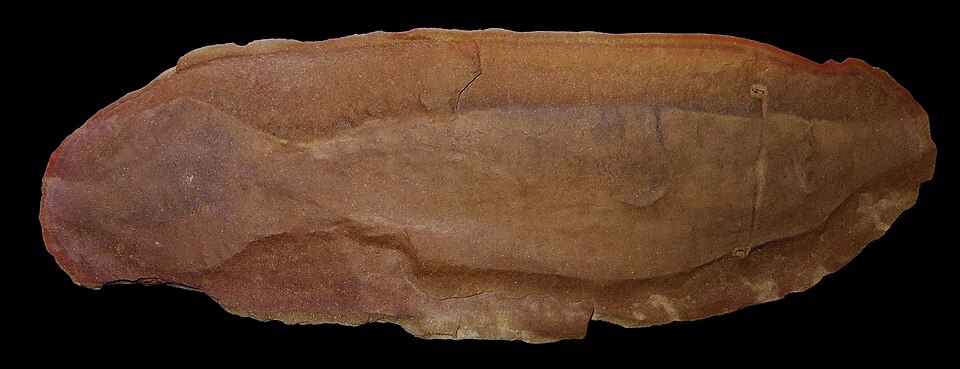
Tullimonstrum gregarium, commonly known as the Tully monster, is a soft-bodied marine animal known exclusively from the Carboniferous-age Mazon Creek lagerstätte of northeastern Illinois, dating to approximately 309 million years ago (Pennsylvanian epoch). Discovered by amateur fossil collector Francis Tully in 1958 and formally described by Eugene Richardson of the Field Museum in 1966, the organism defies easy classification: its body plan — a torpedo-shaped trunk with a long, flexible proboscis ending in a toothed claw, paired eyes mounted on the ends of a rigid transverse bar, and a caudal fin — combines features found in no living animal and no other known fossil organism.1, 8 For more than sixty years, the Tully monster has been one of paleontology's most celebrated problematica, an organism whose phylogenetic placement remains genuinely uncertain despite intensive study using techniques ranging from comparative anatomy to synchrotron X-ray fluorescence mapping.4, 5, 10

Discovery and historical context
Francis Tully, a pipefitter and avid amateur fossil collector from Lockport, Illinois, discovered the first specimen of the organism that would bear his name while splitting open an ironstone concretion at a coal strip mine in Grundy County in 1958. Unable to identify the strange fossil, Tully brought it to the Field Museum of Natural History in Chicago, where it baffled professional paleontologists as thoroughly as it had baffled its discoverer. Eugene Richardson, the museum's curator of fossil invertebrates, recognised the specimen as a genuinely novel organism and, after accumulating additional material, formally described it in 1966 as Tullimonstrum gregarium — "Tully's common monster" — acknowledging both its discoverer and the remarkable abundance of specimens in the Mazon Creek deposits.1, 9
Richardson's description was candid about the difficulty of classifying the animal. He placed it provisionally among the invertebrates but noted that it did not fit comfortably into any known phylum. Subsequent decades of research, during which thousands of additional specimens were collected (many by amateur collectors who have been central to the study of Mazon Creek fossils), failed to resolve the question. The Tully monster became a fixture in popular science writing as the quintessential "mystery fossil," and in 1989 it was designated the official state fossil of Illinois, cementing its status as a cultural as well as scientific icon.8, 11
The Mazon Creek lagerstätte
The preservation of Tullimonstrum is entirely dependent on the exceptional taphonomic conditions of the Mazon Creek lagerstätte, one of the most important Konservat-Lagerstätten (sites of exceptional preservation) in the Paleozoic fossil record. Located in the coal-bearing strata of the Francis Creek Shale member of the Carbondale Formation in northeastern Illinois, the Mazon Creek deposits represent a Late Carboniferous (Pennsylvanian) river delta that emptied into a shallow tropical sea approximately 309 million years ago.2, 11
Organisms that died in or near the delta were rapidly buried in fine-grained sediment and encased in siderite (iron carbonate) concretions that formed around the decaying remains within days to weeks of death. This rapid mineralisation arrested decomposition and preserved not only shells and bones but also the soft tissues of animals that would normally leave no fossil record whatsoever — including jellyfish, worms, larvae, and, crucially, Tullimonstrum.2, 12 The Mazon Creek biota encompasses more than 400 described species of plants and animals from both marine (Braidwood) and terrestrial (Essex) faunal assemblages, providing an unparalleled window into a Carboniferous coastal ecosystem. Tullimonstrum is found exclusively in the marine Braidwood assemblage, often in great abundance, suggesting it was a common member of the shallow marine community.2, 8
Morphology and anatomy
The body of Tullimonstrum was elongated and roughly torpedo-shaped, typically 8 to 35 centimetres in total length, though most specimens fall in the range of 10 to 15 centimetres. The trunk was unsegmented and tapered posteriorly to a tail bearing a caudal fin, usually preserved as a bilobed or rhomboidal structure that suggests the animal was an active swimmer. A series of faint, regularly spaced markings along the trunk in some specimens has been interpreted as possible myomeres (segmental muscle blocks), a feature that, if confirmed, would support a chordate or vertebrate affinity.4, 8
The most striking feature is the proboscis, a long, flexible, trunk-like structure that extended anteriorly from the body and terminated in a small, claw-like apparatus bearing teeth or tooth-like structures. The proboscis could apparently be moved independently of the body, and the terminal claw appears to have functioned as a grasping organ for capturing prey or manipulating food items. The mechanics of the proboscis — whether it was muscular and hydraulically operated, or stiffened by some internal skeletal element — remain uncertain, though its flexibility in preserved specimens suggests a primarily muscular construction.1, 9
Equally distinctive is the transverse bar, a rigid, rod-like structure that projected laterally from the body at approximately the level of the anterior trunk. Each end of the bar bore a circular or bulbous structure interpreted as an eye. This arrangement has no parallel in any known living or fossil organism. The eyes themselves have been the focus of intense scrutiny: Clements and colleagues reported in 2016 that the eyes contained melanosomes (pigment granules) of two distinct types, arranged in a configuration consistent with the structure of vertebrate retinas, including a possible distinction between rod-like and cone-like photoreceptor cells.6 This finding was presented as evidence of vertebrate affinity, though subsequent authors have questioned whether melanosome morphology alone can reliably distinguish vertebrate from invertebrate eyes.5
The vertebrate hypothesis
The classification of Tullimonstrum was transformed in 2016 by two papers published simultaneously in Nature. McCoy and colleagues presented a comprehensive morphological analysis based on over 1,200 specimens, arguing that Tullimonstrum was a vertebrate — specifically, a stem lamprey allied with the jawless fish lineage Petromyzontida. Key evidence included the identification of a putative notochord (a stiff, rod-like axial support structure), structures interpreted as gill pouches in the pharyngeal region, a brain cavity, and the segmental muscle blocks (myomeres) characteristic of chordates. McCoy and colleagues placed Tullimonstrum in a phylogenetic analysis that recovered it as a stem lamprey, closer to modern lampreys than to hagfish.4
In the companion paper, Clements and colleagues independently supported the vertebrate hypothesis by analysing the eyes in detail. Using scanning electron microscopy, they demonstrated that the eye structures contained melanosomes of two distinct size classes, consistent with the presence of both melanin-bearing retinal pigment epithelium and photoreceptor cells — a level of ocular complexity generally associated with vertebrates rather than invertebrates.6 The combined weight of these two studies appeared to resolve a sixty-year mystery, and the vertebrate interpretation was widely reported in the popular press as the definitive answer to the Tully monster's identity.4, 6
Challenges and the invertebrate counter-arguments
The vertebrate hypothesis was challenged almost immediately. In 2017, Sallan and colleagues published a detailed critique arguing that the characters cited by McCoy et al. were ambiguous, poorly preserved, or alternatively interpreted. They noted that the putative notochord could equally represent a gut tract, that the supposed gill pouches lacked diagnostic detail, and that segmental muscle blocks are not unique to vertebrates but also occur in some invertebrate groups such as chaetognaths (arrow worms). More fundamentally, Sallan and colleagues argued that the overall body plan of Tullimonstrum — particularly the proboscis and the bar-mounted eyes — had no parallel among vertebrates, living or fossil, and that forcing the organism into a vertebrate framework required special pleading about highly derived and otherwise unparalleled morphological transformations.5
Subsequent studies have continued to produce conflicting results. Analysis of three-dimensionally preserved specimens by Clements and colleagues in 2018 provided additional anatomical detail but did not conclusively resolve the debate.7 Isotopic and elemental analyses by McCoy and colleagues in 2020 found that the chemical composition of Tullimonstrum specimens differed from that of known vertebrates in the same deposit, a finding that the authors interpreted as reflecting unusual taphonomy but that critics viewed as undermining the vertebrate hypothesis.14
In 2023, Rogers and colleagues used synchrotron X-ray fluorescence imaging to map the elemental composition of Tullimonstrum specimens at high resolution, finding that the putative notochord did not have the chemical signature expected of a vertebrate notochord and that the overall elemental distribution was more consistent with an invertebrate body plan. This study explicitly challenged the vertebrate hypothesis and argued that the available chemical evidence was incompatible with a chordate interpretation.10
Chemical evidence and recent developments
The most recent contribution to the debate came from Clements and colleagues in 2024, who applied a battery of geochemical techniques — including energy-dispersive X-ray spectroscopy, time-of-flight secondary ion mass spectrometry, and synchrotron X-ray absorption spectroscopy — to compare the chemical preservation of Tullimonstrum with known vertebrates (lampreys and fish), known invertebrates (shrimp and cephalopods), and other problematic organisms from the Mazon Creek deposits. The results showed that the chemical signatures of Tullimonstrum's putative anatomical structures did not consistently match either vertebrate or invertebrate reference taxa, leaving the organism's classification genuinely unresolved.13
Clements and colleagues concluded that the taphonomic processes operating in the Mazon Creek siderite concretions altered the original chemistry of soft tissues in ways that make it extremely difficult to use chemical composition as a reliable phylogenetic indicator. This finding has broader implications for the study of soft-bodied fossil preservation generally, suggesting that the chemical fingerprints of different tissue types may converge during diagenesis, erasing the original biological signal that would be needed to distinguish between vertebrate and invertebrate identity.13, 12
Significance in paleontology
The enduring mystery of the Tully monster's classification makes it far more scientifically valuable than a resolved taxonomic question would be. The debate over Tullimonstrum has driven methodological innovation, pushing researchers to develop new techniques for extracting phylogenetic information from soft-bodied fossils — including synchrotron imaging, melanosome analysis, and multi-element geochemical mapping — that have broad applications across paleontology.10, 13
The Tully monster also serves as a cautionary tale about the limits of phylogenetic inference when dealing with organisms that combine features not seen in any living animal. The confidence with which the 2016 vertebrate hypothesis was announced and received in the popular press, followed by the sustained scientific challenge to that interpretation, illustrates the difficulty of translating complex anatomical evidence into definitive phylogenetic conclusions, particularly when the organism in question may represent an extinct body plan with no close modern analogue.4, 5
More broadly, Tullimonstrum is a reminder that the history of life has produced far more morphological diversity than is represented by living organisms. The Carboniferous seas, like the Cambrian oceans before them, harboured body plans that defy placement in the familiar categories of modern zoology. The Mazon Creek lagerstätte, by preserving these soft-bodied organisms that would otherwise be invisible to paleontology, reveals the true breadth of animal form and challenges assumptions about what is biologically possible.2, 12
Cultural legacy
The Tully monster's designation as the Illinois state fossil in 1989 reflects its deep cultural roots in the state, where generations of amateur collectors — particularly those associated with the Mazon Creek fossil beds in Grundy and Will counties — have contributed thousands of specimens to museum collections and to the scientific literature. The Field Museum of Natural History in Chicago holds the largest collection of Tullimonstrum specimens in the world, and the organism features prominently in the museum's public exhibits and educational programmes.8, 11
The Tully monster has become a widely recognised symbol in popular paleontology, appearing on Illinois U-Haul trucks, commemorative licence plates, and the logos of several Illinois scientific and educational organisations. Its appeal lies in precisely the qualities that make it scientifically challenging: an appearance so alien that it seems designed to provoke wonder, and a classification so uncertain that it invites engagement from professional and amateur naturalists alike. In this respect, the Tully monster exemplifies the public fascination with the strangeness of deep time, the recognition that the history of life has produced forms that stretch the limits of biological imagination.8
References
A Carboniferous non-onychophoran lobopodian reveals long-term survival of a Cambrian morphotype
Tullimonstrum gregarium is not a vertebrate: characters, convergence and taphonomy in problematic fossils
New three-dimensionally preserved specimens of Tullimonstrum from the Francis Creek Shale
Synchrotron X-ray fluorescence imaging of Tullimonstrum gregarium challenges the vertebrate hypothesis
The problematic fossil Tullimonstrum: new evidence from isotopic and elemental analysis