Overview
- The problem of evil has a continuous intellectual history spanning more than two millennia, from Epicurus’s trilemma and the Stoic response through Augustine’s privation theory, Aquinas’s greater-good framework, and Leibniz’s optimism, to the modern analytic formulations of Hume, Mackie, Plantinga, and Rowe.
- Each major historical period reframed the problem in response to the dominant philosophical categories of its era — ancient Greek theodicy addressed fate and cosmic order, medieval theodicy addressed divine simplicity and providence, early modern theodicy addressed natural law and the best-possible-world thesis, and contemporary analytic theodicy addresses modal logic and probability theory.
- The 1755 Lisbon earthquake marks a turning point: before it, the dominant Western response was Leibnizian optimism; after it, Voltaire, Hume, and Kant shifted the debate from metaphysical confidence to evidential humility, a trajectory that led directly to the twentieth-century analytic formulations that define the current state of the field.
The problem of evil — whether the existence of suffering and wrongdoing can be reconciled with the existence of an omnipotent, omniscient, and perfectly good God — has a continuous intellectual history spanning more than two millennia. Each major philosophical period has reframed the problem in response to its dominant categories of thought: ancient Greek philosophy addressed cosmic order and fate, patristic and medieval theology addressed divine simplicity and providence, early modern philosophy addressed natural law and the best-possible-world thesis, and contemporary analytic philosophy addresses modal logic and probability theory. This article traces that history from its ancient origins through the current state of the debate, focusing on the thinkers, events, and conceptual shifts that shaped the trajectory of the problem.4, 3
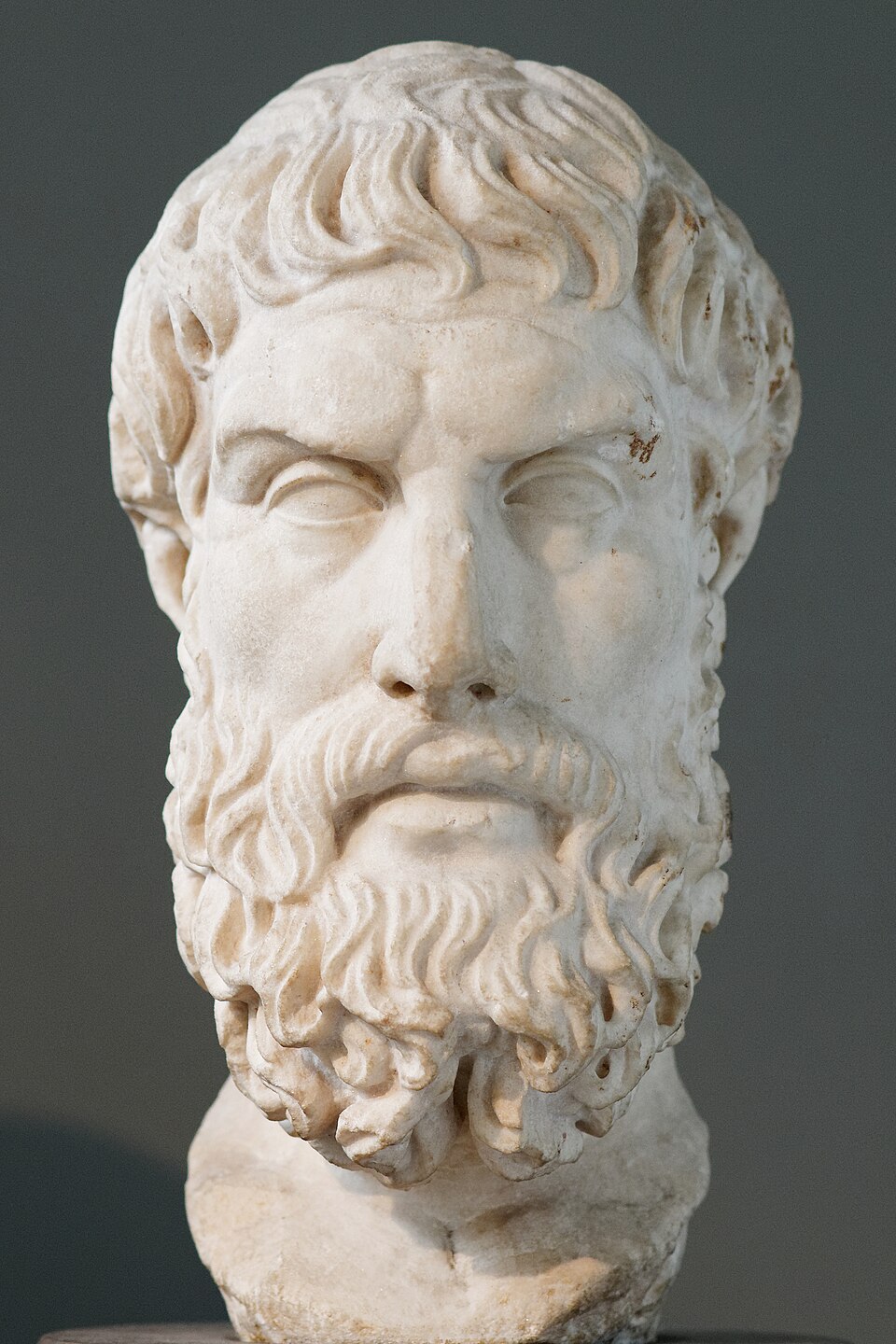

Ancient origins
The tension between divine goodness and the existence of evil was recognized in Greek philosophy before it became a central problem in Christian theology. Epicurus (341–270 BCE) is traditionally credited with the earliest explicit formulation. The version preserved by the Christian apologist Lactantius (c. 250–325 CE) in De Ira Dei presents the problem as a quadrilemma: Is God willing to prevent evil but unable? Then he is not omnipotent. Is he able but unwilling? Then he is malevolent. Is he both able and willing? Then why does evil exist? Is he neither able nor willing? Then why call him God? Whether Epicurus himself formulated the problem in precisely these terms is debated — Lactantius may have sharpened the argument for polemical purposes — but the logical structure was available in the Epicurean tradition.4
The Stoics offered one of the earliest systematic responses. On Stoic metaphysics, the cosmos is a rational, providential whole governed by the logos — a divine rational principle that pervades all things. Evil, on this view, is either an illusion produced by a limited perspective (what appears evil from a local standpoint serves the good of the whole) or a necessary consequence of the material conditions required for the existence of goods. Chrysippus (c. 279–206 BCE) argued that good cannot exist without its opposite — courage requires danger, justice requires injustice, health requires the possibility of disease. This “argument from contrasts” became one of the most enduring responses to the problem, reappearing in various forms in Christian theology. Plutarch later criticized the Stoic position in On Stoic Self-Contradictions, arguing that the claim that evil is necessary for good contradicts the Stoic commitment to divine providence.4, 3
Plato addressed the question obliquely. In the Timaeus, the Demiurge fashions the cosmos from pre-existing material that resists perfect ordering — the recalcitrance of matter, not divine will, explains imperfection. In the Republic (Book II, 379b–c), Plato insists that God is the cause only of good things, not of evil. These two moves — limiting God’s responsibility by appealing either to the intractability of matter or to the attribution of evil to non-divine sources — anticipate strategies that would be developed extensively in later centuries.3
Augustine and the privation theory
Augustine of Hippo (354–430 CE) produced what became the dominant Christian theodicy for over a millennium. Before his conversion, Augustine was a Manichaean — a member of a dualist religion that posited two co-eternal principles, one good and one evil. Manichaeism offered a straightforward answer to the problem of evil: evil exists because an evil principle exists alongside God. Augustine’s conversion to Christianity required him to reject dualism and explain evil within a monotheistic framework in which a single, omnipotent, perfectly good God is the sole creator of all that exists.7
Augustine’s solution drew on Neoplatonic metaphysics. In the Confessions (Book VII) and the Enchiridion, Augustine argued that evil is not a substance or a positive reality but a privatio boni — a privation or absence of good, as blindness is the absence of sight and sickness the absence of health. Everything that exists, insofar as it exists, is good, because it was created by a good God. Evil arises only when a good thing lacks something it ought to have. This metaphysical framework dissolves the problem as traditionally stated: God did not create evil because evil is not a thing that can be created. Evil is a deficiency in created goods, not an independent reality requiring a cause.7, 8
Augustine supplemented the privation theory with a free will theodicy. Moral evil — sin — originates in the misuse of creaturely free will. God created angels and humans with the freedom to choose good or evil, and some chose evil. The Fall of Adam and Eve corrupted human nature, introducing suffering and death into a world originally created perfect. Natural evils (disease, natural disasters, death) are consequences of the cosmic disorder introduced by the Fall. Augustine’s framework thus traces all evil to the misuse of free will: moral evil directly, natural evil indirectly through the Fall’s corruption of the created order.7, 3
Augustine also developed an aesthetic theodicy: the universe as a whole, viewed from God’s eternal perspective, is perfectly ordered and beautiful, even though individual parts of it involve suffering. Evil contributes to the beauty of the whole in the way that shadows contribute to a painting — unpleasant in isolation but necessary for the aesthetic perfection of the composition. In the Enchiridion, Augustine wrote that God “judged it better to bring good out of evil than to permit no evil to exist.”8
Medieval developments
Thomas Aquinas (1225–1274) adopted Augustine’s privation theory and integrated it into a systematic Aristotelian framework. In the Summa Theologiae (I, q. 48–49), Aquinas argued that evil is a privation of due good — not merely any absence of good (a stone does not suffer evil by lacking sight, since sight is not due to a stone) but the absence of a good that a thing ought to have by nature. Aquinas further argued that evil exists only in what is good: a thing that had no goodness at all would not exist, since existence itself is a good. Evil is therefore parasitic on good — it cannot exist independently.9
Aquinas addressed the problem of evil directly in Summa Theologiae I, q. 2, a. 3, where he listed the existence of evil as one of only two objections to the existence of God. His response invoked the principle that God permits evil only because he is powerful enough to bring greater good from it: “This is part of the infinite goodness of God, that He should allow evil to exist, and out of it produce good.” This greater-good framework became the standard scholastic response and remains influential in contemporary philosophical theology. Aquinas distinguished between God’s direct will (voluntas antecedens) and his permissive will (voluntas consequens) — God does not directly will evil but permits it in view of a greater good that could not otherwise be achieved.9
Boethius (c. 477–524 CE) contributed an influential treatment in The Consolation of Philosophy, written while awaiting execution. Boethius argued that divine providence governs all things for the good but that human beings, limited by temporal perspective, cannot perceive the pattern. What appears as evil from a finite standpoint is part of a providential order that only God can see in full. Boethius introduced the distinction between God’s eternal, simultaneous knowledge of all events and the temporal sequence experienced by creatures — a distinction that influenced both the problem of evil and the problem of divine foreknowledge.3
Major pre-modern responses to the problem of evil4, 3
| Thinker | Period | Core strategy | Type of evil addressed |
|---|---|---|---|
| Stoics (Chrysippus) | 3rd c. BCE | Evils are necessary conditions for goods (contrasts) | All evil |
| Plato | 4th c. BCE | God causes only good; imperfection stems from matter | Natural evil |
| Augustine | 4th–5th c. CE | Evil is privation of good + free will + aesthetic order | All evil |
| Boethius | 6th c. CE | Providence governs all; finite perspective causes misperception | All evil |
| Aquinas | 13th c. CE | God permits evil to produce greater good | All evil |
| Leibniz | 18th c. CE | This is the best of all possible worlds | All evil |
Leibniz and the invention of theodicy
Gottfried Wilhelm Leibniz (1646–1716) coined the term “theodicy” (from Greek theos, God, and dike, justice) in his 1710 work Theodicy: Essays on the Goodness of God, the Freedom of Man, and the Origin of Evil. Leibniz — who also developed an influential cosmological argument from the principle of sufficient reason — argued that God, being perfectly good, wise, and powerful, necessarily created the best of all possible worlds. This does not mean that the actual world contains no evil but that no possible world with less evil could contain as much overall good. God surveyed the infinite space of possible worlds, calculated their total goodness, and actualized the one with the greatest balance of good over evil.6
Leibniz distinguished three kinds of evil: metaphysical evil (the finitude and limitation inherent in any created being), physical evil (suffering), and moral evil (sin). Metaphysical evil is necessary — any created world must contain finite beings with limitations. Physical and moral evil, Leibniz argued, are permitted because they are necessary conditions for the greatest overall good in the actual world. The suffering of an individual may be regrettable in isolation but contributes to a total state of affairs that is superior to any alternative. A world without free will, for instance, would lack the goods of moral agency, love, and virtue — goods that outweigh the evils that free will makes possible.6
Leibniz’s optimism became the most influential philosophical theodicy of the early eighteenth century. It also became the most criticized. Pierre Bayle (1647–1706), whose Historical and Critical Dictionary (1697) provoked much of Leibniz’s Theodicy, argued that the evidence of suffering in the world is simply incompatible with the existence of a good and omnipotent God, and that the attempt to reconcile them requires intellectual contortions that no rational person should accept. Bayle’s critique anticipated the direction of Enlightenment thought: the problem of evil would increasingly be treated as an evidential challenge rather than a logical puzzle with a ready solution.4
The Lisbon earthquake and the collapse of optimism
On November 1, 1755 — All Saints’ Day — a massive earthquake struck Lisbon, Portugal, followed by a tsunami and fires. Estimates of the death toll range from 30,000 to 60,000 in a city of approximately 250,000. The timing was theologically provocative: thousands died in churches while attending mass. The earthquake became a focal point for philosophical reflection on the problem of evil and effectively ended Leibnizian optimism as a credible public philosophy.4
Voltaire responded in two works that defined the post-Lisbon intellectual mood. His Poem on the Lisbon Disaster (1756) attacked the proposition that “all is well” as morally obscene in the face of catastrophic suffering. Candide (1759) satirized Leibnizian optimism through the character of Dr. Pangloss, who insists that every misfortune is for the best in this best of all possible worlds. Voltaire did not present a counter-theodicy; his strategy was to show that the optimistic response to suffering is morally inadequate. The proper response to suffering, Voltaire suggested, is not metaphysical explanation but practical compassion — “we must cultivate our garden.”4
Immanuel Kant published a short essay on the earthquake in 1756 that offered a naturalistic explanation of earthquakes as the result of underground cavities and chemical processes. Kant’s treatment was significant not for its seismology but for its philosophical implication: natural disasters are natural events with natural causes, not divine punishments or providential instruments. In 1791, Kant published On the Failures of All Philosophical Attempts at Theodicy, arguing that human reason is fundamentally incapable of justifying God’s permission of evil. The evidential data of suffering exceeds what any theoretical framework can accommodate, and the attempt to explain evil within a rational theodicy is doomed to fail. Kant praised the book of Job for rejecting the theodicies of Job’s friends and submitting to divine mystery rather than pretending to understand God’s reasons.13
Hume and the Enlightenment challenge
David Hume (1711–1776) developed the problem of evil more rigorously than any previous philosopher. In Dialogues Concerning Natural Religion, published posthumously in 1779, the character Philo presents a sustained argument that the evidence of suffering in the natural world undermines the inference from the world to a benevolent designer. Philo does not argue that evil proves there is no God. Rather, he argues that a person surveying the world’s mixture of good and evil, without prior theological commitments, would not infer a perfectly good creator.5
Philo catalogues four features of the natural world that produce unnecessary suffering. First, pain rather than a diminution of pleasure serves as the mechanism for biological self-preservation — a benevolent designer could have achieved the same result without the experience of pain. Second, the world is governed by general laws rather than particular providences — rain falls on the just and unjust alike because meteorology operates mechanistically. Third, creatures are equipped with narrowly calibrated faculties that frequently prove inadequate to their environments. Fourth, the “inaccurate workmanship” of nature means that the elements of the natural system are not finely tuned for the welfare of sentient beings — floods, droughts, diseases, and storms produce suffering that a more carefully designed world could avoid.5
Hume’s argument was not that evil disproves God’s existence but that evil blocks the design argument: one cannot infer a perfectly good and omnipotent designer from a world containing this much suffering. This evidential strategy — arguing from the character of suffering to the improbability of a good God rather than to the logical impossibility of God — anticipates the twentieth-century evidential arguments of Rowe and Draper by nearly two centuries.5, 4
Nineteenth-century developments
The nineteenth century transformed the intellectual landscape of the problem of evil through two developments: Darwinian evolution and the emergence of secular moral philosophy. Charles Darwin’s On the Origin of Species (1859) established that the diversity of life is the product of natural selection acting on random variation over vast timescales. The mechanism of natural selection requires competition, predation, disease, and death as constitutive elements — not regrettable byproducts of an otherwise benign process but the very engine by which complex life arises. Darwin himself recognized the theological implications, writing in a letter to Asa Gray (1860): “I cannot persuade myself that a beneficent and omnipotent God would have designedly created the Ichneumonidae with the express intention of their feeding within the living bodies of Caterpillars.”15
The evolutionary challenge to theodicy differs from earlier formulations. Pre-Darwinian theodicies could attribute animal suffering to the Fall or to the consequences of human sin. The evolutionary account reveals that animal suffering predates the existence of Homo sapiens by hundreds of millions of years. Suffering is not a corruption of an originally perfect creation but a feature of the creative process itself. If God created through evolution, the suffering of billions of sentient creatures over geological time is an integral part of the divine method, not an aberration requiring explanation. Southgate calls this “the groaning of creation” and argues that it poses a distinctive challenge that classical theodicies were not designed to address.15
John Stuart Mill, in his posthumously published Three Essays on Religion (1874), argued that the evidence of nature points away from a benevolent and omnipotent creator. Nature, Mill wrote, is “red in tooth and claw” (borrowing Tennyson’s phrase from In Memoriam) — a system that operates with complete indifference to the welfare of individual creatures. Mill concluded that if a God exists, that God is either not omnipotent (unable to prevent suffering) or not morally perfect (unwilling to prevent it). Mill favored the finite-God hypothesis: a deity of limited power who desires good but cannot fully achieve it.4
Fyodor Dostoevsky explored the existential dimension of the problem in The Brothers Karamazov (1880). In the chapter “Rebellion,” Ivan Karamazov presents a series of cases of children suffering — beaten, tortured, killed — and declares that no future harmony can justify the tears of a single tortured child. Ivan does not deny God’s existence; he “returns the ticket” — refuses to accept a world in which such suffering is the price of cosmic redemption. Dostoevsky’s treatment moved the problem from the domain of logical argument to the domain of moral protest, a register that would prove influential in twentieth-century theology.3
The twentieth-century analytic turn
The twentieth century saw the problem of evil reformulated in the precise terms of analytic philosophy. J. L. Mackie’s 1955 paper “Evil and Omnipotence” presented the logical problem as a formal inconsistency: the propositions “God is omnipotent,” “God is perfectly good,” and “Evil exists” form an inconsistent triad when supplemented with the quasi-logical rules that a good being eliminates evil as far as it can and that omnipotence faces no limits. Mackie argued that theists hold an internally contradictory set of beliefs and that traditional theodicies fail to resolve the contradiction.1
Mackie’s formulation was sharper than previous versions because it employed the tools of formal logic. The claim was not merely that evil makes God improbable (Hume’s evidential strategy) but that God and evil are strictly incompatible — the existence of any evil whatsoever, however minor, entails that an omnipotent, perfectly good God does not exist. This is a much stronger claim, and its refutation by Alvin Plantinga in 1974 is one of the landmark achievements in twentieth-century philosophy of religion.1, 2
Plantinga’s free will defense demonstrated that it is logically possible for an omnipotent, omniscient, perfectly good God to have morally sufficient reasons for permitting evil. The defense invoked the concept of transworld depravity: it is logically possible that every possible creature, in every possible world in which that creature exists and is significantly free, freely chooses wrongly on at least one occasion. If so, God cannot create a world containing free creatures who never do wrong — not because of a limitation on divine power but because the creatures’ free choices are not God’s to determine. The defense does not claim to know why God permits evil; it claims only that the logical possibility of a morally sufficient reason is sufficient to refute the logical problem. Mackie himself acknowledged in The Miracle of Theism (1982) that Plantinga’s defense shows the logical problem is not decisive.2, 14
The evidential turn
With the logical problem widely regarded as resolved, the debate shifted to the evidential problem: does the amount, distribution, and character of evil in the world make God’s existence improbable? William Rowe’s 1979 paper “The Problem of Evil and Some Varieties of Atheism” presented the most influential formulation. Rowe argued from specific cases of apparently gratuitous suffering — a fawn dying in agony from a lightning-caused forest fire, a child murdered by a parent’s partner — to the conclusion that at least some suffering serves no greater good and therefore constitutes evidence against the existence of God.10
P1. There exist instances of intense suffering which an omnipotent, omniscient being could have prevented without thereby losing some greater good or permitting some evil equally bad or worse.
P2. An omniscient, wholly good being would prevent the occurrence of any intense suffering it could, unless it could not do so without thereby losing some greater good or permitting some evil equally bad or worse.
C. Therefore, an omniscient, wholly good, omnipotent being does not exist.
The central debate since Rowe has concerned the “noseeum” inference: the move from “we cannot see a reason for this suffering” to “there likely is no reason.” Skeptical theists argue that human cognitive limitations make this inference unreliable — the goods God sees may be beyond human comprehension. Rowe and his defenders argue that the inference is a standard form of inductive reasoning: in the absence of evidence for a reason, the most reasonable conclusion is that there is none.10, 11
Paul Draper developed a probabilistic version of the evidential argument in his 1989 paper “Pain and Pleasure: An Evidential Problem for Theists.” Rather than arguing from specific cases of gratuitous suffering, Draper argued that the overall distribution of pain and pleasure in the biological world is more probable on the hypothesis of indifference (no God exists and the universe has no moral purpose) than on the hypothesis of theism. The biological role of pain as a survival mechanism and the distribution of pleasure as a reproductive incentive are exactly what one would predict on a naturalistic hypothesis but require special explanation on a theistic one.11
Contemporary theodicies and defenses
John Hick’s soul-making theodicy, first published in Evil and the God of Love (1966), drew on the Irenaean tradition rather than the Augustinian one. Hick argued that humans were not created in a state of original perfection from which they fell but in a state of immaturity from which they must develop. A world of challenge, difficulty, and suffering provides the conditions necessary for the development of moral and spiritual maturity. The “epistemic distance” between God and humanity — God’s existence is not overwhelmingly obvious — is itself a condition of genuine moral freedom, since a creature confronted with incontrovertible proof of God’s existence would lack the freedom to develop an authentic moral character. Hick’s theodicy was innovative in its rejection of the Augustinian Fall narrative, its embrace of evolutionary cosmology, and its universalist eschatology — Hick argued that all persons will eventually achieve their full moral and spiritual development, though this may require post-mortem continuation.3
Marilyn McCord Adams proposed a radically different approach in Horrendous Evils and the Goodness of God (1999). Adams argued that traditional theodicies fail for “horrendous evils” — evils so severe that they appear to defeat the positive meaning of the victim’s life. The Holocaust, child abuse, and extreme torture cannot be explained by appeal to free will, soul-making, or greater goods; the suffering is too extreme for any finite good to outweigh it. Adams argued that only a direct divine engagement with each individual sufferer — an engagement that integrates the experience of horrendous evil into an overall life of beatific meaning through union with God — can constitute an adequate response. Adams’s approach shifted the discussion from general justifications of evil’s existence to particular divine responses to individual sufferers.12
The late twentieth and early twenty-first centuries also saw the development of evolutionary theodicy — attempts to reconcile the existence of God with the suffering inherent in the evolutionary process. Southgate argued that evolutionary creation is the only way God could bring about the extraordinary diversity of life, and that the suffering required by natural selection is an unavoidable cost of this creative method. God’s response to creaturely suffering, on this view, involves ongoing compassionate presence and eschatological redemption of all creation. Critics respond that an omnipotent God could have achieved the same diversity of life through a process that involves less suffering, and that the claim that evolution is the “only way” amounts to a limitation on divine omnipotence.15
The problem after the Holocaust
The Holocaust (1941–1945) — the systematic murder of approximately six million Jews by Nazi Germany — posed the problem of evil in its most extreme historical form. Jewish and Christian theologians alike struggled to reconcile the existence of God with an evil of this magnitude and deliberateness.3
Richard Rubenstein, in After Auschwitz (1966), argued that the traditional Jewish understanding of God as the lord of history who acts in covenant with Israel is no longer tenable after the Holocaust. If God is the lord of history, then God either willed or permitted the murder of six million Jews — either option, Rubenstein argued, makes God morally unacceptable. Rubenstein proposed a “death of God” theology in which the traditional theistic God is replaced by a non-personal ground of being.3
Emil Fackenheim, in God’s Presence in History (1970), argued that the Holocaust is a rupture that resists all theodicy — any attempt to explain it within a providential framework is obscene. But Fackenheim refused to draw the conclusion that God does not exist. Instead, he proposed a “614th commandment”: Jews are forbidden to grant Hitler a posthumous victory by abandoning their faith. The persistence of Jewish faith after Auschwitz is itself an act of defiance against evil.3
These responses differ from the analytic philosophical tradition in their refusal to treat the Holocaust as a data point in an abstract argument. The existential, liturgical, and moral dimensions of the problem — the question of what it means to pray, to trust, and to hope after radical evil — resist assimilation into premise-conclusion form. The post-Holocaust theological literature stands as a reminder that the problem of evil operates at multiple registers, of which the logical and evidential are only two.3, 4
Current state of the field
The contemporary philosophical discussion of the problem of evil is concentrated on three fronts. First, the debate between evidential atheism and skeptical theism continues, with the central question being whether human cognitive limitations permit reliable judgments about the gratuitousness of suffering. Second, the problem of natural evil — especially animal suffering and the suffering inherent in evolutionary processes — has emerged as a major focus, since it falls outside the scope of free will defenses and soul-making theodicies. Third, the relationship between the problem of evil and other arguments in philosophy of religion is under investigation: Oppy has argued that the problem of evil, combined with the success of naturalistic explanations and the sociological explanation of religious belief, makes naturalism more parsimonious than theism as an overall worldview.4, 11, 15
The trajectory of the problem’s history shows a consistent pattern: each era’s theodicy reflects its dominant intellectual framework, and each era’s critique of theodicy reflects the limitations of that framework. The Stoics appealed to cosmic order; Augustine to Neoplatonic metaphysics; Aquinas to Aristotelian teleology; Leibniz to the calculus of possible worlds; Hume to empirical evidence; Mackie to formal logic; Plantinga to modal metaphysics; Rowe to inductive probability. The problem persists not because the same argument is repeated but because each generation reformulates it in the terms it finds most compelling. No resolution has achieved consensus, and the problem of evil continues to function as what Hick called “the most powerful positive objection to the existence of God.”3, 4