Overview
- The ontological argument attempts to prove God’s existence purely through reason, arguing that the very concept of a maximally great or perfect being entails that such a being must exist — a line of reasoning first advanced by Anselm of Canterbury in 1078 and subsequently reformulated by Descartes, Leibniz, Gödel, Hartshorne, and Plantinga.
- Critics have challenged the argument at every stage: Gaunilo argued that parallel reasoning could prove the existence of a perfect island, Kant objected that existence is not a real predicate that adds to a concept, and contemporary philosophers such as Oppy and Sobel have constructed parody arguments to show that the modal version proves too much.
- The debate remains unresolved in contemporary philosophy: modal versions of the argument are logically valid, but their soundness depends on whether the key premise — that maximal greatness is genuinely possible — can be established without begging the question, a point on which theists and atheists continue to disagree.
The ontological argument is an a priori argument for the existence of God that proceeds entirely from the analysis of concepts rather than from empirical observation of the world. Unlike cosmological and teleological arguments, which begin with features of the physical universe and reason toward a divine cause, the ontological argument claims to demonstrate that God’s existence follows from the very definition of God as a being of unsurpassable greatness or perfection. First formulated by Anselm of Canterbury in the eleventh century, the argument has been reformulated by Descartes, Leibniz, Gödel, Hartshorne, Malcolm, and Plantinga, and criticized by Gaunilo, Thomas Aquinas, Kant, Oppy, and Sobel. It remains one of the most debated arguments in the history of philosophy, valued by its defenders as a glimpse into necessary truth and dismissed by its critics as an illegitimate attempt to define God into existence.1, 16
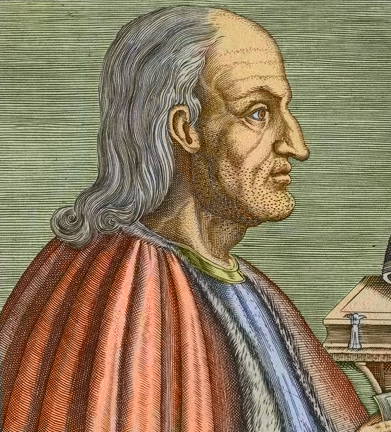

Anselm’s original formulation
Anselm of Canterbury presented the ontological argument in chapters 2 through 4 of his Proslogion (c. 1078), a work written as a prayer addressed to God. Anselm sought a single argument that would, by itself and without appeal to any other consideration, suffice to prove that God exists and possesses the attributes traditionally ascribed to him. His starting point was a definition: God is “that than which nothing greater can be thought” (aliquid quo nihil maius cogitari possit). Anselm argued that even “the fool” who says in his heart that there is no God (Psalm 14:1) understands this definition — the fool grasps what the phrase means, even while denying that such a being exists. The concept of such a being therefore exists at least in the understanding (in intellectu).1
Anselm then argued that existence in reality (in re) is greater than existence in the understanding alone. If that than which nothing greater can be thought existed only in the understanding, then one could think of something still greater — namely, the same being existing in reality as well. But this would be a contradiction, since by definition nothing greater than this being can be thought. Therefore, that than which nothing greater can be thought must exist not only in the understanding but also in reality. The argument can be rendered formally:
P1. God is defined as that than which nothing greater can be thought.
P2. That than which nothing greater can be thought exists at least in the understanding.
P3. Existence in reality is greater than existence in the understanding alone.
C. Therefore, that than which nothing greater can be thought exists in reality — that is, God exists.
In Proslogion 3, Anselm advanced a second, stronger form of the argument. He contended that it is possible to conceive of a being that cannot be thought not to exist, and that such a being is greater than one that can be thought not to exist. If that than which nothing greater can be thought could be thought not to exist, it would not truly be that than which nothing greater can be thought. Therefore, God not only exists but exists necessarily — God cannot be conceived not to exist. This second formulation, which concerns necessary existence rather than mere existence, would prove especially important in the twentieth-century revival of the argument.1, 8
Gaunilo’s objection
The first major criticism of the ontological argument came from Gaunilo, a Benedictine monk at the abbey of Marmoutiers, who responded to Anselm with a treatise titled Pro Insipiente (“On Behalf of the Fool”). Gaunilo objected that Anselm’s reasoning, if valid, could be used to prove the existence of all manner of perfect things. He proposed a parallel argument: consider an island that is more excellent than any other island, an island than which no greater island can be thought. By Anselm’s logic, this island must exist in reality, since an island existing in reality would be greater than one existing only in the understanding. But the conclusion is absurd — no one would accept that a perfect island must exist simply because we can conceive of it. Therefore, Gaunilo argued, Anselm’s reasoning must be fallacious.2, 16
Anselm replied to Gaunilo directly, insisting that the argument applies uniquely to “that than which nothing greater can be thought” and cannot be extended to islands or any other contingent things. The key difference, Anselm maintained, is that islands, no matter how excellent, are limited and contingent by nature — they have a maximum of possible greatness. Only a being whose greatness is unlimited can generate the contradiction that drives the argument. If an island can always be conceived as slightly better (one more palm tree, one more spring), then there is no coherent concept of “the greatest conceivable island,” and the parallel argument never gets off the ground. Whether this reply succeeds remains disputed. Critics note that Anselm needs to explain why the concept of maximal greatness is coherent for a being but not for an island without simply assuming what he set out to prove.1, 2, 15
Aquinas and medieval reception
Although Anselm’s argument was known throughout the medieval period, it did not command universal assent even among theologians committed to demonstrating God’s existence. Thomas Aquinas, in the Summa Theologiae (c. 1265–1274), explicitly rejected the ontological argument while affirming that God’s existence could be proved by other means (the Five Ways). Aquinas offered two main objections. First, he argued that not everyone understands the term “God” to mean that than which nothing greater can be thought; some have conceived of God as a body, for example. The argument therefore cannot assume that the fool has the required concept in his understanding. Second, and more fundamentally, Aquinas held that even if one grants the definition, the argument proves only that the concept of God includes existence — it does not prove that anything corresponding to the concept actually exists in the external world. One cannot move from a definition to an existence claim without first establishing that the thing defined is real.14, 16
Aquinas’s position reflects a broader Aristotelian-Thomistic conviction that all knowledge of God’s existence must ultimately rest on a posteriori reasoning — reasoning from observed effects to their causes. This stance placed him in a different philosophical tradition from Anselm’s Augustinian-Platonic framework, which was more hospitable to the idea that certain truths about God could be grasped through pure reason operating on innate concepts. The divide between these two traditions would continue to shape the reception of the ontological argument for centuries.14, 15
Descartes’s version
René Descartes independently formulated an ontological argument in the fifth of his Meditations on First Philosophy (1641). Descartes’s version differs from Anselm’s in important respects. Rather than arguing from the concept of “that than which nothing greater can be thought,” Descartes argued from the concept of a supremely perfect being (ens perfectissimum). He claimed that existence is a perfection — a property that contributes to a thing’s completeness — and that a supremely perfect being must therefore possess existence, just as a triangle must have interior angles summing to 180 degrees. To conceive of God as lacking existence would be like conceiving of a mountain without a valley: it involves a conceptual contradiction.3
P1. God is defined as a supremely perfect being possessing all perfections.
P2. Existence is a perfection.
C. Therefore, God exists.
Descartes anticipated the objection that his argument assumes what it sets out to prove. He insisted that the connection between God and existence is not something he imposes on the concept but something he discovers within it, just as he discovers mathematical truths by attending to the nature of numbers and figures. The idea of God, Descartes maintained, is a “true and immutable nature” that has its own objective reality independent of the thinker’s will.3, 16
Gottfried Wilhelm Leibniz, writing later in the seventeenth century, argued that Descartes’s version was incomplete as stated. Descartes had assumed that the concept of a supremely perfect being is coherent — that all perfections are compossible, capable of being combined in a single being without contradiction. Leibniz attempted to fill this gap by arguing that perfections are simple, positive, and unanalyzable qualities, and that simple positive qualities cannot conflict with one another. If no two perfections can be incompatible, then the concept of a being possessing all perfections is logically consistent, and the argument can proceed. Whether Leibniz’s proof of compossibility succeeds has itself been debated; critics have questioned whether all the properties traditionally attributed to God (omnipotence, omniscience, perfect goodness) are genuinely simple and unanalyzable.13, 16
Kant’s critique
The most influential criticism of the ontological argument came from Immanuel Kant in the Critique of Pure Reason (1781). Kant’s central objection is that “being is obviously not a real predicate” (Sein ist offenbar kein reales Prädikat) — that is, existence is not a property or determination that can be added to the concept of a thing. When one says that God exists, one does not add a new property to the concept of God; one says rather that the concept of God is instantiated, that something in reality corresponds to it. The concept of a hundred real thalers (coins), Kant argued, contains not one thaler more than the concept of a hundred possible thalers. The difference between a hundred real thalers and a hundred merely possible thalers is not a difference in the concept but a difference in whether the concept has an object.4
If Kant is correct, then both Anselm’s and Descartes’s arguments rest on a mistake. Anselm assumed that a being existing in reality is “greater” than one existing in the understanding alone — which treats existence as a property that contributes to greatness. Descartes assumed that existence is a perfection — which treats existence as a property that contributes to completeness. But if existence is not a genuine property at all, then neither assumption is warranted, and the arguments collapse. A being that is merely conceived and a being that exists in reality do not differ in their properties; they differ only in whether the concept is exemplified.4, 15
Kant’s critique was widely regarded as decisive throughout the nineteenth and early twentieth centuries, and it remains the single most cited objection to the ontological argument. However, its force has been questioned on several grounds. Some philosophers have argued that Kant’s claim about existence applies to first-order existence claims (“horses exist”) but not to claims about necessary existence, which is the modality invoked in Anselm’s second argument and in the modal versions that would follow. Others have challenged Kant’s position directly, arguing that existence can function as a real predicate in certain logical frameworks even if it does not in the Kantian system. The development of modern predicate logic, in which existence is expressed through the existential quantifier rather than as a predicate, has been seen by many as vindicating Kant’s insight, though the relationship between logical formalism and the metaphysical question is itself debated.4, 9, 16
The modal ontological argument
In the twentieth century, the ontological argument was revived in a new form that draws on modal logic — the logic of possibility and necessity. The key figures in this revival were Charles Hartshorne, Norman Malcolm, and Alvin Plantinga. Their modal versions of the argument shift the focus from existence as a predicate (the point of Kant’s critique) to necessary existence as a modal property, and they employ the framework of possible worlds semantics to give the argument rigorous logical form.6, 8, 5
Malcolm, in a 1960 article in The Philosophical Review, argued that Anselm had actually presented two distinct arguments: the one in Proslogion 2, which Kant’s critique successfully refutes, and a second in Proslogion 3, which concerns necessary existence rather than mere existence and is untouched by Kant’s objection. According to Malcolm, Anselm’s second argument establishes that if God exists, God exists necessarily, and if God does not exist, God’s existence is impossible. Since the concept of God is not demonstrably self-contradictory, God’s existence is not impossible, and therefore God exists necessarily. Hartshorne had independently advanced a similar argument in Man’s Vision of God (1941) and elaborated it further in Anselm’s Discovery (1965), arguing that Anselm’s key insight was the recognition that God’s existence, if possible at all, is necessary.8, 6, 7
Plantinga developed the most rigorous version of the modal ontological argument in The Nature of Necessity (1974) and the more accessible God, Freedom, and Evil (1977). His formulation uses the concept of “maximal greatness” and can be stated as follows:
P1. It is possible that a maximally great being exists. (That is, there is a possible world in which maximal greatness is instantiated.)
P2. A maximally great being is one that possesses maximal excellence (omnipotence, omniscience, moral perfection) in every possible world.
P3. If it is possible that a maximally great being exists, then a maximally great being exists in some possible world. (From P1, by the definition of possibility.)
P4. If a maximally great being exists in some possible world, then it exists in every possible world. (From P2, since maximal greatness entails existence in all possible worlds.)
P5. If a maximally great being exists in every possible world, then it exists in the actual world.
C. Therefore, a maximally great being exists.
The argument is logically valid in the modal logic system S5, where the axiom holds that if something is possibly necessary, then it is necessary. Plantinga himself acknowledged that the argument does not constitute a “proof” of God’s existence in the sense of compelling assent from all rational persons. Its soundness depends entirely on the truth of the key premise — that it is genuinely possible for a maximally great being to exist. Plantinga argued that this premise is not obviously false and that it is rational to accept it, making belief in God at least “rationally acceptable” even if the argument does not demonstrate the irrationality of atheism.5, 11
Gödel’s ontological proof
Kurt Gödel, the logician best known for his incompleteness theorems, developed a formal ontological proof using higher-order modal logic. The proof, which Gödel worked on intermittently between roughly 1941 and 1970 but never published in his lifetime, was circulated among colleagues and eventually published posthumously in his Collected Works (1995). Gödel’s version defines God as a being possessing all “positive properties” and argues, through a series of axioms and theorems about the logical structure of positive properties, that the existence of such a being is necessary.18
Gödel’s proof has attracted interest from logicians for its formal sophistication. In 2013, Christoph Benzmüller and Bruno Woltzenlogel Paleo used automated theorem provers to verify that Gödel’s axioms do indeed entail the conclusion — the argument is logically valid given its premises. However, the verification also confirmed a known problem: Gödel’s axioms lead to “modal collapse,” the consequence that every true proposition is necessarily true and every false proposition is necessarily false. This result is widely regarded as a reductio ad absurdum of the axiom set, suggesting that the axioms are too strong. Modified versions of Gödel’s proof that avoid modal collapse have been proposed, but they remain subjects of active research rather than settled results.18, 16
Contemporary objections
Contemporary critics of the ontological argument have developed several lines of objection that go beyond Kant’s critique. Graham Oppy, in Ontological Arguments and Belief in God (1995) and subsequent work, has mounted the most comprehensive philosophical assault on the argument in all its forms. Oppy argues that ontological arguments are dialectically ineffective: they cannot rationally persuade anyone who does not already accept their conclusions, because the key premises (such as the possibility of maximal greatness) are no more obvious or rationally compelling than the conclusion itself. A rational atheist who denies that God exists has equally good reason to deny that it is possible for a maximally great being to exist, since in S5 modal logic, the impossibility of God’s existence follows straightforwardly from the assumption that God does not exist in the actual world.9, 20
Oppy has also pressed a “many-gods” objection against the modal argument. If the argument form is valid, then parallel arguments could establish the existence of different maximally great beings with incompatible properties — a maximally great being who creates through emanation versus one who creates ex nihilo, or a maximally great being who necessarily permits evil versus one who necessarily prevents it. Since these beings cannot all exist, at least some of the parallel possibility premises must be false, but the argument provides no resources for determining which one is the genuine possibility. The form of reasoning is therefore too permissive to establish any particular theological conclusion.19, 20
Jordan Howard Sobel, in Logic and Theism (2004), developed a related line of criticism through parody arguments. Sobel demonstrated that arguments structurally identical to Plantinga’s can be constructed to prove the existence of entities that are plainly nonexistent or mutually contradictory. If one accepts the inference from the possibility of a maximally great being to its actual existence, one must also accept parallel inferences for a “maximally great island,” a “maximally great pizza,” or — more troublingly — a “maximally great evil being.” Defenders of the ontological argument respond that these parodies fail because properties like “island-ness” or “pizza-ness” impose intrinsic limits on greatness, whereas being itself does not. But Sobel argued that this response requires an independent argument for the coherence of unlimited greatness, which brings the dialectic back to the contested possibility premise.10, 16
A further objection concerns the relationship between conceivability and genuine metaphysical possibility. The modal ontological argument requires that maximal greatness is not merely conceivable but genuinely possible — that there really is a possible world in which a maximally great being exists. But conceivability is a notoriously unreliable guide to possibility. One can conceive of scenarios (such as water not being H₂O) that are metaphysically impossible, and one can fail to conceive of the impossibility of things that are in fact impossible (such as certain mathematical falsehoods). The move from “I can conceive of a maximally great being” to “a maximally great being is genuinely possible” therefore requires a bridging principle that critics regard as unwarranted.9, 12
Possible worlds semantics
The modal ontological argument is deeply intertwined with possible worlds semantics, the framework developed by Saul Kripke and others for interpreting modal logic. In this framework, a proposition is possibly true if it is true in at least one possible world, and necessarily true if it is true in all possible worlds. A possible world is not a physical place but a maximal, consistent description of how reality could be — a complete way things might have been.5, 16
The modal system S5, which Plantinga’s argument employs, includes the axiom that if a proposition is possibly necessary, then it is necessary. This means that necessity “transmits” across possible worlds: if there is any possible world in which a proposition holds necessarily (that is, holds in all worlds accessible from that world), then it holds in all possible worlds, including the actual one. When combined with the definition of maximal greatness as existence in every possible world, S5 ensures that the mere possibility of a maximally great being entails its actual existence. The argument’s validity in S5 is not disputed. What is disputed is whether S5 is the correct system of modal logic for this domain, and whether the possibility premise is question-begging within S5, given that the system makes the possibility of necessary existence logically equivalent to the actuality of necessary existence.5, 10, 16
Some critics have argued that the very power of S5 is what makes the modal ontological argument dialectically empty. In S5, “possibly necessarily p” is equivalent to “necessarily p,” and “possibly necessarily not-p” is equivalent to “necessarily not-p.” The question of whether God exists therefore reduces, in S5, to the question of whether God’s existence is possible — which is precisely the question at issue. The modal framework does not resolve the dispute between theist and atheist but merely relocates it from a question about actuality to an equivalent question about possibility.9, 10
Comparison of major versions
Major formulations of the ontological argument15, 16
| Version | Key concept | Central premise | Principal objection |
|---|---|---|---|
| Anselm (Proslogion 2) | That than which nothing greater can be thought | Existence in reality is greater than existence in the understanding alone | Gaunilo’s lost island; existence is not a predicate |
| Anselm (Proslogion 3) | Necessary existence | A being that cannot be thought not to exist is greater than one that can | Conceivability does not entail possibility |
| Descartes | Supremely perfect being (ens perfectissimum) | Existence is a perfection | Kant: existence is not a real predicate |
| Leibniz | Compossibility of perfections | All perfections are compatible; a perfect being is coherent | Not all divine attributes are clearly simple and positive |
| Gödel | Positive properties | God possesses all positive properties; positive properties are consistent | Modal collapse (every truth becomes necessary) |
| Hartshorne / Malcolm | Necessary existence as a modal property | God’s existence is either necessary or impossible; it is not impossible | The possibility premise is question-begging |
| Plantinga | Maximal greatness | It is possible that a maximally great being exists (in some possible world) | Parody arguments; possibility = actuality in S5 |
The current state of the debate
The ontological argument occupies a distinctive position in contemporary philosophy of religion. Among professional philosophers, it is probably the least widely accepted of the major theistic arguments, with surveys consistently showing that most philosophers find it unpersuasive. The 2020 PhilPapers survey of Anglophone philosophers found that only about 15 percent accepted or leaned toward theism, and the ontological argument is generally considered to have fewer adherents than the cosmological or fine-tuning arguments even among theistic philosophers. Yet it continues to generate substantial scholarly literature and remains a fixture in philosophy of religion courses, where it serves as a rich case study in modal logic, the nature of existence, the limits of a priori reasoning, and the relationship between conceivability and possibility.12, 16, 17
Defenders of the argument, such as Plantinga and Robert Maydole, maintain that the possibility premise is rationally defensible even if it cannot be proved with certainty. They point out that we routinely accept possibility claims on the basis of conceivability in other domains and argue that the burden of proof falls on the critic to show that maximal greatness is incoherent. Some defenders have also developed independent arguments for the coherence of the concept of God, drawing on perfect being theology — the tradition of reasoning about what properties a maximally great being would have to possess — to argue that omnipotence, omniscience, and moral perfection are individually coherent and mutually compatible.17, 11
Critics, led by Oppy, continue to argue that the argument is question-begging in its most fundamental move. The proposition “it is possible that a maximally great being exists” is, in S5, logically equivalent to “a maximally great being exists,” and therefore anyone who denies the conclusion has an equally principled reason to deny the premise. The argument is thus dialectically inert: it can confirm the beliefs of those who already accept its conclusion but cannot rationally compel anyone who does not. This assessment does not impugn the argument’s logical validity — it is formally impeccable — but it does impugn its epistemic force as a tool for settling the question of God’s existence.9, 20
The ontological argument also continues to raise deep questions in metaphysics and philosophical logic that extend well beyond the philosophy of religion. The debate over whether existence is a predicate remains active in discussions of the foundations of logic and ontology. The relationship between conceivability and possibility is a live issue in philosophy of mind (where “zombie arguments” against physicalism employ similar modal reasoning) and in the philosophy of mathematics. And the question of whether any proposition can be established as necessary by purely a priori means connects to fundamental issues about the nature and limits of human reason. For these reasons, the ontological argument — even if it fails as a proof of God’s existence — remains one of the most philosophically fertile arguments in the Western intellectual tradition.15, 16