Overview
- Pascal’s Wager, formulated by Blaise Pascal in the Pensées (published posthumously in 1670), argues that rational self-interest requires wagering on God’s existence: if God exists and one believes, the reward is infinite; if God exists and one does not believe, the loss is infinite; and if God does not exist, the costs and benefits of belief and unbelief are finite — making belief the uniquely rational choice under conditions of uncertainty.
- The Wager is not a traditional argument for God’s existence — it does not attempt to demonstrate that God exists — but a pragmatic argument that rational agents have overwhelming practical reasons to cultivate belief in God, even if the theoretical evidence for God’s existence is inconclusive, because the expected utility of belief dominates every alternative strategy.
- Major objections include the many-gods problem (that the reasoning applies equally to incompatible deities, yielding no guidance about which god to believe in), the inauthentic belief objection (that one cannot simply choose to believe and that God would not reward insincere belief), and the infinite utility problem (that standard decision theory breaks down when infinite values are introduced), each of which has generated extensive philosophical analysis.
Pascal’s Wager is a pragmatic argument for belief in God formulated by the French mathematician and philosopher Blaise Pascal (1623–1662) in the Pensées, a collection of notes for an unfinished treatise on Christian apologetics published posthumously in 1670. The Wager occupies a unique position among theistic arguments because it does not attempt to demonstrate that God exists. Instead, it argues that under conditions of uncertainty about God’s existence, rational self-interest requires one to wager in favor of belief. The reasoning employs an early form of decision theory: when the possible gains and losses of belief and unbelief are compared, belief emerges as the dominant strategy because the potential gain (eternal life) is infinite while the potential cost (a finite life lived under religious constraints) is finite. The argument has generated one of the most extensive secondary literatures in the philosophy of religion, attracting analysis from decision theorists, epistemologists, and philosophers of religion.1, 2
The Wager is best understood within its original context. Pascal was writing for the educated libertines of seventeenth-century France — intellectuals who acknowledged that the evidence for God’s existence was inconclusive and who used that inconclusiveness as a reason for unbelief. Pascal’s strategy was to show that even if reason cannot settle the question of God’s existence, practical rationality can settle the question of whether to believe. The Wager was not intended to stand alone but to motivate the inquirer to begin the practices (prayer, sacraments, study) that Pascal believed would eventually produce genuine belief.1, 12
Historical context
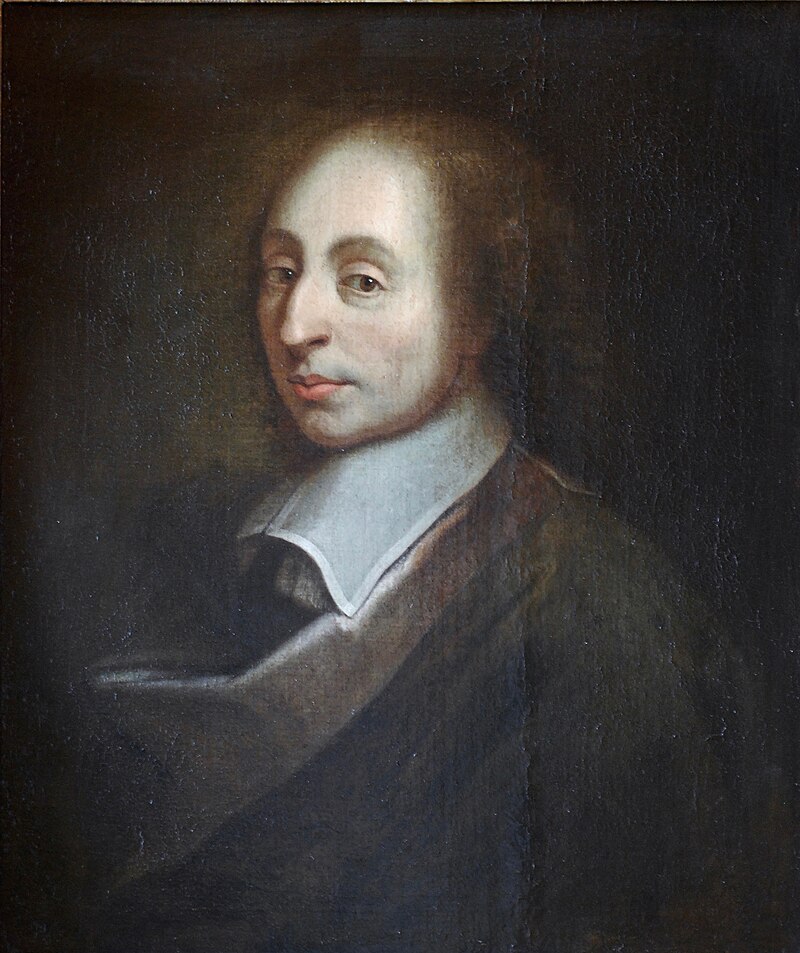

Pascal composed the Pensées during the last years of his life (1657–1662) as preparatory notes for a projected “Apology for the Christian Religion.” The work was never completed; Pascal died at thirty-nine, leaving behind roughly a thousand fragments of varying length and polish. The Wager appears in the section that editors have traditionally numbered as fragment 233 (in the Brunschvicg ordering) or 418 (in the Lafuma ordering). The fragment is written in a conversational style, as a dialogue between Pascal and an imagined interlocutor who is uncertain about God’s existence.1
The intellectual background of the Wager includes the emergence of probability theory, to which Pascal himself made foundational contributions through his correspondence with Pierre de Fermat in 1654. Pascal’s analysis of the expected value of gambling stakes — developed in connection with the “problem of points” (how to divide the stakes of an interrupted game of chance) — provided the mathematical framework that the Wager applies to the question of religious belief. The Wager is thus one of the earliest applications of expected utility reasoning to a non-mathematical decision problem.2, 9
Pascal’s immediate audience was the seventeenth-century French honnête homme — an educated, worldly skeptic influenced by Montaigne’s Essays and the libertine intellectual culture of Paris. Pascal acknowledged the limitations of the traditional arguments for God’s existence: “If there is a God, he is infinitely incomprehensible, since, having neither parts nor limits, he has no relation to us. We are then incapable of knowing either what he is or if he is.” The Wager takes this epistemic situation as its starting point and argues that even under these conditions, belief is the rational course of action.1
The argument
The Wager can be reconstructed as a decision problem with two possible states of the world (God exists, God does not exist) and two possible actions (believe in God, do not believe in God). Pascal argues that since reason cannot determine which state obtains, the decision must be made on the basis of expected utility — the possible outcomes weighted by their probabilities.1, 2
P1. Either God exists or God does not exist, and reason cannot determine which.
P2. If God exists and one believes, one gains infinite happiness (eternal life).
P3. If God exists and one does not believe, one suffers infinite loss (eternal separation from God).
P4. If God does not exist, the gains and losses of belief and unbelief are finite.
P5. Rational agents should choose the action with the highest expected utility.
C. Therefore, one should believe in God.
The decision matrix can be represented as follows:
| God exists | God does not exist | |
|---|---|---|
| Believe | Infinite gain (eternal life) | Finite loss (costs of religious practice) |
| Do not believe | Infinite loss (eternal separation) | Finite gain (freedom from religious constraints) |
The mathematical structure of the argument relies on the properties of infinity in expected utility calculations. Let p be the probability that God exists (where 0 < p < 1). The expected utility of believing is p × ∞ + (1 − p) × (f1), where f1 is the finite utility of believing if God does not exist. The expected utility of not believing is p × (−∞) + (1 − p) × (f2), where f2 is the finite utility of not believing if God does not exist. Since p × ∞ = ∞ for any p > 0, and p × (−∞) = −∞ for any p > 0, the expected utility of belief is infinite and the expected utility of unbelief is negative infinity, regardless of the finite payoffs. Pascal himself put it vividly: “If you gain, you gain all; if you lose, you lose nothing. Wager, then, without hesitation that He is.”1, 2
The many-gods objection
The many-gods objection, first raised in spirit by Denis Diderot in the eighteenth century and developed extensively in contemporary philosophy, argues that the Wager is formally valid for any deity that promises infinite reward for belief and infinite punishment for unbelief. The Christian God, the Islamic Allah, various Hindu deities, and hypothetical gods that reward only atheists all generate the same decision-theoretic structure. If the Wager proves that one should believe in the Christian God, it equally proves that one should believe in every other god that offers infinite stakes — but one cannot believe in all of them simultaneously, and the Wager provides no criterion for choosing among them.10, 5
Responses to the many-gods objection take several forms. Jordan argues that the Wager should be understood as a two-stage argument: the first stage (the Wager proper) shows that one should adopt some form of theistic belief rather than remaining an atheist or agnostic; the second stage involves evaluating which form of theism is best supported by the available evidence, including theological arguments, historical testimony, and religious experience. On this reading, the Wager narrows the field from “any position” to “some form of theism,” and other considerations do the remaining work.4
Bartha proposes a more technical response based on relative probability. Among the competing deity hypotheses, some have higher antecedent probability than others, based on the evidence. If the probability of the Christian God is significantly higher than the probability of reward-atheism gods (which are arguably ad hoc constructions with very low prior probability), the expected utility calculation favors Christianity even in a many-gods framework. The many-gods objection is strongest when the competing deity hypotheses have roughly equal prior probability and weakest when one hypothesis is substantially more probable than the alternatives.5
Oppy argues that the many-gods objection is unanswerable. The space of possible deity hypotheses is unbounded — for any proposed god, one can construct an alternative god that rewards the opposite behavior — and there is no principled way to assign prior probabilities across this infinite space. If the probability is distributed over infinitely many hypotheses, each with infinite expected utility, the standard decision-theoretic framework yields no determinate recommendation.6, 13
Can belief be chosen?
A fundamental objection to the Wager questions its basic psychological presupposition: that one can choose to believe in God. Belief, the objection holds, is not subject to direct voluntary control. One cannot decide to believe that it is raining when one can see clear sky through the window. If belief in God requires genuine conviction that God exists, and one cannot produce conviction by an act of will, then the Wager’s recommendation — “wager that God exists” — is impossible to follow.10, 2
Pascal anticipated this objection and responded in the text of the Wager itself. His interlocutor protests: “I am made in such a way that I cannot believe. What would you have me do?” Pascal replies that the path to belief runs through practice: “Follow the way by which they began: by acting as if they believed, taking the holy water, having masses said, etc. This will naturally make you believe, and deaden your acuteness.” Pascal is recommending an indirect strategy: one cannot choose to believe directly, but one can choose to engage in practices that tend to produce belief over time. The Wager provides the rational motivation to embark on these practices.1
This response raises its own philosophical difficulties. William Clifford argued in “The Ethics of Belief” (1877) that it is morally wrong to believe anything on insufficient evidence. Deliberately cultivating a belief by immersing oneself in practices designed to suppress critical scrutiny is a form of epistemic self-manipulation that violates the ethics of inquiry. William James responded to Clifford in “The Will to Believe” (1896), arguing that in cases where evidence is insufficient, the decision is forced (one must either believe or not believe), and the stakes are momentous, it is permissible to let one’s “passional nature” decide. James’s argument, while sympathetic to the spirit of Pascal’s Wager, differs in important respects: James requires that the evidence be genuinely insufficient and the option “live” (psychologically available to the agent), conditions that constrain the Wager’s scope.8, 7
The inauthentic belief objection
Even if one can produce belief through the practices Pascal recommends, a further objection asks whether God would reward belief that originates from self-interested calculation rather than genuine conviction or love. The Wager recommends believing because it is advantageous, not because one has been persuaded that God exists or moved by love of the divine. If God values authentic faith — the kind that arises from trust, relationship, or honest inquiry — then belief motivated by the desire to maximize expected utility may not merit the infinite reward the Wager promises. A God who rewards only sincere seekers would see through the strategy, rendering the Wager self-defeating.3, 2
Jordan responds that this objection misunderstands the relationship between initial motivation and eventual belief. A person who begins attending church for pragmatic reasons may, through exposure to the community, the teachings, and the practices, develop genuine faith. The initial motivation need not persist as the sustaining motivation. Pascal’s own view was that the practices would “naturally make you believe” — the manufactured belief would eventually become genuine. The Wager is a first step on a longer journey, not the destination.4
Groothuis argues that Pascal intended the Wager to function within a broader apologetic context. The Pensées includes extensive arguments concerning the fulfillment of prophecy, the reliability of testimony about miracles, and the moral and psychological insights of Christianity. The Wager was meant to overcome the initial resistance of the skeptic — to make the skeptic willing to investigate seriously — not to serve as the sole or final ground for belief. Read in this context, the concern about inauthentic belief is less pressing: the Wager opens the door, and the evidence walks the inquirer through it.12
Infinite utility problems
The most technically demanding objections to Pascal’s Wager concern the role of infinite values in decision theory. Standard expected utility theory was developed for finite payoffs and breaks down in several ways when infinite values are introduced. Hájek identifies multiple problems: any option that has even a non-zero probability of yielding an infinite payoff has infinite expected utility, which means that many different actions — not just belief in God — have infinite expected utility, and the theory cannot distinguish among them. Furthermore, the expected utility of mixed strategies (believing with probability 0.5 and not believing with probability 0.5) is also infinite, undercutting the Wager’s claim that full belief is uniquely rational.11, 2
Hájek further argues that the assignment of infinite utility to eternal life is itself philosophically problematic. If eternal life is infinitely valuable, then any non-zero probability of achieving it through any action (including actions unrelated to religious belief) yields infinite expected utility. A person who buys a lottery ticket has a non-zero probability of winning; a person who performs a random act of kindness has a non-zero probability that this act somehow leads to eternal life; any act whatsoever has a non-zero probability of some causal chain leading to infinite reward. The result is that every possible action has infinite expected utility, and the decision framework collapses into indifference — the exact opposite of Pascal’s intended conclusion.11
Defenders have proposed various technical solutions. Some reject the use of standard expected utility theory and propose alternative decision rules — such as the dominance principle (belief dominates unbelief because it yields a better outcome in every possible state of the world) or a lexicographic utility function that compares infinite payoffs first and finite payoffs only when infinite payoffs are equal. Others argue that the probability of achieving infinite reward through non-belief is genuinely zero (not merely very small), which would block the generalization problem. Peterson surveys these technical alternatives and concludes that no single resolution has achieved consensus in the decision theory literature.9, 4
The Wager and other pragmatic arguments
Pascal’s Wager belongs to a broader category of pragmatic arguments for religious belief — arguments that appeal to the practical benefits of belief rather than to evidence for the truth of what is believed. William James’s “The Will to Believe” (1896) is the most influential subsequent example. James argues that under specific conditions — when the evidence is insufficient, the choice between belief and unbelief is “forced” (there is no neutral ground), and the stakes are “momentous” — it is rational and permissible to believe on the basis of practical considerations. James differs from Pascal in important respects: James does not invoke infinite utilities, requires that the hypothesis be “live” (genuinely available to the subject), and grounds his argument in the practical benefits of belief rather than in expected utility calculations about the afterlife.7
Contemporary pragmatic arguments have been developed by Jordan, who distinguishes several types. “Wager” arguments appeal to the expected utility of outcomes that depend on God’s existence. “Will to believe” arguments appeal to the epistemic and practical goods that theistic belief can provide in this life, independently of whether God exists. “Moral” pragmatic arguments contend that theistic belief promotes moral development or social cohesion. Jordan argues that the most defensible pragmatic arguments are those that do not rely on infinite utilities but appeal to the more modest claim that theistic belief, in the context of genuine evidential uncertainty, is practically beneficial and epistemically permissible.4
Craig has argued that the Wager can function as a useful supplement to the traditional theistic arguments. When a person has encountered the cosmological, teleological, and moral arguments and finds the evidence for theism suggestive but not conclusive, the Wager provides additional practical motivation to embrace theism rather than suspending judgment indefinitely. On this reading, the Wager is most effective when it follows rather than precedes the assessment of theoretical evidence.14
Contemporary assessment
Pascal’s Wager continues to generate substantial philosophical discussion. Its significance lies less in its effectiveness as a proof of theism than in the questions it raises about the relationship between epistemic and practical rationality (see faith vs reason), the role of self-interest in belief formation, the proper treatment of infinite values in decision theory, and the legitimacy of pragmatic considerations in matters of belief.2
Major objections and responses2, 4
| Objection | Source | Challenge | Response |
|---|---|---|---|
| Many gods | Diderot, Mackie, Oppy | Applies equally to incompatible deities | Two-stage argument; prior probabilities favor some gods over others |
| Doxastic voluntarism | Various | Belief cannot be directly chosen | Indirect strategy through practice; belief can be cultivated |
| Inauthentic belief | Various | God would not reward self-interested belief | Initial pragmatic motivation can lead to genuine faith |
| Infinite utility | Hájek | Decision theory breaks down with infinite values | Dominance principle; alternative decision rules |
| Ethics of belief | Clifford | Wrong to believe without sufficient evidence | James: permissible when forced, live, and momentous |
The Wager raises a deeper question about what Pascal called the “reasons of the heart” — whether practical, existential, and affective considerations can legitimately influence belief in ways that purely theoretical evidence cannot. Pascal’s insight was that the question of God’s existence is not merely an academic puzzle but an existential decision with profound consequences for how one lives. Whether the decision-theoretic framework he employed is adequate to capture this insight remains a matter of active philosophical debate. The Wager’s enduring significance may lie less in its formal structure, which faces serious technical difficulties, than in its recognition that the question of God’s existence is not one on which human beings can simply suspend judgment without practical consequence.1, 2, 4