Overview
- Teleological arguments infer the existence of a designer from perceived order, purpose, or fine-tuning in the natural world, and they constitute one of the oldest and most persistent families of arguments in the philosophy of religion.
- Classical versions, from Plato and Cicero through Aquinas's Fifth Way and Paley's watchmaker analogy, reason from biological complexity and natural regularity to an intelligent cause, while modern versions focus on the precise calibration of physical constants and initial conditions that permit the existence of life.
- Major objections include the Darwinian explanation of biological complexity through natural selection, the multiverse hypothesis as an alternative account of fine-tuning, and the anthropic principle's claim that observers can only exist in universes compatible with their existence, though each objection has generated substantive philosophical responses.
Teleological arguments — from the Greek telos, meaning "end" or "purpose" — constitute a family of arguments that infer the existence of a designing intelligence from perceived order, regularity, purpose, or fine-tuning in the natural world.10 The reasoning is broadly analogical or abductive: the natural world exhibits features that, in human experience, are characteristically produced by intelligent agents; therefore, the argument concludes, an intelligent agent is the best explanation for those features. This family of arguments is among the oldest in the philosophy of religion, with roots in ancient Greek thought, a central place in medieval natural theology, and a substantial revival in contemporary philosophy driven by discoveries in cosmology and fundamental physics.7, 10
Teleological arguments divide into two broad streams. Classical design arguments reason from the biological complexity and functional organisation of organisms and natural systems to an intelligent designer. Fine-tuning arguments, developed primarily in the late twentieth century, reason from the precise calibration of the fundamental constants of physics and the initial conditions of the universe to an intelligent cause of the cosmos itself.9, 10 Both streams share a common logical core — the inference from order to intelligence — but they differ in their premises, their vulnerability to objections, and their relationship to modern science. This article surveys the historical development of teleological reasoning, presents the formal structure of its major variants, examines the principal objections and responses, and compares the classical and fine-tuning approaches.
Historical development
.jpg)
The inference from natural order to a cosmic intelligence appears early in the Western philosophical tradition. In the Timaeus, composed around 360 BCE, Plato describes the cosmos as the product of a divine craftsman, the Demiurge, who imposes rational order on pre-existing matter by looking to eternal Forms as a blueprint. The cosmos exhibits mathematical regularity and purpose, Plato argues, because it was fashioned by a rational agent who aimed at the Good.1 Plato's account is not an argument from design in the modern sense — it is embedded in a cosmological myth — but it establishes the foundational intuition that order requires an orderer.
Cicero's De Natura Deorum (45 BCE) presents the design inference more explicitly through the Stoic character Balbus, who argues that the intricate mechanisms of the heavens, the adaptations of living things, and the rational structure of the human mind cannot be accounted for by chance. Balbus offers an analogy: just as one would infer an intelligent builder from the discovery of a sundial or a water-clock, so one should infer an intelligent cause from the far more complex mechanisms of nature.2 The Epicurean character Velleius and the Academic sceptic Cotta offer objections, making Cicero's dialogue one of the earliest sustained philosophical examinations of the design argument and its difficulties.
In the thirteenth century, Thomas Aquinas incorporated teleological reasoning into his Summa Theologica as the Fifth Way, the last of his five proofs for the existence of God. Aquinas observed that natural bodies that lack intelligence — such as plants and inanimate objects — nonetheless act for an end, consistently achieving the best result. Things that lack knowledge can act for an end only if directed by a being with knowledge and intelligence, he argued, "as the arrow is shot to its mark by the archer." This directing intelligence, Aquinas concluded, is what all call God.3 The Fifth Way differs from later design arguments in that it appeals not to complexity or improbability but to the goal-directedness (finalitas) of natural processes — a framework rooted in Aristotelian metaphysics.
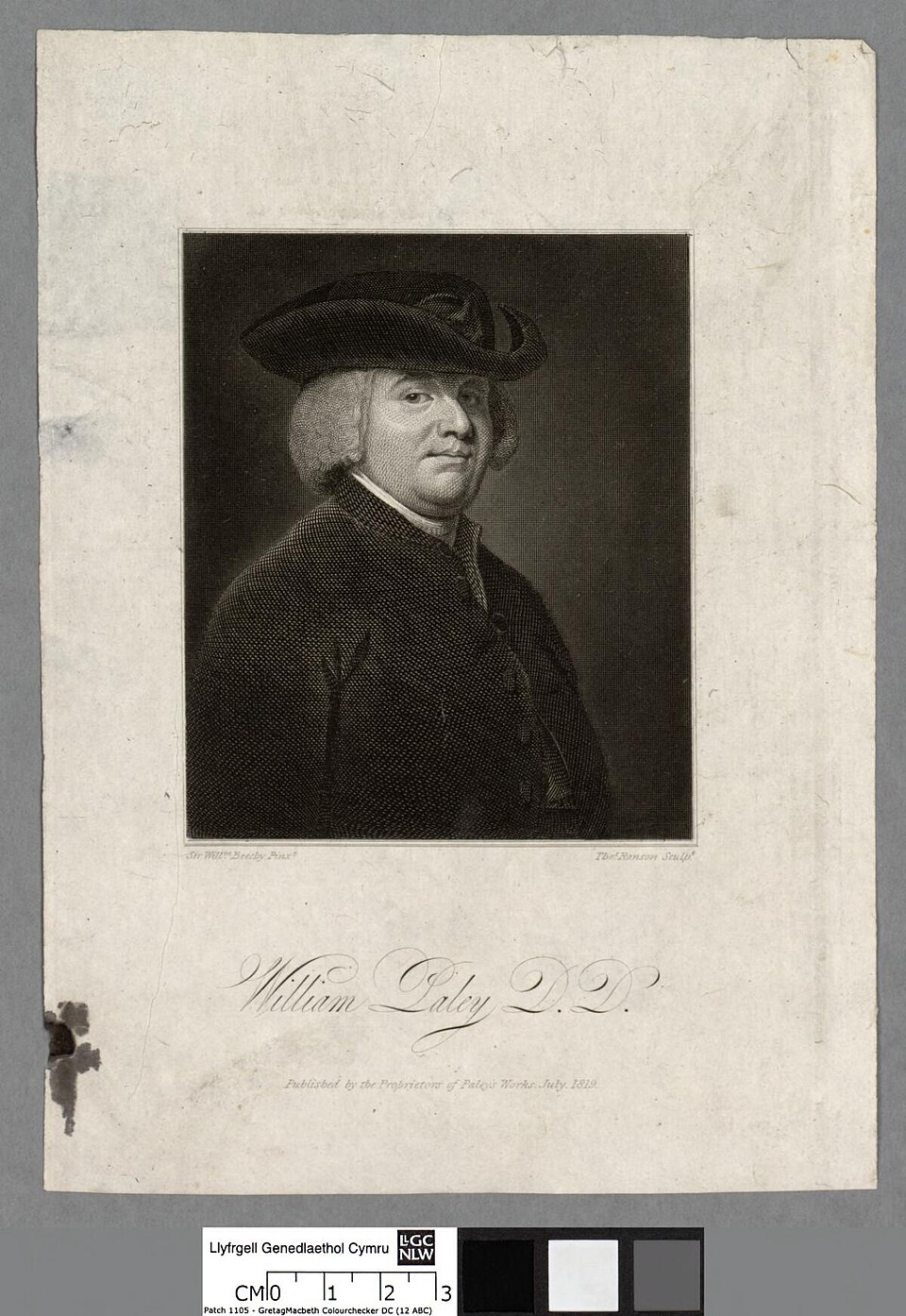
The argument reached its most elaborate pre-Darwinian expression in William Paley's Natural Theology (1802). Paley's opening chapter presents the watchmaker analogy: if one found a stone on a heath, one might suppose it had lain there forever; but if one found a watch, with its intricate arrangement of springs, gears, and hands all cooperating to indicate the time, one would infer that the watch had been designed by an intelligent maker. The inference holds, Paley argued, even if one had never seen a watch before, even if the watch sometimes went wrong, and even if one could not understand every part of its mechanism. Paley then devoted several hundred pages to cataloguing biological adaptations — the human eye, the structure of feathers, the hinge joint of a bivalve shell — arguing that each exhibited a complexity and fitness for purpose far exceeding anything found in a watch, and therefore required a designer of correspondingly greater intelligence.4
Two major intellectual developments disrupted the classical design argument in the eighteenth and nineteenth centuries. David Hume's Dialogues Concerning Natural Religion (published posthumously in 1779) raised a battery of philosophical objections through the character Philo: the analogy between human artefacts and the universe is weak; the argument at best establishes a designer proportional to the effect, not an infinite God; the universe might be self-organising; and multiple designers, or an imperfect designer, cannot be ruled out.5 Charles Darwin's On the Origin of Species (1859) then provided a mechanism — natural selection acting on heritable variation — capable of producing the biological adaptations Paley had catalogued, without the need for intelligent direction.6 The combination of Hume's philosophical critique and Darwin's scientific alternative significantly diminished the influence of classical biological design arguments, though intelligent design proponents would later attempt to revive biological design reasoning on new grounds in subsequent philosophical discussion.
In the late twentieth century, however, the design argument was reformulated on new ground. Physicists and cosmologists observed that the fundamental constants of nature — the strength of gravity, the mass of the electron, the cosmological constant, the strong nuclear force coupling — appear to be calibrated within extremely narrow ranges compatible with the existence of complex structures and life.8 This observation, often called "fine-tuning," prompted a new generation of teleological arguments that bypass biology entirely and reason from physics to a cosmic designer. Philosophers such as Richard Swinburne and Robin Collins have developed these arguments with considerable formal rigour, arguing that theistic design provides a better explanation of fine-tuning than either physical necessity or chance.7, 9
Common logical structure
Despite their diversity, teleological arguments share a common inferential pattern. They begin with an empirical observation about the natural world — that it exhibits order, complexity, purpose, or fine-tuning — and argue that this observation is better explained by intelligent design than by unguided natural processes. The inference can be formalised in different ways. Some teleological arguments employ analogical reasoning (the universe is like a designed artefact, so it probably has a designer). Others employ inference to the best explanation, also called abductive reasoning (design is the best explanation of the observed order). Still others use Bayesian probability theory, arguing that the observed features of the universe are much more probable given the hypothesis of a designer than given the hypothesis of no designer.7, 10
An argument is logically valid if its conclusion follows necessarily from its premises — that is, if the premises cannot all be true while the conclusion is false. An argument is sound if it is valid and all its premises are in fact true. A cogent argument is the inductive analogue: an inductively strong argument with true premises. Most teleological arguments are inductive or abductive rather than deductive, so the relevant assessment is whether they are cogent — whether the premises are true and whether they provide strong evidential support for the conclusion.10 The following sections present the formal structure of the two major variants.
The classical design argument
The classical design argument, exemplified by Paley's watchmaker reasoning, proceeds by analogy from the known productions of human intelligence to the unknown cause of natural complexity. Its formal structure can be rendered as follows:4, 10
P1. Artefacts produced by human intelligence exhibit complex, functional organisation — the arrangement of parts toward the achievement of an end.
P2. Biological organisms and natural systems exhibit complex, functional organisation that is analogous to, and often exceeds, that of human artefacts.
P3. Like effects have like causes.
C. Therefore, biological organisms and natural systems are probably the product of an intelligence analogous to, and greater than, human intelligence.
The strength of this argument depends on the strength of the analogy between artefacts and organisms. Paley devoted the bulk of Natural Theology to strengthening P2 by cataloguing biological adaptations in exhaustive detail — the optics of the eye, the hydrodynamics of fish locomotion, the structural engineering of the human skeleton — arguing that each case exhibited a degree of fit between structure and function that exceeded the most sophisticated human machinery.4 The argument does not claim logical necessity; it claims that design is the best available explanation for the kind of functional complexity observed in nature.
P1 draws on uniform human experience: whenever complex functional arrangements are traced to their source, that source turns out to be an intelligent agent. P3 — the principle that similar effects imply similar causes — is a standard principle of analogical and inductive reasoning. The argument's vulnerability centres on P2 and P3 jointly: if an alternative, non-intelligent mechanism can produce the same kind of functional complexity observed in organisms, then the analogy to human artefacts is weakened and the inference to a designer is no longer the only or best explanation.5, 10
Hume's Dialogues raised several challenges to the classical argument before Darwin provided the biological alternative. Philo objects that the universe is not sufficiently similar to a machine or a house to sustain the analogy; that even if it were, the argument at best establishes a designer proportional to the universe, not an omnipotent or morally perfect God; that the hypothesis of multiple designers, a committee of gods, or an incompetent designer all fit the evidence equally well; and that the matter of the universe might possess its own inherent organising principles, making an external designer unnecessary.5 Hume's interlocutor Cleanthes responds that the analogy is overwhelmingly supported by the sheer degree of functional complexity in nature, and that sceptical alternatives (a committee of designers, inherent organising principles) are ad hoc and lack independent support. The exchange remains philosophically instructive as a map of the logical terrain any analogical design argument must navigate.
The fine-tuning argument
The modern fine-tuning argument shifts the evidential base from biology to physics. Its premise is not that organisms look designed, but that the fundamental constants and initial conditions of the universe are calibrated within extraordinarily narrow ranges that permit the existence of complex chemistry, stars, planets, and life. The argument holds that this calibration requires explanation, and that intelligent design provides a better explanation than chance or physical necessity.9
The physicist Martin Rees has identified six dimensionless numbers whose values appear to be critical for the existence of a life-permitting universe: the strength of the electromagnetic force relative to gravity (N ≈ 1036), the proportion of mass converted to energy in nuclear fusion (ε ≈ 0.007), the cosmic density parameter (Ω ≈ 1), the cosmological constant (λ), the amplitude of primordial density fluctuations (Q ≈ 10−5), and the number of spatial dimensions (D = 3). Small variations in several of these values would produce a universe without stable atoms, without stars capable of synthesising heavy elements, or without the gravitational structure necessary for galaxies and planets to form.8
Robin Collins has provided one of the more detailed philosophical formulations of the fine-tuning argument. His version employs a likelihood principle: an observation counts as evidence for a hypothesis over a rival if the observation is more probable given the first hypothesis than given the second.9 The argument can be formalised as follows:
P1. The fundamental constants of physics and the initial conditions of the universe are fine-tuned for the existence of life — that is, they fall within extremely narrow life-permitting ranges.
P2. Fine-tuning is not physically necessary — the constants could, so far as current physics can determine, have taken different values.
P3. The fine-tuning is much more probable on the hypothesis that the universe was designed by an intelligent agent than on the hypothesis that the values arose by unguided chance.
C. Therefore, the fine-tuning provides significant evidence for the existence of an intelligent designer of the universe.
P1 is an empirical claim supported by work in physics and cosmology. The cosmological constant, for example, is estimated to require a value within approximately one part in 10120 of its theoretically expected magnitude for the universe to avoid either collapsing immediately or expanding too rapidly for structure to form.8, 9 The strong nuclear force coupling constant appears to require calibration within a few percent of its observed value for stable nuclei heavier than hydrogen to exist.8 These estimates are drawn from physical calculations about what would happen if the constants were varied, and they do not depend on the truth of any particular theological framework.
P2 is a claim about the modal status of the constants. If the constants are metaphysically necessary — if they could not have been different — then fine-tuning requires no explanation at all. Current physics does not derive the values of the fundamental constants from any deeper law; the Standard Model of particle physics treats them as free parameters that are determined empirically rather than predicted theoretically.8 This supports P2, though it remains an open question whether a future theory of everything might render the constants necessary.
P3 relies on a comparison of likelihoods. On the theistic hypothesis, an intelligent agent who intends to create a life-permitting universe would be expected to set the constants to life-permitting values; thus the probability of fine-tuning given theism is relatively high. On the chance hypothesis, the probability of the constants falling within extremely narrow life-permitting ranges is, by the stipulation of P1, extremely low.9 The argument does not claim certainty; it claims that design is evidentially favoured over unguided chance as an explanation for fine-tuning.
Swinburne's cumulative teleological case
Richard Swinburne has developed the teleological argument as one component of a cumulative case for the existence of God, using Bayesian probability theory as the formal framework. In The Existence of God, Swinburne distinguishes between two aspects of natural order that require explanation: temporal order (the conformity of nature to simple, universal laws) and spatial order (the fine-tuning of constants and initial conditions that permit complex structures).7
Swinburne argues that the very existence of natural laws — the fact that the universe operates according to simple, mathematically elegant regularities rather than chaos — is itself a feature that calls for explanation. Science explains particular phenomena by appealing to laws, but science does not and cannot explain why there are laws at all, or why the laws take the simple form they do. The simplicity and universality of natural laws, Swinburne argues, are more probable on the hypothesis that the universe was created by a rational agent who values order than on the hypothesis that the universe exists as a brute fact with no explanation for its orderly character.7
For spatial order — the fine-tuning of constants — Swinburne argues along lines parallel to Collins, contending that the prior probability of a life-permitting set of constants is vastly higher given theism than given the naturalistic hypothesis that the constants are the product of chance. Swinburne acknowledges that the teleological argument alone does not establish a high probability for theism; rather, it raises the probability of theism by a significant increment, and the cumulative force of this argument combined with the cosmological argument, the argument from consciousness, the argument from morality, and other considerations yields a total probability that exceeds 0.5.7
Graham Oppy has challenged Swinburne's Bayesian approach on several grounds. Oppy argues that the prior probability of theism is not as high as Swinburne assumes, because the theistic hypothesis — positing an infinite, omnipotent, omniscient being — is not a simple hypothesis in the relevant sense. Oppy further contends that Swinburne's likelihood assessments are difficult to justify with precision, since we lack an independent way of determining how probable it is that God would create a life-permitting universe as opposed to some other kind of universe or no universe at all.13
Objections: evolution and natural selection
The publication of Darwin's On the Origin of Species in 1859 provided a non-teleological mechanism capable of producing the biological adaptations that Paley and his predecessors had attributed to intelligent design. Natural selection, operating on random heritable variation over vast stretches of time, can generate complex functional structures through the gradual accumulation of small, individually advantageous modifications. The eye, the wing, the immune system, and every other biological adaptation that Paley cited as evidence of design can, on the Darwinian account, be explained as the product of cumulative selection without the intervention of a designer.6
Richard Dawkins has articulated this objection with particular force, arguing that natural selection is a "blind watchmaker" — a process that achieves the appearance of design through an algorithm that has no foresight and no intentions. The cumulative power of selection, Dawkins argues, is sufficient to bridge the gap between simple self-replicating molecules and the most complex biological structures, provided enough time and enough variation are available. On this account, Paley's argument fails not because its observations about biological complexity are wrong, but because it incorrectly infers that intelligence is the only possible source of such complexity.11
Defenders of teleological reasoning have responded in several ways. Some, including Alvin Plantinga, have argued that natural selection explains the development of biological complexity given the existence of a life-permitting universe with the right physical laws, but does not explain why the universe has those laws and constants in the first place. On this view, the Darwinian objection is effective against classical biological design arguments but leaves the fine-tuning argument untouched, since fine-tuning concerns the conditions under which natural selection itself is possible.14 Others have argued that even within biology, certain features — the origin of the first self-replicating system, the origin of the genetic code, the emergence of consciousness — are not adequately explained by natural selection alone and remain open to teleological interpretation.10
Objections: the multiverse hypothesis
The most discussed alternative to theistic design as an explanation for cosmic fine-tuning is the multiverse hypothesis — the proposal that our universe is one of an enormous (perhaps infinite) ensemble of universes, each with different values of the fundamental constants, and that we necessarily observe a life-permitting universe because observers can only exist in life-permitting regions of the multiverse.12 On this account, the apparent improbability of our universe's fine-tuning is dissolved: given enough universes with enough variation, it is virtually certain that some will have life-permitting constants, and it is no surprise that we find ourselves in one of those.
The multiverse objection has generated a substantial philosophical literature. Collins has argued that the multiverse, even if it exists, does not eliminate the need for a teleological explanation, because the multiverse itself requires a universe-generating mechanism governed by the right kind of laws — laws capable of producing a sufficiently varied ensemble of universes with different constants. If the mechanism is itself fine-tuned to produce the necessary variety, the explanatory regress has merely been pushed back one level.9 Swinburne has objected to the multiverse on grounds of parsimony, arguing that a single intelligent designer is a simpler hypothesis than the postulation of an unobservable infinity of universes, and that Ockham's razor therefore favours theism over the multiverse as an explanation of fine-tuning.7
Oppy has responded that the comparison of simplicity between theism and the multiverse is not straightforward. An infinite God, Oppy argues, is not obviously a simpler postulation than an infinite multiverse; both hypotheses go radically beyond the observable evidence, and neither can be independently verified.13 Physicists working on inflationary cosmology and string theory have noted that certain physical theories independently predict a multiverse — not as a philosophical convenience but as a consequence of the physics — and if the multiverse follows from well-confirmed physical theories, it is not an ad hoc response to fine-tuning but an independent prediction that happens to address it.8
Objections: the anthropic principle
Closely related to the multiverse hypothesis is the anthropic principle, which in its weakest form states simply that the conditions observed in any universe must be compatible with the existence of the observers who observe them.12 John Barrow and Frank Tipler distinguished several versions of the anthropic principle. The weak anthropic principle (WAP) holds that the observed values of physical constants must be consistent with the existence of carbon-based observers, since we are carbon-based observers. The strong anthropic principle (SAP) makes the stronger claim that the universe must have properties that permit the development of observers at some point in its history.12
The weak anthropic principle is logically uncontroversial — it is a tautology that observers can only observe conditions compatible with their existence. The philosophical question is whether this tautology has explanatory power. Critics of the fine-tuning argument have argued that the WAP, especially when combined with a multiverse, fully explains our observation of life-permitting constants: we observe fine-tuned values because we could not have existed to observe anything else.12
Collins has responded with a much-discussed analogy. Suppose a prisoner is to be executed by a firing squad of one hundred marksmen, and all one hundred miss. The prisoner's survival requires explanation, and it is not adequate to say, "If they had not all missed, I would not be here to wonder about it." The fact that the observation is self-selected does not eliminate the need for an explanation of why the observation obtains in the first place.9 Oppy has challenged this analogy on the ground that the firing-squad case involves a finite and well-understood reference class (one hundred marksmen with known skills), whereas the fine-tuning case involves unknown probability distributions over possible values of physical constants, making the comparison less illuminating than it initially appears.13
Classical design and fine-tuning compared
The classical and fine-tuning versions of the teleological argument share the inference from order to intelligence, but they differ in their evidential bases, their logical structures, and their vulnerability to objections. The following table summarises the principal differences.4, 7, 9, 10
Comparison of classical design and fine-tuning arguments10
| Feature | Classical design argument | Fine-tuning argument |
|---|---|---|
| Evidential base | Biological complexity and adaptation | Physical constants and cosmic initial conditions |
| Logical form | Analogical (artefact → organism) | Abductive / Bayesian (inference to best explanation) |
| Historical origin | Plato, Cicero, Aquinas, Paley | Late 20th-century cosmology and physics |
| Key vulnerability | Darwinian natural selection as alternative | Multiverse hypothesis as alternative |
| Relationship to science | Challenged by evolutionary biology | Motivated by discoveries in physics |
| Scope of conclusion | Designer of organisms (biological) | Designer of the cosmos (cosmological) |
| Probability framework | Informal analogy | Formal likelihood / Bayesian analysis |
| Status of main objection | Natural selection is empirically confirmed | Multiverse is theoretically motivated but unverified |
The table highlights a structural asymmetry in the current debate. The classical design argument faces an objection — natural selection — that is empirically well-established and provides a detailed, testable alternative mechanism for the production of biological complexity. The fine-tuning argument faces an objection — the multiverse — that is theoretically motivated by certain physical models but has not been and may never be empirically verified. This asymmetry does not by itself determine which argument is stronger, but it does shape the character of the philosophical discussion surrounding each version.10
Responses to common objections
Defenders of teleological arguments have developed responses to each of the major objections. Against the Darwinian objection, the standard response, as noted above, is to distinguish the explanatory domains of biology and physics. Natural selection explains the development of biological complexity within a universe that already possesses the right laws and constants, but it does not explain why the universe possesses those laws and constants. The fine-tuning argument is therefore insulated from the Darwinian objection because it operates at a different explanatory level.9, 14
Against the multiverse objection, defenders have advanced several responses. First, if the multiverse is invoked solely to avoid the theistic conclusion and lacks independent scientific motivation, it is ad hoc and violates the principle of parsimony.7 Second, even if a multiverse exists, its universe-generating mechanism must itself be governed by laws capable of producing the necessary variety of constants, and those laws may themselves require fine-tuning, generating a regress.9 Third, some have argued that theism and the multiverse are not mutually exclusive: a designer could have created a multiverse, so the existence of a multiverse would not disprove design.14
Against the anthropic objection, Collins's firing-squad analogy remains influential. The key point is that self-selection effects explain why we observe life-permitting conditions but do not explain why life-permitting conditions obtain. The anthropic principle, on this view, is a selection effect rather than an explanation, and the need for an explanation of the fine-tuning itself remains.9
A further class of objections targets the probability assessments in the fine-tuning argument. Some philosophers have argued that we cannot meaningfully assign probabilities to the values of physical constants because we do not know the relevant probability space — the range of possible values and their distribution. Without a well-defined probability measure over possible constants, the claim that fine-tuning is improbable is meaningless. Collins has responded by arguing that a principle of indifference — assigning equal probability to equal ranges of possible values in the absence of contrary information — is the epistemically appropriate stance when no probability distribution is known, and that this principle yields a vanishingly small probability for life-permitting values.9 Oppy has questioned whether the principle of indifference can be applied to infinite or continuous parameter spaces without generating paradoxes.13
Significance and influence
Teleological arguments have exerted a sustained influence on philosophy, theology, and the dialogue between science and religion. For much of Western intellectual history, the argument from design was regarded as the most intuitive and accessible case for the existence of God, appealing directly to common experience and requiring no specialised philosophical training to appreciate. Paley's Natural Theology was standard reading at Cambridge for decades and was acknowledged by Darwin himself as a formative intellectual influence, even as Darwin's theory ultimately provided the most powerful challenge to Paley's specific formulations.4, 6
In contemporary philosophy of religion, the fine-tuning argument has revived the teleological tradition on ground that is less vulnerable to the Darwinian objection. The argument has generated a large and technically sophisticated literature, engaging physicists, cosmologists, and philosophers in a cross-disciplinary conversation about the ultimate explanation for the structure of the physical world. Whether the fine-tuning of the universe provides genuine evidence for a designer, or whether it will eventually be explained by a deeper physical theory or a multiverse, remains one of the open questions in both philosophy and cosmology.7, 8, 9
The teleological tradition also intersects with other theistic arguments in significant ways. The cosmological arguments address the question of why anything exists at all, while teleological arguments address the question of why what exists exhibits the specific order and structure that it does. The two families of arguments are often deployed together as complementary components of a cumulative case, with cosmological arguments establishing the existence of a necessary being and teleological arguments attributing intelligence and purpose to that being.7 The relationship between teleological reasoning and the moral argument is also substantial: if the universe is designed by a rational agent, the existence of objective moral truths may be more readily explained than on a purely naturalistic worldview.14
Assessing the teleological family of arguments requires distinguishing what they claim from what they do not. They do not claim that the existence of a designer can be demonstrated with deductive certainty; they claim that design is the best available explanation for certain features of the natural world. They do not claim that science is incapable of explaining order; they claim that the existence of the specific kind of order observed — especially at the level of fundamental physics — calls for an explanation that science, by its nature, cannot provide from within its own framework. Whether these claims are correct is a matter of ongoing philosophical inquiry, and the debate over teleological arguments remains one of the most active and consequential in the philosophy of religion.10
References
The Blind Watchmaker: Why the Evidence of Evolution Reveals a Universe without Design