Overview
- The Five Ways are five arguments for the existence of God presented by Thomas Aquinas in the Summa Theologica (1265–1274), each reasoning from an observable feature of the natural world — change, efficient causation, contingency, gradation of perfection, and goal-directed activity — to the existence of a being that serves as the ultimate explanation for that feature.
- Each argument follows a common logical pattern: it identifies a real phenomenon, argues that the phenomenon cannot be explained by an infinite regress of causes of the relevant type, and concludes that a first or ultimate member of the causal series must exist, which Aquinas identifies with God.
- The Five Ways draw heavily on Aristotelian metaphysics — particularly the distinctions between act and potency, essence and existence, and per se and per accidens causal series — and they remain the subject of active philosophical debate, with contemporary Thomists such as Edward Feser and Eleonore Stump offering revised defenses while critics raise objections from infinite regress, Humean causation, and modern physics.
The Five Ways (quinque viae) are five arguments for the existence of God presented by Thomas Aquinas in Question 2, Article 3 of the Summa Theologica, composed between 1265 and 1274.1 Each argument begins from an observable feature of the natural world — change, efficient causation, contingent existence, degrees of perfection, and goal-directed activity — and reasons to the existence of a being that serves as the ultimate explanation for that feature. Aquinas identifies this being with God. The Five Ways are not the whole of Aquinas's natural theology; they are compact summaries, each occupying only a few paragraphs in the original Latin text, that were intended as starting points for the far more elaborate metaphysical discussions that follow in the Summa.5
The arguments draw extensively on the metaphysics of Aristotle, whose works had been recovered in Latin translation during the twelfth and thirteenth centuries and were transforming European intellectual life at the time Aquinas wrote.8, 12 Aristotelian concepts — act and potency, the four causes, substance and accident, matter and form — provide the conceptual vocabulary for each of the Five Ways. Understanding the arguments requires grasping these distinctions, and much of the modern debate over whether the arguments succeed turns on whether their Aristotelian premises are defensible. The Five Ways remain among the most discussed arguments in the philosophy of religion, attracting sustained attention from both defenders and critics.
Historical context
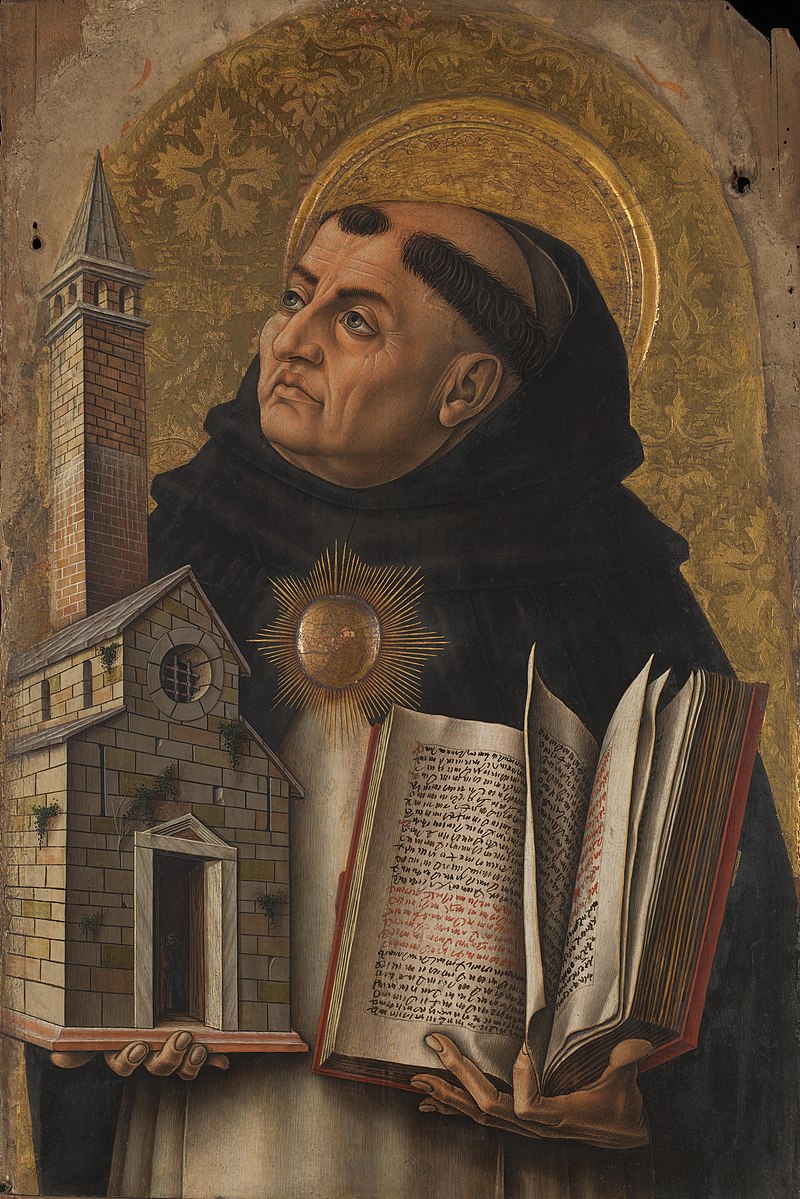

Thomas Aquinas was born around 1225 in Roccasecca, in the Kingdom of Sicily, to a minor noble family. He joined the Dominican order as a young man over the objections of his family, studied under Albertus Magnus at Cologne and Paris, and spent his career teaching and writing at the University of Paris, the papal court, and the Dominican studium in Naples.12 He produced an enormous body of work in roughly twenty years of active writing, including commentaries on Aristotle, disputed questions, and the two great summae — the Summa contra Gentiles (c. 1259–1265) and the Summa Theologica (1265–1274). He died in 1274 at the age of forty-nine, leaving the Summa Theologica unfinished.12
The intellectual context in which Aquinas worked was shaped by two converging traditions. The first was the Christian theological tradition inherited from Augustine, Boethius, Anselm, and the Church Fathers, which had developed its own arguments for the existence and nature of God. The second was the Aristotelian philosophical tradition, which reached medieval Europe through Arabic translations and commentaries, particularly those of Avicenna (Ibn Sina) and Averroes (Ibn Rushd).3, 12 Aristotle's Physics and Metaphysics provided a systematic account of causation, change, and substance that was far more rigorous than anything available in the Latin West, and the reception of these works provoked both excitement and controversy. Some theologians feared that Aristotelian philosophy was incompatible with Christian doctrine; Aquinas devoted much of his career to demonstrating that the two could be harmonized.12
The Summa Theologica was conceived as a comprehensive textbook for students of theology. Its structure is methodical: each question is divided into articles, and each article presents objections, a counter-position, Aquinas's own response, and replies to the objections. The Five Ways appear in the Prima Pars (First Part), Question 2 ("On the existence of God"), Article 3 ("Whether God exists"). Aquinas introduces them after arguing in Article 1 that God's existence is not self-evident to us and in Article 2 that it can be demonstrated through reason.1 The brevity of the Five Ways in the Summa is sometimes misleading; Aquinas treats the same arguments at much greater length in the Summa contra Gentiles, the De Ente et Essentia, and his commentaries on Aristotle's Physics and Metaphysics.5, 13
Key Aristotelian concepts
The Five Ways cannot be assessed without understanding several Aristotelian distinctions that Aquinas presupposes. The most fundamental is the distinction between act (actus) and potency (potentia). Act refers to what a thing actually is or is actually doing; potency refers to what a thing could be or could do but is not yet. A cold cup of water is actually cold and potentially hot; when heated, its potency for heat is actualized. For Aquinas, following Aristotle, every instance of change is the actualization of a potency — the transition from being potentially F to being actually F.8, 14 This analysis of change is not restricted to local motion; it encompasses qualitative alteration, growth and diminution, and substantial change (coming into being and passing away).
A second key distinction is between an essentially ordered (per se) causal series and an accidentally ordered (per accidens) causal series. In an accidentally ordered series, each member's causal power is intrinsic to it and does not depend on the continued activity of prior members. A grandfather causes a father, who causes a son; but the grandfather need not continue to exist or act for the father to generate a son. The series extends backward in time, and Aquinas acknowledges that reason alone cannot demonstrate that such a series had a temporal beginning.1, 2 In an essentially ordered series, by contrast, each member's causal activity depends here and now on the simultaneous causal activity of a prior member. A hand moves a stick, which moves a stone: the stick moves the stone only insofar as it is being simultaneously moved by the hand. Remove the hand's activity and the stick ceases to move the stone instantly, regardless of how many intermediate members are added. In such a series, Aquinas argues, there must be a first member whose causal power is not derived from any prior member, because without it the entire series would lack the causal power to produce any effect at all.2, 5
A third distinction, central to the Third Way, is between necessary and contingent beings. A contingent being is one that can exist or not exist — its nature does not guarantee its existence. A necessary being is one that cannot not exist; its existence belongs to its nature. Aquinas distinguishes between beings that are necessary through another (dependent necessary beings, such as angels in his metaphysics) and a being that is necessary through itself, whose essence is identical with its existence.1, 9
The First Way: argument from motion
The First Way argues from the existence of change (motus) to the existence of a first unchanged changer. Aquinas calls this the "most manifest" of the five arguments.1 The term "motion" in Aquinas's usage is broader than spatial movement; it encompasses any transition from potency to act, including qualitative change, quantitative change, and alteration of any kind.2, 14
P1. Some things in the world are in motion (i.e., undergoing change — the actualization of a potency).
P2. Whatever is in motion is being moved by something already in act with respect to the relevant potency (nothing can actualize its own potency, since it would need to be simultaneously in act and in potency in the same respect).
P3. In an essentially ordered series of movers, if there is no first mover, there are no intermediate movers and no last mover, and thus no motion at all.
P4. But motion exists (from P1).
C. Therefore, there must be a first mover, itself unmoved — which is what all understand to be God.
The argument's central principle is stated in P2: nothing can be simultaneously in potency and in act with respect to the same feature. A thing that is potentially hot cannot make itself actually hot; it must be made hot by something that is already actually hot (or more precisely, by something that is in act with respect to the relevant causal power). This principle derives directly from Aristotle's Physics, Book VII, where Aristotle argues that "everything that is in motion is moved by something."14 Aquinas recognizes that this principle requires defense and devotes extensive discussion to it in his commentary on the Physics and in the Summa contra Gentiles.13
The argument's force depends on the essentially ordered character of the causal series in question. Aquinas is not arguing that there must have been a first event in a temporal sequence of changes. He is arguing that the change occurring at this very moment depends on a simultaneous hierarchical series of causes, and that such a series requires a first member that is pure act — a being with no unactualized potencies — in order to ground the causal activity of the entire series.2, 5 This is why the argument, properly understood, does not depend on whether the universe had a temporal beginning. Even if the universe has always existed, each present instance of change requires a sustaining cause that is itself unchanged.
Critics have challenged P2 on both metaphysical and physical grounds. Anthony Kenny argues that the principle "whatever is moved is moved by another" is ambiguous and that Aquinas conflates different senses of change and causation in applying it.4 From the perspective of modern physics, the principle of inertia — the idea that a body in motion continues in motion unless acted on by an external force — appears to contradict the Aristotelian claim that all motion requires a concurrent mover. Thomistic interpreters respond that inertial motion is not "motion" in the Aristotelian sense of actualization of a potency; uniform rectilinear motion involves no change in the relevant metaphysical sense, and the First Way concerns changes of state, not persistence of state.2
The Second Way: argument from efficient causation
The Second Way argues from the existence of efficient causes to the existence of a first uncaused cause. Where the First Way concerns the actualization of potencies, the Second Way concerns the production of effects by their causes more broadly.1
P1. In the observable world, there exist efficient causes arranged in series.
P2. Nothing can be the efficient cause of itself, for it would have to exist prior to itself, which is impossible.
P3. In an essentially ordered series of efficient causes, it is not possible to proceed to infinity, because without a first cause there would be no intermediate causes and no last cause, and thus no causation at all.
C. Therefore, there must be a first efficient cause — which all call God.
The Second Way is closely related to the First and is sometimes treated as a reformulation of the same basic insight. The key difference is one of emphasis: the First Way focuses specifically on change as the actualization of potency, while the Second Way addresses the broader phenomenon of causal dependence.5 The argument again turns on the distinction between essentially and accidentally ordered causal series. In an accidentally ordered series (parent-child-grandchild), removing an earlier member does not eliminate the causal power of later members. In an essentially ordered series, each member's causal activity depends here and now on the causal activity of a prior member, and the entire series depends on a first cause that possesses causal power non-derivatively.2
David Hume's critique of causation poses a challenge to the Second Way's premises. Hume argues that the idea of a necessary connection between cause and effect cannot be established through experience; all we observe is constant conjunction, not causal power or metaphysical dependence.7 If causation is merely regular succession, then the premise that every effect requires a cause in the robust Aristotelian sense becomes questionable. Thomistic responses to this challenge typically distinguish between Hume's epistemological point — that we do not directly perceive causal power through the senses — and the metaphysical claim that causal power is real. Eleonore Stump argues that Aquinas's account of causation is grounded not in empirical observation alone but in a metaphysical analysis of what it means for potencies to be actualized, and that this analysis is not vulnerable to Hume's empiricist critique in the way that a purely inductivist account of causation would be.9
The Third Way: argument from contingency
The Third Way is often called the argument from contingency, though Aquinas's formulation differs from the Leibnizian version that is more familiar in modern discussions. Aquinas argues from the existence of beings that are generated and corrupted — beings whose nature admits of both existence and non-existence — to the existence of a being whose existence is necessary.1
P1. We observe things in nature that are capable of existing and not existing (they are generated and corrupted).
P2. If everything were merely capable of not existing, then at some point nothing would have existed (since what can fail to exist, given infinite time, eventually does fail to exist).
P3. If at some point nothing existed, then nothing could have come into existence, since nothing comes from nothing.
P4. But things do exist now.
P5. Therefore, not everything is merely capable of not existing; there must be something whose existence is necessary.
P6. A necessary being either has its necessity from another or from itself. A series of necessary beings each deriving necessity from another cannot proceed to infinity (by the same reasoning as the Second Way).
C. Therefore, there must be a being having of itself its own necessity — which all call God.
The most contested premise is P2. Aquinas appears to reason that if every being is contingent, then given infinite past time, every being would have at some point failed to exist, and if every being failed to exist at the same time, then nothing would exist — and nothing could subsequently come into existence. Critics have questioned this inference on multiple grounds. William Rowe argues that even if each contingent being fails to exist at some time, it does not follow that there is a time at which all contingent beings fail to exist simultaneously; this is a quantifier shift fallacy, moving from "for each thing, there is a time at which it does not exist" to "there is a time at which nothing exists."10 J. L. Mackie raises a similar objection, noting that an infinite series of overlapping contingent beings could sustain continuous existence without any moment of universal non-existence.6
Defenders of the Third Way have responded in several ways. Some argue that Aquinas's reasoning is not about temporal succession but about ontological dependence: the point is not that contingent beings will eventually all perish simultaneously, but that the existence of any contingent being requires an explanation in something whose existence is not contingent.5, 9 On this reading, the Third Way is closer to the Leibnizian argument from sufficient reason than the temporal reading suggests. Others, including Joseph Owens, argue that Aquinas's premise should be understood in terms of Aristotelian natural philosophy, where "possible not to be" refers specifically to material beings composed of matter and form, whose matter has the potency to receive different forms.13 On this interpretation, the argument's premises are about the metaphysical structure of material substances rather than about probability over infinite time.
The Third Way also introduces a distinction between two types of necessary being: those that have their necessity caused by another (such as, in Aquinas's framework, immaterial substances like angels) and a being that has its necessity of itself. This reflects Avicenna's distinction between what is necessary through itself (wajib al-wujud bi-dhatihi) and what is necessary through another, a distinction that entered medieval Latin philosophy through translations of Avicenna's works.3
The Fourth Way: argument from gradation
The Fourth Way is often regarded as the most difficult of the five arguments and the one most distant from modern philosophical sensibilities. It argues from the existence of degrees of perfection in things — degrees of goodness, truth, nobility, and being — to the existence of something that is the maximum in each of these perfections and is therefore the cause of perfection in all other things.1
P1. Among things in the world, some are more and some less good, true, noble, and the like.
P2. "More" and "less" are predicated of different things according as they resemble in their different ways something which is the maximum (as a thing is hotter the more it resembles that which is hottest).
P3. That which is the maximum in any genus is the cause of all in that genus (as fire, which is the maximum of heat, is the cause of all hot things).
P4. Therefore, there is something which is the cause of being, goodness, truth, and every other perfection in all things.
C. This we call God.
The argument's philosophical background lies in the Platonic tradition of participation as mediated through Aristotle and the Neoplatonic sources available to Aquinas. The core idea is that graded perfections in things (some things are better, truer, or more fully in being than others) require an explanation, and that explanation is a maximum instance of the relevant perfection that serves as both the standard of comparison and the efficient cause of the perfection in lesser instances.5, 12
P3 is the premise that attracts the sharpest criticism. Aquinas's own example — that fire, as the hottest thing, is the cause of all hot things — relies on medieval natural philosophy that modern science does not support. Heat is not caused by the presence of a maximally hot substance; it is a property explained by molecular kinetics. Kenny argues that the example reveals a general flaw: the principle that the maximum in a genus is the cause of all members of that genus is false as a general claim, and the argument collapses once this principle is rejected.4
Thomistic interpreters have responded by distinguishing the illustrative example (fire as the cause of heat, which reflects outdated science) from the underlying metaphysical principle. Edward Feser argues that the Fourth Way should be understood in terms of the doctrine of the transcendentals — being, goodness, truth, and unity, which are convertible properties that belong to every existing thing in varying degrees.2 On this reading, the argument is not about any particular genus (heat, whiteness) but about being itself: things have being in varying degrees (a stone has more being than a shadow, a living thing more than an inert one), and the existence of degrees of being requires a being that is maximally actual — ipsum esse subsistens, subsistent being itself — as the source and cause of being in everything else.2, 9 Whether this interpretation faithfully represents Aquinas's own intention in the text, and whether the resulting argument succeeds, remain open questions.
The Fifth Way: argument from final causality
The Fifth Way argues from the goal-directed behaviour of natural bodies to the existence of an intelligent being that directs them toward their ends. It is the most explicitly teleological of the Five Ways and is sometimes classified as a teleological argument, though it differs from later design arguments such as William Paley's in important respects.1
P1. Natural bodies that lack intelligence act for an end, which is apparent from the fact that they always or nearly always act in the same way to obtain the best result.
P2. Whatever acts for an end and lacks intelligence must be directed to that end by some intelligent being (as an arrow is directed by an archer).
C. Therefore, some intelligent being exists by whom all natural things are directed to their ends — which we call God.
The argument depends on the Aristotelian concept of final causality: the idea that natural substances have inherent tendencies toward specific ends or outcomes. An acorn tends toward becoming an oak; fire tends to rise; heavy bodies tend to fall. For Aristotle, these tendencies are as real and fundamental as efficient causes, and explaining why a natural substance behaves as it does requires specifying not only what moved it but what end it is directed toward.8, 14 Aquinas's argument is that these natural teleological tendencies in non-intelligent things require an intelligent cause, because direction toward an end is a hallmark of intelligence, and things that lack intelligence cannot direct themselves.1
The Fifth Way is sometimes confused with the argument from biological complexity or the argument from "irreducible complexity" associated with the modern intelligent design movement. The distinction is significant. Paley's watchmaker argument (and its contemporary descendants) argues from the specific complexity and apparent design of biological organisms to a designer. Aquinas's Fifth Way argues from the regular, law-like behaviour of natural substances in general — not from biological complexity in particular.2 The argument applies to the behaviour of fundamental particles, chemical elements, and physical forces just as much as to living organisms. For this reason, the standard objection to Paley's argument — that Darwinian evolution explains the apparent design of biological organisms through natural selection — does not straightforwardly apply to Aquinas's Fifth Way, which concerns the goal-directedness of natural substances at a more basic level than biological adaptation.2, 11
The central challenge to the Fifth Way is whether the concept of final causality is defensible. The mechanical philosophy that emerged in the seventeenth century with Descartes, Galileo, and Newton explicitly rejected Aristotelian final causes in favour of a purely efficient-causal account of nature. On this view, natural laws describe regularities in the behaviour of matter, but these regularities do not reflect genuine teleology — they are simply brute patterns. If final causality is eliminated from the description of nature, then P1 is false and the argument does not get off the ground.4, 6 Thomistic philosophers respond that the elimination of final causality is either incoherent or question-begging. Feser argues that efficient causation itself presupposes final causation: a cause produces a specific effect rather than any other (or none at all) because it is directed toward that specific effect, and this directedness is precisely what final causality means.2 On this view, the regular behaviour described by physical laws is itself evidence of final causality, not a replacement for it.
Comparison of the Five Ways
Though the Five Ways share a common logical structure — identify a phenomenon, argue that it requires a first or ultimate cause, conclude that this cause is God — they differ in their starting points, their metaphysical machinery, and the aspect of God's nature they are intended to reveal. The following table summarizes the key features of each argument.1, 2, 5
| Way | Starting point | Key principle | Concludes to | Primary source |
|---|---|---|---|---|
| First | Change (motus) | Whatever is moved is moved by another | Unmoved mover (pure act) | Aristotle, Physics VII–VIII |
| Second | Efficient causation | Nothing is its own efficient cause | First uncaused cause | Aristotle, Metaphysics II |
| Third | Contingent existence | Contingent beings require a necessary ground | Necessary being (per se) | Avicenna; Aristotle, Metaphysics XII |
| Fourth | Degrees of perfection | Degrees require a maximum that causes them | Maximal being (ipsum esse) | Plato; Aristotle, Metaphysics II |
| Fifth | Goal-directed activity | Unintelligent things directed to ends require a director | Intelligent governor of nature | Aristotle, Physics II |
The table reveals that the First and Second Ways are closely related, both concerning causal series and their termination in a first cause. The Third Way shifts the focus from causal activity to the ontological status of existing things, asking why contingent beings exist at all. The Fourth Way introduces a Platonic element absent from the others, reasoning from the participation of things in perfections to the source of those perfections. The Fifth Way concerns the directedness of natural processes rather than their existence or causal structure. Together, the five arguments are meant to converge on a single being that is pure act, uncaused, necessary, maximally perfect, and supremely intelligent — attributes that Aquinas elaborates in the questions that follow in the Summa.1, 5
Major objections
The Five Ways have attracted sustained criticism from the medieval period to the present. Several objections apply to all five arguments or to the shared logical structure that underlies them.
The infinite regress objection challenges the claim that essentially ordered causal series cannot proceed to infinity. Aquinas takes this claim as a premise rather than proving it rigorously in the text of the Summa, though he provides more extended arguments in the Summa contra Gentiles and elsewhere.1, 3 Hume questions whether we have any rational basis for denying the possibility of an infinite causal regress: if every member of the series has a cause, why must the series as a whole have a first cause?7 J. L. Mackie presses this objection, arguing that the demand for a first cause may simply reflect a psychological need for closure rather than a logical requirement.6 Defenders respond that the argument depends specifically on the impossibility of an infinite essentially ordered series, not a temporally ordered one, and that an essentially ordered series without a first member would be a series in which every member derives its causal power from a prior member but no member possesses causal power non-derivatively — which, they argue, would mean the series possesses no causal power at all.2
The gap problem concerns the identification of the first cause with God. Even if each argument succeeds in establishing a first mover, first cause, necessary being, maximal perfection, or intelligent director, a critic may ask why these should be identified with the God of theism rather than with some impersonal metaphysical principle, or why all five conclusions should be taken to refer to the same being. Mackie observes that the conclusions of the Five Ways, taken individually, do not entail the full array of divine attributes — omnipotence, omniscience, perfect goodness, personality — that theism ascribes to God.6 Aquinas was aware of this gap and addresses it explicitly: the Five Ways are intended only to establish that God exists, and the subsequent questions in the Summa (Questions 3 through 26) are devoted to demonstrating that the being identified as the terminus of each argument must possess simplicity, perfection, infinity, immutability, eternity, unity, knowledge, will, and the other divine attributes.1, 5 The arguments are thus best understood as the first step in a cumulative case rather than standalone proofs of theism.
The objection from modern physics questions whether the Aristotelian metaphysical framework that the Five Ways presuppose remains tenable in light of contemporary science. Quantum mechanics describes events at the subatomic level that appear to lack efficient causes in the classical sense: radioactive decay, for example, occurs spontaneously and unpredictably, without any identifiable triggering cause. If uncaused events are physically possible, then the premise that every change or effect requires a cause may be false.11 Graham Oppy argues that developments in modern physics significantly weaken the plausibility of the causal principles on which the Five Ways depend.11 Thomistic responses to this objection typically argue that quantum indeterminacy does not constitute genuine uncaused change; the behaviour of quantum systems is constrained by the Schrodinger equation and other physical laws, which themselves describe regularities that require explanation. On this view, quantum events are not exceptions to the principle of causation but instances of a different mode of causation (indeterministic efficient causation) that still requires a metaphysical ground.2
Contemporary Thomistic responses
The Five Ways have experienced a significant revival in analytic philosophy of religion since the late twentieth century. Several philosophers working in the Thomistic tradition have reformulated the arguments in terms accessible to contemporary analytic philosophy and have responded to the standard objections.
Edward Feser's work has been particularly influential in popularizing and defending the Five Ways for a contemporary audience. In Aquinas: A Beginner's Guide (2009) and subsequent publications, Feser argues that the standard objections to the Five Ways — including the infinite regress objection, the objection from modern physics, and the gap problem — rest on misunderstandings of Aquinas's arguments that result from reading them through a post-Cartesian, mechanistic lens rather than in their original Aristotelian-Thomistic context.2 Feser's central contention is that the act-potency distinction, the theory of the four causes (material, formal, efficient, and final), and the concept of essentially ordered causal series are not outdated relics of medieval science but defensible metaphysical principles that remain relevant to contemporary philosophical inquiry. He argues that the mechanical philosophy's rejection of formal and final causality created a philosophical framework that was unable to account for causation, change, and natural regularity without reintroducing teleological concepts under different names.2
Eleonore Stump's Aquinas (2003) offers a rigorous analytic reconstruction of Aquinas's metaphysics and natural theology, placing the Five Ways within the broader context of his philosophical system. Stump argues that the arguments cannot be properly evaluated in isolation from Aquinas's theory of being, his account of the essence-existence distinction, and his doctrine of divine simplicity.9 On her reading, the Five Ways are not five independent arguments that happen to reach the same conclusion but five perspectives on a single metaphysical insight: that the existence of beings whose essence is distinct from their existence requires explanation in a being whose essence is its existence. This interpretation emphasizes the Third Way as the most fundamental of the five, with the others serving as complementary approaches to the same underlying question.9
John Wippel's analysis in The Cambridge Companion to Aquinas provides a detailed exegetical treatment of each Way, tracing its sources in Aristotle, Avicenna, and Aquinas's own earlier works. Wippel argues that the Five Ways must be read in conjunction with the lengthier treatments in the Summa contra Gentiles and the De Ente et Essentia to be properly understood, and that critics who base their objections solely on the compressed text of the Summa Theologica are engaging with an abbreviated summary rather than the full arguments.5
Graham Oppy, writing from a critical perspective, argues in Arguing About Gods (2006) that even the strongest contemporary reformulations of the Five Ways fail to establish their conclusions. Oppy contends that alternative hypotheses — including the hypothesis that the universe is a brute fact requiring no external explanation, or that an infinite regress of causes is metaphysically possible — are at least as reasonable as the theistic hypothesis, and that the arguments therefore do not provide compelling grounds for theism.11 The exchange between Thomistic defenders and their critics exemplifies the ongoing character of the debate: the arguments are neither universally accepted nor universally rejected, and their assessment depends in part on prior commitments about the status of Aristotelian metaphysics, the nature of causation, and the explanatory obligations of a satisfactory metaphysical theory.
Philosophical assessment
The Five Ways occupy a distinctive position in the history of natural theology. They are not arguments from probability, analogy, or cumulative evidence; they are intended as demonstrative proofs, proceeding from premises that Aquinas takes to be self-evident or empirically manifest to conclusions that follow with logical necessity.1, 5 Whether they succeed as demonstrations depends on the defensibility of their Aristotelian premises — the act-potency distinction, the impossibility of infinite essentially ordered series, the reality of final causation, and the doctrine of degrees of being. Philosophers who accept these premises as defensible tend to regard the arguments as at least logically valid (the conclusions follow from the premises); those who reject the premises regard the arguments as unsound regardless of their formal validity.
The question of logical validity can be assessed independently of the truth of the premises. Each argument has the form of a reductio: if no first cause existed, certain observable phenomena (change, causation, contingent existence, degrees of perfection, goal-directed activity) would be impossible; but these phenomena manifestly exist; therefore a first cause exists. The formal structure of each argument is valid — the conclusion does follow from the premises. The philosophical debate therefore turns on soundness: whether the premises are in fact true.4, 10 An argument is logically valid if the conclusion follows necessarily from the premises. An argument is sound if it is valid and all its premises are true. The Five Ways are generally regarded as valid; their soundness is the contested question.
The Five Ways also raise the question of what role historical context should play in the evaluation of philosophical arguments. The arguments were developed within a specific intellectual framework — Aristotelian metaphysics as received and modified by medieval Islamic and Christian thinkers — and some of their premises (the fire example in the Fourth Way, the physics of natural motion in the First Way) reflect the natural philosophy of their time. Whether the arguments can be separated from their historical context and reformulated in terms that are defensible by contemporary standards, or whether they are inextricably bound to a metaphysical framework that modern philosophy and science have superseded, remains a central point of disagreement.4, 11 The continued production of serious philosophical literature both defending and criticizing the Five Ways — seven centuries after they were written — suggests that the arguments retain significant philosophical interest regardless of one's assessment of their ultimate success.