Overview
- The problem of hell argues that the doctrine of eternal conscious torment is incompatible with divine justice and omnibenevolence — infinite punishment for finite sins appears to violate any recognizable principle of proportionality, making the traditional doctrine a significant challenge to classical theism.
- Alternative views within Christian theology include annihilationism (the unsaved cease to exist rather than suffer eternally), universalism (all persons are eventually reconciled to God), and the free will defense of hell (the damned freely choose separation from God) — each faces its own philosophical and scriptural objections.
- Critics argue that no finite set of earthly actions can warrant an infinite duration of suffering, that an omniscient God who creates persons foreknowing their damnation bears responsibility for their fate, and that the existence of hell undermines the claim that God desires the salvation of all — defenders respond with appeals to libertarian free will, the infinite gravity of sin against an infinite being, and the intrinsic value of creaturely freedom.
The problem of hell is the philosophical and theological challenge posed by the doctrine of eternal conscious torment to the classical theistic attributes of omnipotence, omniscience, and omnibenevolence. In its sharpest form, the argument contends that a God who is perfectly good, fully knowing, and all-powerful would not create beings whom he foreknows will suffer unending punishment — and that the existence of such a God is therefore incompatible with the traditional doctrine of hell. The problem is a specific instance of the broader problem of evil, but it carries a distinctive force: whereas natural evils and moral evils might be explained by appeal to natural laws or free will, the suffering in hell is typically understood as divinely ordained or at least divinely sustained, raising direct questions about God’s character rather than about the structure of the created world.1, 3, 9
The doctrine has been a source of philosophical discomfort since at least the patristic era, when Origen of Alexandria proposed universal salvation as an alternative to eternal damnation. In contemporary philosophy of religion, the problem of hell has been developed by Marilyn McCord Adams, Jonathan Kvanvig, Michael Martin, and David Bentley Hart, among others, and has generated a range of responses from defenders of traditional Christianity, including Jerry Walls, William Lane Craig, and C. S. Lewis. The debate touches on fundamental questions about the nature of justice, the limits of divine goodness, the metaphysics of free will, and the coherence of infinite punishment for finite beings.1, 2, 11
The traditional doctrine
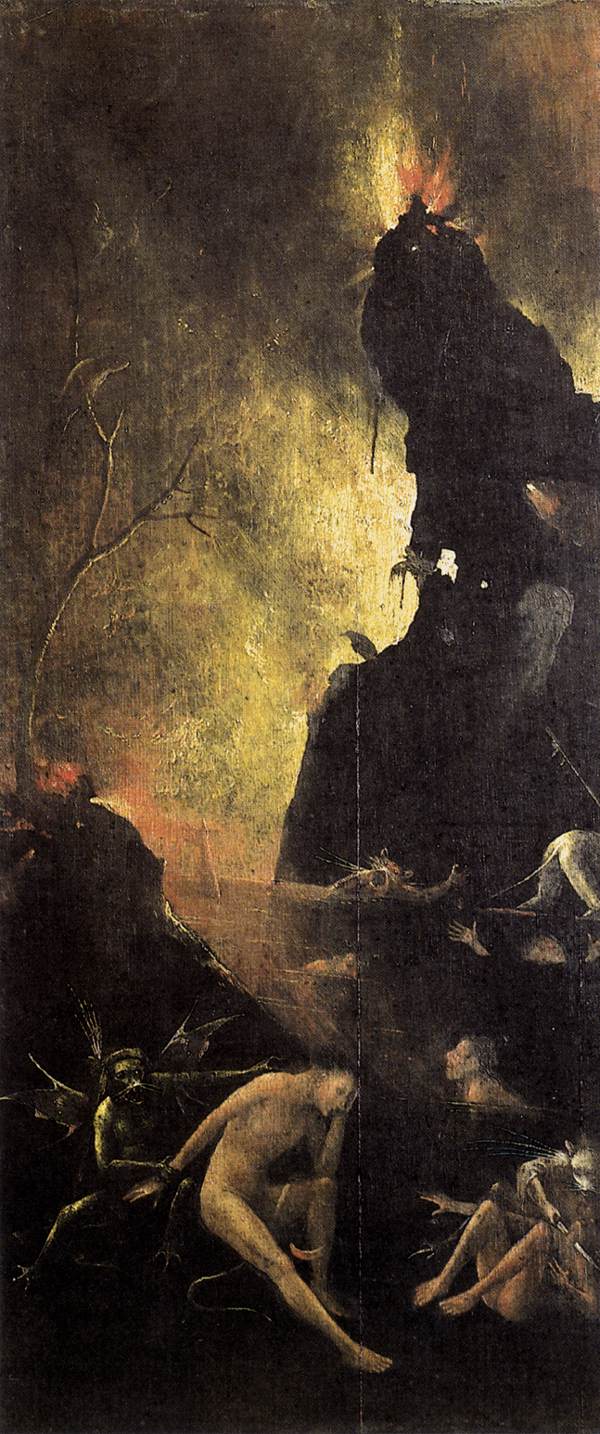

The traditional Christian doctrine of hell, as formulated in the medieval period and codified in the creeds of various denominations, holds that the souls of the damned endure conscious suffering for all eternity. This suffering is typically described as both physical (fire, torment) and spiritual (permanent separation from God). The doctrine was taught explicitly by Augustine, who argued that the punishment of the wicked is eternal in the same sense that the reward of the righteous is eternal, and was reaffirmed by Thomas Aquinas, who held that the severity of punishment in hell is proportioned to the gravity of sin but that its duration is always infinite. The Fourth Lateran Council (1215) and the Council of Florence (1439) affirmed the eternity of hell as binding Catholic doctrine.9, 10
Protestant reformers generally retained the doctrine. John Calvin and Martin Luther both affirmed eternal punishment, though they differed from Aquinas on details of how sin and grace operate. The Westminster Confession (1646) states that the wicked “shall be cast into eternal torments, and be punished with everlasting destruction from the presence of the Lord.” In contemporary evangelical Protestantism, the doctrine of eternal conscious torment remains the majority position, though alternatives have gained significant ground in recent decades.9, 10
The philosophical significance of the traditional doctrine lies in its absoluteness. The punishment is not corrective (there is no possibility of repentance or reform after death), not temporary (it has no end point), and not proportional in any straightforward sense (a finite life of sin results in an infinite duration of suffering). These features distinguish it from every other form of punishment recognized in human moral reasoning, and they are the basis of the philosophical challenges that follow.3, 11
The proportionality objection
The most intuitive philosophical objection to the doctrine of hell is the argument from proportionality. Every recognized principle of justice, both in legal philosophy and in common moral reasoning, holds that punishment should be proportional to the offense. A just legal system does not impose a life sentence for jaywalking, and a just parent does not ground a child for a lifetime over a single act of disobedience. If proportionality is a requirement of justice — and virtually all ethical traditions agree that it is — then infinite punishment for finite sins appears to be a paradigmatic case of injustice, regardless of the severity of those sins.3, 5
P1. A just punishment is proportional to the offense.
P2. All human sins are committed by finite beings in a finite amount of time and are therefore finite in nature.
P3. Eternal conscious torment is an infinite punishment.
P4. An infinite punishment for a finite offense is disproportionate.
C. Therefore, eternal conscious torment is unjust.
The standard theistic response to the proportionality objection is that sin against an infinite being is itself infinitely grave. On this view, developed most fully by Anselm of Canterbury in Cur Deus Homo, the gravity of an offense is determined not only by the nature of the act but by the dignity of the one offended. Since God is infinitely great, any sin against God is an offense of infinite magnitude and therefore warrants infinite punishment. Jonathan Kvanvig has argued that this response fails because it conflates the status of the offended party with the intrinsic gravity of the act. Insulting a king may be graver than insulting a commoner in a feudal system, but no finite act of insult, however exalted the victim, naturally scales to infinite magnitude. The inference from “God is infinite” to “offenses against God are infinite” requires an additional premise that is neither self-evident nor universally accepted.3, 9
A further dimension of the proportionality problem concerns the distribution of punishment. On the traditional doctrine, all the damned receive eternal punishment, but the range of sins that merit damnation spans an enormous spectrum: from active, deliberate cruelty to the mere failure to accept a particular religious belief. The person who lived a morally exemplary life but sincerely could not believe in God receives the same infinite punishment as the most vicious torturer. Michael Martin argued that this consequence is so contrary to basic moral intuitions that it counts as strong evidence against the truth of any theological system that entails it.5
The free will defense of hell
The most influential contemporary defense of hell appeals to libertarian free will. On this view, associated most famously with C. S. Lewis and developed philosophically by Jerry Walls, hell is not an externally imposed punishment but the natural consequence of a free creature’s refusal to accept God. Lewis wrote in The Great Divorce (1945) that “the doors of hell are locked on the inside” — that the damned are in hell because they have chosen to be there, preferring their own autonomy to submission to God. On this account, God does not send anyone to hell; rather, God respects the free choices of his creatures, and those who persistently reject God receive what they have chosen: existence apart from the source of all goodness.2, 9
Walls developed this view into a rigorous philosophical account in Hell: The Logic of Damnation (1992). He argued that if libertarian free will is genuine — if human beings have the power to accept or reject God without being causally determined to do either — then it is logically possible that some creatures will freely reject God forever. God’s omnibenevolence is preserved because God offers grace to all and desires the salvation of all, but God’s respect for creaturely freedom means that he will not override the free choice of those who refuse him. The suffering of hell, on this view, is not a positive infliction of pain but the natural misery that results from existing in permanent separation from the source of all joy, meaning, and fulfillment.2, 4
This defense faces several objections. First, there is the question of whether any being with full knowledge of the consequences would freely choose eternal separation from God. If the damned in hell know that they are suffering and that God offers relief, it seems psychologically implausible that they would persist in refusal. Lewis and Walls respond that sin progressively corrupts the will, so that the damned eventually become incapable of wanting what is good — not because God has removed their freedom but because they have, through a long series of free choices, destroyed their own capacity for joy. Critics argue that this makes the final state of the damned functionally equivalent to a mental illness, and that a loving God would intervene to restore their capacity for rational choice rather than allowing them to persist in a self-destructive condition they can no longer recognize as such.1, 3, 9
Second, the free will defense of hell faces a challenge from divine foreknowledge. If God knew before creating a given person that the person would freely reject God and end up in eternal suffering, God could have refrained from creating that person. The act of creating a being whom one foreknows will suffer eternally appears, on its face, to be incompatible with perfect love. Walls responds that the value of the person’s existence and the genuine opportunity for salvation that God provides outweigh the eventual suffering, but critics question whether any good — however great — can outweigh an infinite amount of suffering, since infinite suffering is, by definition, unbounded.1, 3, 12
Annihilationism
Annihilationism (also called conditional immortality or conditionalism) is the view that the unsaved do not endure eternal conscious torment but instead cease to exist. On this account, the soul is not naturally immortal; immortality is a gift bestowed by God on the redeemed, while the unredeemed are destroyed after a period of punishment proportional to their sins. The annihilationist position has been defended by Edward Fudge, Clark Pinnock, and John Stott, among others, and has gained considerable support within evangelical Christianity in recent decades.7, 10
Annihilationism resolves the proportionality objection by making punishment finite: the unsaved may suffer for a period proportional to their sins before being destroyed, and the destruction itself is permanent but not experienced. Fudge argued at length in The Fire That Consumes (first published in 1982, with expanded editions in 1994 and 2011) that the biblical language of “destruction,” “perishing,” and “consuming fire” supports annihilation rather than eternal conscious torment, and that the traditional doctrine owes more to Greek philosophical assumptions about the natural immortality of the soul than to the biblical text itself.7
Critics of annihilationism come from both sides. Traditional defenders of eternal torment argue that key biblical texts — particularly Matthew 25:46 (“eternal punishment”) and Revelation 20:10 (“tormented day and night forever and ever”) — cannot be reconciled with annihilation without strained exegesis. From the philosophical side, Graham Oppy has noted that while annihilationism avoids the proportionality problem, it raises its own difficulties: permanent nonexistence imposed as a penalty for failing to hold correct beliefs seems harsh in itself, and the question remains whether a perfectly good God would create beings he foreknows will be annihilated rather than simply not creating them.10, 12
Universalism
Christian universalism is the view that all persons will eventually be reconciled to God and that hell, if it exists, is corrective and temporary rather than retributive and eternal. The position has ancient roots in Origen, Gregory of Nyssa, and other early church fathers, and has been revived in contemporary theology by figures such as Thomas Talbott, Robin Parry, and David Bentley Hart. Hart’s That All Shall Be Saved (2019) presented the universalist case with particular philosophical force, arguing that the traditional doctrine of hell is not merely problematic but logically incoherent given the classical attributes of God.11, 9
Hart’s argument proceeds along several lines. First, he contends that a God who is the source of all being and all goodness cannot will the permanent destruction or suffering of any part of his creation without contradicting his own nature. If God is perfect goodness, and if all rational creatures are made in God’s image, then God’s purposes for creation cannot be fully realized unless all rational creatures are eventually brought to fulfillment. A creation in which some persons are eternally damned is, by definition, a creation that falls short of God’s purposes — which is incompatible with divine omnipotence. Second, Hart argues that the free will defense of hell rests on an impoverished understanding of freedom. Genuine freedom, he contends, is not the mere ability to choose among options but the capacity to choose in accordance with the good. A will that chooses eternal separation from the source of all goodness is, in Hart’s view, not genuinely free but enslaved to irrationality — and divine love would not allow such enslavement to persist indefinitely.11, 15
Critics of universalism, including Walls and Thomas Talbott’s interlocutors, raise several concerns. The primary theological objection is that universalism appears to undermine the significance of human choice and the urgency of evangelism: if all will be saved regardless, the stakes of moral and religious decision-making are diminished. The philosophical concern is that universalism may require a form of divine coercion — if some persons persistently refuse God, universal reconciliation can only be achieved by eventually overriding their free refusal, which is the very thing the free will defense claims God cannot (or will not) do. Hart responds that this objection assumes a libertarian view of freedom that he regards as incoherent, but the debate remains unresolved.2, 9, 11
The problem of divine foreknowledge and creation
A particularly forceful dimension of the problem of hell arises from the conjunction of the doctrine with divine omniscience. If God is omniscient, he knew before creating any person the complete trajectory of that person’s life, including whether the person would accept or reject God. If God is omnipotent, he was free to create a different world — one in which all persons freely accept God — or to refrain from creating persons he foreknew would be damned. The decision to create beings destined for eternal suffering, when alternatives were available, appears incompatible with perfect goodness.1, 3
This argument is distinct from the generic problem of evil because it does not rely on the existence of suffering in the natural world, which can be attributed to natural laws or free creaturely choices. The suffering in hell is the direct and foreknown consequence of God’s creative decision. Marilyn McCord Adams pressed this point with particular force, arguing that the traditional doctrine makes God a collaborator in the damnation of the very creatures he claims to love. Adams argued that a truly loving God would not create a being he foreknew would endure eternal torment, just as a loving parent would not conceive a child she foreknew would live in unrelenting agony. The analogy is imperfect — God has capacities that parents lack — but Adams contended that greater power increases rather than diminishes moral responsibility, making the problem more acute for an omnipotent being than for a finite parent.1
The free will defense can respond that God cannot create a world in which all free creatures freely choose rightly, because free choices are not under God’s control by definition. This is the logic of Plantinga’s transworld depravity argument, extended to the case of hell. But Kvanvig has argued that even if God cannot guarantee universal salvation in a world with free creatures, God could still decline to create those creatures he foreknows will be damned. The creation of such creatures, when God knows their fate in advance, amounts to a deliberate decision to bring into existence beings who will suffer eternally. Kvanvig concludes that the traditional doctrine of hell is indefensible and proposes instead a modified view on which those who reject God are eventually annihilated rather than tormented forever.3, 8
Hell as evidence against theism
From the perspective of counter-apologetics, the problem of hell functions as a specific and powerful instance of the evidential problem of evil. The argument is not merely that hell is morally troubling but that the doctrine’s existence within a theistic system constitutes evidence against the system’s truth. If a perfectly good God would not institute eternal conscious torment, and if the major theistic traditions teach that he has, then either God is not perfectly good, the traditions are mistaken about what God has done, or God does not exist. For the atheist or agnostic, the simplest explanation is the last: the doctrine of hell is a human invention, reflecting the retributive impulses and social control mechanisms of the cultures that produced it rather than the character of an omnibenevolent deity.5, 12, 14
John Loftus has argued that the problem of hell is among the strongest arguments against Christianity specifically, because it is not an argument about the generic possibility of a divine being but about the internal coherence of a particular theological system. Christianity claims simultaneously that God is perfectly loving, that God desires the salvation of all, that God has the power to save all, and that some will nevertheless be eternally damned. Loftus contends that no combination of free will, divine respect for autonomy, and the gravity of sin can render this set of claims jointly consistent without effectively redefining one or more of the terms involved.14
The problem of hell thus poses a challenge not only to the philosophical coherence of theism but to the moral credibility of specific revelatory traditions. If the doctrine cannot be defended on moral or philosophical grounds, the tradition that teaches it must either revise its teachings (as universalists and annihilationists propose) or accept that its central claims about God’s nature are in tension with its claims about God’s actions — a tension that critics regard as a reductio ad absurdum of the traditional theological framework.3, 11, 13
References
The Fire That Consumes: A Biblical and Historical Study of the Doctrine of Final Punishment (3rd ed.)