Overview
- Qualia are the subjective, qualitative properties of conscious experience — the redness of red, the painfulness of pain, the taste of coffee — that seem to resist complete characterization in physical, functional, or behavioral terms, making them a central challenge for physicalist theories of mind.
- Frank Jackson’s knowledge argument (the Mary’s Room thought experiment) and David Chalmers’s zombie argument both contend that a complete physical description of the world leaves out facts about qualia, implying that physicalism is either false or incomplete — though physicalist responses such as the phenomenal concept strategy and illusionism offer rejoinders.
- The philosophical status of qualia has direct consequences for debates over the hard problem of consciousness, the possibility of machine consciousness, and the argument from consciousness in philosophy of religion, where the irreducibility of subjective experience is taken as evidence for a non-physical dimension of reality.
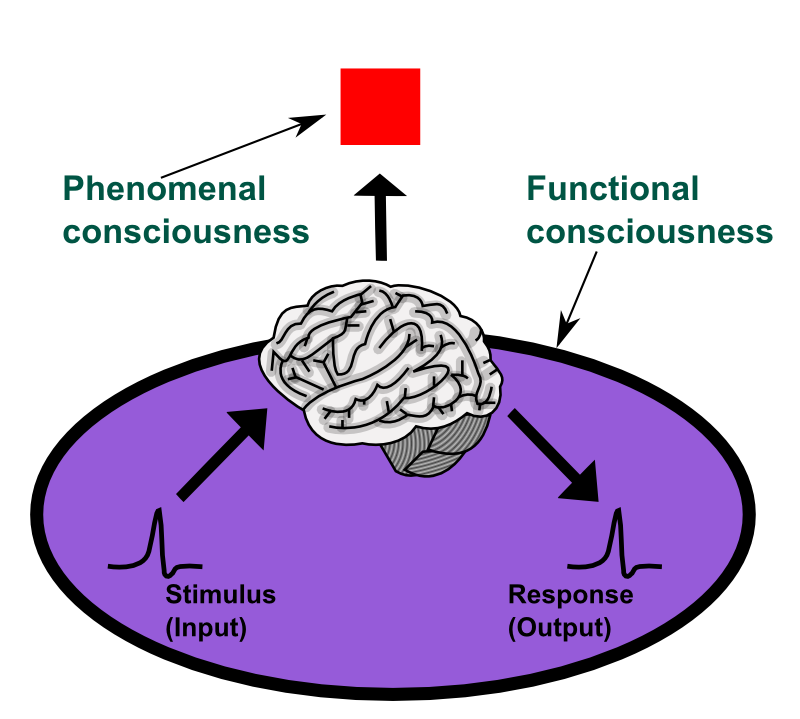
Qualia (singular: quale) are the subjective, qualitative properties of conscious experience — the felt redness of a red sensation, the sharp painfulness of a stubbed toe, the particular taste of a ripe strawberry. The term picks out what philosophers call the phenomenal character of experience: what it is like, from the first-person perspective, to undergo a particular mental state. Qualia are distinguished from the representational or functional aspects of a mental state. Two experiences might represent the same object and play the same causal role in behavior while differing in their qualitative character, as the inverted spectrum thought experiment is designed to show. Since the seventeenth century, the apparent difficulty of accommodating subjective qualities within a purely physical ontology has made qualia a central problem in the philosophy of mind, and qualia remain at the heart of contemporary debates over the hard problem of consciousness.4, 16
.png)
The concept and its history
The philosophical puzzle of subjective qualities has deep roots. Galileo, Locke, and Descartes all recognized a distinction between primary qualities (those belonging to objects themselves, such as shape and motion) and secondary qualities (those that exist only in the perceiver, such as color, taste, and smell). This distinction laid the groundwork for the modern concept of qualia by identifying a class of properties whose existence depends essentially on the conscious subject rather than on the external world.12 The term “qualia” was introduced into twentieth-century analytic philosophy by C. I. Lewis in 1929, though the concept it names is far older. Lewis used it to refer to the recognizable qualitative characters of the given in experience — the specific shade of blue one sees, the precise pitch of a tone one hears.16
In contemporary philosophy, qualia are typically characterized by four properties, though not all philosophers accept all four. They are held to be ineffable (they cannot be fully communicated to someone who has not experienced them), intrinsic (they are non-relational properties of experiences), private (they are accessible only to the subject who has them), and directly apprehensible (to have a quale is to know what it is like). Thomas Nagel captured the core idea in 1974 by arguing that an organism has conscious experience if and only if there is “something it is like” to be that organism — and what it is like constitutes the organism’s qualia. No amount of third-person, objective information about a bat’s neural architecture can tell us what it is like for the bat to perceive the world through echolocation.4, 16
Mary’s Room and the knowledge argument
The most celebrated argument that qualia pose a problem for physicalism is Frank Jackson’s knowledge argument, presented through the thought experiment known as Mary’s Room. Mary is a brilliant neuroscientist who has spent her entire life confined to a black-and-white room. Through black-and-white books and television, she has acquired every physical fact there is to know about color vision: the physics of light, the neurophysiology of the retina, the processing in the visual cortex, the functional role of color terms in language and behavior. She knows everything physical there is to know. When Mary is finally released from her room and sees a red tomato for the first time, Jackson argued, she learns something new: she learns what it is like to see red.1
P1. Before her release, Mary knows all physical facts about color vision.
P2. Upon seeing red for the first time, Mary learns a new fact — what it is like to see red.
C. Therefore, there are facts about conscious experience that are not physical facts, and physicalism is false.
The argument targets any view that identifies the totality of facts with physical facts. If Mary’s complete physical knowledge leaves something out — namely, the qualitative character of seeing red — then the physical facts do not exhaust all the facts. Jackson originally drew an explicitly dualist conclusion: there exist non-physical properties (qualia) that are not captured by any physical description, however complete.1, 2 The argument generated an enormous literature. Jackson himself later abandoned its conclusion, arguing that Mary does not learn a new fact but rather acquires a new ability — the ability to recognize, imagine, and remember red experiences. This “ability hypothesis,” developed independently by Laurence Nemirow and David Lewis, holds that knowing what an experience is like is a matter of know-how rather than propositional knowledge, and thus the knowledge argument fails to establish the existence of non-physical facts.13
The explanatory gap and zombies
Joseph Levine’s concept of the explanatory gap (1983) provides a related but distinct challenge. Levine observed that even if we grant that pain is identical to C-fiber firing, the identity statement leaves an explanatory residue: we understand why water = H2O by understanding how molecular structure produces the macro-properties of water, but we do not understand why C-fiber firing feels like pain rather than like nothing at all. The gap is not between the physical facts and some additional non-physical facts, but between physical descriptions and phenomenal descriptions. Levine was careful to note that this is an epistemic gap — a gap in our understanding — that does not by itself entail an ontological gap. But the persistence of the gap, even as neuroscience advances, has seemed to many philosophers to suggest that something deeper is at stake.5
David Chalmers pressed the challenge further with the zombie argument. A philosophical zombie is a being physically and functionally identical to a conscious human in every respect — same brain, same behavior, same information processing — but that has no qualia whatsoever. There is nothing it is like to be a zombie. Chalmers argued that zombies are conceivable without contradiction: we can coherently imagine a physical duplicate of ourselves that lacks inner experience. If conceivability is a guide to metaphysical possibility, then it is possible for the physical facts to be exactly as they are while the phenomenal facts differ. This means that qualia are not logically supervenient on the physical — they are something over and above the physical structure of the world. If the zombie argument succeeds, no form of physicalism can account for qualia.3, 11
The zombie argument has been resisted on several fronts. Some philosophers deny that zombies are genuinely conceivable, arguing that our apparent ability to conceive of them reflects a failure to fully grasp what is entailed by physical identity. Others accept that zombies are conceivable but deny that conceivability implies metaphysical possibility — perhaps our conceptual capacities do not track the space of genuine possibilities closely enough to support such inferences. Saul Kripke’s work on the necessary a posteriori — truths that are necessarily true but knowable only through experience — has been invoked by both sides: dualists use it to argue that the conceivability of zombies reveals a real gap in nature, while physicalists use it to argue that the apparent conceivability of zombies is compatible with the necessary identity of phenomenal and physical states.6, 14
Physicalist responses
Physicalist philosophers have developed several strategies for accommodating qualia within a naturalistic framework. The phenomenal concept strategy, defended by David Papineau among others, holds that the explanatory gap arises not from a gap in nature but from a gap between our concepts. We have two fundamentally different ways of thinking about the same brain state: a physical concept (neural activity in the visual cortex) and a phenomenal concept (the experience of redness). These concepts are cognitively independent — possessing one does not provide the other — but they refer to the same property. The knowledge argument is thus explained without positing non-physical facts: what Mary gains upon seeing red is not a new fact but a new concept, a new way of representing a fact she already knew under a physical description.9
A more radical approach is qualia eliminativism, associated primarily with Daniel Dennett. In “Quining Qualia” (1988) and Consciousness Explained (1991), Dennett argued that the philosophical concept of qualia — as intrinsic, ineffable, private, and directly apprehensible properties — is incoherent. He marshaled a series of thought experiments designed to show that every supposed feature of qualia dissolves under scrutiny. Intrinsicness collapses because our experience of a quality is always mediated by cognitive processing; ineffability is undermined by our extensive ability to describe, compare, and communicate experiences; privacy is challenged by the possibility of interpersonal calibration; and direct apprehensibility is refuted by the many known cases of introspective error. If qualia in the philosopher’s technical sense do not exist, the problems they generate are pseudoproblems.7, 8
Keith Frankish’s illusionism takes a middle path. Frankish agrees that phenomenal consciousness, in the strong sense of intrinsic qualitative properties, does not exist. But he takes seriously the robust introspective impression that it does exist and treats this impression as a genuine explanandum. We are under a systematic introspective illusion: our cognitive systems represent our own states as having qualitative properties, but the properties detected by introspection are functional and representational rather than intrinsic. The “hard problem” is thereby replaced by the “illusion problem”: explaining why our introspective mechanisms generate the illusion of qualia.10
Implications for consciousness and religion
The status of qualia has consequences that extend well beyond the philosophy of mind. In artificial intelligence and cognitive science, the question of whether a computational system could have qualia bears directly on whether such a system could be conscious. If qualia are functional properties — definable in terms of their causal roles — then any system that instantiates the right functional organization, whether biological or silicon, could in principle have subjective experience. If qualia are non-functional properties tied to specific physical substrates or to non-physical aspects of reality, then functional replication alone would not suffice for consciousness, and a sophisticated computer simulation of the human brain might process information identically to a human while lacking any inner life.3, 14
In the philosophy of religion, qualia feature prominently in the argument from consciousness. Richard Swinburne and J. P. Moreland have argued that the existence of irreducible subjective experience is more probable on theism than on naturalism. If qualia cannot be explained in purely physical terms — if the qualitative character of experience is genuinely something over and above the physical processes that accompany it — then the physical world alone cannot account for the full range of reality. A conscious creator, on this reasoning, provides a more natural explanation for the existence of conscious creatures than does a fundamentally non-conscious material universe. The strength of this argument depends directly on whether qualia are genuinely irreducible to physical processes or whether physicalist accounts can dissolve the apparent gap.15, 3
The debate over qualia remains one of the most active and contentious in contemporary philosophy. After more than four decades of sustained argument since Jackson’s original paper, there is no consensus on whether qualia exist in the robust metaphysical sense, whether the knowledge argument and zombie argument succeed, or whether physicalist strategies adequately address the challenge. What is widely agreed is that the problem is genuine and deep: any adequate theory of mind must either explain qualia, explain them away, or give compelling reasons for thinking the concept is confused. The difficulty of doing any of these things with full satisfaction is a measure of how little we understand about the relationship between the objective, third-person world described by physics and the subjective, first-person world of conscious experience.11, 16