Overview
- Archaeological discoveries in the Near East have illuminated the world in which the biblical texts were composed, providing material evidence for ancient Israelite culture, religion, architecture, and daily life, while also revealing significant discrepancies between some biblical narratives and the material record.
- Key discoveries — including the Merneptah Stele (the earliest extra-biblical reference to Israel, c. 1208 BCE), the Tel Dan Inscription (the earliest reference to the House of David, c. 840 BCE), and the Siloam Inscription (confirming Hezekiah's tunnel construction) — demonstrate that archaeology can confirm specific historical details mentioned in biblical texts while simultaneously complicating the broader narratives in which those details are embedded.
- The relationship between archaeology and the Bible has shifted over the past century from William Foxwell Albright's 'biblical archaeology' approach, which used excavation to confirm the Bible's historical reliability, to a more independent 'archaeology of the land of the Bible' or 'Syro-Palestinian archaeology' that treats the biblical text as one source among many and evaluates material evidence on its own terms.
Archaeology and the biblical text exist in a relationship that has grown more complex over the past century. Early excavators in Palestine and Mesopotamia frequently approached their work with the explicit goal of confirming the Bible's historical accounts. William Foxwell Albright, the dominant figure in mid-twentieth-century biblical archaeology, argued that excavation was steadily vindicating the essential historicity of the biblical narrative from the patriarchs through the monarchy. By the 1970s and 1980s, a generation of archaeologists trained in anthropological method began to challenge this framework, arguing that the material evidence needed to be evaluated independently of the biblical text and that the two sources of evidence — textual and material — did not always agree.1, 10
The result is a picture that is neither a simple confirmation nor a simple refutation of the biblical accounts. Archaeological evidence illuminates the world described in the Bible, confirms specific details, and provides context that makes certain narratives more intelligible. At the same time, the material record raises questions about the scale, dating, and historicity of several major biblical events, including the patriarchal wanderings, the exodus from Egypt, the conquest of Canaan, and the grandeur of the united monarchy under David and Solomon.1, 9

History of biblical archaeology
Systematic archaeological exploration of the biblical lands began in the nineteenth century. Edward Robinson's surveys of Palestine in 1838 and 1852 identified dozens of biblical sites by correlating modern Arabic place names with their Hebrew equivalents. The Palestine Exploration Fund, established in London in 1865, sponsored excavations at Jerusalem, Lachish, and other sites. Flinders Petrie's 1890 excavation at Tell el-Hesi introduced the principle of stratigraphic excavation and ceramic typology — the recognition that pottery styles change over time and can be used to date the layers in which they are found — to Palestinian archaeology.2, 4
The field was transformed in the mid-twentieth century by Albright and his students. Albright's approach, which he called "biblical archaeology," treated the Bible as a fundamentally reliable historical source that archaeology could confirm and illuminate. His excavations at Tell Beit Mirsim and his synthesis of archaeological, epigraphic, and biblical evidence in works such as From the Stone Age to Christianity (1940) established a framework in which the patriarchal narratives reflected genuine second-millennium BCE traditions and the conquest of Canaan described a historical event. This approach dominated American biblical studies for decades.10, 16
Beginning in the 1970s, the Albright synthesis came under sustained criticism. Thomas L. Thompson's The Historicity of the Patriarchal Narratives (1974) argued that the archaeological parallels Albright and his student E. A. Speiser had cited to support the historicity of the patriarchal stories were illusory — the customs and practices described in Genesis could be paralleled in multiple periods and did not anchor the narratives to any specific time. Independently, John Van Seters reached similar conclusions. William Dever, himself a student of Albright's student G. Ernest Wright, advocated renaming the field "Syro-Palestinian archaeology" to signal its independence from the biblical agenda, while insisting that archaeology remained relevant to biblical studies as an independent source of evidence.10, 11, 12
Inscriptions and extra-biblical texts
Epigraphic discoveries have provided direct points of contact between the biblical text and the material record. The Merneptah Stele, a victory inscription of the Egyptian pharaoh Merneptah dating to approximately 1208 BCE, contains the earliest known reference to Israel outside the Bible. The relevant line reads: "Israel is laid waste and his seed is not." The determinative used for "Israel" in the hieroglyphic text indicates a people rather than a land, suggesting that at this date Israel was recognized as a distinct ethnic or social group in Canaan but did not yet control a defined territory.7, 1
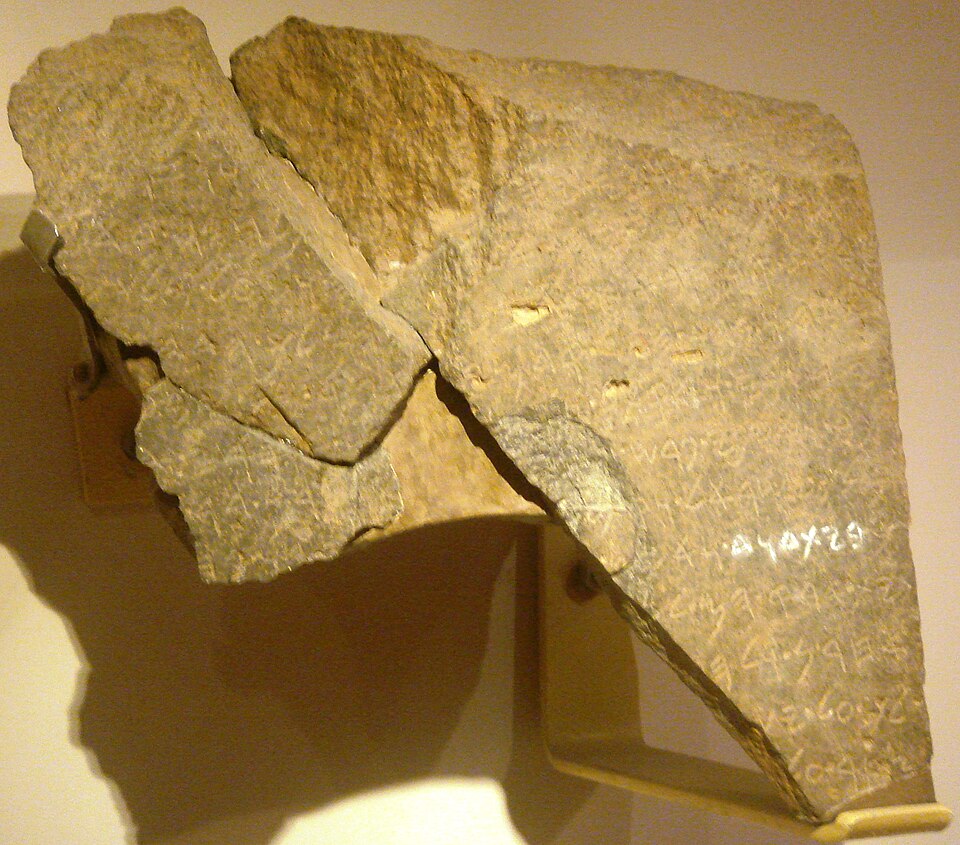
The Tel Dan Inscription, discovered in 1993–1994 by Avraham Biran at the site of ancient Dan in northern Israel, dates to approximately 840 BCE and records a victory by an Aramean king (likely Hazael of Damascus) over kings of Israel and the "House of David" (bytdwd). This is the earliest extra-biblical reference to the Davidic dynasty and confirms that a dynasty tracing its origin to a figure named David existed by the ninth century BCE. The Mesha Stele (Moabite Stone), dating to approximately 840 BCE, records the Moabite king Mesha's revolt against Israelite domination and mentions the Israelite deity Yahweh, the tribe of Gad, and the Israelite king Omri, paralleling the account in 2 Kings 3.6, 8
The Siloam Inscription, discovered in 1880 in the rock-cut tunnel connecting the Gihon Spring to the Pool of Siloam in Jerusalem, describes the construction of a water tunnel by two teams of workers cutting from opposite ends. The tunnel is identified with the water system described in 2 Kings 20:20 and 2 Chronicles 32:30, attributed to King Hezekiah in preparation for the Assyrian siege of 701 BCE. The inscription's paleography and the tunnel's archaeological context are consistent with a late eighth-century BCE date.6, 14
Mesopotamian and Egyptian texts have illuminated biblical narratives in broader ways. The Assyrian annals of Sennacherib describe the siege of Jerusalem in 701 BCE from the Assyrian perspective, recording that Hezekiah was shut up "like a caged bird" — a siege that the biblical account in 2 Kings 18–19 describes as ending with divine intervention. The Babylonian Chronicles record Nebuchadnezzar's capture of Jerusalem in 597 BCE, matching the account in 2 Kings 24:10–17. The Cyrus Cylinder records Cyrus the Great's policy of allowing exiled peoples to return to their homelands, providing context for the return from exile described in Ezra 1.4, 5
The patriarchs and the second millennium
The patriarchal narratives in Genesis 12–50 describe Abraham, Isaac, Jacob, and their families as semi-nomadic pastoralists migrating between Mesopotamia, Canaan, and Egypt. Albright and his student Speiser argued that specific customs described in the patriarchal stories — the adoption of a slave as heir (Genesis 15:2–3), the use of a handmaid as a surrogate mother (Genesis 16:1–4), and the binding force of deathbed blessings — found parallels in cuneiform texts from Nuzi (fifteenth century BCE) and Mari (eighteenth century BCE), anchoring the patriarchal period to the second millennium.5, 12
Thompson's 1974 study systematically challenged these parallels. He demonstrated that the practices cited were not unique to the second millennium but could be found across a wide chronological range. The Nuzi parallels, for instance, reflected general Near Eastern legal customs rather than a specific period. He also argued that several details in the patriarchal narratives — the prominence of camels as transport animals, the references to the Philistines, the mention of Arameans — fit better with first-millennium contexts. Domesticated camels, for example, do not appear in the archaeological record of the southern Levant as working animals until approximately the tenth century BCE, though Genesis portrays Abraham as possessing camel caravans. The patriarchal narratives contain no reference to Egyptian administration in Canaan during the Late Bronze Age, when Egypt exercised direct control over the region, a silence that is difficult to explain if the stories originated in that period.1, 12
The exodus and the conquest
The biblical account of the exodus — the departure of the Israelites from Egypt, the wilderness wandering, and the conquest of Canaan — is the foundational narrative of Israelite identity. Archaeological investigation has produced a complex picture. No Egyptian text mentions an Israelite presence in Egypt, an exodus event, or the destruction of an Egyptian army in the sea, though the absence of such records in Egyptian royal inscriptions — which typically recorded victories, not defeats — is not unexpected. The store-cities of Pithom and Raamses mentioned in Exodus 1:11 have been identified with Tell el-Retabeh (or Tell el-Maskhuta) and Pi-Ramesses (modern Qantir), both of which show major building activity under Ramesses II (c. 1279–1213 BCE), providing a plausible setting for the narrative's claim of forced labor.1, 5
The conquest narrative in the book of Joshua presents a more difficult archaeological problem. Joshua describes the rapid, violent destruction of multiple Canaanite cities, but the archaeological evidence does not match this picture at several key sites. Jericho (Tell es-Sultan) shows no evidence of occupation or fortification walls in the Late Bronze Age (c. 1550–1200 BCE), the period when the conquest is traditionally placed. Ai (et-Tell) was uninhabited from approximately 2400 to 1200 BCE. Hazor does show a massive destruction layer in the thirteenth century BCE, consistent with Joshua 11:10–11, but the cause cannot be attributed to a specific agent on archaeological grounds alone. Several other sites listed as conquered in Joshua show no destruction layers at the relevant period.1, 9
The emergence of Israel in the central highlands of Canaan during the Iron Age I period (c. 1200–1000 BCE) is well attested archaeologically. Survey data show a dramatic increase in small, unwalled settlements in the hill country of Ephraim, Manasseh, and Judah — from approximately 30 sites in the Late Bronze Age to more than 300 in Iron I. These villages show a distinctive material culture characterized by pillared courtyard houses, collared-rim storage jars, and an absence of pig bones. Whether these settlers were former Canaanites, incoming groups from outside, or a combination remains debated. The pattern of gradual, indigenous settlement in previously sparsely populated areas differs markedly from the conquest model in Joshua.1, 11, 15
The united monarchy
The biblical books of Samuel and Kings describe a united monarchy under Saul, David, and Solomon that ruled over all Israel from Jerusalem, with Solomon constructing a magnificent temple and governing an empire that stretched from the Euphrates to the border of Egypt. The archaeological evidence for this kingdom has been the subject of intense debate since the 1990s.1, 9
Finkelstein has argued that the monumental architecture traditionally dated to Solomon's reign — six-chambered gates and ashlar buildings at Megiddo, Hazor, and Gezer, which Yigael Yadin had identified with Solomon's building program described in 1 Kings 9:15 — should be redated to the ninth century BCE, the period of the Omride dynasty of the northern kingdom of Israel. In this view, tenth-century Jerusalem was a small highland village, and the biblical portrait of Solomon's grandeur reflects a later projection of northern Israelite or Judahite royal ideology onto the past. Amihai Mazar and others have defended a modified version of the traditional chronology, arguing that the monumental architecture at Megiddo and Hazor can be dated to the tenth century and that the absence of extensive tenth-century remains in Jerusalem may reflect the limitations of excavation in a continuously occupied city.1, 9
The existence of David as a historical figure is supported by the Tel Dan Inscription's reference to the "House of David" (bytdwd) in the ninth century BCE. The scale of David's kingdom, however, remains debated. The biblical account describes a territory stretching from Dan to Beersheba with vassal states in Transjordan and Syria. The archaeological evidence for the tenth century BCE in the southern Levant suggests a society in the early stages of state formation, with limited urbanization and no monumental construction in Jerusalem that can be securely dated to this period, though recent excavations by Eilat Mazar in the City of David have been interpreted by some as evidence of a tenth-century administrative center.8, 9, 15
The divided monarchy and later periods
Archaeological confirmation of biblical narratives increases substantially for the period of the divided monarchy (c. 930–586 BCE). The Omride dynasty of the northern kingdom of Israel (ninth century BCE), mentioned only briefly and negatively in Kings, left substantial archaeological remains. Samaria, the capital founded by Omri (1 Kings 16:24), has been excavated extensively, revealing a royal acropolis with fine ashlar masonry, ivory inlays (cf. the "ivory house" of 1 Kings 22:39), and ostraca recording tax receipts. The battle of Qarqar in 853 BCE, not mentioned in the Bible, is recorded in Assyrian annals as involving Ahab of Israel with a contingent of 2,000 chariots — one of the largest chariot forces in the anti-Assyrian coalition — suggesting a level of military capability consistent with a significant state.1, 4
The Assyrian conquest of the northern kingdom in 722 BCE, the Babylonian destruction of Jerusalem in 586 BCE, and the subsequent period of exile and return are well attested in both the archaeological record and extra-biblical texts. The Lachish reliefs from Sennacherib's palace at Nineveh depict the siege and capture of the Judahite city of Lachish in 701 BCE in remarkable detail, and excavation of Lachish confirms a massive destruction at this date. Seal impressions bearing the names of biblical figures — including Baruch son of Neriah (Jeremiah's scribe, Jeremiah 36:4), Gemariah son of Shaphan (Jeremiah 36:10), and possibly King Hezekiah himself — have been found in controlled excavations and on the antiquities market.4, 6
Religion and cult practices
Archaeological evidence has complicated the biblical portrayal of Israelite religion as centered on the exclusive worship of Yahweh. The Hebrew Bible itself records repeated cycles of apostasy and reform, but the archaeological record suggests that the worship of deities other than Yahweh was not a departure from normative practice but rather the norm for much of Israelite history. Inscriptions from Kuntillet Ajrud (c. 800 BCE) in the northeastern Sinai mention "Yahweh of Samaria and his Asherah" and "Yahweh of Teman and his Asherah," suggesting that the goddess Asherah was worshipped as Yahweh's consort at certain Israelite shrines. Hundreds of pillar figurines representing a female figure, likely Asherah, have been found in Judahite domestic contexts from the eighth and seventh centuries BCE.13, 15
Cult sites outside Jerusalem have been excavated at multiple locations, including an Israelite temple at Arad in the Negev with a standing stone (massebah) and two incense altars in its inner sanctum, and a large open-air cult site at the Bull Site in the Samarian hills. These finds illustrate a decentralized religious landscape that the Deuteronomistic reform under Josiah (2 Kings 22–23) sought to suppress by centralizing worship in Jerusalem and abolishing local shrines. Whether Josiah's reform actually occurred as described, or is a literary construction of the Deuteronomistic editors, remains debated; the archaeological evidence for its effects is limited.1, 13
Key archaeological evidence
Selected archaeological discoveries and their biblical connections1, 6, 9
| Discovery | Date | Biblical connection | Significance |
|---|---|---|---|
| Merneptah Stele | c. 1208 BCE | Earliest mention of "Israel" | Israel exists as a recognizable group by late 13th c. BCE |
| Tel Dan Inscription | c. 840 BCE | "House of David" (bytdwd) | Earliest extra-biblical reference to Davidic dynasty |
| Mesha Stele | c. 840 BCE | Moabite revolt (cf. 2 Kings 3) | Mentions Yahweh, Omri, Gad; parallels biblical account |
| Siloam Inscription | c. 700 BCE | Hezekiah's tunnel (2 Kings 20:20) | Confirms water engineering project described in Kings |
| Kuntillet Ajrud inscriptions | c. 800 BCE | "Yahweh and his Asherah" | Evidence for Asherah worship alongside Yahweh |
| Lachish reliefs | c. 700 BCE | Siege of Lachish (2 Kings 18:13–14) | Assyrian visual record confirms biblical siege account |
| Babylonian Chronicles | c. 597 BCE | Fall of Jerusalem (2 Kings 24:10–17) | Babylonian record matches biblical date and event |
| Cyrus Cylinder | c. 539 BCE | Return from exile (Ezra 1:1–4) | Persian policy of repatriation confirmed |
| Ketef Hinnom silver scrolls | c. 600 BCE | Priestly blessing (Numbers 6:24–26) | Oldest known text of a biblical passage |
Methodological frameworks
The relationship between archaeological evidence and biblical texts is mediated by methodological assumptions that vary among practitioners. Three broad positions can be identified. Maximalists, represented in recent scholarship by Kitchen, argue that the biblical narratives are historically reliable unless positively disproven by external evidence, and that the absence of archaeological confirmation does not constitute evidence of absence. Minimalists, associated with scholars such as Thompson, Philip Davies, and Niels Peter Lemche, argue that the biblical narratives were largely composed in the Persian or Hellenistic periods and cannot be used as historical sources for the pre-exilic period without independent corroboration. A centrist position, represented by Dever and Mazar, treats the biblical text as a legitimate historical source that must be evaluated critically alongside the material evidence, neither accepted uncritically nor dismissed wholesale.1, 9, 10
Finkelstein has advocated a "low chronology" that redates key strata in Israelite sites by approximately 50–100 years, with significant consequences for the historical reconstruction of the united monarchy and the emergence of the Israelite state. In Finkelstein's chronology, the monumental architecture traditionally assigned to Solomon belongs to the Omride period, and the tenth-century BCE settlement in Jerusalem and Judah was too small and too rural to support the biblical description of a powerful centralized kingdom. Mazar's "modified conventional chronology" defends earlier dates for some of the same strata, and the debate has stimulated new research in radiocarbon dating and ceramic typology that continues to refine the archaeological timeline.1, 9
The field has also been shaped by the recognition that the biblical writers had their own theological and literary purposes that shaped their presentation of the past. The Deuteronomistic History (Joshua through 2 Kings), composed or edited in the late seventh and sixth centuries BCE, presents Israelite history through the lens of covenant theology, evaluating kings by their fidelity to exclusive Yahweh worship. Archaeological evidence, by contrast, provides no theological narrative — it shows what people built, ate, made, and used, leaving interpretation to the investigator. The productive tension between these two types of evidence continues to drive research in the archaeology of the biblical world.1, 3, 16
References
The Bible Unearthed: Archaeology's New Vision of Ancient Israel and the Origin of Its Sacred Texts
The Quest for the Historical Israel: Debating Archaeology and the History of Early Israel