Overview
- The Book of Joshua describes a rapid, total military conquest of Canaan under Joshua's command, but the Book of Judges presents the settlement as incomplete and gradual, with long lists of cities the Israelite tribes failed to capture.
- Archaeological evidence at the key sites named in Joshua is mixed: Jericho and Ai show no destruction layers consistent with a late-thirteenth-century conquest, while Hazor preserves a massive thirteenth-century destruction that aligns with the biblical account, and Lachish shows a destruction datable to roughly 1150 BCE.
- Four major scholarly models have been proposed for Israelite origins in Canaan — military conquest, peaceful infiltration, peasant revolt, and gradual emergence from indigenous Canaanite populations — and the current consensus favors some version of the emergence model, informed by settlement survey data showing hundreds of new small villages appearing in the central highlands during Iron Age I.
The conquest of Canaan is one of the central narratives of the Hebrew Bible. The Book of Joshua describes a swift, divinely aided military campaign in which the Israelites, led by Joshua son of Nun, cross the Jordan River, destroy the fortified cities of Canaan, and take possession of the land promised to their ancestors. The account culminates in a sweeping summary: "So Joshua took the whole land, according to all that the LORD had spoken to Moses" (Joshua 11:23, NRSV). Yet the very next book in the biblical canon, the Book of Judges, presents a strikingly different picture in which individual tribes struggle to dislodge Canaanite inhabitants and large swaths of the land remain unconquered. The tension between these two biblical portrayals — total conquest versus incomplete settlement — has been a focal point of both textual and archaeological inquiry for over a century.
The archaeological investigation of the conquest narrative began in earnest in the 1930s and has produced results that are, at best, mixed. Some sites named in Joshua show destruction layers broadly consistent with the biblical timeline; others show no destruction at the relevant period or were entirely unoccupied. This article examines the biblical texts, the excavation history of the principal sites, and the scholarly models that have been proposed to explain how Israel came to inhabit Canaan.
The biblical account in Joshua
The Book of Joshua narrates the Israelite conquest as a three-phase military campaign. The first phase is the crossing of the Jordan and the destruction of Jericho, whose walls collapse after the Israelites march around the city for seven days (Joshua 6:1–21). The second phase describes the campaign in the central highlands: the destruction of Ai (Joshua 8:1–29) and the deception by the Gibeonites who secure a treaty by pretending to be from a distant land (Joshua 9:3–27). The third phase encompasses campaigns in the south against a coalition of five kings (Joshua 10:1–43) and in the north against a coalition led by Jabin king of Hazor (Joshua 11:1–15).
The narrative emphasizes totality. After the northern campaign, the text states: "So Joshua took all that land, the hill country and all the Negeb and all the land of Goshen and the lowland and the Arabah and the hill country of Israel and its lowland" (Joshua 11:16, NRSV). The cities of Jericho, Ai, and Hazor are specifically said to have been burned. Joshua 11:13 notes that "Israel burned none of the cities that stood on mounds except Hazor alone," implying selective destruction but comprehensive territorial control. The book concludes with tribal allotments distributing the conquered land among the twelve tribes (Joshua 13–21).
The alternative account in Judges
The Book of Judges opens with a catalogue of military operations undertaken by individual tribes after Joshua's death, and the dominant theme is failure. Judges 1 reports that Judah and Simeon captured certain cities, but it then proceeds through a lengthy register of places each tribe could not take. Manasseh "did not drive out the inhabitants of Beth-shean and its villages, or Taanach and its villages, or the inhabitants of Dor and its villages, or the inhabitants of Ibleam and its villages, or the inhabitants of Megiddo and its villages; but the Canaanites continued to live in that land" (Judges 1:27, NRSV). Ephraim could not drive out the Canaanites of Gezer (Judges 1:29). Zebulun, Asher, Naphtali, and Dan all failed to dispossess the local populations of specific cities (Judges 1:30–35).
The picture in Judges is not of a conquered land but of a contested one, in which Israelite tribes coexist with — and are often subordinate to — the indigenous Canaanite populations. The theological framework of Judges attributes this situation to Israel's disobedience: "I will not drive them out before you; but they shall become adversaries to you, and their gods shall be a snare to you" (Judges 2:3, NRSV). Regardless of the theological explanation, the factual claims in Judges 1 stand in marked tension with the summary statements in Joshua 11–12.6, 19
Jericho (Tell es-Sultan)
Jericho is the most iconic site in the conquest narrative. The Book of Joshua describes its walls falling flat after seven days of Israelite processions and trumpet blasts, followed by the total destruction and burning of the city (Joshua 6:20–24). The site, identified as Tell es-Sultan near the modern Palestinian city of Jericho, has been the subject of four major archaeological campaigns, and its stratigraphy has become one of the most debated questions in biblical archaeology.
The British archaeologist John Garstang excavated at Tell es-Sultan between 1930 and 1936. He identified a collapsed double mud-brick wall on the summit of the tell and dated its destruction to approximately 1400 BCE on the basis of pottery typology and the absence of Mycenaean imports. This date placed the fall of Jericho's walls squarely within the timeframe that a literal reading of 1 Kings 6:1 would assign to the conquest (approximately 1406 BCE), and Garstang concluded that he had found archaeological confirmation of the Joshua narrative.2
Kathleen Kenyon's excavations at Jericho between 1952 and 1958 fundamentally revised Garstang's conclusions. Using the stratigraphic methods she had developed at other sites, Kenyon determined that the collapsed walls Garstang had attributed to Joshua's era belonged to a much earlier period. The massive destruction layer, including collapsed walls and extensive burning, dated to the end of the Middle Bronze Age, approximately 1550 BCE — roughly 150 years before even Garstang's proposed date and some 350 years before the thirteenth-century date preferred by most scholars who associate the conquest with the reign of Ramesses II.1 Kenyon found no significant fortification walls and only sparse occupation debris from the Late Bronze Age (1550–1200 BCE). She concluded that during the period typically assigned to the Israelite conquest, Jericho was at most a small, unfortified settlement — there were no walls to fall.1
In 1990, the archaeologist Bryant Wood published a challenge to Kenyon's dating. Wood argued that Kenyon's ceramic analysis was too narrowly focused on the absence of imported Cypriot bichrome ware and that local pottery forms, scarab evidence, and a radiocarbon sample from the British Museum supported a destruction date of approximately 1400 BCE, consistent with Garstang's original conclusion.3 Wood's proposal attracted significant attention, particularly among scholars seeking archaeological support for the conquest narrative. However, in 1995 Hendrik Bruins and Johannes van der Plicht published new radiocarbon dates from charred cereal grains recovered from Kenyon's destruction layer. These samples, analyzed using accelerator mass spectrometry, yielded calibrated dates in the late seventeenth to sixteenth century BCE, confirming Kenyon's Middle Bronze Age dating and contradicting Wood's proposed Late Bronze I date.4 The radiocarbon sample Wood had cited was later found to have been affected by a calibration error at the British Museum laboratory during the early 1980s.4
The current consensus among archaeologists, though not unanimous, is that the destruction of Jericho's fortifications dates to approximately 1550 BCE, centuries before any plausible date for the events described in Joshua.1, 4, 6
Ai (et-Tell)
The Book of Joshua describes the destruction of Ai as the second major Israelite victory after Jericho. After an initial defeat attributed to Achan's sin (Joshua 7), Joshua sets an ambush, lures the defenders out of the city, and burns Ai to the ground, killing all twelve thousand inhabitants (Joshua 8:1–29). The Hebrew name "Ai" itself means "the ruin," which some scholars have noted may reflect an etiological tradition — a story composed to explain a pre-existing ruin.
The site most widely identified with biblical Ai is et-Tell, a prominent mound approximately 14 kilometres north of Jerusalem. Judith Marquet-Krause excavated et-Tell in three seasons between 1933 and 1935, and her work revealed that the site had been a substantial fortified city during the Early Bronze Age (approximately 3100–2400 BCE) but was then completely destroyed and abandoned.10 Joseph Callaway of the Southern Baptist Theological Seminary conducted nine seasons of excavation at et-Tell between 1964 and 1972, confirming Marquet-Krause's findings: the site was unoccupied from approximately 2400 BCE until a small, unfortified Iron Age I village was established around 1200 BCE.9 There is no Late Bronze Age occupation at et-Tell whatsoever — no city, no walls, no destruction layer. If et-Tell is Ai, there was no city for Joshua to destroy during the proposed conquest period.9, 6
The absence of a Late Bronze Age city at et-Tell has prompted several responses. Some scholars have proposed alternative identifications for Ai. Bryant Wood and the Associates for Biblical Research excavated Khirbet el-Maqatir, a site approximately one kilometre west of et-Tell, and identified Late Bronze I remains including a fortress wall and a gate complex that they argue correspond to the small fortified city described in Joshua 7–8.3 This identification remains controversial, and the majority of scholars continue to regard et-Tell as the most probable location of biblical Ai, with the archaeological evidence presenting a serious difficulty for the historicity of the Joshua 8 account as a Late Bronze Age event.6, 18
Hazor
Hazor stands in sharp contrast to Jericho and Ai. The Book of Joshua identifies Hazor as "the head of all those kingdoms" and describes its destruction by fire during the northern campaign: "Joshua turned back at that time, and took Hazor, and struck its king down with the sword. ... And he burned Hazor with fire" (Joshua 11:10–11, NRSV). The site, located in the upper Galilee at Tel Hazor, was the largest Canaanite city in the southern Levant, covering approximately 200 acres at its maximum extent including a massive lower city.
.jpg)
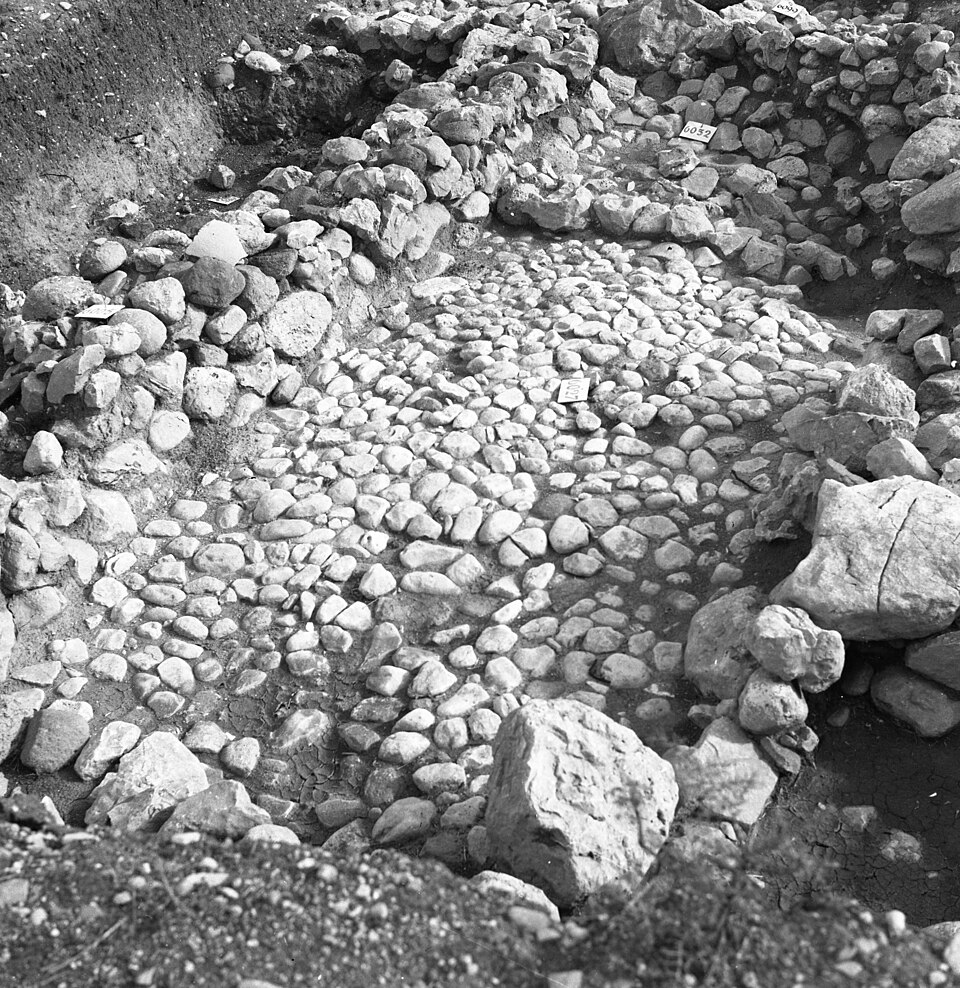
Yigael Yadin of the Hebrew University of Jerusalem excavated Hazor in four seasons between 1955 and 1958, with a final season in 1968. He uncovered evidence of a massive conflagration that destroyed the final Late Bronze Age city, which he dated to approximately 1233 BCE on the basis of pottery and stratigraphy. The destruction layer included thick deposits of ash, charred wooden beams, cracked basalt slabs, and fallen mud-brick walls.7 Yadin identified this destruction with Joshua's conquest as described in Joshua 11.
Excavations resumed at Hazor in 1990 under Amnon Ben-Tor of the Hebrew University, and his team confirmed and refined Yadin's findings. The destruction of Stratum XIII in the upper city and Stratum 1a in the lower city dates to no earlier than the middle of the thirteenth century BCE. Ben-Tor emphasized that the destruction was clearly intentional: statues of deities and rulers were deliberately mutilated by cutting off their heads and hands, an act of iconoclasm that suggests the destroyers held the Canaanite religious objects in contempt.8 Ben-Tor has argued that this pattern of deliberate desecration is more consistent with the Israelites — who, according to the biblical text, were commanded to destroy Canaanite cult objects — than with other potential destroyers such as the Egyptians or the Sea Peoples, who would have had no ideological motive for iconoclasm.8
Not all scholars accept Ben-Tor's identification of the destroyers. The late thirteenth century was a period of widespread upheaval across the eastern Mediterranean — the so-called Late Bronze Age collapse — and multiple agents could have been responsible for the destruction of Hazor. Nevertheless, the archaeological evidence at Hazor is consistent with the biblical account in a way that the evidence at Jericho and Ai is not: there was a major Canaanite city at the site, and it was destroyed by fire in the thirteenth century BCE.7, 8, 6
Lachish and other sites
Tel Lachish (Tell ed-Duweir), one of the largest and most important sites in the Judean lowlands, is mentioned in Joshua 10:31–32 as having been captured and its population put to the sword during the southern campaign. The site was excavated by James Leslie Starkey in the 1930s, and later by David Ussishkin of Tel Aviv University in an extensive campaign from 1973 to 1994. Ussishkin documented two Late Bronze Age destruction events. Level VII was destroyed in the late thirteenth century, and Level VI — the final Canaanite city — was destroyed by a massive conflagration that Bayesian radiocarbon modeling has placed between approximately 1210 and 1130 BCE.11, 20 The destruction of Level VI is broadly consistent with the period assigned to the Israelite settlement, though identifying the specific destroyer remains difficult. The Egyptian pharaoh Ramesses III, the Sea Peoples, and the incoming Israelites have all been proposed as candidates.20
At Bethel (Beitin), Albright and James Kelso excavated in the 1930s and identified a massive destruction layer at the end of the Late Bronze Age, which Albright attributed to the Israelite conquest.16 At Tell Beit Mirsim, which Albright identified as biblical Debir, he found a similar Late Bronze Age destruction. However, the identification of Tell Beit Mirsim with Debir has been largely abandoned in favor of Khirbet Rabud, where Late Bronze Age remains have also been found.16, 18
The overall pattern across the sites named in Joshua is uneven. Some sites show destructions datable to the late thirteenth or twelfth century BCE. Others — critically including Jericho and Ai, the two most dramatically narrated conquests in the Book of Joshua — do not. The destructions that do exist cannot always be attributed to a single cause, since the Late Bronze Age collapse brought widespread destructions across the entire eastern Mediterranean region from Greece to Egypt.6, 19
The Merneptah Stele and the date of Israel's presence
The earliest known reference to Israel outside the Bible appears on the Merneptah Stele, a granite victory inscription erected by the Egyptian pharaoh Merneptah around 1208 BCE. The stele, discovered by Flinders Petrie at Thebes in 1896, records military campaigns in Canaan and includes the line: "Israel is laid waste and his seed is not."12
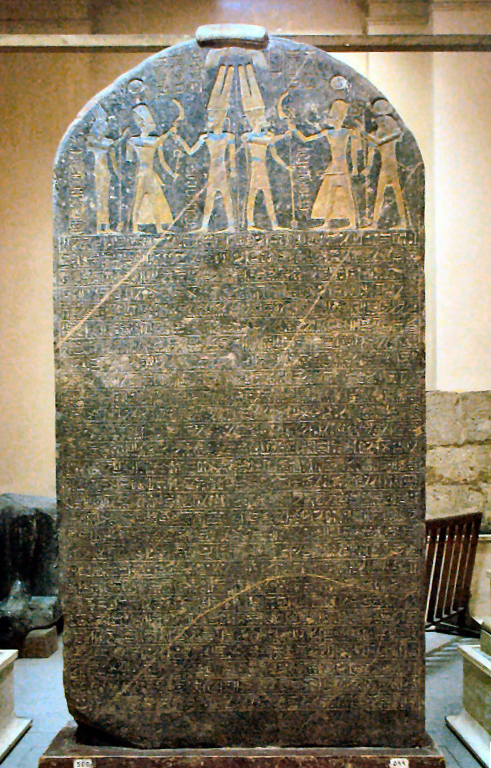

The hieroglyphic determinative applied to "Israel" marks it as a people or ethnic group rather than a city or territory, indicating that the Egyptians understood Israel as a socioethnic entity present in Canaan at the end of the thirteenth century BCE.12
The Merneptah Stele provides a fixed chronological anchor. By approximately 1208 BCE, an entity called Israel existed in Canaan and was significant enough to be mentioned in a pharaonic victory inscription alongside the Canaanite cities of Ashkelon, Gezer, and Yanoam. Whatever process brought Israel into being — whether military conquest, peaceful migration, internal social revolution, or gradual emergence — it must have been underway before this date. The stele does not describe how Israel arrived in Canaan or where it came from; it records only that it was there.12, 17
Models of Israelite settlement
The tension between the biblical conquest narrative and the archaeological evidence has generated four major scholarly models for how Israel came to inhabit Canaan. These models differ fundamentally in whether they view Israel as arriving from outside Canaan or emerging from within it.
The conquest model, associated with William F. Albright and G. Ernest Wright, took the Joshua narrative as a broadly reliable account of military invasion. Albright argued in the mid-twentieth century that the widespread destructions visible at Late Bronze Age sites across Canaan — including Bethel, Lachish, Tell Beit Mirsim, and Hazor — corroborated the biblical picture of a violent Israelite takeover.16 This model was dominant in American biblical archaeology from the 1930s through the 1960s. Its major weakness is that several key sites named in Joshua, above all Jericho and Ai, lack the expected destruction evidence, and the destructions that do exist at other sites cannot be securely attributed to the Israelites rather than to other agents in the chaotic Late Bronze Age collapse.6, 18
The peaceful infiltration model, proposed by the German scholars Albrecht Alt in 1925 and Martin Noth in the 1930s, argued that the Israelites were originally semi-nomadic pastoralists who gradually and peacefully settled in the sparsely populated hill country of Canaan, avoiding the fortified Canaanite city-states in the lowlands. In this view, the conquest narratives in Joshua are later literary compositions that retroject military glory onto what was actually a slow, undramatic process of sedentarization. Armed conflict with the Canaanites occurred only later, as the expanding Israelite population came into contact with established urban centers.13
The peasant revolt model, introduced by George Mendenhall in 1962 and elaborated by Norman Gottwald in 1979, rejected the assumption that Israel came from outside Canaan. Mendenhall proposed that the early Israelites were indigenous Canaanite peasants and pastoralists who revolted against the exploitative Late Bronze Age city-state system. In this reading, "Israel" was not an ethnic group that invaded from the desert but a social movement that coalesced within Canaan itself, uniting disaffected lower-class populations under a new religious ideology centered on the worship of Yahweh.14 Gottwald expanded this into a comprehensive sociological analysis, arguing that Israel emerged through a revolutionary withdrawal from Canaanite feudal structures, though he acknowledged that the process was more complex than a simple class uprising.15 Mendenhall himself later distanced his original proposal from Gottwald's more explicitly Marxist formulation.14
The gradual emergence model, most associated with Israel Finkelstein, draws on archaeological survey data rather than on the biblical text or sociological theory. In the 1980s and 1990s, systematic surveys of the central hill country of Canaan revealed that approximately 300 new small, unwalled villages appeared in the highlands during Iron Age I (approximately 1200–1000 BCE), a dramatic increase from the roughly 30 settlements documented in the same region during the preceding Late Bronze Age.5 These villages were modest — typically clusters of stone houses surrounding a central courtyard — and their material culture was largely continuous with Late Bronze Age Canaanite traditions. The settlers used the same pottery forms, the same agricultural techniques, and the same architectural styles as the surrounding Canaanite population.5, 6 Finkelstein concluded that the early Israelites were not foreign invaders or revolutionary peasants but rather indigenous Canaanite pastoralists and villagers who, in the wake of the Late Bronze Age urban collapse, settled previously marginal highland areas. The process was gradual, peaceful, and archaeologically invisible as a "conquest."5, 18
William Dever, while differing from Finkelstein on certain chronological questions, reached a broadly similar conclusion: the early Israelites were "largely an indigenous Canaanite population" whose ethnic identity crystallized over time in the highland settlements of Iron Age I.18 The current scholarly consensus, insofar as one exists, favors some version of the emergence model, though with significant ongoing debate about the roles of migration, conflict, and external influence in shaping early Israel.6, 18, 19
Summary of archaeological evidence by site
The following table summarizes the state of the archaeological evidence at the principal sites named in the Joshua conquest narrative, comparing what the biblical text claims with what excavation has revealed.
Archaeological evidence at conquest sites1, 6, 7, 9, 11
| Site | Biblical claim | Archaeological finding | Consistent? |
|---|---|---|---|
| Jericho (Tell es-Sultan) | Walls collapsed; city burned (Joshua 6) | Destruction dates to ~1550 BCE (Middle Bronze Age); no Late Bronze Age walls | No |
| Ai (et-Tell) | City burned; 12,000 killed (Joshua 8) | Unoccupied ~2400–1200 BCE; no city to destroy | No |
| Hazor (Tel Hazor) | City burned (Joshua 11:10–11) | Massive 13th-century destruction layer with deliberate iconoclasm | Yes |
| Lachish (Tell ed-Duweir) | City captured (Joshua 10:31–32) | Level VI destroyed ~1210–1130 BCE; agent uncertain | Possible |
| Bethel (Beitin) | Not in Joshua; implied in Judges 1:22–25 | Late Bronze Age destruction layer attested | Possible |
| Debir (Khirbet Rabud) | City captured (Joshua 10:38–39) | Late Bronze Age remains found; limited excavation | Uncertain |
The state of the evidence
The archaeological investigation of the conquest of Canaan has produced a picture that is considerably more complex than either a straightforward confirmation or a straightforward refutation of the biblical text. The narrative in Joshua describes events at specific, identifiable sites, and at some of those sites the material evidence does not support the account as narrated. At Jericho, the destruction is too early. At Ai, there is no city to destroy. At Hazor, the evidence is consistent with the biblical account. At Lachish and other sites, destructions exist but cannot be securely attributed to the Israelites.1, 6, 7, 9
The Merneptah Stele establishes that an entity called Israel existed in Canaan by approximately 1208 BCE. The Iron Age I highland surveys document a substantial population expansion in the central hill country during the twelfth and eleventh centuries BCE, with material culture continuous with the Late Bronze Age Canaanite tradition.5, 12 Whatever the origins of this population, the process by which it came to occupy the highlands does not appear to have left the kind of destruction evidence across all the sites that a rapid military conquest would be expected to produce.
The Book of Joshua and the Book of Judges themselves preserve the tension. Joshua describes total conquest; Judges describes incomplete settlement. The archaeological record is closer to Judges than to Joshua: a gradual, uneven process in which some Canaanite cities were destroyed (by various agents, not necessarily the Israelites alone), others continued to function, and a new population of small-village settlers expanded into previously underutilized highland areas.5, 6, 18 The question of how to reconcile these different sources of evidence — and whether they can be reconciled — remains one of the central problems in the archaeology of ancient Israel.
References
Radiocarbon Dating of Cereal Grains and Short-Lived Charcoal from a Late Bronze Age Destruction Layer of Tell es-Sultan (Jericho)
The Bible Unearthed: Archaeology's New Vision of Ancient Israel and the Origin of Its Sacred Texts
The Tribes of Yahweh: A Sociology of the Religion of Liberated Israel, 1250–1050 B.C.E.