Overview
- The biblical text contains references to peoples, places, technologies, and institutions that did not exist during the time periods in which the narratives are set, including Philistines and domesticated camels in the patriarchal stories, the city name Dan centuries before its renaming, and Persian-era coinage attributed to the age of Solomon.
- These anachronisms are identifiable through archaeological excavation, ancient Near Eastern inscriptions, and comparative linguistic analysis, which establish when specific peoples emerged, when animals were domesticated, when technologies were developed, and when place-names came into use.
- The presence of anachronisms in a text does not render the text valueless as a historical source but provides evidence for when and under what circumstances the text reached its present form, placing the composition or final editing of many passages centuries after the events they describe.
An anachronism is an element in a text that belongs to a time period other than the one being described — a reference to a people, place, technology, institution, or linguistic term that did not yet exist at the narrative’s setting but was familiar to the text’s author or editor. The Hebrew Bible contains a number of such elements, identifiable through archaeological excavation, ancient inscriptions, and comparative linguistics. Their presence provides evidence for the circumstances under which biblical texts reached their present form, placing the composition or final editing of many passages centuries after the events they narrate.1, 17
This article presents the anachronisms organized by type — peoples and nations, place-names, animals and agriculture, technology and material culture, language and institutions, and religious practices — with the relevant biblical passages quoted alongside the external evidence that establishes the chronological difficulty. The goal is not to evaluate whether the narratives are “true” or “false” in some broad sense, but to document what the archaeological and textual record reveals about when specific elements entered the biblical text.1

Peoples and nations
Several of the peoples named in the patriarchal narratives did not emerge as identifiable ethnic or political groups until centuries after the events described. Three cases are especially well documented: the Philistines, the Arameans, and the Chaldeans.1, 3
Philistines in the patriarchal narratives
The Book of Genesis places the Philistines in Canaan during the time of Abraham and Isaac. The text of Genesis 21:32–34, NIV states:
Genesis 21:32–34, NIV“After the treaty had been made at Beersheba, Abimelek and Phicol the commander of his forces returned to the land of the Philistines. Abraham planted a tamarisk tree in Beersheba, and there he called on the name of the LORD, the Eternal God. And Abraham stayed in the land of the Philistines for a long time.”
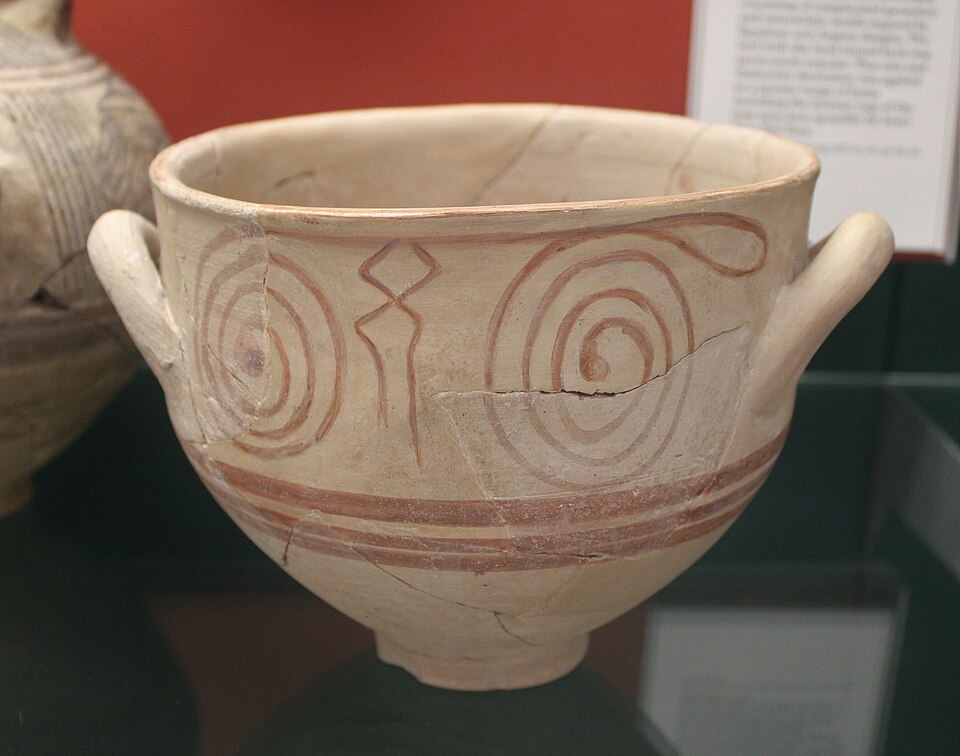
The patriarchal period is set in the early to mid-second millennium BCE, with Abraham conventionally dated to approximately 2000–1800 BCE. The Philistines, however, arrived in the coastal plain of Canaan as part of the “Sea Peoples” migration at the end of the Late Bronze Age, around 1175 BCE. Excavations at Ashkelon, Ashdod, and Ekron — three of the five cities of the Philistine Pentapolis — show no Philistine material culture before the early twelfth century BCE.3, 18 Distinctive Aegean-style pottery, including locally produced Mycenaean IIIC:1b ware, appears in the archaeological record only at this point.3 Ancient DNA analysis from the Ashkelon cemetery has confirmed a European-derived genetic component in the earliest Iron Age I burials that is absent from the preceding Late Bronze Age population, consistent with a migration event from the Aegean region.7
A second passage makes the same identification. Genesis 26:1, NIV reads:
Genesis 26:1, NIV“Now there was a famine in the land — besides the previous famine in Abraham’s time — and Isaac went to Abimelek king of the Philistines in Gerar.”
The reference to “Abimelek king of the Philistines” uses a political title and ethnic designation that corresponds to the Iron Age Philistine city-states, not to any known polity of the Middle Bronze Age. The gap between the narrative setting and the historical emergence of the Philistines is approximately six to eight centuries.6
Arameans in the patriarchal period
The patriarchal narratives describe Abraham’s extended family as Aramean. Genesis 25:20, NIV states:
Genesis 25:20, NIV“Isaac was forty years old when he married Rebekah daughter of Bethuel the Aramean from Paddan Aram and sister of Laban the Aramean.”
A liturgical text in Deuteronomy makes the identification explicit. Deuteronomy 26:5, NIV reads:
Deuteronomy 26:5, NIV“Then you shall declare before the LORD your God: ‘My father was a wandering Aramean, and he went down into Egypt with a few people and lived there and became a great nation, powerful and numerous.’”
The Arameans first appear in the historical record in Assyrian inscriptions from the reign of Tiglath-Pileser I (c. 1114–1076 BCE), where they are mentioned as tribal groups in the Syrian steppe. Aramean kingdoms — including Aram-Damascus, Bit-Adini, and Sam’al — emerged as significant political entities in the eleventh through ninth centuries BCE.10 No reference to Arameans as a distinct people appears in any text datable to the patriarchal period. The use of the ethnic term “Aramean” in Genesis and Deuteronomy applies a later designation to earlier populations from the region of northern Mesopotamia and Syria.10, 1
Chaldeans in the time of Abraham
The opening of the Abraham cycle identifies his place of origin with a term that belongs to a much later period. Genesis 11:28–31, NIV reads:
Genesis 11:28–31, NIV“While his father Terah was still alive, Haran died in Ur of the Chaldeans, in the land of his birth. … Terah took his son Abram, his grandson Lot son of Haran, and his daughter-in-law Sarai, the wife of his son Abram, and together they set out from Ur of the Chaldeans to go to Canaan.”
The Chaldeans (Akkadian Kaldu) are first attested in Assyrian records from the ninth century BCE, during the reign of Ashurnasirpal II (883–859 BCE). They were a group of tribal communities occupying the marshlands and lower regions of southern Babylonia.11 The Chaldean dynasty came to rule Babylon under Nabopolassar (626–605 BCE), making the Neo-Babylonian period (626–539 BCE) the era most closely associated with the term “Chaldean.” The designation “Ur of the Chaldeans” (’Ur Kasdim) uses a geographic qualifier that would have been meaningful to a reader of the first millennium BCE but does not correspond to any known political reality of the early second millennium.11, 1
Kings of Edom “before any Israelite king reigned”
A passage in Genesis contains a chronological reference point that presupposes a later historical development. Genesis 36:31, NIV states:
Genesis 36:31, NIV“These were the kings who reigned in Edom before any Israelite king reigned.”
This sentence assumes the reader knows that Israelite kings eventually did reign. The Israelite monarchy began with Saul, conventionally dated to approximately 1030 BCE. The statement is written from a perspective that looks back on the monarchy as an established fact, a perspective unavailable to Moses or any figure of the patriarchal or pre-monarchic period.1 Archaeological evidence from excavations in the Faynan region of southern Jordan indicates that copper-producing polities existed in the area identified with Edom from the eleventh to ninth centuries BCE, while a fully organized Edomite state emerged only in the eighth to seventh centuries.12, 5
Place-names
Several geographic names used in the patriarchal and early historical narratives belong to later periods. These reflect the common ancient practice of updating place-names to keep a text intelligible to contemporary readers, but they also indicate editorial activity after the events described.2, 17
The city of Dan
In the account of Abraham’s military expedition to rescue Lot, the text states that Abraham pursued the retreating kings “as far as Dan” (Genesis 14:14, NIV). The Book of Judges, however, records that the city was originally called Laish and was renamed Dan only after the tribe of Dan conquered it during the period of the Judges:
Judges 18:29, NIV“They renamed the city Dan after their ancestor Dan, who was born to Israel — though the city used to be called Laish.”
The conquest of Laish by the Danites is set in the pre-monarchic period, conventionally around the twelfth or eleventh century BCE. Abraham’s time is set roughly seven to eight centuries earlier. The use of the name “Dan” in Genesis 14:14 reflects a later updating of the place-name — the biblical text itself, in Judges, preserves the record that the city had a different name during the earlier period.9 Excavations at Tel Dan (Tell el-Qadi) confirm continuous settlement from the Early Bronze Age under the name Laish, with the Israelite/Danite phase beginning in the Iron Age I period.9
The district of Rameses
The Joseph narrative uses a place-name tied to a specific Egyptian dynasty. Genesis 47:11, NIV reads:
Genesis 47:11, NIV“So Joseph settled his father and his brothers in Egypt and gave them property in the best part of the land, the district of Rameses, as Pharaoh directed.”
The city of Pi-Ramesses (“House of Ramesses”) was constructed during the reign of Ramesses II (1279–1213 BCE) as the new capital of the eastern Delta. Excavations at Tell el-Dab’a and Qantir, the site of Pi-Ramesses, confirm major construction activity during the Ramesside period (thirteenth century BCE), with the city reaching its peak in the reign of Ramesses II.8 Joseph’s time in Egypt is set several centuries earlier, conventionally around 1700–1600 BCE, during the Hyksos period. The use of the name “Rameses” in the Joseph narrative applies a thirteenth-century place-name to an earlier setting. The same name appears in the Exodus narrative (Exodus 1:11), where the Israelites are said to have built the store-cities of Pithom and Rameses.16
Animals and agriculture
The patriarchal narratives describe the ownership and use of domesticated camels as routine features of pastoral life. Archaeological and zooarchaeological evidence indicates a different timeline for camel domestication in the Levant.4
Domesticated camels
Camels appear repeatedly in the Genesis accounts of the patriarchs. Genesis 12:16, NIV states:
Genesis 12:16, NIV“He treated Abram well for her sake, and Abram acquired sheep and cattle, male and female donkeys, male and female servants, and camels.”
The camel caravan is a central element of the narrative in which Abraham’s servant travels to find a wife for Isaac:
Genesis 24:10, NIV“Then the servant left, taking with him ten of his master’s camels loaded with all kinds of good things from his master.”
Systematic analysis of camel bones from archaeological sites across the southern Levant, conducted at Tel Aviv University, found that camel bones first appear in significant numbers in the Aravah Valley copper-smelting sites dating to the last third of the tenth century BCE and later.4 Earlier layers at the same sites — and at sites throughout Israel — contain no camel bones in domestic contexts. This pattern indicates that the dromedary camel was introduced as a domesticated pack animal in the southern Levant no earlier than approximately 930 BCE, nearly a millennium after the patriarchal period as conventionally dated.4 Evidence from the Arabian Peninsula suggests that initial camel domestication may have occurred somewhat earlier in southeastern Arabia (late second millennium BCE), but the animals did not reach the Levant as domesticates until the Iron Age IIA period.2
Kenneth Kitchen has argued that scattered references to camels in earlier texts (such as an Old Babylonian text from Alalakh and a Sumerian lexical list) indicate some familiarity with camels before the first millennium.2 The zooarchaeological evidence from the Levant itself, however, consistently places the appearance of domestic camel bones in stratified archaeological contexts no earlier than the tenth century BCE.4
Iron and bronze working in Genesis 4
The genealogy of Cain in Genesis 4:22, NIV describes metalworking technology in the earliest generations of humanity:
Genesis 4:22, NIV“Zillah also had a son, Tubal-Cain, who forged all kinds of tools out of bronze and iron.”
This verse places both bronze and iron technology in the pre-flood period, which in the Genesis chronology precedes all subsequent human history. The archaeological record indicates that copper smelting began in the Levant and Anatolia around 5000 BCE, bronze (copper-tin alloy) production emerged around 3300 BCE, and iron smelting developed as a widespread technology only around 1200–1000 BCE in the Near East.14 The Hittites worked iron on a limited scale from approximately 1500 BCE, but iron did not replace bronze as the primary utilitarian metal in the Levant until the Iron Age I–II transition (eleventh to tenth centuries BCE). The verse pairs bronze and iron as though both were standard metallurgical products, a description that corresponds to the Iron Age rather than to any earlier period.14, 1
Technology and material culture
Beyond metallurgy, several passages reference objects, monetary systems, and military equipment that belong to periods later than their narrative settings.1
Persian coinage in Solomon’s era
The Book of Chronicles describes donations for the construction of Solomon’s Temple using a monetary unit that did not yet exist. 1 Chronicles 29:7, NIV reads:
1 Chronicles 29:7, NIV“They gave toward the work on the temple of God five thousand talents and ten thousand darics of gold, ten thousand talents of silver, eighteen thousand talents of bronze and a hundred thousand talents of iron.”
Solomon’s Temple was built in approximately 960 BCE according to the biblical chronology (1 Kings 6:1). The daric (’adarkon, Hebrew אֲדַרְכֹנִים) was a gold coin first minted under the Persian king Darius I (522–486 BCE), approximately 450 years after Solomon’s reign.15 Standardized minted coinage itself was an invention of the seventh century BCE, originating in Lydia (western Anatolia). Before the introduction of coinage, Near Eastern economies used weighed quantities of silver and gold as media of exchange. The reference to darics in a passage set in the tenth century BCE reflects the monetary system of the Persian period, when the Book of Chronicles reached its final form.15, 19
Military numbers and chariot forces
The description of Philistine military forces in 1 Samuel attributes an exceptionally large chariot force to the Philistines during the early Iron Age. 1 Samuel 13:5, NIV states:
1 Samuel 13:5, NIV“The Philistines assembled to fight Israel, with three thousand chariots, six thousand charioteers, and soldiers as numerous as the sand on the seashore.”
This passage attributes 3,000 chariots to the Philistines in the early Iron Age (c. 1050 BCE). For comparison, at the Battle of Kadesh (1274 BCE), one of the largest recorded chariot engagements of antiquity, the Hittite coalition deployed approximately 2,500 chariots according to Egyptian records. The chariot was a prestige weapon requiring extensive resources — horses, trained drivers, maintenance infrastructure, and flat terrain for deployment. The hilly terrain of the Judean Shephelah, where the engagement in 1 Samuel 13 is set, was unsuitable for massed chariot warfare. Archaeological evidence from Philistine sites shows no indication of chariot production or stabling facilities on the scale implied by this passage.18 The Septuagint reading of this verse gives “thirty thousand” chariots rather than three thousand, making the number still larger.
Language and administrative terms
The vocabulary used in several biblical passages reflects the linguistic and administrative world of periods later than the narrative settings. Two cases involve the ethnic designation “Hebrew” and the Persian administrative title “satrap.”17
The term “Hebrew” in the Joseph narrative
In the Joseph story, set in Egypt during the second millennium BCE, the term “Hebrew” is used as an ethnic identifier. Genesis 39:14, NIV reads:
Genesis 39:14, NIV“She called her household servants. ‘Look,’ she said to them, ‘this Hebrew has been brought to us to make sport of us! He came in here to sleep with me, but I screamed.’”
And in Genesis 41:12, NIV:
Genesis 41:12, NIV“Now a young Hebrew was there with us, a servant of the captain of the guard. We told him our dreams, and he interpreted them for us, giving each man the interpretation of his dream.”
The Hebrew term ’ivri (עִבְרִי) is used here as a clear ethnic label. The Amarna Letters (fourteenth century BCE) and other Late Bronze Age texts mention a group called Habiru or ’Apiru, a social designation referring to displaced persons, mercenaries, and laborers rather than an ethnic group.2 The earliest Egyptian reference to “Israel” as a people in Canaan is the Merneptah Stele (c. 1208 BCE). The use of “Hebrew” as a fixed ethnic designation — particularly in the mouth of an Egyptian speaker — corresponds to first-millennium usage rather than to the social realities of the mid-second millennium.16
Persian administrative vocabulary in Daniel and Ezra
The Book of Daniel, set during the Babylonian exile (sixth century BCE), uses administrative terminology from the later Persian period. Daniel 3:2–3, NIV reads:
Daniel 3:2–3, NIV“He then summoned the satraps, prefects, governors, advisers, treasurers, judges, magistrates and all the other provincial officials to come to the dedication of the image he had set up.”
The term “satrap” (Aramaic ’ahashdarpanayya’, אֲחַשְׁדַּרְפְּנַיָּא) is a loanword from Old Persian xsharapavan, meaning “protector of the realm.” The satrapy system was formalized under Darius I (522–486 BCE) as the administrative framework of the Achaemenid Empire.17 The narrative of Daniel 3 is set during the reign of Nebuchadnezzar II (605–562 BCE), before the Persian conquest of Babylon in 539 BCE and before the satrapy system existed. The same term appears in Ezra 8:36, where it refers to Persian-era officials, a historically appropriate context. Its appearance in Daniel 3, set in the Babylonian period, applies Persian administrative vocabulary to a pre-Persian setting.
The Aramaic portions of Daniel (2:4b–7:28) also contain several Greek loanwords, including musical instrument names in Daniel 3:5 — qitharos (κιθάρα, “zither”), pesanterin (ψαλτήριον, “psaltery”), and sumponeyah (συμφωνία, “pipes”). Greek cultural influence in Mesopotamia is attested from the Hellenistic period following Alexander’s conquest in 331 BCE, and while limited Greek trade contacts existed earlier, the specific musical terminology in Daniel corresponds to Hellenistic-era usage.17
Religious practices and institutions
The biblical text sometimes projects later Israelite and Jewish religious institutions back onto earlier periods. The terminology and practices described reflect the ritual systems of the monarchic or Second Temple periods rather than the settings in which the narratives take place.1
Sacrificial vocabulary in Genesis
The pre-flood and post-flood narratives describe formalized sacrificial practices. Genesis 8:20, NIV states:
Genesis 8:20, NIV“Then Noah built an altar to the LORD and, taking some of all the clean animals and clean birds, he sacrificed burnt offerings on it.”
This verse uses the term mizbeah (מִזְבֵּחַ, “altar”) and the concept of ’olah (עֹלָה, “burnt offering”), which is the same term used throughout Leviticus for the specific category of whole-animal sacrifice offered at the Tabernacle and Temple. The distinction between “clean” and “unclean” animals presupposes the dietary and ritual classification system codified in Leviticus 11 and Deuteronomy 14. The narrative applies the technical vocabulary of the later Israelite sacrificial system to a figure who, within the Genesis timeline, predates Israel by many centuries.1, 17
The “house of the LORD” at Shiloh
The opening chapters of 1 Samuel describe the sanctuary at Shiloh using language associated with the later Jerusalem Temple. 1 Samuel 1:9, NIV reads:
1 Samuel 1:9, NIV“Once when they had finished eating and drinking in Shiloh, Hannah stood up. Now Eli the priest was sitting on his chair by the doorpost of the LORD’s house.”
And in 1 Samuel 3:3, NIV:
1 Samuel 3:3, NIV“The lamp of God had not yet gone out, and Samuel was lying down in the house of the LORD, where the ark of God was.”
The Hebrew term used is hekal YHWH (הֵיכַל יְהוָה), “temple of the LORD,” with architectural details such as doorposts and a permanent lamp installation. Excavations at Khirbet Seilun (the site identified with biblical Shiloh) have revealed cultic remains from the Iron Age I period, including evidence of destruction around 1050 BCE, but no monumental temple structure of the kind implied by the term hekal.1 The architectural language of these passages — doorposts, permanent lamps, the designation hekal — corresponds to the Jerusalem Temple rather than to the archaeological remains at Shiloh.
Summary of anachronisms by category
The following table collects the anachronisms discussed above, organized by the biblical passage, the element in question, the narrative date implied by the text, and the date range established by the external evidence.
Anachronisms in the Hebrew Bible: narrative setting vs. external evidence1, 3, 4, 11, 15
| Passage | Anachronistic element | Narrative setting | Earliest external attestation |
|---|---|---|---|
| Genesis 21:32–34 | Philistines in Canaan | c. 2000–1800 BCE | c. 1175 BCE (Sea Peoples migration) |
| Genesis 25:20 | Arameans as ethnic group | c. 1900–1700 BCE | c. 1100 BCE (Assyrian records) |
| Genesis 11:28–31 | Chaldeans in southern Mesopotamia | c. 2000–1800 BCE | c. 880 BCE (Assyrian records) |
| Genesis 36:31 | Israelite monarchy presupposed | Patriarchal period | c. 1030 BCE (Saul’s reign) |
| Genesis 14:14 | City name “Dan” | c. 2000–1800 BCE | c. 1150–1100 BCE (Danite conquest) |
| Genesis 47:11 | District of Rameses | c. 1700–1600 BCE | c. 1279–1213 BCE (Ramesses II) |
| Genesis 12:16; 24:10 | Domesticated camels | c. 2000–1800 BCE | c. 930 BCE (camel bones in Aravah) |
| Genesis 4:22 | Iron working | Pre-flood (primeval) | c. 1200–1000 BCE (Iron Age I) |
| 1 Chronicles 29:7 | Darics (Persian gold coins) | c. 960 BCE | c. 520 BCE (Darius I) |
| Daniel 3:2–3 | Satraps (Persian title) | c. 600–560 BCE | c. 522 BCE (Darius I) |
| Daniel 3:5 | Greek musical terms | c. 600–560 BCE | Hellenistic period (post-331 BCE) |
Anachronisms as compositional evidence
The anachronisms cataloged above are not uniformly of the same type. Some represent simple updating of place-names — a scribal practice well attested in the ancient Near East, where a copyist would substitute a current name for an obsolete one to keep the text understandable. The use of “Dan” for “Laish” in Genesis 14:14 may fall into this category, and the biblical text itself preserves the evidence for the original name in Judges 18:29.
Other anachronisms involve more substantive elements — the Philistines as a named people with a king, domesticated camels as a standard feature of pastoral wealth, the daric as a unit of monetary donation. These are not simple name substitutions. They involve embedding later cultural realities into the narrative fabric of the story, suggesting that the passages in question were composed during or after the period to which the anachronistic elements belong.1, 20
The linguistic anachronisms in Daniel — Persian administrative titles, Greek loanwords — bear on the question of when the book reached its final form. The Aramaic of Daniel belongs to a phase of the language that postdates the sixth-century setting of the narrative, and the Greek terminology is most naturally explained as reflecting the Hellenistic period.17 The Hebrew portions of Daniel also contain vocabulary and syntactic features characteristic of Late Biblical Hebrew, the form of the language used in texts from the Persian and Hellenistic periods (Esther, Ezra-Nehemiah, Chronicles) rather than the Classical Biblical Hebrew of pre-exilic compositions.19
The presence of anachronisms does not, by itself, determine the historicity of the events described. A narrative composed centuries after the events it records may still preserve genuine historical memories, transmitted through oral tradition or earlier written sources that are no longer extant. What anachronisms do establish is a terminus post quem — a date after which the text in its present form must have been written. A passage mentioning darics cannot have been written before darics existed. A passage mentioning satraps in their Persian administrative sense cannot have been composed before the satrapy system was established. Each anachronism provides a fixed point for dating the composition or editing of the text in which it appears.
The place-name updating debate
The simplest anachronisms — updated place-names — have generated the least controversy. The phenomenon of scribal updating is well documented in ancient Near Eastern textual transmission. Egyptian texts were routinely modernized as they were copied, and Mesopotamian scribes updated geographic and personal names in literary and administrative texts. Kenneth Kitchen has argued that many of the geographic anachronisms in Genesis are of this type: editorial glosses added during copying to help readers identify locations whose ancient names had fallen out of use.2
This explanation accounts well for cases like the name “Dan” in Genesis 14:14, where a single word has been substituted and the original name is preserved elsewhere in the biblical text. It is more difficult to apply to cases where the anachronistic element is woven into the narrative itself. The domesticated camels in Genesis 24 are not a marginal gloss; they are central to the story’s plot, serving as the means by which Abraham’s servant travels and as a marker of Abraham’s wealth. The Philistines in Genesis 26 are not mentioned in passing; Abimelek is identified as “king of the Philistines,” a political title integrated into the narrative structure.1
The distinction between a scribal gloss and a compositional anachronism is significant for understanding the formation of the biblical text. A gloss updates a detail; a compositional anachronism indicates that the passage was written during a period when the anachronistic element was a familiar part of the author’s world. Both are evidence of the text’s history, but they carry different implications for how much of the narrative originates in the period it describes versus the period in which it was written.20
Anachronisms and Pentateuch authorship
The anachronisms within the first five books of the Bible bear directly on the question of when and by whom these books were composed. The attribution of the Pentateuch to Moses places its composition in the late second millennium BCE (conventionally thirteenth century). Several of the anachronisms documented above — the Philistines, the Chaldeans, the Arameans, domesticated camels, the city name Dan, the reference to Israelite kings in Genesis 36:31 — fall within the Pentateuch and indicate that at least portions of the text were written or edited well after the Mosaic period.
The medieval rabbi Abraham ibn Ezra (1089–1167 CE) noted several of these difficulties in his commentary on Deuteronomy, including the phrase “the Canaanite was then in the land” (Genesis 12:6), which implies that the Canaanite was no longer in the land when the text was written — a situation that did not obtain until after the Israelite settlement. Ibn Ezra wrote cryptically that “the one who understands will be silent,” recognizing the implication without stating it explicitly.19
The anachronisms are consistent with the compositional model in which the Pentateuch reached its present form through a process of writing, editing, and compilation extending from the monarchic period (tenth to seventh centuries BCE) through the exilic and post-exilic periods (sixth to fifth centuries BCE). On this model, earlier traditions — some perhaps very ancient — were incorporated into a text that also reflects the cultural, geographic, and linguistic world of its editors. The anachronisms do not demonstrate that no historical memory underlies the patriarchal narratives, but they do demonstrate that the text as it stands cannot be the unedited product of the periods it describes.1, 17
Anachronisms in the New Testament
While the majority of identifiable anachronisms occur in the Hebrew Bible, where the gap between narrative setting and composition may span centuries, the New Testament contains a smaller number of elements that raise analogous questions.
The Gospel of Matthew describes the Pharisees as a dominant force in Jewish life during Jesus’s ministry (c. 30 CE), with organized authority in synagogues throughout Galilee. The text of Matthew 23:2–3, NRSV reads:
Matthew 23:2–3, NRSV“The scribes and the Pharisees sit on Moses’ seat; therefore, do whatever they teach you and follow it; but do not do as they do, for they do not practice what they teach.”
The phrase “Moses’ seat” (kathedra Mōuseōs, καθέδρα Μωῦσέως) refers to a seat of teaching authority. Archaeological examples of stone seats identified as “Moses’ seats” have been found in synagogues from the third century CE and later, but no synagogue structures from the early first century CE have been identified in Galilee with certainty. The level of Pharisaic institutional authority described in Matthew — with organized control over synagogue teaching and formal legal rulings — more closely reflects the post-70 CE period, when the rabbinic movement (the successors to the Pharisees) became the dominant force in Jewish communal life after the destruction of the Temple.19 The Gospel of Matthew is dated by most textual evidence to the 80s CE, and its portrayal of Pharisaic authority may reflect the author’s own experience of the rabbinic movement rather than the situation during Jesus’s lifetime.
The Gospel of John contains several references to followers of Jesus being “put out of the synagogue” (aposynagōgos, ἀποσυνάγωγος). John 9:22, NRSV reads:
John 9:22, NRSV“His parents said this because they were afraid of the Jews; for the Jews had already agreed that anyone who confessed Jesus to be the Messiah would be put out of the synagogue.”
The term aposynagōgos appears only in John’s Gospel (also at John 12:42 and John 16:2) and describes a formal policy of exclusion. The Birkat haMinim — a benediction against sectarians that may have targeted Jewish Christians — is associated with the rabbinic assembly at Yavneh, conventionally dated to around 85–90 CE. John’s Gospel is dated by manuscript and internal evidence to approximately 90–100 CE. The formal synagogue expulsion described in John may reflect tensions between the Johannine community and the emerging rabbinic movement in the late first century rather than an organized policy during Jesus’s lifetime in the 20s and 30s CE.19
What anachronisms reveal about the biblical text
Anachronisms in the biblical text function as windows into the world of the text’s authors and editors. When Genesis describes Abraham owning camels, the passage reveals something about the period when the Abraham narratives were written down — a period when camel caravans were a familiar feature of Near Eastern life. When Chronicles mentions darics, the passage reveals that the Chronicler was writing in the Persian period, when darics were in circulation. When Daniel uses Persian administrative titles and Greek musical terms, the text reveals the linguistic environment in which it was composed.
This information is valuable for reconstructing the literary history of the Bible. Each anachronism provides a minimum date for the passage in which it occurs, helping to map the chronological layers of the text. A passage cannot be older than its youngest element. When multiple anachronisms in a single book point to the same general period — as the Persian and Greek elements in Daniel both point to the Hellenistic era — they converge on a compositional date for that book’s final form.17
At the same time, anachronisms do not require the conclusion that the narratives are pure invention.2 The Philistines may not have been in Canaan during Abraham’s time, but the Abraham narratives may still preserve memories of real interactions between pastoral groups and settled populations in the region. The camels may be anachronistic, but the social dynamics of the stories — negotiation over wells, marriages between clan groups, migration during famine — may reflect genuine features of second-millennium life transmitted through oral tradition and later put into writing using the cultural vocabulary of the author’s own time.2, 16
The identification of anachronisms is, fundamentally, a chronological exercise. It establishes when specific elements entered the text, and by extension, when the text in its current form was produced. The evidence presented above — drawn from excavation reports, ancient inscriptions, zooarchaeological analysis, and comparative linguistics — provides the data from which the reader can assess the relationship between the biblical narratives and the historical periods they describe.
References
The Bible Unearthed: Archaeology's New Vision of Ancient Israel and the Origin of Its Sacred Texts
The Early Iron Age Camel Site and the Introduction of Domesticated Camels to the Southern Levant
Dan I: A Chronicle of the Excavations, the Pottery Neolithic, the Early Bronze and the Middle Bronze Age Tombs
David and Solomon: In Search of the Bible's Sacred Kings and the Roots of the Western Tradition