Overview
- The figure of Satan as a cosmic adversary of God is not present in the earliest Hebrew Bible texts — the Hebrew word satan originally meant “adversary” or “accuser” and referred to a role or function, not a proper name, as seen in the heavenly prosecutor of Job and the angelic obstacle in Numbers.
- The transformation of Satan from a member of God's court into an independent evil being was driven by Persian dualistic influence during and after the Babylonian exile, the theological need to explain evil without implicating God, and the flourishing of apocalyptic literature in the intertestamental period.
- By the New Testament period, Satan had become the devil — a personal cosmic enemy of God, ruler of demons, tempter of humanity, and architect of evil in the world — a fully developed figure that bears little resemblance to the ha-satan of the Hebrew Bible and reflects centuries of theological evolution.
The figure of Satan as understood in Christianity — a personal, cosmic adversary of God, ruler of demons, the tempter who brought sin into the world, and the enemy who will be defeated at the end of time — is the product of a long and traceable development across more than a millennium of religious thought. The Satan of popular imagination is not the figure found in the oldest layers of the Hebrew Bible. It emerged gradually through shifts in Israelite theology, exposure to Persian dualism, the creativity of apocalyptic literature in the Second Temple period, and the theological needs of the early Christian movement. Tracing this development illuminates how a minor functionary in God's heavenly court became the supreme embodiment of evil.1, 2
Ha-satan in the Hebrew Bible
The Hebrew word satan (שָׂטָן) is a common noun meaning "adversary," "accuser," or "obstacle." In several passages of the Hebrew Bible, the word is used in its ordinary sense with no supernatural connotation. In 1 Samuel 29:4, the Philistine commanders worry that David might become a satan — an adversary — to them in battle. In 1 Kings 11:14, God raises up Hadad the Edomite as a satan against Solomon. In Numbers 22:22, the angel of the LORD positions himself in the road as a satan to Balaam — an obstruction, blocking his path. In none of these cases does the word refer to a cosmic evil being; it denotes a role or function that any human or angelic figure might fill.3, 14
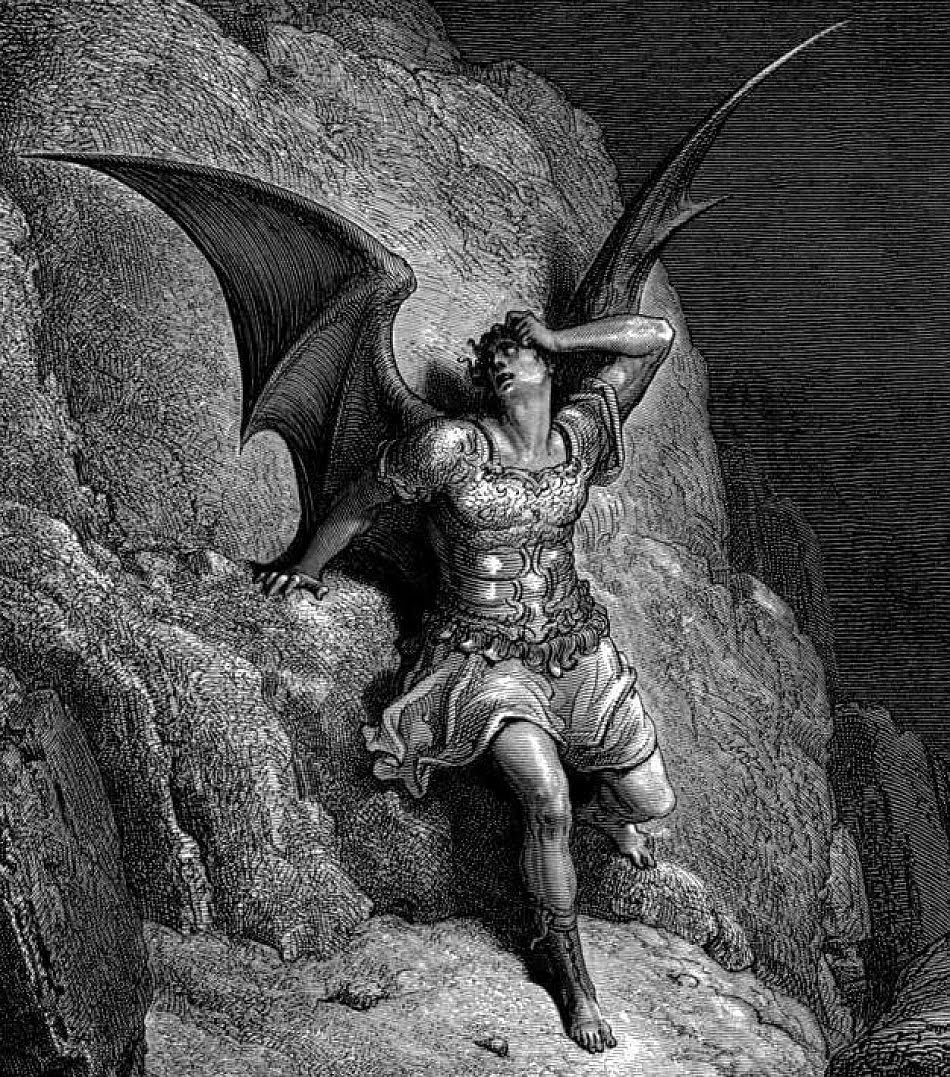

The figure designated ha-satan ("the adversary," with the definite article) appears in only three passages of the Hebrew Bible: Job 1–2, Zechariah 3:1–2, and 1 Chronicles 21:1. The definite article is significant: it indicates a title or role description ("the adversary"), not a proper name. In the prologue to Job, ha-satan is a member of the bene elohim ("sons of God") — the divine council that attends upon God. He functions as a prosecuting attorney or roving investigator, challenging the sincerity of Job's piety and proposing that it be tested through suffering. Crucially, ha-satan acts only with God's explicit permission; he is subordinate to God, not in rebellion against him. He is skeptical and provocative, but he is not evil in the later sense. His role is to test, not to tempt; to accuse, not to corrupt.5, 1
In Zechariah 3:1–2, ha-satan appears in a courtroom scene, standing at the right hand of the high priest Joshua to accuse him before the angel of the LORD. Again, he functions as a prosecutorial figure within the divine court. The LORD rebukes ha-satan, but the passage gives no indication that ha-satan is a fallen angel or an independent agent of evil. He is performing a legitimate, if unwelcome, judicial function.3, 15
The passage in 1 Chronicles 21:1 represents a transitional moment. It reads: "Satan stood up against Israel, and incited David to count the people of Israel." This is significant for two reasons. First, the word satan appears here without the definite article, suggesting it may be functioning as a proper name rather than a title. Second, the passage is a retelling of an earlier account in 2 Samuel 24:1, which states: "Again the anger of the LORD was kindled against Israel, and he incited David against them, saying, 'Go, count the people of Israel and Judah.'" In the earlier version, it is God himself who incites David; in the later Chronicler's version, composed after the exile, the agency has been transferred to Satan. This shift reveals a theological discomfort with attributing morally questionable actions directly to God — a discomfort that would drive much of Satan's subsequent development.2, 15
The serpent in Eden
The identification of the serpent in Genesis 3 with Satan is so deeply embedded in Christian tradition that it is often assumed to be the plain meaning of the text. It is not. The Genesis narrative introduces the serpent as "more crafty than any other wild animal that the LORD God had made" (Genesis 3:1, NRSV) — that is, as one of God's creatures, distinguished by its intelligence but not identified as a fallen angel, a demon, or a cosmic adversary. The serpent speaks, deceives, and is punished by being condemned to crawl on its belly, but the narrative gives no indication that it is anything other than an unusually cunning animal. The Hebrew Bible nowhere identifies the serpent with Satan.2, 4
The equation of the serpent with Satan developed gradually. The earliest known text to make the connection explicitly is the Wisdom of Solomon, a Jewish work composed in Greek probably in the first century BCE, which states: "Through the devil's envy death entered the world" (Wisdom 2:24), an apparent allusion to the Eden narrative. The Life of Adam and Eve (first century CE) elaborates a narrative in which Satan, expelled from heaven for refusing to worship Adam, uses the serpent as his instrument of revenge. By the New Testament period, the identification was established: Revelation 12:9 speaks of "that ancient serpent, who is called the Devil and Satan," explicitly fusing the Genesis figure with the developed Satan of Christian theology. But this fusion was a product of interpretive tradition, not of the Genesis text itself.1, 3, 6
Persian dualism and the exile
The Babylonian exile (586–539 BCE) was a watershed in the development of Israelite theology, and the concept of Satan is one of the areas most clearly affected by the encounter with Persian religious thought. Zoroastrianism, the dominant religion of the Persian Empire that liberated the Judean exiles, is characterized by a pronounced dualism: the good deity Ahura Mazda is opposed by the evil spirit Angra Mainyu (Ahriman) in a cosmic conflict that structures all of reality. This is fundamentally different from pre-exilic Israelite theology, in which YHWH was the sole source of both good and evil — as stated explicitly in Isaiah 45:7: "I form light and create darkness, I make weal and create woe; I the LORD do all these things."13, 11
The influence of Persian dualism on Second Temple Judaism is debated in its details but widely acknowledged in its broad contours. The emergence of a dualistic framework — in which good and evil are represented by opposing supernatural beings — appears in Jewish literature only after the exile, during the period of Persian and then Hellenistic rule. The Dead Sea Scrolls, produced by the Qumran community between the second century BCE and the first century CE, contain some of the most striking examples. The Community Rule (1QS 3:13–4:26) describes a cosmic conflict between the "Prince of Light" (or "Angel of Truth") and the "Angel of Darkness" (or "Spirit of Deceit"), who has dominion over the "sons of darkness." This is a thoroughgoing dualism that goes far beyond anything in the pre-exilic Hebrew Bible and shows clear affinities with Zoroastrian thought.10, 11
The theological motivation for this development is not difficult to identify. As Israelite religion moved toward a stricter monotheism — insisting that YHWH was the only God and the sovereign ruler of all creation — it faced the problem of evil with new urgency. If God is the sole author of all that exists, how does evil arise? The pre-exilic solution (God causes both good and evil) became theologically unsatisfying. An independent evil figure — not a rival god, which would compromise monotheism, but a rebellious angel or spirit acting in defiance of God's will — provided a way to preserve divine goodness while accounting for the reality of evil. Satan filled this role.1, 2, 7
Intertestamental development
The period between the Hebrew Bible and the New Testament — roughly the third century BCE through the first century CE — saw an explosion of apocalyptic and pseudepigraphic literature in which the figure of Satan was elaborated far beyond anything in the canonical Hebrew Bible. These texts, though not included in the Jewish or Protestant canons, were widely read and deeply influential on the worldview of early Judaism and Christianity.9, 6
The Book of the Watchers (1 Enoch 1–36), composed in the third century BCE, develops the tradition found in Genesis 6:1–4 about the "sons of God" who descended to earth and took human wives. In this expanded narrative, a group of angels led by Semjazâ (or, in some recensions, Azazel) rebel against God by descending to earth, mating with human women, and teaching humanity forbidden knowledge — metallurgy, weapons-making, cosmetics, astrology, and sorcery. Their offspring are the giants (Nephilim) whose violence corrupts the earth and provokes the flood. Although Satan is not the leader of the fallen angels in 1 Enoch (the text uses other names), the narrative establishes the template of angelic rebellion that would later be applied to Satan: a heavenly being who defies God, corrupts humanity, and is ultimately punished.6, 9
The Book of Jubilees (second century BCE) introduces the figure of Mastema (from the Hebrew for "hostility"), a chief of the evil spirits who functions very much like the later Satan. Mastema tests Abraham by urging God to demand the sacrifice of Isaac (Jubilees 17:16), paralleling ha-satan's role in Job. He is responsible for the plagues of Egypt and for various acts of temptation and destruction. Jubilees also makes the first explicit connection between the fallen angels, the demons, and a single organizing figure of evil — a development that would prove decisive for the New Testament portrait of Satan as "ruler of the demons."9, 2
At Qumran, the dualism is expressed through the figure of Belial (or Beliar), the "Angel of Darkness" who leads the forces of evil against the "Sons of Light." The War Scroll (1QM) envisions a final eschatological battle between the two camps. The Community Rule explains that God created two spirits to govern humanity: the Spirit of Truth and the Spirit of Deceit, and that the conflict between them will continue until God's appointed end. This cosmic dualism — with a named evil figure commanding legions of lesser spirits in opposition to God — represents a dramatic development from the ha-satan of Job, who was a member of God's court acting under divine authority.10, 11
Satan in the New Testament
By the time the New Testament was composed (c. 50–120 CE), the figure of Satan had crystallized into the form that would dominate Christian theology for two millennia. The New Testament Satan is a personal being with a proper name (the definite article is dropped), variously called Satan, the devil (diabolos, Greek for "slanderer"), Beelzebul, the tempter, the evil one, the ruler of this world, and the prince of the power of the air. He commands a hierarchy of demons. He tempts Jesus in the wilderness (Matthew 4:1–11; Luke 4:1–13). He "entered into" Judas Iscariot (Luke 22:3; John 13:27). He is "the ruler of this world" (John 12:31) and "the god of this age" who blinds the minds of unbelievers (2 Corinthians 4:4). He prowls "like a roaring lion, seeking someone to devour" (1 Peter 5:8).16, 1
The temptation narrative in Matthew and Luke is especially revealing of how fully developed the figure had become. Satan appears as a personal being who engages Jesus in dialogue, quotes scripture, offers worldly power in exchange for worship, and functions as an independent agent of evil whose goal is to divert Jesus from his mission. This is not the prosecuting attorney of Job, faithfully carrying out a function within God's court. This is a cosmic enemy who seeks to subvert God's plan. The distance between the two figures is the measure of the theological evolution that occurred in the intervening centuries.3, 2
The Gospels present Jesus's ministry as a sustained assault on Satan's kingdom. Exorcisms are not merely acts of healing but episodes in a cosmic war: "If it is by the Spirit of God that I cast out demons, then the kingdom of God has come to you" (Matthew 12:28). Jesus declares that he saw "Satan fall from heaven like a flash of lightning" (Luke 10:18). The entire framework of Jesus's mission is cast in terms of a conflict between God and Satan for dominion over the world — a framework that owes more to the apocalyptic literature of the intertestamental period than to anything in the Hebrew Bible.1, 16
The Book of Revelation provides the fullest New Testament elaboration, weaving together the various strands of the tradition into a single cosmic narrative. Satan is identified as "the great dragon," "that ancient serpent" (explicitly linking him to the Genesis narrative for the first time in canonical literature), and "the deceiver of the whole world" (Revelation 12:9). He is cast out of heaven, wages war against the saints, empowers the beast and the false prophet, and is ultimately defeated and thrown into "the lake of fire" for eternal punishment (Revelation 20:10). This narrative of cosmic rebellion, war, and final defeat draws on the Enochic tradition, the combat mythology of the ancient Near East, and the dualistic frameworks of Second Temple apocalypticism, synthesizing them into the definitive Christian account of Satan's career.4, 9
Post-biblical elaboration
The development of Satan did not end with the New Testament. Early Christian theologians continued to elaborate the figure, drawing on the diverse biblical and intertestamental traditions and synthesizing them into a more coherent biography than any single ancient text provides. Origen (c. 185–254 CE) interpreted Isaiah 14:12–15 — a taunt song against the king of Babylon ("How you are fallen from heaven, O Day Star, son of Dawn!") — as a description of Satan's fall from heaven. The Latin Vulgate translated "Day Star" (helel in Hebrew) as lucifer, and the name stuck. Similarly, Ezekiel 28:12–17, a lament over the king of Tyre who was "in Eden, the garden of God" and was cast out for pride, was reinterpreted as a reference to Satan's original exalted state and subsequent fall. Neither passage in its original context refers to a supernatural being; both are prophetic poetry directed at human rulers. Their application to Satan is a product of later Christian interpretation, not of the texts' own meaning.3, 4, 8
Augustine of Hippo (354–430 CE) systematized the doctrine further, arguing that Satan was a good angel who fell through pride before the creation of humanity, that he tempted Adam and Eve through the serpent, and that his rebellion explains the origin of evil in a world created by a good God. This Augustinian synthesis became the dominant framework of Western Christianity and remains the standard theological account. It is, however, a synthesis of texts that were not originally about Satan (Isaiah 14, Ezekiel 28, Genesis 3), texts from non-canonical literature (1 Enoch, Jubilees), and New Testament passages that themselves represent different stages of development. The coherent "biography" of Satan — from primordial angel to prideful rebel to serpent in Eden to tempter of Christ to eschatological adversary — is a theological construction, not a historical or literary given.8, 1
The medieval period saw further elaboration: the development of detailed demonologies ranking Satan's lieutenants by name and function, the association of Satan with the figure of the Antichrist, the iconographic tradition of Satan as a horned, goat-footed figure (drawing on pagan imagery of Pan and other nature deities), and the use of Satan as a polemical weapon against heretics, Jews, Muslims, and other perceived enemies of the church. Each stage of development added new layers to the figure while claiming to describe an unchanging reality. The historical record, however, reveals not a timeless doctrine but a concept that evolved in response to specific theological problems, cultural encounters, and political needs across more than a thousand years of religious history.1, 8, 3