Overview
- The Hebrew Bible preserves extended expressions of doubt from its most prominent figures — Abraham questions God’s promise, Moses resists his commission, Job challenges divine justice, and the Psalms contain lament traditions in which the speaker accuses God of abandonment, hiddenness, and injustice
- The New Testament records doubt among Jesus’ closest followers: Thomas demands physical evidence of the resurrection, John the Baptist sends messengers from prison questioning whether Jesus is the Messiah, and Peter sinks after momentarily trusting Jesus on the water
- Scholarly analysis distinguishes several types of biblical doubt — existential protest, vocational resistance, evidential skepticism, and theological questioning — and notes that the biblical narrative consistently treats honest doubt as a feature of the faith journey rather than a disqualifying failure
The biblical literature contains extensive records of doubt, protest, and questioning directed at God by figures the texts present as faithful. These episodes are not confined to minor characters or narrative asides; they involve the patriarchs, prophets, psalmists, and apostles at critical moments in the biblical narrative. Scholarly analysis of these texts distinguishes several categories of doubt — existential lament, vocational resistance, evidential skepticism, and theological protest — and observes that the biblical writers consistently preserve and even valorize honest questioning rather than treating it as a failure of piety.2
The lament tradition in the Psalms
The most sustained biblical expression of doubt appears in the lament psalms, which constitute roughly one-third of the Psalter. Walter Brueggemann’s influential classification divides the Psalms into three categories: psalms of orientation (expressing settled trust), psalms of disorientation (expressing crisis, doubt, and protest), and psalms of new orientation (expressing restored faith after suffering). The disorientation psalms — including Psalms 13, 22, 44, 74, 88, and 137 — give voice to experiences of divine absence, injustice, and abandonment (see also hiddenness of God).2
Psalm 22 opens with the cry that Jesus would later quote from the cross: “My God, my God, why have you forsaken me? Why are you so far from saving me, from the words of my groaning?” (Psalm 22:1, ESV). The psalm continues with extended descriptions of suffering and divine silence before turning, in its second half, to expressions of trust and praise. This structure — lament followed by resolution — characterizes most lament psalms, but not all. Psalm 88 is unique in the Psalter: it is pure lament from beginning to end, closing with the word “darkness” and offering no resolution, no praise, and no expression of restored confidence. Craigie and Tate note that Psalm 88’s inclusion in the canon demonstrates that the biblical tradition regarded unresolved anguish as a legitimate form of prayer.1
Psalm 73, attributed to Asaph, records a crisis of faith provoked by the prosperity of the wicked: “But as for me, my feet had almost stumbled, my steps had nearly slipped. For I was envious of the arrogant when I saw the prosperity of the wicked” (Psalm 73:2–3, ESV). The psalmist describes maintaining his piety as “in vain” (Psalm 73:13, ESV) before finding resolution in the sanctuary. Brueggemann interprets Psalm 73 as a paradigmatic movement from disorientation to new orientation, in which the doubter’s honesty about injustice is the precondition for a deepened understanding of God’s purposes.10
Doubt in the patriarchal narratives
The Genesis narratives record doubt at the earliest stages of the covenant relationship. God promises Abraham offspring as numerous as the stars (Genesis 15:5, ESV), and Abraham “believed the Lord” (Genesis 15:6, ESV) — the verse Paul would later cite as the paradigmatic act of faith. Yet the same Abraham, in the very next verse, asks: “O Lord God, how am I to know that I shall possess it?” (Genesis 15:8, ESV). God responds not with rebuke but with a covenant ceremony. Later, both Abraham and Sarah laugh at the promise of a son in old age (Genesis 17:17; Genesis 18:12, ESV) — responses that blend incredulity with delight and give the child his name, Isaac (“he laughs”).12, 15
Jacob’s wrestling with a divine figure at the Jabbok (Genesis 32:22–32, ESV) has been interpreted by commentators from the Targums through modern scholarship as a physical enactment of spiritual struggle. Jacob refuses to release his opponent until he receives a blessing, and his new name, Israel (“he struggles with God”), becomes the name of the covenant people — a naming that embeds the motif of struggle with the divine into the national identity itself.15
Moses and vocational resistance
The call narrative of Moses in Exodus 3–4 contains one of the most extended episodes of resistance to a divine commission in the Hebrew Bible. Moses raises five successive objections: “Who am I that I should go to Pharaoh?” (Exodus 3:11, ESV); “What shall I say to them?” if they ask God’s name (Exodus 3:13, ESV); “But behold, they will not believe me” (Exodus 4:1, ESV); “I am not eloquent” (Exodus 4:10, ESV); and finally the blunt refusal: “Oh, my Lord, please send someone else” (Exodus 4:13, ESV). Brevard Childs observes that this progressive resistance follows a literary pattern in which each objection draws a more specific divine response — a theophany, a name revelation, miracle signs, the appointment of Aaron — until the final objection provokes divine anger but not rejection.5
Later in the narrative, Moses’ doubts deepen under the pressures of leadership. In Numbers 11:11–15, he accuses God of burdening him unjustly: “Why have you dealt ill with your servant? And why have I not found favor in your sight, that you lay the burden of all this people on me?” He concludes by asking God to kill him rather than let him continue under the weight of the task. The text records God responding by distributing the burden of leadership to seventy elders rather than punishing Moses for the outburst.5, 15
Job and the protest against innocent suffering
The book of Job represents the most sustained and philosophically sophisticated expression of doubt in the Hebrew Bible. Job, described in the prologue as “blameless and upright” (Job 1:1, ESV), loses his children, his wealth, and his health, and then engages in three cycles of dialogue with friends who insist that his suffering must be the consequence of sin. Job rejects their explanations and escalates his challenge to God: “I would speak to the Almighty, and I desire to argue my case with God” (Job 13:3, ESV). He demands a hearing: “Oh, that I had one to hear me! Here is my signature! Let the Almighty answer me!” (Job 31:35, ESV).3
Marvin Pope’s commentary notes that Job’s language moves from protest to something approaching legal action against God — he demands a rib, a covenant lawsuit, in which God must justify his treatment of a righteous person. Carol Newsom argues that the book of Job stages a contest between competing “moral imaginations”: the retribution theology of the friends, the protest theology of Job, and the divine speeches from the whirlwind, which neither vindicate the friends nor concede Job’s specific charges but reframe the question entirely by invoking the vastness and inscrutability of creation.3, 11
The divine response in Job 38–41 does not answer Job’s question about why the righteous suffer. God speaks instead of cosmic design, wild animals, and forces beyond human comprehension. David Clines interprets the divine speeches as a refusal to operate within the categories Job has set up: God does not defend his justice in the terms Job demands but overwhelms the conversation with a vision of reality that renders the question, though not illegitimate, unanswerable from the human vantage point. Crucially, the epilogue states that God declares Job — the doubter and protester — to have spoken “what is right” about God, while the friends who defended traditional theology are rebuked (Job 42:7, ESV).4
Prophetic questioning
The prophetic literature contains figures who challenge God directly about the moral order. Jeremiah opens what scholars call his “confessions” — a series of lament passages unique among the prophetic books — with a legal challenge: “Righteous are you, O Lord, when I complain to you; yet I would plead my case before you. Why does the way of the wicked prosper? Why do all who are treacherous thrive?” (Jeremiah 12:1, ESV). Jeremiah’s confessions (Jeremiah 11:18–12:6; 15:10–21; 17:14–18; 18:18–23; 20:7–18) record a prophet who accuses God of deception: “O Lord, you have deceived me, and I was deceived; you are stronger than I, and you have prevailed” (Jeremiah 20:7, ESV).15
Habakkuk structures his entire prophecy as a dialogue of doubt with God. The book opens with a complaint: “O Lord, how long shall I cry for help, and you will not hear? Or cry to you ‘Violence!’ and you will not save?” (Habakkuk 1:2, ESV). God responds by announcing that the Babylonians will be his instrument of judgment, which provokes Habakkuk’s second complaint: how can a just God use a more wicked nation to punish a less wicked one? (Habakkuk 1:12–13, ESV). Francis Andersen observes that Habakkuk’s structure — complaint, divine response, deeper complaint, further response — models a theology in which doubt is not silenced but engaged through ongoing dialogue.8
Doubt among Jesus’ followers
The Gospels record doubt among Jesus’ closest associates. John the Baptist, imprisoned by Herod Antipas, sends his disciples to ask Jesus: “Are you the one who is to come, or shall we look for another?” (Matthew 11:3, ESV). The question is striking given that the same Gospels present John as the one who identified Jesus at the Jordan baptism. Jesus responds not by rebuking the doubt but by pointing to evidence: “Go and tell John what you hear and see: the blind receive their sight and the lame walk, lepers are cleansed and the deaf hear, and the dead are raised up, and the poor have good news preached to them” (Matthew 11:4–5, ESV). Albright and Mann note that Jesus meets evidential doubt with empirical testimony rather than with an appeal to authority.7
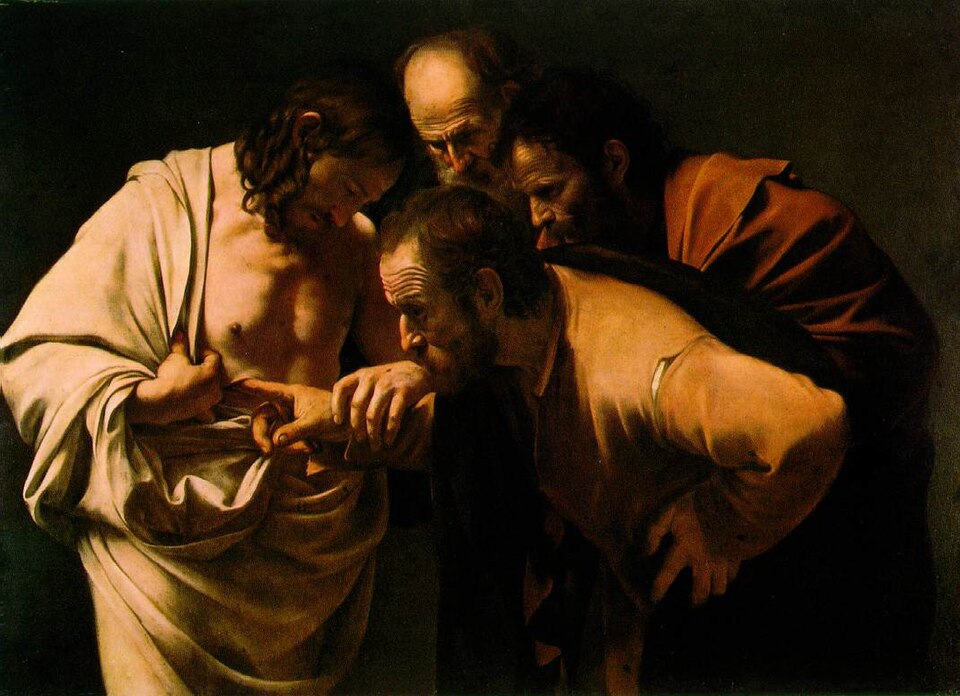

Thomas, absent when the risen Jesus first appears to the disciples, states: “Unless I see in his hands the mark of the nails, and place my finger into the mark of the nails, and place my hand into his side, I will never believe” (John 20:25, ESV). When Jesus appears again, he invites Thomas to conduct exactly the examination he demanded: “Put your finger here, and see my hands; and put out your hand, and place it in my side. Do not disbelieve, but believe” (John 20:27, ESV). Raymond Brown argues that the Thomas episode serves a literary function in the Fourth Gospel: it addresses the situation of all subsequent believers who, unlike the original disciples, do not have access to physical evidence. Jesus’ statement “Blessed are those who have not seen and yet have believed” (John 20:29, ESV) is directed at the Gospel’s audience, but it follows — rather than replaces — the provision of evidence to the one who asked for it.6
Peter’s experience of walking on water and then sinking (Matthew 14:28–31, ESV) provides another model: initial faith gives way to fear when Peter “saw the wind,” and Jesus responds with the question “O you of little faith, why did you doubt?” The Greek oligopistos (“little faith”) appears in Matthew four times, always describing disciples whose faith is real but insufficient for the circumstance. It denotes wavering within faith, not the absence of faith.7
Gideon and the demand for signs
The Gideon narrative in Judges 6–8 presents a figure who responds to a divine commission with repeated demands for confirming signs. When the angel of the Lord appears, Gideon’s first response is a complaint: “If the Lord is with us, why then has all this happened to us?” (Judges 6:13, ESV). After receiving his commission, Gideon requests a sign (Judges 6:17, ESV), then a second sign involving a fleece (Judges 6:36–37, ESV), and then reverses the conditions for a third test (Judges 6:39, ESV). Robert Boling notes that the fleece tests, which would be criticized as “putting God to the test” in other biblical contexts, are narrated without censure — God complies with each request, and Gideon proceeds to lead Israel to victory.9
Scholarly typology of biblical doubt
Biblical scholars and theologians have identified several distinct types of doubt in the biblical material, each with its own characteristics and theological significance:2, 14
Types of doubt in the biblical literature2, 14
| Type | Description | Examples | Divine response |
|---|---|---|---|
| Existential lament | Protest against suffering, abandonment, or divine silence | Psalms 22, 44, 88; Job | Presence, reframing, or silence |
| Vocational resistance | Questioning one’s adequacy or God’s choice of agent | Moses, Gideon, Jeremiah | Signs, assurance, provision of helpers |
| Evidential skepticism | Demanding verifiable proof before believing | Thomas, Gideon’s fleece | Evidence provided |
| Theological questioning | Challenging God’s justice or moral governance | Habakkuk, Jeremiah, Psalm 73 | Dialogue, explanation, or reframing |
| Wavering faith | Momentary loss of confidence amid difficulty | Peter on the water, John the Baptist in prison | Rescue, evidence, gentle rebuke |
Theological significance
The consistent preservation of doubt narratives in the biblical canon has drawn scholarly attention. Brueggemann argues that the lament tradition serves a theological function that praise alone cannot: it holds God accountable to the covenant relationship and refuses to let piety suppress the reality of suffering. The absence of lament, Brueggemann contends, produces a distorted theology in which faith becomes affirmation disconnected from lived experience.10
Gregory Boyd, in Benefit of the Doubt (2013), distinguishes between “certainty-seeking faith” and “covenant faith.” The first treats doubt as the enemy of belief and seeks to eliminate it through apologetic proof or emotional reassurance. The second, which Boyd argues is the model found in the biblical texts, treats faith as a committed relationship that can withstand questions, protests, and uncertainty — much as a marriage persists through disagreements without requiring the partners to suppress their concerns.14
The biblical pattern is notable for what it does not contain: there is no systematic prohibition of doubt, no creedal requirement of certainty, and no narrative in which a figure is condemned solely for honest questioning. Figures are criticized for testing God presumptuously (Deuteronomy 6:16, ESV) or for abandoning the covenant entirely, but the sustained tradition of lament, protest, and demand for evidence suggests that the biblical authors regarded these as legitimate expressions within the covenant relationship rather than violations of it. Job, who protested most forcefully, is vindicated; the friends, who defended orthodox certainty, are rebuked (Job 42:7–8, ESV).4, 15