Overview
- The Epistle of James claims to be written by ‘James, a servant of God and of the Lord Jesus Christ,’ but its polished Greek rhetoric, extensive vocabulary, familiarity with Hellenistic literary conventions, and near-total absence of references to Jesus’s life have led critical scholarship to question whether an Aramaic-speaking Galilean could have composed it
- The letter’s most prominent theological passage — James 2:14–26 — uses the same Old Testament proof text (Genesis 15:6), the same key terms (dikaioō, pistis, erga), and the same example (Abraham) as Paul’s argument in Galatians and Romans, but reaches the opposite conclusion: ‘a person is justified by works and not by faith alone’
- James was absent from multiple early canonical lists, disputed by Eusebius in the fourth century, and famously dismissed by Martin Luther as ‘an epistle of straw’ — its acceptance into the New Testament canon was gradual and contested
The Epistle of James is a 108-verse letter addressed “to the twelve tribes in the Dispersion” (James 1:1, ESV) that combines moral exhortation, wisdom instruction, and social critique in a style that draws heavily on both the Jewish wisdom tradition and Hellenistic rhetorical conventions. The letter claims to be written by “James, a servant of God and of the Lord Jesus Christ” (James 1:1, ESV), traditionally identified as James the brother of Jesus, who according to both Paul (Galatians 1:19) and Josephus led the Jerusalem church until his execution in 62 CE.13, 14
The epistle’s place in the New Testament was contested from antiquity. It is absent from the Muratorian Fragment (the earliest surviving canonical list, c. 170–200 CE), disputed by Eusebius in the fourth century, and famously dismissed by Martin Luther as “an epistle of straw.”10, 11, 12 Its relationship to Paul’s theology — particularly the question of whether James 2:14–26 constitutes a direct response to Pauline teaching on justification by faith — remains one of the most debated issues in New Testament scholarship.
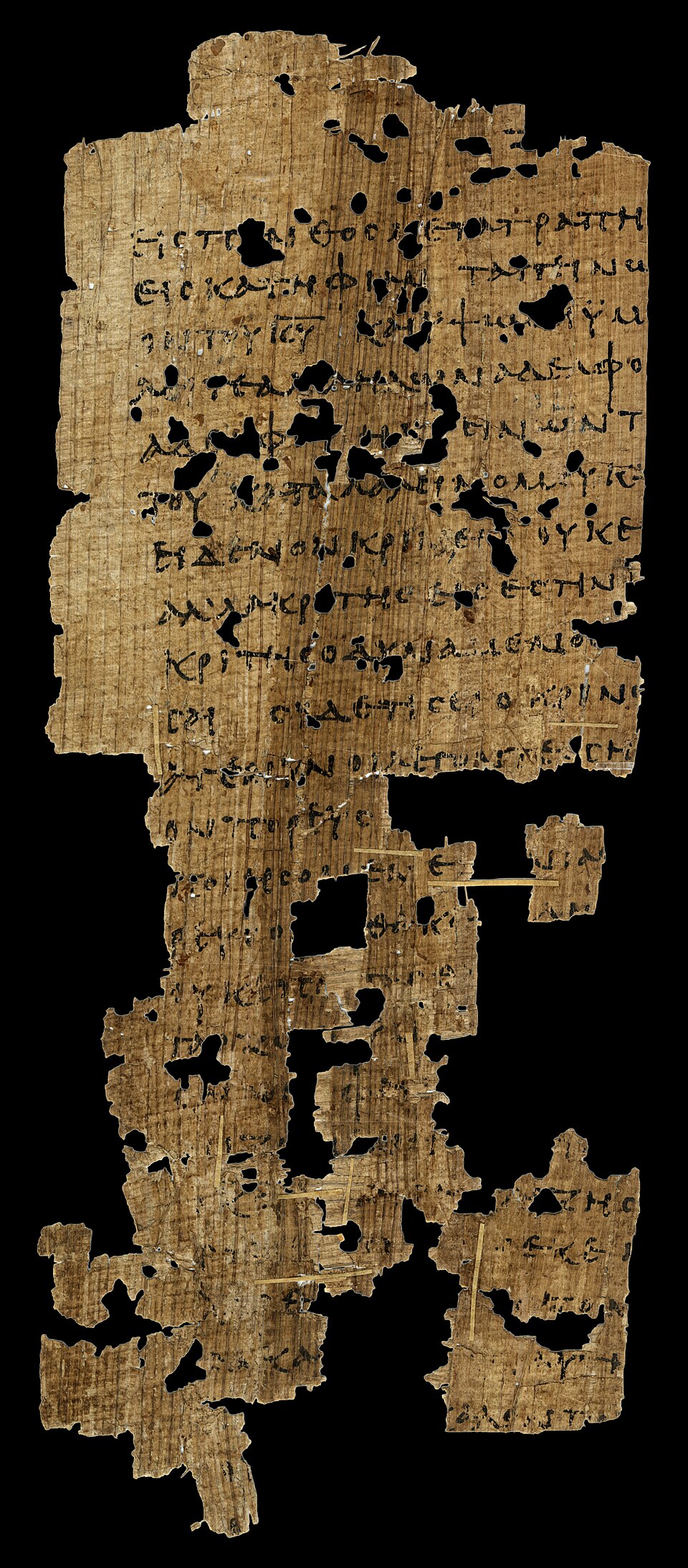
_recto_Jas_3,_13-4,_4.jpg)
Authorship
The letter identifies its author as “James, a servant of God and of the Lord Jesus Christ” (James 1:1, ESV). The New Testament mentions several figures named James, but the traditional identification is with James the brother of Jesus (also called “James the Just”), who is described in Galatians 2:9 as a “pillar” of the Jerusalem church and in Acts 15 as presiding over the Jerusalem council.14, 15
Dale Allison, in the International Critical Commentary, identifies several features of the letter that create difficulties for this attribution. The Greek of the epistle is among the most polished in the New Testament. The author employs a wide vocabulary (including 73 hapax legomena — words that appear nowhere else in the New Testament), uses rhetorical devices drawn from the Greco-Roman diatribe tradition (imaginary interlocutors, rhetorical questions, vivid exempla), and demonstrates familiarity with the Septuagint rather than the Hebrew text of the Old Testament.1
Allison frames the question directly:
“[It] is not simply a question of whether a first-century Galilean could have spoken or even written Greek, even good Greek. It is rather a question of how likely it is that the brother of Jesus could have written fairly accomplished Greek, possessed such a large Greek vocabulary, employed the LXX, and adopted Hellenistic literary topoi.”
Ehrman argues that the historical James was an Aramaic-speaking peasant from rural Galilee who, based on the socioeconomic profile of his family and region, was almost certainly illiterate or at best semi-literate in Hebrew. The composition of a rhetorically sophisticated Greek letter, Ehrman contends, falls well outside what can be plausibly attributed to such an author.5
Luke Timothy Johnson, in the Anchor Bible commentary, argues for the plausibility of traditional authorship, noting that bilingualism was more common in first-century Palestine than is sometimes assumed and that James could have employed a secretary (amanuensis) to produce the finished Greek text. Johnson also points to the letter’s affinities with the sayings of Jesus in the Synoptic tradition as evidence of a connection to the Jerusalem community.2 Bauckham occupies a middle position, arguing that even if the final Greek text was composed by someone other than James himself, the letter preserves authentic Jacobean traditions — teachings associated with James that were put into literary form by a later editor.8
Language and style
Martin Dibelius classified James as paraenesis — a collection of loosely connected moral exhortations without a sustained argumentative structure, similar to the wisdom literature of Proverbs or Sirach.3 More recent scholarship has qualified this assessment. Johnson identifies thematic coherence in the letter’s treatment of speech ethics (the tongue in chapter 3), wealth and poverty (chapters 1–2, 5), and the relationship between hearing and doing (1:22–25, 2:14–26).2
The letter’s Greek style includes several notable features. It employs alliteration (James 1:2: pasan charan hēgēsasthe, “count it all joy”), the technique of chain-linking (sorites) in 1:2–4 (testing produces steadfastness, steadfastness produces completeness), and the diatribe form in 2:18–26 (addressing an imaginary opponent with “But someone will say”). Laws notes that the author shows particular skill in the use of vivid imagery: the wave of the sea (1:6), the withering flower (1:10–11), the mirror (1:23–24), the bit and rudder (3:3–4), and the forest fire (3:5).6
Ralph Martin observes that the letter contains only two explicit references to Jesus Christ (James 1:1 and James 2:1) and no references to Jesus’s death, resurrection, or atoning work. The ethical teaching of the letter could, with the removal of these two verses, function as a Jewish wisdom text.4 Dibelius noted this feature and argued that it reflects the letter’s origins in Jewish paraenetic tradition that was only lightly Christianized.3
Dating
Proposals for the date of composition range from the 40s CE (during the lifetime of James the Just) to the early second century. The arguments turn on the relationship between the letter and Pauline theology, the level of institutional development reflected in the text, and the authorship question.1
Josephus records the execution of James by the high priest Ananus ben Ananus in 62 CE, during the interval between the death of the procurator Festus and the arrival of his replacement Albinus (Jewish Antiquities 20.200).13 If the letter was written by the historical James, it must date before 62 CE.
Johnson favors a date in the late 40s or 50s CE, arguing that the letter’s simple church structure (elders rather than bishops and deacons), its lack of engagement with later theological developments, and its affinities with early Palestinian Christianity point to early composition.2 Allison, who considers the letter pseudepigraphic, places it in the late first or early second century, noting that the faith-works discussion in chapter 2 appears to presuppose acquaintance with Pauline theology in a form that had already become subject to misinterpretation — a development that suggests distance from Paul’s own historical context.1
The address “to the twelve tribes in the Dispersion” (James 1:1, ESV) implies that the intended audience is geographically dispersed, which, if taken literally, points to a period when the Jesus movement had spread beyond Palestine.14 Hartin argues that the term “Dispersion” (diaspora) may be metaphorical — referring to Christians as spiritual exiles — but notes that even this metaphorical usage is more characteristic of later Christian self-understanding (cf. 1 Peter 1:1) than of the earliest Jerusalem community.7
Dating proposals for the Epistle of James1, 2, 7
| Date range | Authorship position | Key arguments | Representative scholars |
|---|---|---|---|
| 40s–50s CE | Authentic (James the Just) | Simple church structure; pre-Pauline theology; Palestinian Jewish character | Johnson, Moo, Davids |
| 50s–60s CE | Authentic (James the Just) | Written in response to early misunderstandings of Paul; before 62 CE execution | Bauckham, Hartin |
| 70s–90s CE | Pseudepigraphic | Presupposes developed Pauline theology; polished Greek; diaspora audience | Laws, Martin |
| 90s–120s CE | Pseudepigraphic | Late canonical reception; absence from earliest lists; literary sophistication | Dibelius, Allison |
James and Paul on faith and works
The most discussed feature of the epistle is its treatment of the relationship between faith and works in James 2:14–26. The passage uses the same Old Testament proof text (Genesis 15:6: “Abraham believed God, and it was counted to him as righteousness”), the same key terms (dikaioō, “justify”; pistis, “faith”; erga, “works”), and the same central example (Abraham) as Paul’s arguments in Galatians 3 and Romans 4 — but reaches the opposite conclusion.1, 16
Paul writes in Galatians:
Galatians 2:16, ESV“We know that a person is not justified by works of the law but through faith in Jesus Christ, so we also have believed in Christ Jesus, in order to be justified by faith in Christ and not by works of the law, because by works of the law no one will be justified.”
And in Romans:
Romans 3:28, ESV“For we hold that one is justified by faith apart from works of the law.”
James writes:
James 2:14–17, ESV“What good is it, my brothers, if someone says he has faith but does not have works? Can that faith save him? If a brother or sister is poorly clothed and lacking in daily food, and one of you says to them, ‘Go in peace, be warmed and filled,’ without giving them the things needed for the body, what good is that? So also faith by itself, if it does not have works, is dead.”
James 2:21–24, ESV“Was not Abraham our father justified by works when he offered up his son Isaac on the altar? You see that faith was active along with his works, and faith was completed by his works; and the Scripture was fulfilled that says, ‘Abraham believed God, and it was counted to him as righteousness’ — and he was called a friend of God. You see that a person is justified by works and not by faith alone.”
Parallel vocabulary and argument structure1, 16
| Element | Paul (Galatians 2–3; Romans 3–4) | James (James 2:14–26) |
|---|---|---|
| Proof text | Genesis 15:6 (Abraham believed God) | Genesis 15:6 (Abraham believed God) |
| Central example | Abraham | Abraham (and Rahab) |
| Key verb | dikaioō (“justify”) | dikaioō (“justify”) |
| Conclusion on faith | “Justified by faith apart from works of the law” | “Justified by works and not by faith alone” |
| Rhetorical address | “O foolish Galatians!” (Galatians 3:1) | “Do you want to be shown, you foolish person?” (James 2:20) |
| Role of works | Works of the law do not justify | Works complete and demonstrate faith |
Allison argues that the verbal and structural parallels are too extensive to be coincidental and that James 2 represents a conscious response to Pauline teaching, whether directed at Paul himself or at a later reception of Paul’s letters that had produced antinomian conclusions.1 Dibelius similarly concluded that the passage reflects engagement with Pauline theology, though he regarded it as engagement with a popularized, potentially distorted form of Paul’s teaching rather than with Paul’s letters directly.3
Johnson offers an alternative reading, arguing that James and Paul use the term “works” (erga) with different referents: Paul refers to “works of the law” (Torah observance as a boundary marker), while James refers to deeds of mercy and obedience. On this reading, the two authors are answering different questions and are not in direct contradiction.2 Martyn’s commentary on Galatians, however, emphasizes that Paul’s argument extends beyond ritual law to the principle that human action of any kind is insufficient for justification — a claim that James 2:24 (“justified by works and not by faith alone”) appears to deny directly.16
Wisdom tradition and Jewish character
The Epistle of James draws extensively on the Jewish wisdom tradition. The opening exhortation to seek wisdom from God (James 1:5), the identification of wisdom as “pure, then peaceable, gentle, open to reason, full of mercy and good fruits” (James 3:17, ESV), and the contrast between heavenly wisdom and earthly, “demonic” wisdom (James 3:15) echo the personification of wisdom in Proverbs 8, Sirach 24, and the Wisdom of Solomon.2, 14
Bauckham identifies numerous parallels between James and the sayings tradition of Jesus as preserved in the Synoptic Gospels, particularly the Sermon on the Mount: the blessing on the poor (James 2:5 / Matthew 5:3), the prohibition of oaths (James 5:12 / Matthew 5:34–37), the command to be “doers of the word” (James 1:22 / Matthew 7:24–27), and the warning against judging (James 4:11–12 / Matthew 7:1).8 These parallels, Bauckham argues, reflect the author’s access to oral or written Jesus traditions, though James never attributes these sayings to Jesus by name.8
Laws observes that the letter’s ethical teaching is grounded entirely in the Jewish concept of Torah fulfillment: the “royal law” is “You shall love your neighbor as yourself” (James 2:8, ESV; cf. Leviticus 19:18), and the “perfect law” is the “law of liberty” (James 1:25), a concept with roots in both Jewish and Stoic thought. The christological content of the letter is minimal: no reference to Jesus’s death, resurrection, second coming, or atoning work appears anywhere in the text.6
Social critique
The epistle contains some of the sharpest social criticism in the New Testament. Chapter 2 opens with a denunciation of favoritism toward the wealthy in the assembly:
James 2:2–4, ESV“For if a man wearing a gold ring and fine clothing comes into your assembly, and a poor man in shabby clothing also comes in, and if you pay attention to the one who wears the fine clothing and say, ‘You sit here in a good place,’ while you say to the poor man, ‘You stand over there,’ or, ‘Sit down at my feet,’ have you not then made distinctions among yourselves and become judges with evil thoughts?”
Chapter 5 addresses the wealthy directly:
James 5:1–4, ESV“Come now, you rich, weep and howl for the miseries that are coming upon you. Your riches have rotted and your garments are moth-eaten. Your gold and silver have corroded, and their corrosion will be evidence against you and will eat your flesh like fire. You have laid up treasure in the last days. Behold, the wages of the laborers who mowed your fields, which you kept back by fraud, are crying out against you, and the cries of the harvesters have reached the ears of the Lord of hosts.”
Hartin notes that these passages reflect a social setting in which economic inequality within the Christian community had become a pressing concern. The reference to “your assembly” (sunagōgē, James 2:2) — using the Jewish term for a place of gathering rather than the Christian ekklēsia — has been cited as evidence of the letter’s early date and Jewish Christian provenance.7 Johnson argues that the social critique draws on the prophetic tradition of Amos, Isaiah, and Micah, in which the oppression of the poor by the wealthy constitutes a fundamental violation of covenant obligations.2
Canonical reception
The Epistle of James had a slow and uneven path to canonical acceptance. The letter does not appear in the Muratorian Fragment, an early list of recognized scriptures from the late second century. Bruce Metzger notes that the earliest certain reference to James as scripture comes from Origen of Alexandria in the early third century, though even Origen acknowledged that the letter was “disputed” (antilegomenon).12
Eusebius, writing in the early fourth century, classified James among the “disputed books” (antilegomena):
“Among the disputed writings, which are nevertheless recognized by many, are extant the so-called epistle of James and that of Jude, also the second epistle of Peter, and those that are called the second and third of John.”
Eusebius notes that “not many of the ancients have mentioned it” (Ecclesiastical History 2.23.25), indicating that the letter was neither widely quoted nor widely recognized before the fourth century.10
The letter was included in the canon by Athanasius in his 39th Festal Letter of 367 CE, the first surviving canonical list that matches the modern 27-book New Testament. The Third Council of Carthage (397 CE) confirmed this list for the Western church.12 The Syriac-speaking church was slower to accept the letter: the Peshitta (early fifth century) includes James, but earlier Syriac collections did not.12
Luther’s critique
Martin Luther’s assessment of James is the most consequential critical evaluation the letter has received. In his 1522 preface to the New Testament, Luther wrote:
“In a word, St. John’s Gospel and his first epistle, St. Paul’s epistles, especially Romans, Galatians, and Ephesians, and St. Peter’s first epistle are the books that show you Christ and teach you all that is necessary and salvatory for you to know, even if you were never to see or hear any other book or doctrine. Therefore St. James’ epistle is really an epistle of straw, compared to these others, for it has nothing of the nature of the gospel about it.”
Luther removed James, along with Hebrews, Jude, and Revelation, from its traditional position in the New Testament and placed these four books at the end, separated from the other letters by a gap. In his preface to James and Jude, Luther stated:
“I do not regard it as the writing of an apostle... he mangles the Scriptures and thereby opposes Paul and all Scripture... he tries to accomplish by harping on the law what the apostles accomplish by stimulating people to love.”
Luther’s primary objection was theological: James 2:24 (“a person is justified by works and not by faith alone”) appeared to contradict the doctrine of sola fide (justification by faith alone), which Luther regarded as the central article of the Christian faith.11 Luther later softened his language, removing the “epistle of straw” phrase from subsequent editions of his preface, but he never restored James to equal standing with the Pauline letters. The four books remained at the end of Luther’s German Bible, unnumbered in the table of contents, a practice that persisted in German-language Bibles into the twentieth century.11
Pseudepigraphy and context
The question of whether James is pseudepigraphic — written in the name of James the Just by a later author — is related to the broader phenomenon of pseudepigraphy in antiquity. Multiple texts attributed to James circulated in the early centuries of Christianity, including the Protevangelium of James (an infancy gospel), the Apocryphon of James (a Nag Hammadi text), the First Apocalypse of James, the Second Apocalypse of James, and a letter of James to Quadratus. None of these is considered authentic by modern scholarship.9
Paul himself acknowledges the existence of forged letters: “We ask you, brothers, not to be quickly shaken in mind or alarmed, either by a spirit or a spoken word, or a letter seeming to be from us” (2 Thessalonians 2:2, ESV). The phenomenon of writing in another’s name was widespread in the ancient world, and multiple New Testament letters are considered by critical scholarship to be pseudepigraphic, including 2 Thessalonians, the Pastoral Epistles, Ephesians, Colossians, and 2 Peter (see Pauline and disputed letters).5, 9
Ehrman argues that ancient pseudepigraphy was understood by its practitioners as a form of literary convention rather than outright deception, but he notes that ancient readers who discovered pseudepigraphy generally regarded it negatively. The gradual acceptance of James into the canon, despite centuries of doubt, may reflect the letter’s perceived usefulness for moral instruction rather than confidence in its apostolic authorship.5
Structure and contents
Dibelius argued that the letter has no coherent structure, characterizing it as a loosely organized collection of independent paraenetic units.3 More recent analyses have identified thematic patterns. Johnson proposes that the letter follows a chiastic structure centered on the speech-ethics section in chapter 3, with opening and closing sections forming an inclusio on themes of testing, patience, and prayer.2
The major thematic units are: trials and wisdom (1:2–18); hearing and doing (1:19–27); partiality and the royal law (2:1–13); faith and works (2:14–26); the tongue and speech ethics (3:1–18); conflict and worldliness (4:1–12); presumption and commerce (4:13–17); the rich and the oppressed (5:1–6); patience and suffering (5:7–11); oaths (5:12); prayer, healing, and confession (5:13–20).2
Hartin identifies the theme of “perfection” or “completeness” (teleios) as a unifying thread: the letter opens with a call to let steadfastness “have its full effect, that you may be perfect and complete, lacking in nothing” (James 1:4, ESV) and returns to this theme through the contrast between divided and undivided commitment (the “double-minded” person of 1:8, the “friendship with the world” of 4:4, the wholeness achieved through prayer and confession in 5:13–16).7
References
Forged: Writing in the Name of God — Why the Bible’s Authors Are Not Who We Think They Are