Overview
- The Hebrew Bible contains no single, unified portrait of a coming messiah — the term mashiach (“anointed one”) refers to reigning kings, priests, and even the Persian emperor Cyrus, and the concept of an eschatological deliverer developed gradually across centuries of Israelite and Jewish tradition
- By the first century CE, Jewish messianic expectations had diversified into at least four distinct models — a royal Davidic warrior-king, a priestly messiah, a prophetic figure like Moses, and a heavenly “Son of Man” — with different communities emphasizing different paradigms, as the Dead Sea Scrolls, Psalms of Solomon, and apocalyptic literature attest
- The New Testament authors applied Hebrew Bible passages to Jesus using interpretive methods common in Second Temple Judaism — including typology, pesher, and midrash — often reading texts that originally addressed Israelite kings, the nation of Israel, or specific historical situations as foreshadowing or fulfilled in the life of Jesus
Messianic prophecy refers to passages in the Hebrew Bible that have been read — by Jewish and Christian interpreters across the centuries — as foretelling the coming of a future deliverer, a “messiah” (Hebrew: mashiach, “anointed one”). The concept is central to Christian theology, which identifies Jesus of Nazareth as the fulfillment of these texts, and to Jewish tradition, which has understood the same passages in a range of ways — as references to historical kings, to the nation of Israel collectively, or to a future figure whose arrival remains anticipated.1, 2
The study of messianic prophecy involves two distinct questions. The first is historical: what did these texts mean in their original settings, and how were they understood by their earliest audiences? The second is hermeneutical: by what interpretive methods did later readers — including the authors of the New Testament — come to apply these texts to specific individuals or events? This article examines both questions, tracing the development of the messianic concept from the Israelite monarchy through Second Temple Judaism and into the New Testament period.
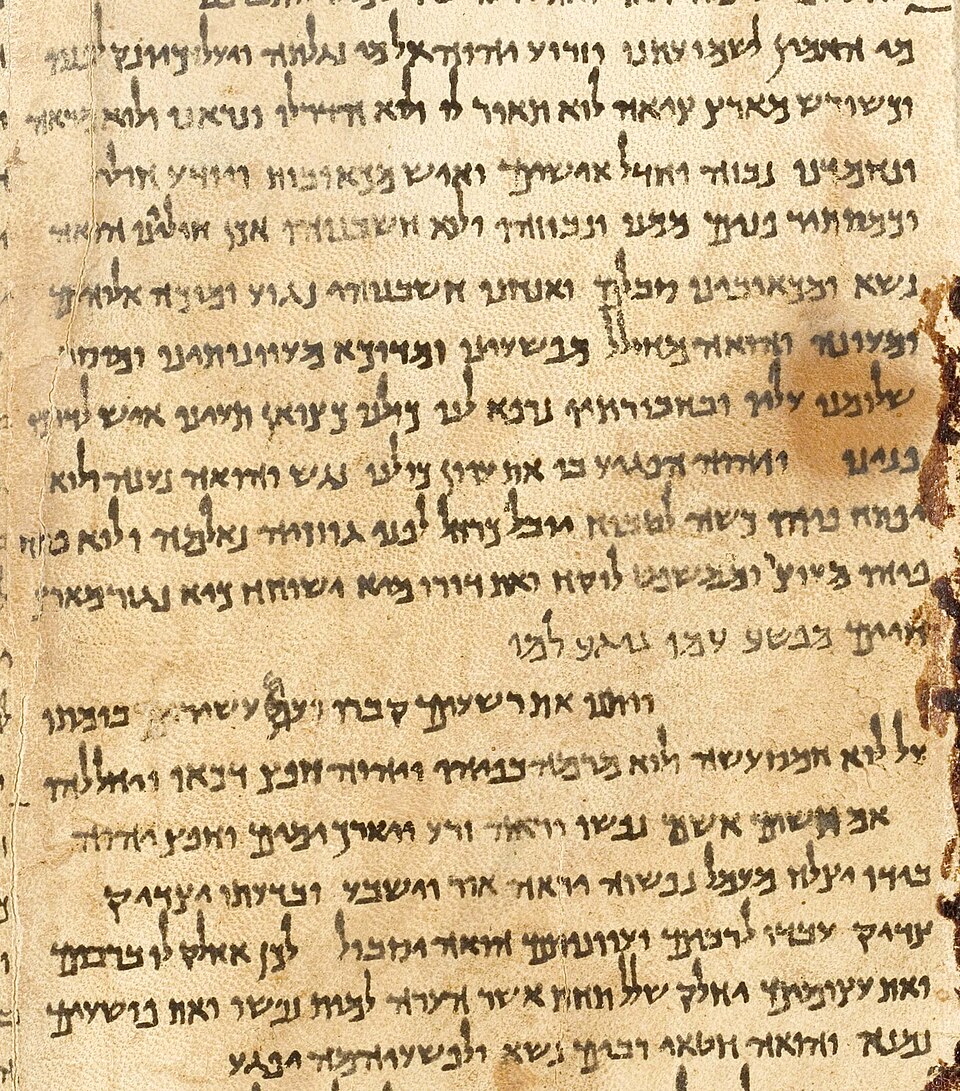

The “anointed one” in the Hebrew Bible
The Hebrew word mashiach appears thirty-nine times in the Hebrew Bible. In its earliest usage, the term is not eschatological. It refers to a person who has been ritually anointed with oil as a sign of divine appointment to an office. Saul is “the LORD’s anointed” (1 Samuel 24:6, NRSV). David receives the same title (2 Samuel 19:21). The high priest is called “the anointed priest” (Leviticus 4:3). In one passage, the patriarchs are described collectively as God’s “anointed ones” (Psalm 105:15). Most strikingly, the Persian king Cyrus the Great is called God’s mashiach in Isaiah 45:1: “Thus says the LORD to his anointed, to Cyrus, whose right hand I have grasped” (NRSV).2, 9
Sigmund Mowinckel, in his influential study He That Cometh, argued that the term “messiah” should be distinguished from its later eschatological sense. In the pre-exilic period, mashiach referred to the reigning king — not to a future figure. The concept of an eschatological deliverer, Mowinckel argued, developed only after the monarchy had ended and the Davidic line no longer sat on any throne. The hope for a future anointed king grew out of the memory of what had been lost.2
Royal ideology and the Davidic covenant
The theological foundation for later messianic expectation lies in the Davidic covenant, recorded in 2 Samuel 7:12–16. Through the prophet Nathan, God promises David:
2 Samuel 7:12–14, NRSV“When your days are fulfilled and you lie down with your ancestors, I will raise up your offspring after you, who shall come forth from your body, and I will establish his kingdom. He shall build a house for my name, and I will establish the throne of his kingdom forever. I will be a father to him, and he shall be a son to me.”
In its narrative context, this promise refers to Solomon, who builds the temple (“a house for my name”). The language of divine sonship — “I will be a father to him, and he shall be a son to me” — reflects the ancient Near Eastern convention of describing the king as God’s adopted son, a motif paralleled in Egyptian and Mesopotamian royal inscriptions. Psalm 2:7 uses similar language: “He said to me, ‘You are my son; today I have begotten you’” (NRSV) — a formula scholars associate with a royal coronation liturgy.2, 6
Other psalms elaborate the Davidic royal ideology. Psalm 72 describes a king whose reign brings justice to the poor, abundance to the land, and submission from foreign nations. Psalm 89 recites the Davidic covenant promises at length, then laments that God appears to have broken them: “You have renounced the covenant with your servant; you have defiled his crown in the dust” (Psalm 89:39, NRSV). Psalm 110 combines royal and priestly themes: “The LORD says to my lord, ‘Sit at my right hand’” and “You are a priest forever according to the order of Melchizedek” (Psalm 110:1, 4, NRSV). These texts were composed during the monarchy as celebrations of the reigning king, but after the fall of the Davidic dynasty in 586 BCE, they were increasingly read as descriptions of a future ideal ruler.1, 2
Prophetic oracles and their original contexts
Several prophetic passages became central to later messianic interpretation. In their original settings, these texts addressed the political crises of their own times.6, 17
Isaiah 7:14
During the Syro-Ephraimite crisis of approximately 735 BCE, when the kingdoms of Syria and northern Israel threatened Judah, the prophet Isaiah offered King Ahaz a sign: “Look, the young woman is with child and shall bear a son, and shall name him Immanuel” (Isaiah 7:14, NRSV). The Hebrew word ’almah (עַלְמָה) means “young woman,” not specifically “virgin.” The sign had an immediate time horizon: “before the child knows how to refuse the evil and choose the good, the land before whose two kings you are in dread will be deserted” (Isaiah 7:16, NRSV). The Greek Septuagint translated ’almah as parthenos (παρθένος, “virgin”), and it is this Greek rendering that the Gospel of Matthew cites in Matthew 1:23.3, 8, 12
Isaiah 9:6–7
Isaiah’s oracle declares: “For a child has been born for us, a son given to us; authority rests upon his shoulders; and he is named Wonderful Counselor, Mighty God, Everlasting Father, Prince of Peace. His authority shall grow continually, and there shall be endless peace for the throne of David” (Isaiah 9:6–7, NRSV). Many scholars understand this as a coronation hymn for a Judean king — possibly Hezekiah — employing the hyperbolic throne names common in ancient Near Eastern royal protocol. The passage immediately preceding it describes deliverance from an oppressor “as on the day of Midian” (Isaiah 9:4, NRSV), a reference to the military victory in Judges 7.2, 17
Micah 5:2–6
The oracle “But you, O Bethlehem of Ephrathah, who are one of the little clans of Judah, from you shall come forth for me one who is to rule in Israel” (Micah 5:2, NRSV) anticipates a ruler from David’s ancestral town. The verses that follow describe this ruler’s mission in terms of military deliverance from Assyria: “they shall rule the land of Assyria with the sword” (Micah 5:6, NRSV). The original context is the Assyrian crisis of the late eighth century BCE.3, 8
Isaiah 52:13–53:12 (the Suffering Servant)
The fourth “Servant Song” in Isaiah describes a figure who “was despised and rejected by others; a man of suffering and acquainted with infirmity” and who “bore the sin of many” (Isaiah 53:3, 12, NRSV). The identity of the servant has been debated for centuries. Within the book of Isaiah, the servant is explicitly identified as Israel in multiple passages: “But you, Israel, my servant, Jacob, whom I have chosen” (Isaiah 41:8, NRSV; see also Isaiah 44:1, Isaiah 49:3). Some scholars read Isaiah 53 as a personification of the suffering nation during the Babylonian exile. Others understand the servant as an individual prophet — perhaps the author of Second Isaiah himself. Christian interpretation, following passages such as Acts 8:32–35, has identified the servant as Jesus. Jewish interpretation has historically identified the servant as the nation of Israel or as a righteous remnant within it.5, 18
Zechariah 9:9–10
“Rejoice greatly, O daughter Zion! Shout aloud, O daughter Jerusalem! Lo, your king comes to you; triumphant and victorious is he, humble and riding on a donkey” (Zechariah 9:9, NRSV). The verse immediately following describes this king’s reign in terms of universal disarmament: “He shall command peace to the nations; his dominion shall be from sea to sea” (Zechariah 9:10, NRSV). The Gospel of Matthew cites verse 9 in connection with Jesus’ entry into Jerusalem (Matthew 21:5).3
Messianic expectations in Second Temple Judaism
By the Second Temple period (516 BCE – 70 CE), messianic expectations had diversified considerably. John J. Collins, in The Scepter and the Star, identifies four distinct messianic paradigms that circulated in Judaism around the turn of the era: a royal Davidic figure, a priestly messiah, a prophetic figure modeled on Moses or Elijah, and a heavenly “Son of Man.” Different communities and different texts emphasized different models, and some texts combined them.1
The Dead Sea Scrolls
The Qumran community expected not one messiah but at least two: a “messiah of Aaron” (a priestly figure) and a “messiah of Israel” (a royal figure), with the priestly messiah holding the higher rank. The Community Rule (1QS 9:11) refers to “the coming of a prophet and the messiahs of Aaron and Israel.” Other Qumran texts, such as 4Q174 (Florilegium) and 4Q252, apply passages from 2 Samuel 7, Genesis 49:10, and Isaiah 11 to a future Davidic figure, while the so-called “Messianic Apocalypse” (4Q521) describes a figure associated with the resurrection of the dead and good news for the poor — language echoed in Jesus’ reply to John the Baptist in Matthew 11:5.1, 10, 11
The Psalms of Solomon
The Psalms of Solomon, composed in the first century BCE in response to the Roman conquest of Jerusalem in 63 BCE, present the most detailed pre-Christian portrait of a Davidic messiah. Psalm of Solomon 17 describes a king who will “purge Jerusalem from gentiles” and “destroy the unrighteous rulers” by “the word of his mouth.” This messiah is a military and political figure who restores Israel’s independence, redistributes the land among the tribes, and rules with justice — but he is not divine. He is “the Lord Messiah” (christos kyriou) who acts under God’s authority.1, 15
Apocalyptic literature
The Similitudes of Enoch (1 Enoch 37–71, first century BCE or CE) describe a pre-existent heavenly figure called the “Chosen One” and the “Son of Man” who sits on God’s throne and judges the nations. Fourth Ezra (c. 100 CE) envisions a messiah who reigns for four hundred years and then dies, after which God raises the dead and renders final judgment. These texts illustrate the range of messianic expectation that existed contemporaneously: there was no single, standardized template for what “the messiah” would be or do.1, 13
New Testament interpretive methods
The New Testament authors applied Hebrew Bible texts to Jesus using several interpretive methods that were recognized practices within Second Temple Judaism. Richard Longenecker classifies first-century Jewish exegesis into four categories: literalist, midrashic, pesher, and allegorical. The New Testament employs all four, though in varying degrees.4
Pesher interpretation
The Hebrew word pesher means “interpretation.” In the Dead Sea Scrolls, pesher commentaries — most notably the Habakkuk Commentary (1QpHab) — take prophetic texts and apply them directly to the interpreter’s own community and time, treating the original prophecy as a coded message about the end times whose meaning was hidden from the prophet himself and revealed only to the Teacher of Righteousness. The structure is: “[quotation of scripture] — its interpretation concerns [contemporary figure or event].”4, 16
Several New Testament applications of the Hebrew Bible follow a similar pattern. Matthew’s account of the flight to Egypt cites Hosea 11:1 (“Out of Egypt I have called my son”) with the formula “This was to fulfill what had been spoken by the Lord through the prophet” (Matthew 2:15, NRSV). In its original context, Hosea 11:1 refers to the nation of Israel during the Exodus: “When Israel was a child, I loved him, and out of Egypt I called my son. The more I called them, the more they went from me; they kept sacrificing to the Baals” (Hosea 11:1–2, NRSV). Matthew applies the verse to Jesus by reading “my son” as fulfilled in a new sense.3, 7
Typology
Typological interpretation reads earlier events, persons, or institutions as patterns (typoi) that are recapitulated or fulfilled in later ones. Matthew’s infancy narrative, for example, presents Jesus as a new Moses: a wicked ruler threatens infants, the child escapes, and a deliverer emerges from exile. Paul employs typology when he writes that Adam “is a type of the one who was to come” (Romans 5:14, NRSV). Typological reading does not require that the original author intended a future referent; the pattern is recognized retrospectively.4, 6
Formula citations in Matthew
The Gospel of Matthew contains approximately ten to fourteen “formula quotations” — passages from the Hebrew Bible introduced with variations of “this was to fulfill what had been spoken through the prophet.” Krister Stendahl, in The School of St. Matthew, demonstrated that these quotations often follow a Greek text that differs from both the standard Septuagint and the Masoretic Hebrew, suggesting that Matthew (or his community) adapted the wording of the cited passages to fit the events being described. Stendahl compared this practice to the pesher method of Qumran, in which both communities shared a conviction that prophecy was being fulfilled in their own time.7, 12
Major prophecies: original and applied readings
The following section examines several of the most frequently cited messianic prophecies, presenting each text in its original context alongside the New Testament passage that applies it to Jesus.
Isaiah 7:14 — the sign to Ahaz
In its original setting, Isaiah offers a sign to King Ahaz during a specific military crisis, with a time-bound fulfillment: the threatened kingdoms will fall before the child is old enough to “refuse the evil and choose the good” (Isaiah 7:16, NRSV). The Gospel of Matthew applies this verse to the virginal conception of Jesus (Matthew 1:22–23), following the Septuagint’s rendering of ’almah as parthenos. Raymond Brown notes that Matthew’s use represents a second, christological reading layered onto a text that originally addressed eighth-century political events.8, 12
Isaiah 9:6–7 — the child born
Read as a coronation hymn for a Judean king, the passage employs the exalted throne names characteristic of ancient Near Eastern royal protocol. Read as messianic prophecy, it describes a future ruler whose reign brings endless peace. The adjacent verses describe military deliverance “as on the day of Midian” (Isaiah 9:4, NRSV) and promise that “of the increase of his government and of peace there shall be no end, on the throne of David” (Isaiah 9:7, NRSV). Christian tradition has applied the passage to Jesus; the New Testament does not directly cite Isaiah 9:6–7 in connection with specific events in Jesus’ life, though the language of the passage — “Wonderful Counselor, Mighty God, Everlasting Father, Prince of Peace” — has shaped Christological theology from the early church onward.2, 3, 17
Isaiah 52:13–53:12 — the Suffering Servant
The New Testament identifies the Suffering Servant with Jesus in several passages. In Acts 8:32–35, Philip encounters an Ethiopian official reading Isaiah 53 and explains it as referring to Jesus. 1 Peter 2:22–25 applies the servant’s suffering to Christ. In the broader context of Isaiah, the servant is elsewhere identified as the nation of Israel (Isaiah 41:8, Isaiah 44:1, Isaiah 49:3). The Janowski-Stuhlmacher volume The Suffering Servant traces how this passage has been interpreted across Jewish and Christian traditions: as the nation of Israel suffering in exile, as a righteous individual within Israel, as the prophet himself, and as the crucified Jesus.5, 14
Micah 5:2 — the ruler from Bethlehem
Matthew cites Micah 5:2 in connection with Jesus’ birth in Bethlehem (Matthew 2:5–6). The verses that follow the oracle in Micah describe the ruler’s mission as repelling an Assyrian invasion (Micah 5:5–6), a military context that does not correspond to the events of Jesus’ life. The passage illustrates a recurring feature of messianic prophecy: the New Testament cites specific verses while the surrounding context describes conditions — military victory, national restoration — that were not realized in Jesus’ first-century ministry.3, 8
Zechariah 9:9–10 — the humble king
Matthew and John both cite Zechariah 9:9 in connection with Jesus’ entry into Jerusalem on a donkey (Matthew 21:5; John 12:15). The immediately following verse describes universal disarmament and worldwide dominion: “He shall command peace to the nations; his dominion shall be from sea to sea” (Zechariah 9:10, NRSV). The application of verse 9 to a specific event while the conditions of verse 10 remain unrealized exemplifies what scholars describe as “partial fulfillment” — a concept addressed differently across interpretive traditions.3, 18
Jeremiah 31:15 — Rachel weeping
Matthew applies this verse to Herod’s massacre of children in Bethlehem (Matthew 2:17–18). In its original context, Jeremiah 31:15 is a lament over the Babylonian exile, and the verses that follow promise immediate restoration: “there is a reward for your work, says the LORD: they shall come back from the land of the enemy” (Jeremiah 31:16, NRSV). Matthew cites the lament but does not reference the restoration promise that completes the passage.3, 8, 12
Isaiah 61:1–2 — the anointed proclaimer
In Luke 4:18–19, Jesus reads from Isaiah 61 in the Nazareth synagogue: “The Spirit of the Lord is upon me, because he has anointed me to bring good news to the poor” (NRSV). Luke’s quotation ends at “the year of the Lord’s favor” and omits the phrase that immediately follows in Isaiah: “and the day of vengeance of our God” (Isaiah 61:2, NRSV). The selective quotation — stopping mid-verse — has been noted by commentators as an interpretive act, applying the favorable elements of the prophecy to Jesus’ present ministry while leaving the judgment elements unaddressed.3, 4
Major Hebrew Bible passages applied as messianic prophecy1, 3
| Passage | Original context | New Testament application | Interpretive method |
|---|---|---|---|
| Isaiah 7:14 | Sign to King Ahaz during Syro-Ephraimite crisis (c. 735 BCE); ’almah = “young woman” | Matthew 1:22–23 (virginal conception, via Septuagint parthenos) | Pesher / typology |
| Isaiah 9:6–7 | Coronation hymn for a Judean king, likely Hezekiah; exalted throne names | Not directly cited in NT; applied in later Christian tradition | Eschatological reinterpretation |
| Isaiah 52:13–53:12 | Fourth Servant Song; servant identified as Israel in Isa 41:8, 44:1, 49:3 | Acts 8:32–35; 1 Peter 2:22–25 (applied to Jesus’ suffering) | Typology |
| Micah 5:2–6 | Ruler from Bethlehem to repel Assyrian invasion (8th c. BCE) | Matthew 2:5–6 (birth of Jesus in Bethlehem) | Pesher / formula citation |
| Zechariah 9:9–10 | Humble king arriving on a donkey; universal disarmament follows | Matthew 21:5; John 12:15 (triumphal entry) | Partial fulfillment |
| Jeremiah 31:15 | Lament over the Babylonian exile; restoration promised in v. 16 | Matthew 2:17–18 (massacre of innocents) | Pesher / formula citation |
| Isaiah 61:1–2 | Anointed proclaimer of liberty; includes “day of vengeance” | Luke 4:18–19 (Nazareth synagogue; stops mid-verse) | Selective citation |
| Psalm 110:1, 4 | Royal coronation liturgy combining kingship and priesthood | Mark 12:36; Acts 2:34–35; Hebrews 5:6 (enthronement of Christ) | Eschatological reinterpretation |
The question of adjacent context
A recurring feature across many of the passages applied to Jesus as messianic prophecy is the presence, in immediately adjacent verses, of descriptions of conditions that have not been realized. Isaiah 2:2–4 describes nations streaming to Jerusalem to learn God’s ways, followed by the declaration that “they shall beat their swords into plowshares, and their spears into pruning hooks; nation shall not lift up sword against nation, neither shall they learn war anymore” (Isaiah 2:4, NRSV). Isaiah 65:17–22 describes a new heaven and new earth in which infant mortality ceases and lifespans are dramatically extended. Ezekiel 37:24–28 promises an eternal Davidic king, the banishment of wild beasts, and a permanent sanctuary “in their midst forevermore.” Zephaniah 3:14–20 declares that God will “deal with all your oppressors” and make Israel “renowned and praised among all the peoples of the earth.”9
Interpretive traditions address this pattern in different ways. The Christian theological framework of “already and not yet” holds that Jesus fulfilled certain aspects of messianic prophecy in his first coming (the “already”) while the remaining conditions — universal peace, the end of death, the restoration of Israel — await his return (the “not yet”). This framework appears as early as the New Testament itself: the letter to the Hebrews acknowledges that “we do not yet see everything in subjection” to Christ (Hebrews 2:8, NRSV).3, 4
Jewish interpretation, by contrast, has generally maintained that the messianic prophecies describe a single, coherent future event. Because the observable conditions described in these passages — universal peace, the end of exile, the rebuilding of the temple, the acknowledgment of God by all nations — have not been realized, the messiah has not yet come. This is not a rejection of the prophecies but a reading that takes their full scope as the standard of fulfillment.1, 18
Scholarly perspectives
Modern biblical scholarship approaches messianic prophecy through several methodological lenses. Historical-critical analysis examines what texts meant to their original authors and audiences, often concluding that passages later read as messianic originally addressed contemporary political situations. John J. Collins observes that the small number of prophetic oracles that gave rise to the Davidic messianic model — principally Isaiah 9, Isaiah 11, Micah 5, and Jeremiah 23 — were not necessarily eschatological in their original formulation but became so through a process of reinterpretation after the monarchy ended.1
Michael Fishbane has documented extensive evidence that reinterpretation of earlier texts is already at work within the Hebrew Bible itself. Later biblical authors reapplied, extended, and transformed the words of earlier ones — a process Fishbane terms “inner-biblical exegesis.” The phenomenon of reading older texts in light of new circumstances is not a Christian invention but a practice embedded in the biblical tradition from its earliest layers.6
Paula Fredriksen emphasizes the diversity of first-century messianic expectations and cautions against reading later Christian theology back into the pre-Easter period. The followers of Jesus, she argues, applied messianic categories to him only after his death, drawing on whatever scriptural templates seemed to fit the unexpected events they had witnessed. The process was creative and retrospective, not the fulfillment of a pre-existing checklist.13
E. P. Sanders notes that Jesus himself appears to have been reticent about messianic titles during his ministry. The Gospels present him as deflecting or redefining such titles rather than claiming them in the terms his contemporaries would have recognized. The messianic identity attributed to Jesus was, in significant part, a product of post-Easter theological reflection applied through the interpretive lens of the Hebrew Bible.14
The Beale-Carson Commentary on the New Testament Use of the Old Testament examines every Old Testament citation and allusion in the New Testament, providing detailed analysis of how each passage functions in both its original and applied contexts. The editors note that the New Testament authors operated with a conviction that “God’s past acts of redemption foreshadow his greater future acts” — a hermeneutical principle that underlies the entire New Testament appropriation of the Hebrew Bible, whether through direct citation, typological pattern, or narrative echo.3
References
The Birth of the Messiah: A Commentary on the Infancy Narratives in the Gospels of Matthew and Luke