Overview
- The Hebrew Bible preserves traces of an earlier stage in Israelite religion in which Yahweh was one deity among others in a broader Near Eastern religious landscape, and scholars have reconstructed a trajectory from Yahweh's origins as a regional deity associated with the southern desert to his eventual status as the sole God of monotheistic Judaism.
- Egyptian topographical lists from the fourteenth and thirteenth centuries BCE place a deity called 'Yhw' among Shasu nomads south of Canaan, and biblical poetry in Deuteronomy 33:2, Judges 5:4-5, and Habakkuk 3:3 independently associates Yahweh with the regions of Seir, Paran, Sinai, and Teman — converging evidence that has led most scholars to conclude Yahweh originated outside the land of Israel.
- Inscriptions at Kuntillet Ajrud and Khirbet el-Qom reference 'Yahweh and his Asherah,' the Hebrew Bible preserves a divine council in which Yahweh receives Israel as his allotment among the nations, and the Deuteronomic reform of the seventh century BCE and the Babylonian exile of the sixth century catalyzed the transition from monolatry — worship of one god while acknowledging others — to the explicit monotheism of Second Isaiah.
The Hebrew Bible presents Yahweh as the eternal God of Israel — the creator of heaven and earth, the deity who revealed himself to the patriarchs, delivered the Israelites from Egypt, and entered into a covenant with them at Sinai. Yet the biblical text itself preserves traces of an earlier stage in Israelite religion, one in which Yahweh was not the only god but rather one deity among others in a broader Near Eastern religious landscape. Passages describing a divine council, references to other gods by name, and the persistent polemic against the worship of "other gods" all point to a period in which Yahweh's exclusive claim to Israel's devotion was contested rather than assumed.1, 2
Scholars across multiple disciplines — epigraphy, archaeology, comparative religion, textual criticism — have drawn on both the biblical text and extrabiblical evidence to reconstruct a trajectory. That trajectory runs from Yahweh's origins as a regional deity associated with the southern desert, through a period of identification and merger with El (the head of the Canaanite pantheon), through centuries of monolatrous worship in which Yahweh was venerated alongside other deities including a goddess called Asherah, and finally to the explicit monotheism that emerged during and after the Babylonian exile of the sixth century BCE.3, 4 This hub article surveys the major stages of that trajectory and introduces the detailed examinations found in the child articles below.
The name Yahweh
The personal name of Israel's God is represented in the Hebrew Bible by four consonants: YHWH (יהוה), known as the Tetragrammaton. By the Second Temple period, the name had become too sacred to pronounce aloud, and readers substituted Adonai ("my Lord") when encountering it in the text. The Masoretes, medieval Jewish scribes who added vowel markings to the consonantal Hebrew text, placed the vowels of Adonai on the Tetragrammaton as a reminder to make this substitution, producing the hybrid form that was later misread as "Jehovah" in European tradition. Most scholars reconstruct the original pronunciation as Yahweh, based on Greek transliterations such as Iabe and Iaoue found in early Christian writers including Clement of Alexandria and Theodoret of Cyrrhus.3, 4
The meaning of the name is linked in the biblical text to the Hebrew verb hyh ("to be"). In the theophany at the burning bush, when Moses asks God's name, the reply is ehyeh asher ehyeh — traditionally rendered "I am who I am" or "I will be what I will be" (Exodus 3:13-15). This folk etymology connects the name to the verb of existence, but the precise grammatical form and original meaning remain debated among philologists. Frank Moore Cross argued that the name derives from a causative (Hiphil) form of the verb, meaning "he who causes to be" or "he who creates," and that it may originally have been an epithet of El, the creator god of the Canaanite pantheon, before becoming an independent divine name.3 Thomas Römer has proposed that the name may have had a non-Semitic or pre-Semitic origin connected to Yahweh's association with the southern desert regions before being assimilated into Hebrew verbal morphology.4
The earliest attestations of the name outside the Bible appear in Egyptian topographical lists. An inscription at the temple of Soleb in Nubia, dating to the reign of Amenhotep III (c. 1390–1352 BCE), includes in a list of foreign toponyms the entry ta Shasu Yhw — "the land of the Shasu of Yhw." A duplicate of this list appears at the temple of Amarah West, dating to the reign of Ramesses II (c. 1279–1213 BCE).6, 11 The Shasu were semi-nomadic pastoralists inhabiting the arid regions south and east of Canaan — the Negev, Sinai, Edom, and Midian. The Egyptian scribes categorized foreign lands by their associated deities, and the entry places "Yhw" as the deity or sacred site associated with a particular group of Shasu. This is significant because it locates the worship of a deity whose name corresponds to Yahweh among southern desert populations in the Late Bronze Age, centuries before the earliest Israelite settlement in the central hill country of Canaan.4, 6
Yahweh's southern origins
The Egyptian evidence from Soleb and Amarah West converges with a strand of biblical poetry that associates Yahweh with regions to the south and southeast of Canaan. Three of the oldest poetic passages in the Hebrew Bible describe Yahweh as coming from the south:
Deuteronomy 33:2, NRSV"The LORD came from Sinai, and dawned from Seir upon us; he shone forth from Mount Paran."
Judges 5:4-5, NRSV"LORD, when you went out from Seir, when you marched from the region of Edom, the earth trembled, and the heavens poured, the clouds indeed poured water. The mountains quaked before the LORD, the One of Sinai, before the LORD, the God of Israel."
Habakkuk 3:3, NRSV"God came from Teman, the Holy One from Mount Paran."
Seir and Edom lie to the southeast of the Dead Sea. Teman is a region within Edom. Paran is associated with the wilderness south of Canaan. Sinai, whatever its precise location, is consistently placed in the arid south. These passages describe Yahweh not as a deity native to Canaan but as one who arrives from elsewhere — from the mountains and deserts to the south.3, 4 Notably, these are among the most archaic compositions in the Hebrew Bible: the Song of Deborah (Judges 5) is widely dated on linguistic grounds to the twelfth or eleventh century BCE, making it one of the oldest texts preserved in biblical literature.3
This convergence of Egyptian and biblical evidence gave rise to what scholars call the Kenite hypothesis or Midianite hypothesis. First proposed in the nineteenth century and refined by subsequent scholars, the hypothesis holds that Yahweh was originally the deity of a group in the southern desert — the Kenites, the Midianites, or a related population — and that the Israelites adopted Yahweh worship through contact with these southern peoples.3, 4 The biblical text provides its own narrative of such contact: Moses flees to Midian, marries the daughter of Jethro (called a "priest of Midian"), and first encounters Yahweh at the burning bush in the wilderness (Exodus 2:15-22, Exodus 3:1-6). Jethro later offers sacrifices to God and presides over a sacrificial meal with Aaron and the elders of Israel (Exodus 18:10-12). The Kenites, described in Judges 1:16 as descendants of Moses' father-in-law, settled among the Israelites in the southern Negev. While the hypothesis remains debated, the combined weight of the Egyptian topographical evidence and the archaic biblical poetry has led most scholars of Israelite religion to accept that Yahweh's origins lie outside the land of Canaan, in the arid regions to the south.1, 4 A detailed examination of the evidence is presented in The Kenite hypothesis.
Yahweh among the gods
The Hebrew Bible contains passages that presuppose the existence of other gods alongside Yahweh. The first commandment — "You shall have no other gods before me" (Exodus 20:3) — does not deny the existence of other gods but demands exclusive loyalty to Yahweh. The Song of Moses asks, "Who is like you, O LORD, among the gods?" (Exodus 15:11). Psalm 89:6 inquires, "For who in the skies can be compared to the LORD? Who among the heavenly beings is like the LORD?" These formulations assume a plurality of divine beings and assert Yahweh's supremacy among them, not his solitary existence.1, 2
The concept of a divine council — an assembly of gods presided over by a chief deity — is well attested in the religions of the ancient Near East, particularly in the Ugaritic texts from Ras Shamra (modern Syria), where El presides over an assembly of gods called the "sons of El" (bn il).11 The Hebrew Bible preserves its own version of this motif. Psalm 82 depicts God standing in the "divine council" (adat-el) and judging "among the gods" (elohim):
Psalm 82:1-2, 6-7, NRSV"God has taken his place in the divine council; in the midst of the gods he holds judgment: 'How long will you judge unjustly and show partiality to the wicked? ... I say, "You are gods, children of the Most High, all of you; nevertheless, you shall die like mortals, and fall like any prince."'"
A particularly significant text is Deuteronomy 32:8-9. The Masoretic Text reads: "When the Most High apportioned the nations ... he fixed the boundaries of the peoples according to the number of the sons of Israel." But a Dead Sea Scroll fragment (4QDeutj) reads "sons of God" (bene elohim), and the Septuagint reads "angels of God" (aggelōn theou). Most textual critics regard the Dead Sea Scrolls reading as more original, with the Masoretic Text reflecting a later theological correction that removed the polytheistic implication.10 In the earlier reading, the passage describes a scene in which the Most High (Elyon, a title of El) divides the nations among the divine beings, and Yahweh receives Israel as his particular allotment: "the LORD's own portion is his people, Jacob his allotted share" (Deuteronomy 32:9). This text, on its face, distinguishes between Elyon (the Most High) who makes the allotment and Yahweh who receives it — implying that Yahweh was originally understood as a subordinate member of El's divine council before the two deities were identified with each other.2, 10
The identification of Yahweh with El appears to have occurred early in Israelite history. The patriarchal narratives in Genesis use the names El Shaddai, El Elyon, and El Olam interchangeably with Yahweh, and Exodus 6:3 states explicitly: "I appeared to Abraham, Isaac, and Jacob as El Shaddai, but by my name Yahweh I was not known to them." Frank Moore Cross argued that this identification was a deliberate theological move: Yahweh, originally a separate deity, was merged with El, absorbing El's attributes as creator, father of the gods, and presider over the divine council.3 Mark S. Smith has documented the evidence for this convergence in detail, showing how epithets, myths, and cultic practices originally belonging to El were transferred to Yahweh as the two deities became one in Israelite theology.1 A fuller treatment of the divine council and the development of Israelite theology is presented in From monolatry to monotheism.
Yahweh and Asherah
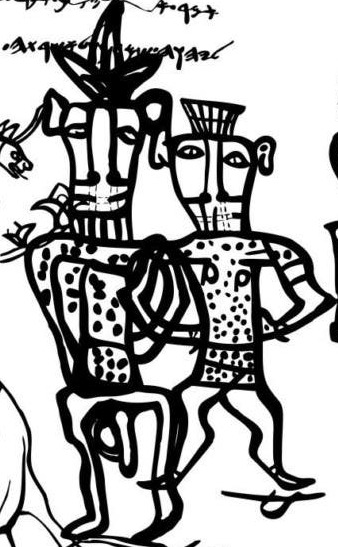

Among the most striking archaeological discoveries bearing on Israelite religion are inscriptions that pair Yahweh with a goddess called Asherah. In the Ugaritic texts, Athirat (the cognate of Hebrew Asherah) is the consort of El, the mother of the gods, and a prominent figure in the Canaanite pantheon.1, 8 The Hebrew Bible mentions Asherah or "the asherah" (a cultic object, likely a wooden pole or stylized tree) more than forty times, overwhelmingly in condemnation — the Deuteronomistic History repeatedly denounces the placing of asherah objects in Yahweh's temples and high places (1 Kings 15:13, 2 Kings 21:7, 2 Kings 23:6). The very persistence and vehemence of the polemic suggests that Asherah worship was widespread and deeply rooted in Israelite practice.5
The extrabiblical evidence confirms this. Inscriptions discovered at Kuntillet Ajrud, a remote site in the northeastern Sinai dating to approximately 800 BCE, include blessing formulae that read: "I bless you by Yahweh of Samaria and his Asherah" (lyhwh šmrn wl'šrth) and "I bless you by Yahweh of Teman and his Asherah" (lyhwh htmn wl'šrth).7 These inscriptions were found on large storage jars (pithoi) along with drawings that some scholars have interpreted as depicting divine figures. The site was excavated by Ze'ev Meshel in 1975–76 and fully published in 2012.7 A second site, Khirbet el-Qom in the Judean hill country (approximately 750 BCE), yielded a tomb inscription that reads: "Blessed be Uriyahu by Yahweh ... and by his Asherah."9
The interpretation of these inscriptions is debated. The possessive suffix ("his Asherah") is grammatically unusual if Asherah is understood as a proper divine name, since Hebrew does not normally attach possessive suffixes to proper nouns. Some scholars argue that "his asherah" refers to a cultic object (a wooden pole or sacred tree) rather than to a goddess by that name.8 Others, including William Dever, have argued that the inscriptions reflect a living religious practice in which Asherah was venerated as Yahweh's consort — that for ordinary Israelites, as opposed to the reformist scribes who produced the Deuteronomistic History, the worship of Yahweh and Asherah together was entirely normal.5 The hundreds of Judean pillar figurines — small clay female figures found throughout Judah in eighth- and seventh-century contexts — may represent the goddess or may serve an apotropaic function; their significance remains contested.5, 11 A detailed examination of the inscriptions and their interpretation is presented in Yahweh and Asherah.
The Mesha Stele and early Yahweh worship
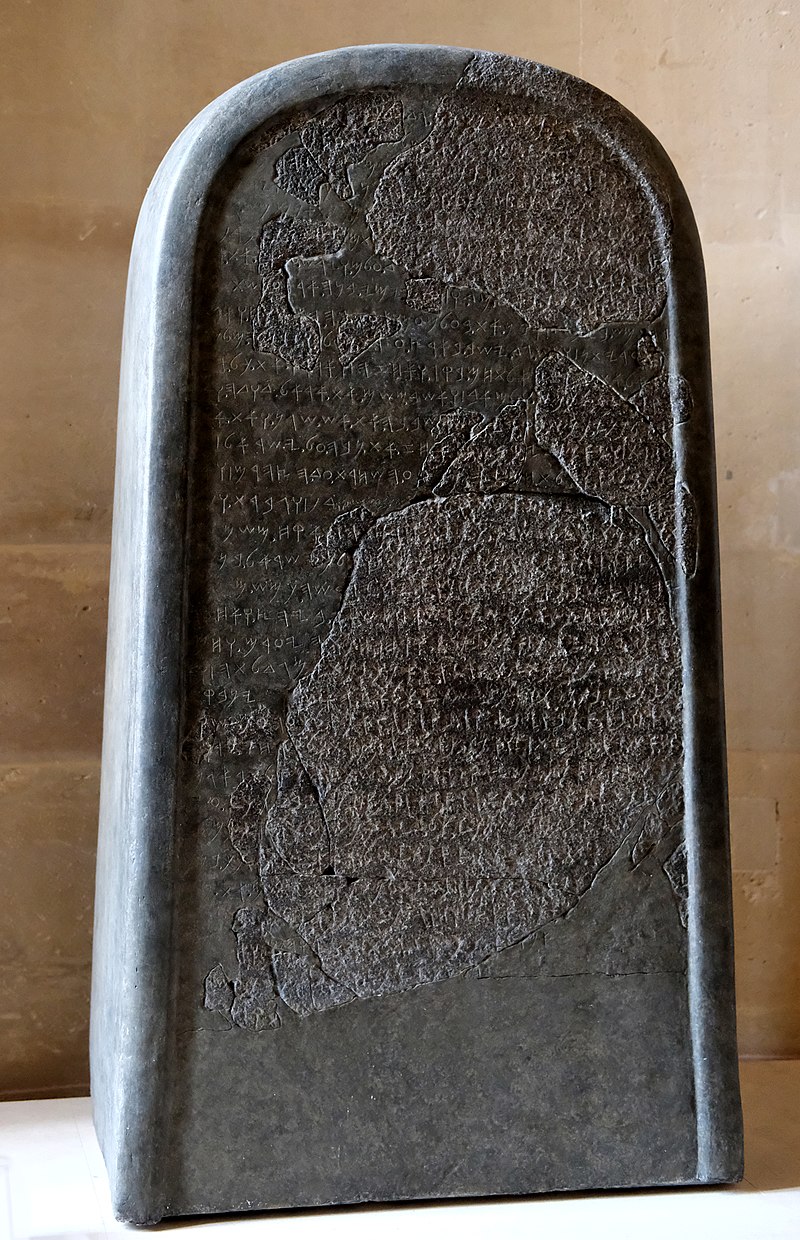

The Mesha Stele, a royal inscription of King Mesha of Moab dated to approximately 840 BCE and now in the Louvre, provides the earliest certain extrabiblical reference to Yahweh by name. The inscription describes Mesha's revolt against Israelite domination and his military campaigns against Israelite cities in Moab. In one passage, Mesha reports that he captured the Israelite town of Nebo and "took from there the vessels of YHWH, dragging them before Chemosh" — that is, Mesha seized the cultic implements of Yahweh's sanctuary and presented them as trophies before his own national god.11
The Mesha Stele is significant for the study of Yahweh's history because it reveals how Yahweh was perceived by Israel's neighbors. The inscription treats Yahweh as a national deity parallel to Chemosh: just as Chemosh is the god of Moab who fights for his people, Yahweh is the god of Israel who fights for his. Mesha attributes Israel's earlier domination of Moab to Chemosh's anger with his own land, not to Yahweh's power — a perspective that mirrors the biblical pattern in which Israel's defeats are attributed to Yahweh's anger with Israel (Judges 2:14).11 This mutual symmetry between national deities is characteristic of the monolatrous stage of Israelite religion, in which each nation had its own god and Yahweh's uniqueness lay in his special relationship to Israel, not in the nonexistence of other gods.
The stele also confirms that Yahweh worship was practiced in the territory of the northern kingdom of Israel (not only in Judah) in the ninth century BCE and that sanctuaries with cultic vessels existed in Israelite towns in the Transjordan.11
The Deuteronomic reform and the rise of monotheism
The transition from monolatry to monotheism — from the exclusive worship of Yahweh among gods whose existence was acknowledged to the denial that other gods exist at all — was not a single event but a process that unfolded over roughly two centuries, from the late seventh century to the late sixth century BCE. Two historical catalysts stand out: the Deuteronomic reform under King Josiah, and the Babylonian exile.4, 11
According to 2 Kings 22-23, during the eighteenth year of Josiah's reign (c. 622 BCE), a "book of the law" was discovered in the Temple during renovations. The contents of this book prompted Josiah to undertake a sweeping religious reform. He centralized all legitimate worship of Yahweh in the Jerusalem Temple, destroyed the high places and local sanctuaries throughout Judah and the former territory of the northern kingdom, removed the Asherah from the Temple, defiled the altars to other deities, and expelled the priests who had served at the provincial shrines. The reform was a deliberate attempt to establish Yahweh as the sole legitimate object of Israelite worship and the Jerusalem Temple as the sole legitimate place of that worship.11
Most scholars identify the "book of the law" found in the Temple with an early form of the Book of Deuteronomy, or at least its core legal section (Deuteronomy 12–26), which insists on a single sanctuary chosen by Yahweh and prohibits the worship of other gods. The Deuteronomistic History (Joshua through 2 Kings), which was composed or substantially edited during and after Josiah's reign, evaluates every king of Israel and Judah by a single criterion: whether he did what was right in the eyes of Yahweh or followed other gods. This consistent theological framework reflects the Deuteronomic movement's program of exclusive Yahweh worship.4, 11
The destruction of Jerusalem by Nebuchadnezzar in 586 BCE and the subsequent exile of the Judean elite to Babylon created a theological crisis. The Temple was destroyed, the Davidic monarchy was ended, and the people were removed from their land. In response, the exilic and post-exilic prophets — particularly the anonymous prophet known as Second Isaiah (Isaiah 40–55) — articulated a theology that was not merely monolatrous but explicitly monotheistic. Second Isaiah does not merely demand that Israel worship Yahweh alone; he denies that other gods exist at all:
Isaiah 45:5, NRSV"I am the LORD, and there is no other; besides me there is no god."
Isaiah 44:6, NRSV"Thus says the LORD, the King of Israel, and his Redeemer, the LORD of hosts: I am the first and I am the last; besides me there is no god."
These declarations represent a qualitative shift from the earlier biblical material. Where the Song of the Sea asked "Who is like you, O LORD, among the gods?" (Exodus 15:11) — a question that presupposes the existence of other gods — Second Isaiah asserts that there are no other gods to be compared with. The other "gods" of the nations are dismissed as mere human fabrications, blocks of wood and stone without power or consciousness (Isaiah 44:9-20).2, 4 This explicit monotheism, forged in the crisis of exile, became the defining theological commitment of Second Temple Judaism and the foundation on which both Christianity and Islam would later build.
The trajectory in summary
The scholarly reconstruction of Yahweh's history can be summarized as a series of stages, each supported by a combination of biblical and extrabiblical evidence. The following visualization presents these stages in approximate chronological order.
Stages in the development of Yahweh worship1, 4
In the earliest stage, Yahweh was worshipped by Shasu populations in the arid regions south of Canaan, as attested by the Egyptian topographical lists at Soleb and Amarah West and by the oldest biblical poetry associating Yahweh with Seir, Paran, and Teman.6, 11 During the emergence of Israel in the central hill country of Canaan (c. 1200–1000 BCE), Yahweh was adopted as the national deity and identified with El, absorbing El's attributes, titles, and mythological associations (see also origins of religion).1, 3 Through the monarchic period, Israelite religion was broadly monolatrous: Yahweh was the primary deity, but other gods — including Asherah, Baal, and the astral deities — continued to receive worship alongside him, as both the biblical polemic and the archaeological record attest.5, 7 The Deuteronomic reform of the late seventh century sought to eliminate this pluralism by centralizing worship and destroying rival cult sites.11 The Babylonian exile provided the theological catalyst for the final step: the prophetic assertion that other gods do not exist at all, culminating in the monotheism of Second Isaiah and its enduring legacy.2, 4
Articles in this series
This hub article introduces the broad trajectory of Yahweh's history from regional deity to sole God. The following articles examine specific stages and questions in detail:
The Kenite hypothesis examines the evidence that Yahweh originated among the Kenites, Midianites, or a related southern desert population, drawing on the Egyptian topographical lists at Soleb and Amarah West, the archaic biblical poetry associating Yahweh with Seir, Paran, and Teman, and the biblical traditions connecting Moses with a Midianite priest.4, 6 Exodus 3:1-6 Deuteronomy 33:2
From monolatry to monotheism traces the theological development from the divine council passages of the Hebrew Bible — in which Yahweh is one among many elohim — through the exclusive Yahweh worship demanded by the Deuteronomists, to the explicit denial of other gods' existence in Second Isaiah, examining the textual, archaeological, and historical evidence at each stage.1, 2, 10 Psalm 82 Isaiah 44:6
Yahweh and Asherah presents the inscriptions at Kuntillet Ajrud and Khirbet el-Qom that pair Yahweh with a goddess called Asherah, the Judean pillar figurines, and the biblical polemic against Asherah worship, examining the debate over whether Asherah was worshipped as Yahweh's consort in ancient Israelite religion.5, 7, 9 1 Kings 15:13 2 Kings 23:6
References
The Origins of Biblical Monotheism: Israel's Polytheistic Background and the Ugaritic Texts
Kuntillet ʿAjrud (Horvat Teman): An Iron Age II Religious Site on the Judah-Sinai Border