Overview
- The earliest archaeological evidence for ritual behaviour dates to the Middle Palaeolithic, with Neanderthal burials at sites such as Shanidar Cave and the extensive use of red ochre by early Homo sapiens in southern Africa as early as 100,000 years ago, suggesting that symbolic and possibly spiritual thought predates modern human cultural complexity.
- Cognitive science identifies several mental faculties that predispose humans toward religious belief, including theory of mind, hypersensitive agency detection, and teleological reasoning, leading many researchers to view religion as a cognitive byproduct of adaptations that evolved for social and ecological purposes rather than for religion itself.
- The emergence of large-scale ritual architecture such as Gobekli Tepe around 9600 BCE, centuries before agriculture, challenges the long-held assumption that organized religion was a product of sedentary farming societies and suggests that communal ritual may have been a driver rather than a consequence of social complexity.
Religion is among the most universal and distinctive features of human societies. Every known culture, past and present, has exhibited some form of religious or ritual behaviour, from the burial practices of Neanderthals to the elaborate temple complexes of early civilizations.7, 8 Understanding how and why religion emerged is a question that spans archaeology, cognitive science, evolutionary biology, and anthropology. The archaeological record provides fragmentary but compelling evidence that symbolic and ritual behaviour extends deep into the Palaeolithic, while cognitive science has identified specific features of the human mind that predispose our species toward beliefs in supernatural agents, an afterlife, and purposeful design in nature.9, 15
The study of religion's origins does not ask whether religious beliefs are true or false; rather, it seeks to understand the natural processes — cognitive, social, and ecological — that gave rise to religious thought and behaviour as observable phenomena in the human species. This article surveys the archaeological evidence for early ritual, the cognitive mechanisms that underpin religious belief, the major evolutionary theories proposed to explain religion's persistence, and the relationship between religious behaviour and the emergence of social complexity.8, 18
Archaeological evidence for early ritual
The earliest proposed evidence for ritual behaviour comes from Neanderthal burial sites dating to the Middle Palaeolithic, roughly 100,000 to 40,000 years ago. At Shanidar Cave in the Zagros Mountains of northern Iraq, excavations by Ralph Solecki in the 1950s and 1960s uncovered the remains of ten Neanderthal individuals, several of whom appeared to have been intentionally buried. The most famous, known as Shanidar IV, was found surrounded by concentrations of pollen from several flowering plant species, leading Solecki to propose that the body had been laid to rest on a bed of flowers — a finding he interpreted as evidence for symbolic thought and perhaps a belief in an afterlife among Neanderthals.1 The flower burial interpretation has been debated for decades, with sceptics suggesting that the pollen was introduced by burrowing rodents or natural wind deposition. However, renewed excavations at Shanidar beginning in 2014 uncovered additional Neanderthal remains in articulated positions within deliberately prepared niches, providing stronger evidence for intentional burial practices at the site regardless of the flower pollen question.2

Other Neanderthal sites have yielded further indications of symbolic behaviour. At Cueva de los Aviones in southeastern Spain, deposits dated to approximately 115,000 years ago contained perforated marine shells with traces of red and yellow mineral pigments, suggesting that Neanderthals used body ornamentation tens of thousands of years before the arrival of modern humans in Europe.4 While body ornamentation is not religion per se, it demonstrates the capacity for symbolic thought — the ability to invest objects and actions with meanings beyond their immediate physical properties — which is considered a necessary cognitive prerequisite for religious belief.7
Among anatomically modern humans, the evidence for symbolic behaviour is richer and older still. At Blombos Cave in South Africa, deposits dating to approximately 100,000 years ago have yielded a sophisticated ochre-processing workshop, including ochre crayons with engraved geometric patterns, perforated shell beads, and toolkits for grinding and mixing pigments.3 Red ochre appears to have held particular significance for Middle Stone Age populations across Africa, with its use documented at dozens of sites spanning tens of thousands of years. While the precise symbolic meaning of ochre use remains unknown, its persistence and widespread distribution suggest that it served social or ritual purposes — perhaps marking the body for ceremonies, initiations, or funerary rites — rather than purely utilitarian functions.3, 7
Cognitive foundations of religious thought
Cognitive scientists of religion have identified several features of the human mind that appear to predispose our species toward religious belief. These are not adaptations for religion itself but rather cognitive systems that evolved to solve ecological and social problems and that, as a side effect, generate intuitions consistent with religious concepts.8, 9
Theory of mind, the ability to attribute mental states — beliefs, desires, intentions — to other individuals, is fundamental to human social cognition and is fully developed by around age four in typical children. This capacity allows humans to model the thoughts and motivations of others, but it also extends readily to non-human entities: animals, natural forces, and invisible agents. Once a mind can attribute intention to others, it can attribute intention to gods, spirits, and ancestors with equal cognitive ease.8, 10
Hypersensitive agency detection, described by Stewart Guthrie as the tendency to see "faces in the clouds," is the cognitive bias toward interpreting ambiguous stimuli as caused by intentional agents rather than by impersonal forces.16 A rustling bush might be the wind, or it might be a predator; our ancestors who erred on the side of detecting agents when none were present (a false positive) survived more reliably than those who failed to detect real agents (a false negative). This asymmetry in the costs of error means natural selection favoured a hair-trigger agency detection device, which in turn generates a world perceived as populated by unseen agents — precisely the kind of world described by religious cosmologies.9, 16
Teleological reasoning, the tendency to perceive purpose and design in natural phenomena, emerges early in cognitive development. Children across cultures spontaneously explain natural features in purposive terms — rocks are "for climbing," rain exists "so plants can grow" — and this intuitive teleology persists into adulthood, particularly under conditions of cognitive load or stress. Justin Barrett has described children as "born believers" whose natural cognitive equipment generates god-like concepts without explicit instruction.10 Together, these cognitive biases — theory of mind, agency detection, and teleological reasoning — create what Pascal Boyer has called a "mental toolkit" that makes supernatural concepts not only possible but cognitively natural and easy to acquire, remember, and transmit.8
Evolutionary theories of religion
If the cognitive foundations of religion are byproducts of adaptations that evolved for other purposes, why has religion persisted and elaborated so dramatically across human cultures? Several evolutionary theories have been proposed to explain religion's persistence, and they fall broadly into two camps: those that view religion as a non-adaptive byproduct and those that view it as having been shaped by cultural or genetic selection for its social benefits.8, 12
The byproduct hypothesis, advanced most influentially by Pascal Boyer and Scott Atran, holds that religion is a parasitic exploitation of cognitive systems that evolved for non-religious purposes. On this view, religious concepts are "culturally successful" because they are minimally counterintuitive — they violate just enough intuitive expectations to be attention-grabbing and memorable (a being that is invisible but otherwise has human-like intentions) while remaining anchored in ordinary cognitive categories (a person, an animal, an artefact). Concepts that violate too many intuitions become incomprehensible and fail to spread; those that violate none are forgettable. Religion occupies the cognitive sweet spot between the banal and the bizarre.8, 9
The social cohesion hypothesis proposes that religion persists because it promotes cooperation within groups. Shared rituals, moral codes, and beliefs in supernatural monitoring create trust among individuals who might otherwise have difficulty cooperating at scale. Roy Rappaport argued that ritual creates unfalsifiable "sacred postulates" — propositions accepted on faith rather than evidence — that serve as unquestionable anchors for social contracts, thereby reducing the transaction costs of cooperation.18 Ara Norenzayan has extended this argument with the concept of "Big Gods" — moralizing, omniscient deities who monitor and punish moral transgressions — proposing that belief in such beings enabled the scaling of human cooperation beyond the small kin-based groups of the Palaeolithic into the large, anonymous societies of the Holocene.13
The costly signalling hypothesis, drawing on evolutionary signalling theory, proposes that religious commitments serve as honest signals of cooperative intent. Because religious rituals are often costly — involving fasting, scarification, time-consuming ceremonies, or material sacrifice — they are difficult to fake, and individuals who bear these costs credibly signal their commitment to the group. Joseph Henrich has formalised this idea through the concept of credibility-enhancing displays (CREDs), arguing that learners attend not only to what cultural models say but to what they do, and that costly religious acts serve as powerful cues of sincere belief that facilitate cultural transmission.11
The supernatural punishment hypothesis, developed by Dominic Johnson, focuses specifically on the role of believed-in punishing agents. Fear of supernatural punishment for selfish behaviour, Johnson argues, may have functioned as an internalised policing mechanism that reduced free-riding in ancestral groups, particularly in situations where human monitoring was absent or unreliable.14 These theories are not mutually exclusive; contemporary researchers increasingly view religion as a multifaceted phenomenon whose origins involve cognitive byproducts, cultural evolution, and social selection operating in concert.12
Animism and shamanism as early forms
Many anthropologists regard animism — the attribution of personhood, agency, or spiritual essence to non-human entities such as animals, plants, rivers, and stones — as among the oldest and most widespread forms of religious thought. The term was introduced by E. B. Tylor in 1871 as the "minimum definition of religion," and while Tylor's evolutionary framework has long been abandoned, the concept of animism has been revitalised in recent anthropological work. Graham Harvey and others have reframed animism not as a primitive error but as a relational ontology in which human beings understand themselves as participants in a community of persons that includes non-human beings.23 Animistic worldviews are documented among hunter-gatherer and horticultural societies on every inhabited continent, and their cross-cultural prevalence suggests deep antiquity.7, 23
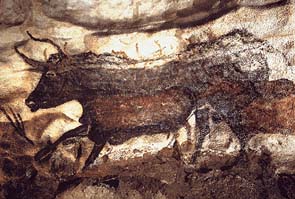
Shamanism, characterised by the practice of individuals entering altered states of consciousness to interact with a spirit world on behalf of their community, is similarly widespread among small-scale societies and has been argued to represent one of the earliest institutionalised forms of religious specialisation. Brian Hayden has proposed that shamanic practices emerged among Upper Palaeolithic hunter-gatherers, driven by the social advantages that accrued to individuals who could claim privileged access to supernatural knowledge — advantages in dispute resolution, healing, and the coordination of group activities such as hunts and migrations.17 The painted caves of Upper Palaeolithic Europe, including Lascaux and Chauvet, have been interpreted by some researchers as shamanistic in function, serving as sites for vision quests or spirit communication, although such interpretations remain speculative and contested.7, 17
Gobekli Tepe and pre-agricultural ritual
Perhaps no archaeological discovery has more profoundly challenged assumptions about the origins of religion than Gobekli Tepe, a monumental site in southeastern Turkey dating to approximately 9600 to 8000 BCE.
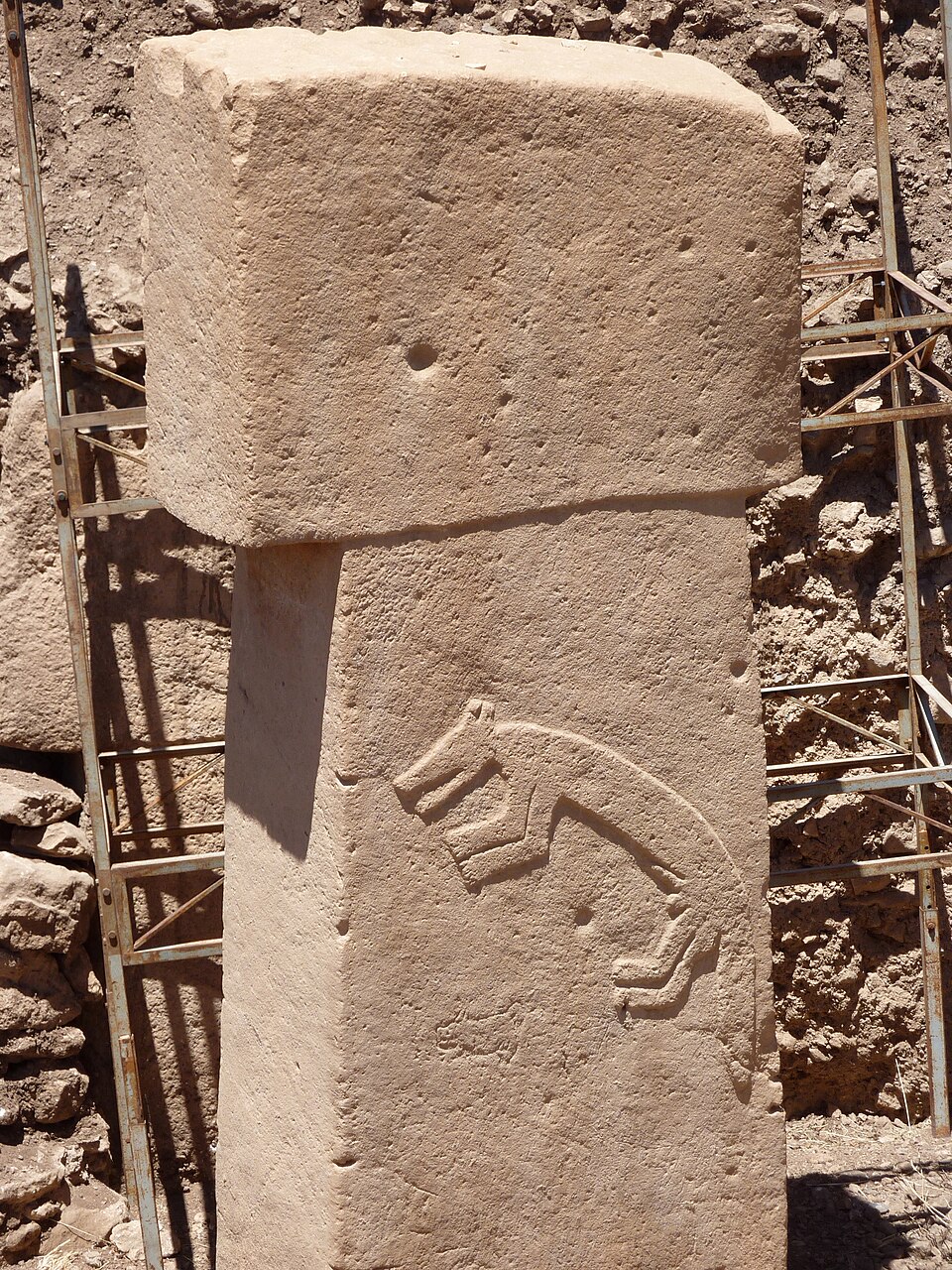

The site consists of multiple enclosures defined by massive T-shaped limestone pillars, some standing over five metres tall and weighing up to ten tonnes, carved with elaborate relief sculptures of animals including foxes, snakes, boars, cranes, and scorpions. The site consists of multiple enclosures defined by massive T-shaped limestone pillars, some standing over five metres tall and weighing up to ten tonnes, carved with elaborate relief sculptures of animals including foxes, snakes, boars, cranes, and scorpions. The pillars appear to have been quarried, transported, and erected by large groups of people working in a coordinated effort, and the site shows no evidence of permanent habitation — it was apparently a dedicated ritual centre visited periodically by mobile hunter-gatherer populations from the surrounding region.6
The significance of Gobekli Tepe lies in its dating. It was constructed at least a millennium before the earliest evidence for plant domestication in the region, overturning the long-held assumption, articulated most influentially by Jacques Cauvin, that organised religion was a consequence of the agricultural revolution and the sedentary, hierarchical societies it produced.5 Instead, Gobekli Tepe suggests that the causal relationship may run in the opposite direction: the need to organise large labour forces for the construction and maintenance of ritual centres may have driven the intensification of food production, the establishment of permanent settlements, and eventually the domestication of plants and animals in the surrounding Fertile Crescent.6 This "religion first" hypothesis, while not universally accepted, has become a major framework in discussions of the Neolithic transition in the Near East.
The Natufian culture of the Levant, which preceded the Neolithic in the same broad region (roughly 14,500 to 11,500 years ago), also demonstrates ritual elaboration among semi-sedentary hunter-gatherers. Natufian sites contain evidence for intentional burials with grave goods, possible feasting events, and the construction of communal structures that may have served ceremonial functions, suggesting that the development of ritual complexity was a gradual process that accelerated but did not originate with agriculture.20
Religion and social complexity
The relationship between religion and social complexity is one of the most actively debated topics in the evolutionary study of religion. A central question is whether the emergence of moralizing, high-god religions — belief systems featuring omniscient deities concerned with human morality — preceded or followed the development of large, politically complex societies.13, 19
Norenzayan's "Big Gods" hypothesis proposes that belief in moralizing supernatural agents was a cultural prerequisite for scaling human cooperation beyond small, face-to-face groups. In small-scale societies, cooperation can be maintained through reputation, kinship, and direct reciprocity, but in larger groups where individuals interact with strangers, these mechanisms break down. Belief in gods who see everything, judge moral behaviour, and punish transgressors could substitute for the absent human monitoring, enabling cooperative norms to extend to interactions among anonymous individuals.13 On this view, moralizing religions were a cultural innovation that enabled the formation of chiefdoms, states, and empires.
However, a large-scale analysis of the historical record published in 2019 by Harvey Whitehouse and colleagues, drawing on the Seshat Global History Databank, found that increases in social complexity typically preceded the appearance of moralizing gods rather than followed them. The study examined hundreds of polities across world history and concluded that societies generally reached a threshold of roughly one million people before moralizing high-god beliefs became prevalent, suggesting that such beliefs may be a consequence of social complexity rather than its cause.19 This finding has been contested on methodological grounds, and the debate remains unresolved, but it has complicated the straightforward "Big Gods" narrative and prompted researchers to consider whether other forms of religious practice — ritual, ancestor veneration, local spirit beliefs — may have been more important than moralizing theology in the initial scaling of human societies.21
Proposed sequence of religious and social developments7, 13, 19
| Period | Approximate date | Religious/ritual development | Social context |
|---|---|---|---|
| Middle Palaeolithic | ~300,000–40,000 BP | Intentional burial, ochre use, body ornamentation | Small mobile bands (20–50 individuals) |
| Upper Palaeolithic | ~40,000–12,000 BP | Cave art, figurines, shamanic practices | Larger bands, seasonal aggregation camps |
| Epipalaeolithic/Natufian | ~14,500–11,500 BP | Elaborate burials, feasting, communal structures | Semi-sedentary villages (100–300) |
| Pre-Pottery Neolithic | ~11,500–8,500 BP | Monumental ritual centres (Gobekli Tepe), skull cults | Early farming communities (hundreds) |
| Pottery Neolithic–Chalcolithic | ~8,500–5,000 BP | Temple complexes, priest specialists, ancestor veneration | Towns and proto-urban centres (thousands) |
| Bronze Age states | ~5,000–3,000 BP | State religions, moralizing gods, codified mythologies | Cities, kingdoms, empires (tens of thousands+) |
Ancestor veneration
Ancestor veneration — the practice of honouring, communicating with, or making offerings to deceased kin — is one of the most widespread forms of religious behaviour, documented in societies across Africa, East Asia, Oceania, and the pre-Columbian Americas. Lyle Steadman, Craig Palmer, and Christopher Tilley have argued that ancestor worship may represent one of the oldest and most foundational forms of religion, rooted in the human capacity for maintaining social bonds with individuals who are no longer physically present.24 Because the dead cannot contradict claims made about them, ancestors readily become authoritative figures whose purported wishes and pronouncements can be invoked to legitimise social norms, inheritance rules, and territorial claims.
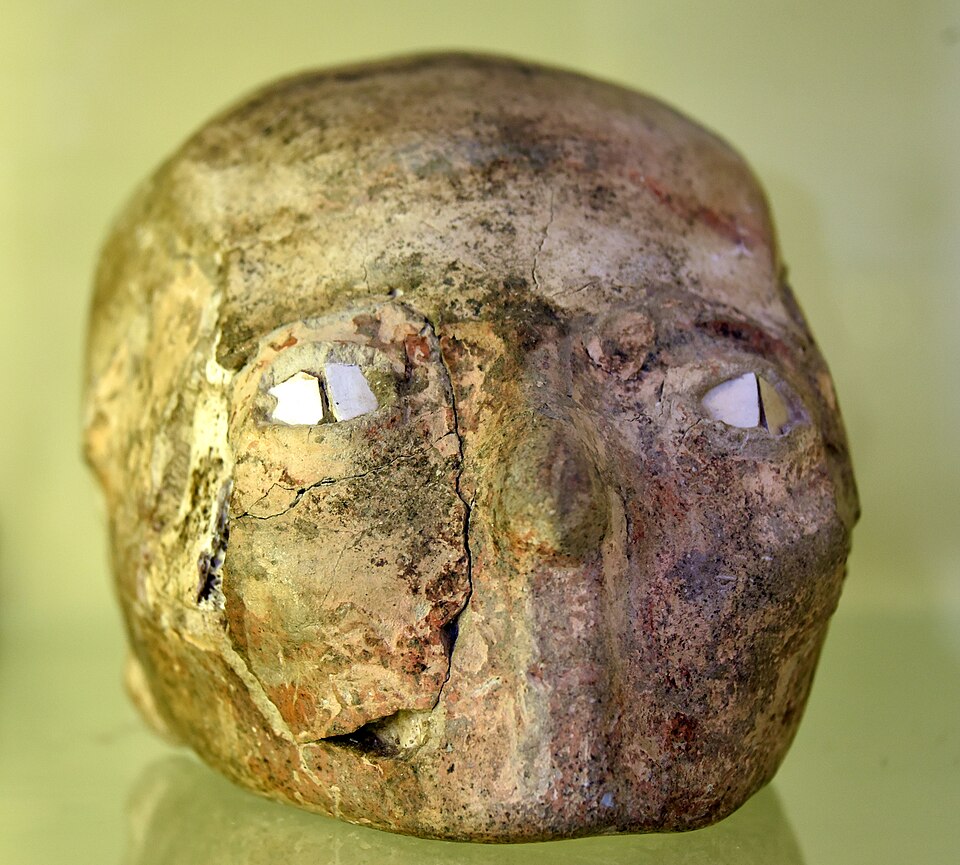

Archaeological evidence for ancestor veneration includes the plastered skulls of the Pre-Pottery Neolithic B period (roughly 8500 to 7000 BCE) found at Jericho, Ain Ghazal, and other Levantine sites, where the skulls of selected individuals were removed after burial, modelled with plaster to reconstruct facial features, and displayed in domestic contexts. This practice suggests not only reverence for specific deceased individuals but also the use of ancestral remains as material symbols of lineage identity and social continuity.22 Similar patterns of secondary treatment of the dead — exhumation, curation, and ritual manipulation of bones — appear in diverse cultural contexts worldwide, from the ossuaries of Neolithic Europe to the ancestor houses of Melanesia, suggesting that the veneration of the dead is a recurrent, perhaps inevitable, consequence of the human capacities for attachment, memory, and symbolic thought.24
Agriculture and organized religion
The Neolithic transition from mobile foraging to sedentary agriculture, beginning approximately 12,000 years ago in the Fertile Crescent, was accompanied by profound changes in religious practice. As communities became larger, more sedentary, and more economically interdependent, the scale and complexity of ritual activity increased correspondingly. Jacques Cauvin argued that a "revolution of symbols" preceded and enabled the economic changes of the Neolithic, with new religious concepts — particularly the emergence of female figurines and bull symbolism — reflecting a fundamental cognitive shift in how humans related to the natural world.5
Sedentary farming villages of the Neolithic and Chalcolithic periods developed communal ritual spaces that evolved over millennia into the temples, ziggurats, and sacred precincts of the earliest urban civilizations. At Catalhoyuk in central Anatolia, occupied from roughly 7500 to 5700 BCE, many houses contained elaborate wall paintings, sculpted animal heads, and sub-floor burials, blurring the distinction between domestic and ritual space. The site's excavator, Ian Hodder, has interpreted this evidence as reflecting a society in which religious practice was embedded in everyday domestic life rather than separated into specialised sacred institutions.22
The emergence of full-time religious specialists — priests, diviners, temple administrators — is generally associated with the rise of chiefdoms and early states, where surplus agricultural production could support non-producing elites. In Mesopotamia, Egypt, and the Indus Valley, temples became centres of economic redistribution as well as ritual activity, and religious authority became intertwined with political power. Kent Flannery and Joyce Marcus have documented how the institutionalisation of religion co-evolved with the creation of social inequality, with religious ideology serving to legitimise the authority of emerging hereditary elites by framing social hierarchies as reflections of a cosmic order.22
Cross-cultural universals in religious behaviour
Despite the enormous diversity of religious traditions, certain features recur across cultures with sufficient regularity to suggest that they are grounded in shared cognitive and social propensities rather than in historical diffusion from a common source. These cross-cultural universals include belief in supernatural agents (gods, spirits, ancestors) who possess mental states and can influence human affairs; rituals that mark life transitions (birth, puberty, marriage, death); moral codes attributed to or sanctioned by supernatural authority; and practices aimed at communicating with or influencing the supernatural through prayer, sacrifice, or altered states of consciousness.8, 9
The universality of afterlife beliefs is particularly striking. Virtually all documented cultures have some conception of continued existence after death, whether as ancestor spirits, reincarnated souls, inhabitants of an underworld, or disembodied presences. Cognitive scientists have proposed that afterlife beliefs arise naturally from the difficulty the human mind has in simulating the complete cessation of mental states: when asked to imagine what a dead person "knows" or "feels," even avowed atheists show implicit tendencies to attribute ongoing mental activity to the deceased.8, 15
Ritual behaviour itself appears to be a human universal, and its formal properties — stereotyped sequences of actions performed in prescribed orders, often involving special objects, locations, or bodily postures — are remarkably consistent across cultures. Rappaport argued that the formal properties of ritual (invariance, performance, and the encoding of sacred postulates) are not arbitrary cultural elaborations but functional necessities for the maintenance of social contracts in the absence of written law or centralised enforcement.18 The convergent evolution of similar ritual forms in historically unconnected societies — initiation rites involving ordeal, communal feasting to mark seasonal transitions, funerary practices involving secondary treatment of remains — supports the view that religious behaviour emerges from a common cognitive and social substrate rather than from a single cultural invention that spread by diffusion.7, 12
References
Symbolic use of marine shells and mineral pigments by Iberian Neandertals 115,000 years ago
Göbekli Tepe, Turkey. A brief summary of research at a new World Heritage Site (2015–2019)
The evolution of costly displays, cooperation and religion: credibility enhancing displays and their implications for cultural evolution