Overview
- The Hebrew Bible contains a diverse body of prophetic literature spanning centuries of Israelite history, in which prophets functioned primarily as covenant mediators who delivered messages on behalf of Yahweh to their contemporaries, with predictive elements constituting only one dimension of a broader role that included ethical instruction, political commentary, and theological reflection.
- The New Testament authors applied Hebrew Bible passages to Jesus and the early church using interpretive methods common in Second Temple Judaism — including typology, pesher, midrash, and allegory — reading texts that originally addressed the Israelite monarchy, the nation in exile, or specific historical crises as pointing forward to events in the life of Jesus and the formation of the church.
- The relationship between biblical prophecy and its claimed fulfillment raises questions that belong to textual analysis rather than theology: what did a passage mean in its original context, by what method was it later reapplied, and what does the distance between original meaning and later application reveal about how the biblical texts were read and transmitted across centuries.
The Hebrew Bible devotes a substantial portion of its canon to prophetic literature. The books of Isaiah, Jeremiah, Ezekiel, and the twelve Minor Prophets constitute the Nevi'im Acharonim (Latter Prophets) of the Jewish canon, and the Former Prophets — Joshua, Judges, Samuel, and Kings — narrate Israelite history through a framework shaped by prophetic theology. In the Christian Old Testament, the prophetic books are placed at the end of the canon, immediately before the New Testament, an arrangement that emphasizes the forward-looking dimension of prophecy and its perceived connection to the events narrated in the Gospels and Epistles.1, 3
The relationship between these prophetic texts and their claimed fulfillment in later literature is among the most consequential questions in biblical studies. The New Testament contains more than three hundred explicit quotations of the Hebrew Bible and several hundred additional allusions, and a significant number of these are presented as fulfilled prophecy.6 Examining this relationship requires attention to three distinct questions: what did a given passage mean in its original historical and literary context, by what interpretive method was it later applied to new circumstances, and what does the gap — or continuity — between those two readings reveal about how biblical texts were transmitted and reinterpreted across centuries? This hub article surveys the landscape of biblical prophecy and its fulfillment claims, introducing the categories of prophetic literature, the methods by which later readers reapplied prophetic texts, and the specific case studies examined in greater detail in the articles linked throughout.
The nature of Israelite prophecy
The Hebrew word navi (prophet) denotes a person who speaks on behalf of another — in the biblical context, one who delivers a message from Yahweh to the people of Israel. The prophet functioned as a covenant mediator, standing between God and the community, addressing the political, social, and religious circumstances of the moment.1, 17 While modern usage often equates prophecy with prediction, the prophets of the Hebrew Bible spent the majority of their oracles addressing the present rather than the future. Isaiah called upon the Judean court to trust Yahweh during the Syro-Ephraimite crisis rather than seek an Assyrian alliance. Amos denounced the economic exploitation of the poor in eighth-century Israel. Jeremiah urged submission to Babylon as the means of national survival. In each case, the prophet's primary function was to interpret the present moment in light of the covenant between Yahweh and Israel.1, 18
Within this broader role, prophets did articulate expectations about the future. These ranged from immediate political predictions — Isaiah's declaration that the Syro-Ephraimite coalition would fail within a specific timeframe (Isaiah 7:16) — to oracles of judgment against nations, to long-range visions of restoration after exile. Prophets also delivered oracles concerning a future ideal king, a renewed covenant, a purified temple, and a transformation of the natural order. These diverse future-oriented oracles are the raw material from which later traditions of fulfillment would be constructed.1, 8

Israelite prophecy did not emerge in a vacuum. Prophetic activity is attested across the ancient Near East, from the Mari texts of eighteenth-century BCE Mesopotamia to the inscription of Balaam son of Beor at Deir Alla in Transjordan (c. eighth century BCE). The biblical tradition itself acknowledges the existence of prophets outside Israel, including Balaam (Numbers 22–24). What distinguishes Israelite prophecy within this broader context is not the phenomenon of inspired speech itself but its theological framework: the prophets of the Hebrew Bible operate within the covenant between Yahweh and Israel, and their messages of judgment and restoration are grounded in the terms of that covenant.1, 2
Criteria for true prophecy within the text
The Hebrew Bible itself addresses the question of how to distinguish authentic prophecy from false prophecy, and the criteria it articulates provide an important framework for understanding how the biblical tradition viewed the prophetic enterprise. The primary legislative text is Deuteronomy 18:15–22, which establishes two criteria for evaluating a prophet's words: the prophet must speak in the name of Yahweh (not in the name of other gods), and the thing spoken must come to pass. If a prophet speaks in Yahweh's name and the prediction does not occur, the prophet has spoken presumptuously.15
This criterion appears straightforward, but the prophetic literature itself complicates its application. The book of Jeremiah articulates what might be called a doctrine of conditional prophecy. In Jeremiah 18:7–10, Yahweh declares that if a nation against which judgment has been pronounced turns from its evil, Yahweh will relent of the disaster; conversely, if a nation to which good has been promised turns to evil, Yahweh will reconsider the good intended. The book of Jonah dramatizes this principle: Jonah announces that Nineveh will be overthrown in forty days, Nineveh repents, and the predicted destruction does not occur (Jonah 3:4–10). By the criterion of Deuteronomy 18:22, Jonah's prophecy failed; by the logic of Jeremiah 18, it succeeded precisely because the prophetic word accomplished its purpose.1, 15
A second criterion appears in Deuteronomy 13:1–5, which addresses the case of a prophet whose sign or wonder does come to pass but who then counsels the worship of other gods. In this case, the accuracy of the prediction is insufficient to establish the prophet's authenticity; fidelity to Yahweh remains the overriding test. Together, these passages indicate that the biblical tradition viewed prophetic authenticity not as a simple matter of predictive accuracy but as a complex evaluation involving theological content, ethical consistency, and historical outcome.15
Categories of prophetic literature
The prophetic material in the Hebrew Bible encompasses several distinct literary types, each with its own relationship to the question of fulfillment.
Oracles of judgment and restoration. The largest category of prophetic speech consists of oracles addressed to Israel, Judah, and the surrounding nations, pronouncing judgment for covenant violation and offering hope of restoration. The prophets of the eighth century BCE — Amos, Hosea, Isaiah, and Micah — delivered oracles of judgment against the northern and southern kingdoms that were understood, in retrospect, as having been fulfilled by the Assyrian destruction of Samaria in 722 BCE and the Babylonian destruction of Jerusalem in 586 BCE. The same prophets also articulated visions of future restoration beyond the judgment, including the return from exile and the renewal of the Davidic monarchy.1, 18
Royal and messianic oracles. Certain prophetic texts address the Israelite or Judean king and include language that later traditions applied to an expected future deliverer. The oracle of Isaiah 7:14, spoken during the Syro-Ephraimite crisis of c. 735 BCE, announces that a young woman ('almah) will conceive and bear a son named Immanuel as a sign to King Ahaz. The oracle of Isaiah 9:6–7 celebrates the birth or enthronement of a royal figure in extravagant language. The oracle of Micah 5:2 designates Bethlehem Ephrathah as the origin of a future ruler. In their original contexts, these texts addressed the Davidic monarchy of their own era; in subsequent Jewish and Christian tradition, they were reread as pointing to a future eschatological figure.5, 11

Servant songs. Four passages in Isaiah 40–55 (conventionally identified as Isaiah 42:1–4, 49:1–6, 50:4–9, and 52:13–53:12) describe a figure called the Servant of Yahweh who suffers unjustly, bears the sins of others, and is ultimately vindicated. Within the literary context of Second Isaiah, this figure has been identified by interpreters variously as the nation of Israel, a remnant within Israel, the prophet himself, or a specific historical individual such as King Jehoiachin. The fourth song, describing the servant's suffering and death, became one of the most cited prophetic texts in early Christianity, applied by the New Testament authors to the crucifixion of Jesus.9
Apocalyptic visions. The book of Daniel and certain portions of Isaiah, Ezekiel, Joel, and Zechariah employ a distinct mode of prophetic expression: symbolic visions of heavenly events, angelic mediators, cosmic upheaval, and a periodized view of history moving toward a divinely ordained climax. The visions of Daniel 7–12 present a sequence of kingdoms symbolized by beasts, culminating in the arrival of divine judgment and the establishment of an everlasting kingdom. These texts raise distinctive questions about fulfillment, since their highly symbolic language admits multiple readings and their detailed historical correspondence to events of the second century BCE has led many analysts to classify them as vaticinium ex eventu — prophecy written after the fact.19, 20
Inner-biblical reinterpretation
The process by which prophetic texts were reapplied to new circumstances did not begin with the New Testament. It is a phenomenon visible within the Hebrew Bible itself, described by Michael Fishbane as inner-biblical exegesis — the reinterpretation of earlier biblical traditions (traditum) by the ongoing process of transmission (traditio).4
One of the clearest examples appears in the book of Daniel. In Daniel 9:2, Daniel reads the prophecy of Jeremiah that Jerusalem's desolation would last seventy years (Jeremiah 25:11–12; 29:10). The angel Gabriel then reinterprets the seventy years as seventy weeks of years — 490 years — extending the original timeframe to encompass events well beyond the return from Babylonian exile. What began as a concrete prediction about the duration of exile became, through inner-biblical reinterpretation, an elaborate periodization of history reaching into the second century BCE.4, 19
The book of Isaiah itself shows evidence of this process. Many analysts identify distinct layers within the book: chapters 1–39 (First Isaiah, largely eighth century BCE), chapters 40–55 (Second Isaiah, exilic period), and chapters 56–66 (Third Isaiah, post-exilic period). The later sections reinterpret and extend the oracles of the earlier sections, applying eighth-century language about judgment and restoration to the new context of exile and return. The editorial shaping of the book as a unified whole, attributed to a single prophet named Isaiah, transforms what were originally distinct prophetic voices into a continuous prophetic tradition spanning centuries.8, 18
The book of Chronicles provides another example. The Chronicler systematically revises the narrative of Samuel-Kings, adding prophetic speeches and reframing events to demonstrate that prophetic words were fulfilled in subsequent history. Where 2 Kings presents the fall of Jerusalem as a political catastrophe, 2 Chronicles frames it explicitly as the fulfillment of prophetic warning, adding the notice that the exile lasted until the land had enjoyed its sabbaths, “to fulfill the word of the LORD by the mouth of Jeremiah” (2 Chronicles 36:21, NRSV). This editorial reframing transforms historical narrative into a demonstration of prophetic reliability.4
Second Temple interpretive methods
By the Second Temple period (c. 515 BCE to 70 CE), the prophetic books had achieved scriptural status and were being actively reinterpreted through several distinct hermeneutical methods. These methods shaped how both Jewish and early Christian communities would read prophetic texts as pointing to their own time and circumstances.3, 7
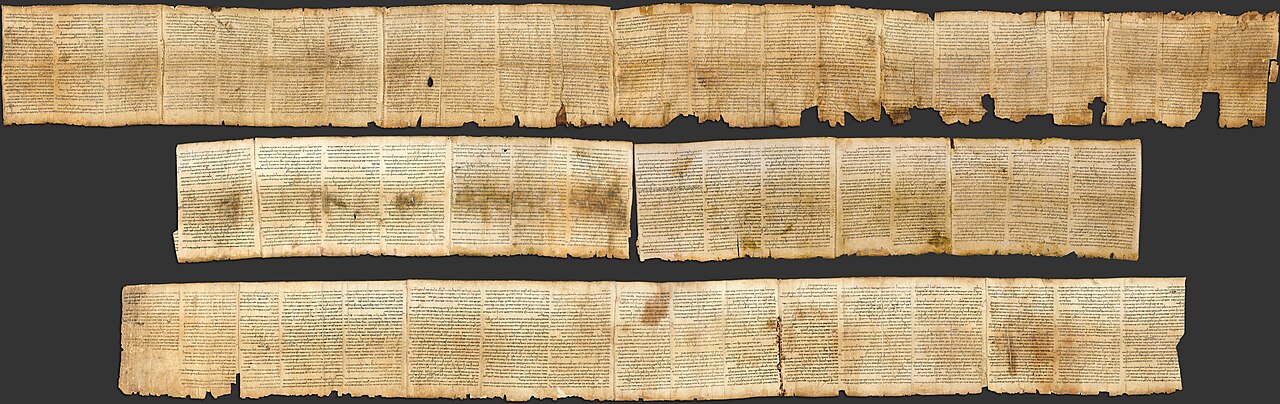
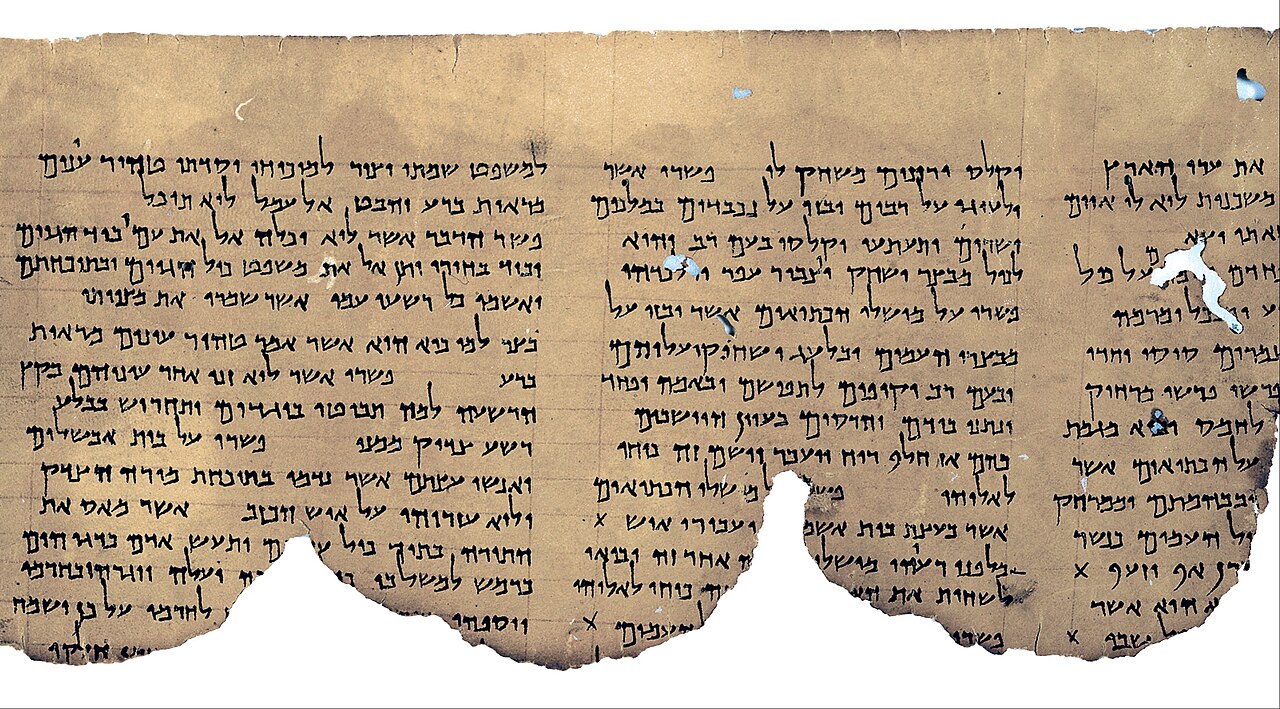
Pesher. The term pesher (a word of Aramaic origin meaning “interpretation” or “solution”) refers to a mode of biblical interpretation preserved most fully in the Dead Sea Scrolls. In pesher interpretation, a prophetic text is read as containing a hidden meaning that refers not to the prophet's own time but to the eschatological present of the interpreter's community. The Habakkuk Pesher (1QpHab), found at Qumran, reads the oracle of Habakkuk verse by verse and applies each line to the history and expectations of the Qumran sect, identifying the Wicked Priest, the Teacher of Righteousness, and the Kittim as the referents of Habakkuk's seventh-century BCE words. The pesher method assumes that the prophet spoke in a kind of divinely inspired code whose true meaning was sealed until the last days, when a divinely guided interpreter could decode it.12, 3
_Written_in_Hebrew_-_Google_Art_Project.jpg)
Typology. Typological interpretation identifies a correspondence between an earlier event, person, or institution and a later one, based on the conviction that God works in recurring patterns. The Exodus becomes a type for the return from Babylonian exile in Second Isaiah, where Yahweh is depicted as once again leading the people through the wilderness, providing water from rock, and making a way through the sea (Isaiah 43:16–21). In later Christian usage, Adam becomes a type of Christ, the Passover lamb a type of Christ's sacrifice, and the manna in the wilderness a type of the eucharist. Typological reading differs from direct prediction in that the original event is understood as genuinely historical in its own right; it is the pattern, not a coded message, that connects type and antitype.7, 6
Midrash. The term midrash covers a broad range of interpretive practices in which a biblical text is explored, expanded, and applied through close attention to verbal details, apparent contradictions, and the juxtaposition of passages from different parts of Scripture. Midrashic reading often draws connections between texts on the basis of shared vocabulary (gezerah shavah) or applies a general principle derived from one text to a different situation (qal va-chomer, reasoning from the lesser to the greater). These rabbinic hermeneutical rules, attributed to Hillel and later systematized by Rabbi Ishmael into thirteen principles, are visible in embryonic form in Second Temple literature and in the exegetical methods of the New Testament authors.7, 14
Allegory. Allegorical interpretation reads the surface narrative of a text as a vehicle for a deeper, often spiritual or philosophical meaning. Philo of Alexandria (c. 20 BCE – c. 50 CE) developed allegorical reading into a systematic method for interpreting the Torah in light of Greek philosophy. While allegory plays a less central role in the New Testament's use of prophetic texts than pesher and typology, Paul employs it explicitly in Galatians 4:21–31, where he reads the story of Sarah and Hagar as an allegory of the two covenants.7
Interpretive methods applied to prophetic texts7, 3
| Method | Core principle | Example source | Example application |
|---|---|---|---|
| Pesher | Prophetic text contains hidden meaning about the interpreter's own time | Dead Sea Scrolls (Qumran) | Habakkuk's oracle read as referring to the Teacher of Righteousness and the Wicked Priest |
| Typology | Earlier event or figure prefigures a later one through a divinely intended pattern | Second Isaiah; Paul's letters | The Exodus as a type for the return from exile; Adam as a type of Christ |
| Midrash | Close reading of verbal details to draw connections across texts | Rabbinic literature; Matthew | Linking Hosea 11:1 (“Out of Egypt I called my son,” NRSV) to the flight to Egypt |
| Allegory | Surface narrative encodes a deeper spiritual or philosophical meaning | Philo; Galatians 4 | Sarah and Hagar as the two covenants |
| Direct prediction | Prophet explicitly foretells a specific future event | Isaiah 7; Micah 5 | Bethlehem as the birthplace of a future ruler |
New Testament fulfillment citations
The New Testament's use of the Hebrew Bible as fulfilled prophecy is extensive and varied. The Gospel of Matthew alone contains approximately sixty explicit quotations of the Old Testament, including a distinctive series of so-called formula quotations introduced by phrases such as “this was to fulfill what had been spoken by the prophet” (Matthew 1:22; 2:15; 2:17; 2:23; 4:14; 8:17; 12:17; 13:35; 21:4; 27:9, NRSV). Krister Stendahl's analysis of these formula quotations identified a text form distinct from both the Masoretic Text and the Septuagint, suggesting that the Matthean community used a variant textual tradition — or freely adapted the text — when constructing its fulfillment claims.13
Several categories of fulfillment citation can be distinguished in the New Testament. In the first category, a text that originally addressed a specific historical situation is reapplied to a new situation deemed analogous. Matthew applies Hosea 11:1 (“Out of Egypt I called my son,” NRSV) to the infant Jesus' return from Egypt (Matthew 2:15). In Hosea's original context, the “son” is the nation of Israel and the reference is to the Exodus. Matthew's application transforms a retrospective statement about Israel's history into a prophecy about the child Jesus. This is a typological reading: Israel's experience prefigures Christ's.6, 10
In a second category, a text whose original meaning is debated is read through the lens of later events. The Gospel of Matthew applies Isaiah 7:14 to the virginal conception of Jesus, citing the passage in a form that follows the Septuagint's rendering of Hebrew 'almah (“young woman”) as Greek parthenos (“virgin”). In Isaiah's original context, the sign of Immanuel was addressed to King Ahaz during the Syro-Ephraimite crisis and referred to a child whose birth was imminent in that situation. The application to Jesus depends both on the Septuagint's translation choice and on a typological extension of the sign beyond its original referent.10, 18
In a third category, a passage is read as direct prediction. The Gospel of Matthew cites Micah 5:2 in the narrative of Jesus' birth in Bethlehem, presenting the prophet's designation of Bethlehem as the origin of a future ruler as a prediction fulfilled by the location of Jesus' birth (Matthew 2:5–6). Whether the Matthean narrative shaped itself around the prophecy or the historical fact prompted the citation is a question that the texts themselves leave open.10
The Pauline letters offer a different mode of engagement with prophetic fulfillment. Paul rarely employs the formula-quotation style of Matthew. Instead, he reads the Hebrew Bible as a unified witness to the gospel, interpreting Abraham's faith, the law's function, and the inclusion of the Gentiles through a christological lens. In Romans 9–11, Paul assembles a catena of prophetic quotations from Isaiah, Hosea, and Joel to construct an argument about God's faithfulness to Israel and the incorporation of the Gentiles — an argument built not on individual predictive texts but on the prophetic tradition as a whole.6, 7
Case studies in prophecy and fulfillment
Several specific prophecy-fulfillment pairings have received extensive attention in both Jewish and Christian scholarship. Each raises distinct issues about original context, interpretive method, and the nature of fulfillment.
Isaiah 53 and the suffering servant. The fourth Servant Song describes a figure who is despised and rejected, who bears the iniquities of others, and who is “cut off from the land of the living” (Isaiah 53:8, NRSV). The New Testament identifies this figure with Jesus: the Ethiopian eunuch asks Philip whether the passage refers to the prophet himself or to someone else, and Philip responds by proclaiming Jesus (Acts 8:34–35). Within the context of Isaiah 40–55, the servant figure is also identified with Israel (“But you, Israel, my servant”; Isaiah 41:8, NRSV), and later Jewish interpretation consistently understood the passage as referring to the nation's suffering in exile rather than to an individual. Both readings are grounded in the text; the question is one of referent, not of misquotation.9
The sign of Immanuel. As noted above, Isaiah 7:14 in its original context addresses King Ahaz. The birth of a child named Immanuel (“God is with us”) serves as a chronological marker: before the child knows right from wrong, the Syro-Ephraimite threat will be removed. The Septuagint's rendering of 'almah as parthenos opened the text to a reading centered on virginal conception, and Matthew's application of the verse to Mary and Jesus rests on this Greek translation. The distance between the Hebrew original and the Greek-mediated application illustrates how translation itself became a vehicle of reinterpretation.10, 18
Jeremiah's new covenant. In Jeremiah 31:31–34, the prophet announces that Yahweh will make a new covenant with the house of Israel and the house of Judah, writing the law on their hearts rather than on stone tablets. This passage is quoted at length in Hebrews 8:8–12 and applied to the covenant inaugurated by Jesus' death. In Jeremiah's original context, the new covenant is made with Israel and Judah specifically and envisions a renewed relationship between Yahweh and his people within the existing covenantal framework. The author of Hebrews reads it as establishing a covenant that supersedes the Mosaic one, an interpretation that extends the passage beyond its original addressees and theological scope.6
Daniel's seventy weeks. The passage in Daniel 9:24–27 presents a periodized history of seventy weeks of years leading to the anointing of a holy one, the cutting off of an anointed one, and the desolation of the sanctuary. Within the literary context of Daniel, the sequence corresponds to the period from the Babylonian exile through the persecution of Antiochus IV Epiphanes in 167–164 BCE. Christian interpreters from the patristic period onward have read the passage as pointing to the coming and death of Christ. The dual applicability of the text — fitting both the Maccabean crisis and a christological reading, depending on the hermeneutical framework applied — exemplifies the open-ended character of apocalyptic symbolism.19
Prophecy written after the fact
A significant question in the study of biblical prophecy concerns texts that appear to predict events with such precision that they may have been composed after those events occurred. The technical term for this phenomenon is vaticinium ex eventu, Latin for “prophecy from the event.” The concept is not confined to the Bible; it is attested in Mesopotamian literature from the second millennium BCE, in Greek oracular traditions, and in other ancient Near Eastern texts.19
The book of Daniel provides the paradigmatic biblical example. The visions in Daniel 7–12 present a sequence of empires — Babylon, Media, Persia, and Greece — described with increasing specificity as the narrative approaches the reign of Antiochus IV Epiphanes (175–164 BCE). The description of events during the Maccabean period is detailed and accurate, while the prediction of Antiochus's death diverges from what the historical sources record actually happened. This pattern — detailed accuracy up to a certain point in history followed by inaccuracy after that point — has led many analysts to conclude that the visions were composed during the Maccabean period, with the transition from accuracy to inaccuracy marking the point at which the author moved from retrospective narration to genuine prediction.19
Similar analysis has been applied to other texts. The oracle against Tyre in Ezekiel 26–28, which predicts the total destruction of Tyre by Nebuchadnezzar, was not fulfilled as described; Nebuchadnezzar besieged Tyre for thirteen years but did not destroy it, and Ezekiel 29:17–20 acknowledges that Nebuchadnezzar received no reward from the campaign. The so-called “little apocalypse” of Isaiah 24–27 and portions of Zechariah 9–14 have similarly been dated by some analysts to periods later than the prophets to whom they are attributed, based on historical and linguistic evidence.1, 16
The identification of vaticinium ex eventu is itself an analytical judgment, not a statement of certainty. It rests on the convergence of linguistic dating, historical correspondence, and the literary conventions of the ancient world. What the phenomenon establishes, regardless of one's position on any individual text, is that ancient authors composed prophetic literature within a tradition in which the retrospective narration of past events in prophetic form was an accepted literary practice, attested across multiple cultures and centuries.19, 20
Unfulfilled and reinterpreted prophecy
Not all prophetic oracles in the Hebrew Bible were fulfilled as originally formulated. The handling of apparently unfulfilled prophecy within the biblical tradition itself reveals a pattern of reinterpretation, deferral, and transformation that is as significant as the fulfilled prophecies.
The prophecies of Ezekiel concerning Tyre offer one example. Ezekiel 26:7–14 predicts that Nebuchadnezzar will destroy Tyre, make it a bare rock, and ensure that it is “never again rebuilt” (Ezekiel 26:14, NRSV). The city survived Nebuchadnezzar's siege, and the same prophetic book contains a later oracle (Ezekiel 29:17–20, dated to 571 BCE) acknowledging that Nebuchadnezzar did not receive the expected plunder from Tyre and redirecting the promise of compensation to a campaign against Egypt. The juxtaposition of these passages within the same book preserves a visible record of prophetic revision.1
The expectation of a restored Davidic monarchy presents a broader example. Multiple prophetic texts envision a future king from the line of David who will rule over a reunited Israel and Judah in a reign of justice and peace (Isaiah 11:1–9; Jeremiah 23:5–6; Ezekiel 37:24–28). The post-exilic period saw the return of Judeans from Babylon but no restoration of the Davidic monarchy. The figure of Zerubbabel, a Davidic descendant who served as governor under Persian authority, was hailed by the prophets Haggai and Zechariah in language suggestive of royal restoration (Haggai 2:23; Zechariah 6:12–13), but no independent monarchy materialized. The unfulfilled expectation was not abandoned but deferred, generating the diverse messianic hopes of the Second Temple period and ultimately shaping both rabbinic and Christian eschatology.5, 11
The process of deferral is itself a form of reinterpretation. When a prophetic oracle addressed to a specific situation is not fulfilled in that situation, it can be detached from its original context and reattached to a future one. The oracle becomes, in John Barton's phrase, a text “in search of a referent,” available for application to whatever future circumstances the interpretive community deems appropriate. This dynamic explains how texts originally addressed to eighth-century Judah or sixth-century exiles could be read, centuries later, as predictions of events in the first century CE or beyond.3
The question of original meaning
Central to any analysis of prophecy and fulfillment is the distinction between what a text meant in its original context and what it was later taken to mean. This distinction, while basic to historical-critical study, has profound implications for how fulfillment claims are evaluated.
The psalm quoted more frequently than any other in the New Testament is Psalm 110, which begins: “The LORD says to my lord, ‘Sit at my right hand until I make your enemies your footstool’” (NRSV). In its original setting, this psalm is a royal psalm — an enthronement liturgy addressed to the reigning king of Judah. The “my lord” of the first line is the king, and the psalm celebrates Yahweh's promise of victory and eternal priesthood to the monarch. In the New Testament, the psalm is applied to the exaltation of Jesus at God's right hand (Acts 2:34–35; Hebrews 1:13), a reading that identifies the “my lord” not as a historical king but as the risen Christ. Both readings are coherent within their respective frameworks; what differs is the referent assigned to the psalm's language.6, 14
The same dynamic applies to texts that do not employ royal or messianic language. Paul's use of Deuteronomy 25:4 (“You shall not muzzle an ox while it is treading out the grain,” NRSV) to argue that Christian ministers deserve material support (1 Corinthians 9:9) is a reading that extends a law about animal welfare to a new domain through a form of analogical reasoning. Paul himself asks, “Is it for oxen that God is concerned?” (NRSV) — suggesting that the deeper meaning of the text lies beyond its surface reference. This interpretive move, in which a text's original subject matter is subordinated to a perceived deeper significance, is characteristic of how the New Testament authors read the Hebrew Bible as a whole.7
Abraham Heschel described the prophets as individuals seized by an overwhelming awareness of divine pathos — God's concern for justice, mercy, and faithfulness in the human world.17 Within this framework, the prophets' oracles are not primarily coded predictions awaiting decipherment but passionate addresses to the moral and theological crises of their time. The predictive elements, where they exist, emerge from the prophets' conviction that covenant violation will bring consequences and that Yahweh's purposes cannot ultimately be thwarted. Fulfillment, in this reading, is not a matter of matching prediction to outcome but of recognizing the continuity of divine purpose across history.
Jewish and Christian readings
The prophetic texts of the Hebrew Bible are shared scripture for Judaism and Christianity, but the two traditions have read them through fundamentally different hermeneutical frameworks, producing different conclusions about what has been fulfilled and what remains anticipated.
In rabbinic tradition, the prophets are understood primarily as moral teachers and covenant mediators rather than as predictors of distant events. The Talmud (Megillah 14a) states that many prophets arose in Israel, but only those whose messages had relevance for future generations were recorded in scripture. Messianic fulfillment in rabbinic thought is eschatological — deferred to a future age in which the Davidic monarchy will be restored, the Temple rebuilt, the exiles gathered, and the nations brought to acknowledge the God of Israel. The prophetic texts remain open, their fulfillment awaited.14, 5
In Christian tradition, beginning with the New Testament itself, the prophetic texts are read as a unified witness to Christ. The conviction that Jesus is the Messiah determines how the texts are read: passages originally addressed to historical kings become prophecies of Christ's kingship, passages about Israel's suffering become prophecies of Christ's suffering, and passages about future restoration become prophecies of the church. Luke's Gospel presents the risen Jesus as explaining to his disciples that “everything written about me in the law of Moses, the prophets, and the psalms must be fulfilled” (Luke 24:44, NRSV), establishing a hermeneutical principle that reads the entire Hebrew Bible as christologically oriented.6, 7
These divergent readings are not simply the result of one tradition reading the text correctly and the other incorrectly. They reflect fundamentally different assumptions about the nature of prophetic speech, the identity of the messiah, and the direction of history. The same text — Isaiah 53, Psalm 22, Daniel 7 — yields different but internally coherent readings when approached through different hermeneutical frameworks. The texts themselves do not resolve the dispute; they are the field on which the dispute takes place.9, 14
Scope of detailed articles
The articles within this section examine specific dimensions of the prophecy-fulfillment question in greater depth. Messianic prophecy traces the development of the messianic concept from the Israelite monarchy through the diverse expectations of Second Temple Judaism and into the New Testament's christological application. Each article follows the same method: the texts are quoted at sufficient length to show what they say, the original context is established, the interpretive method by which the text was later reapplied is identified, and the distance between original meaning and later application is made visible without editorial judgment about which reading is correct.
The goal throughout is not to adjudicate between Jewish and Christian readings, nor to determine whether any prophecy was “truly” fulfilled in a metaphysical sense. It is to present the textual evidence — the prophetic passages, the fulfillment claims, and the interpretive methods that connect them — with sufficient clarity that the reader can assess the evidence independently. The prophetic texts of the Hebrew Bible are among the most consequential documents in the history of Western religion, and how they are read continues to shape the self-understanding of billions of people. The texts deserve to be examined with the same care and precision brought to any primary source, and the fulfillment claims made about them deserve the same scrutiny applied to any historical argument.8
References
Prophecy and the Prophets in Ancient Israel: Proceedings of the Oxford Old Testament Seminar
The Birth of the Messiah: A Commentary on the Infancy Narratives in the Gospels of Matthew and Luke