Overview
- Matthew, Mark, and Luke share extensive verbatim wording, common narrative sequences, and parallel pericopes to a degree that requires a literary relationship — approximately 76% of Mark's content appears in Matthew and 42% in Luke, often in identical Greek phrasing
- Each Gospel also contains substantial unique material: Matthew includes birth narratives, the Sermon on the Mount, and eleven parables found nowhere else; Luke includes the parables of the Good Samaritan and the Prodigal Son, the Magnificat, and the Emmaus road narrative; Mark contains two unique healing accounts and a distinctive narrative style
- Approximately 235 verses of material appear in both Matthew and Luke but not in Mark, consisting primarily of sayings and teachings attributed to Jesus — this shared non-Markan material is designated Q (from German Quelle, 'source') in synoptic scholarship
The Gospels of Matthew, Mark, and Luke are called the "synoptic" Gospels because they can be "seen together" (from the Greek synoptikos, συνοπτικός, "seeing the whole together") — their narratives follow the same general outline, share large blocks of material in common, and in many passages reproduce one another's wording verbatim or near-verbatim in the original Greek.1, 5 The Gospel of John, by contrast, follows a different chronological framework, omits most of the material found in the synoptics, and includes extended discourses and signs narratives that have no parallel in Matthew, Mark, or Luke. When the three synoptic texts are arranged in parallel columns — as in Kurt Aland's Synopsis Quattuor Evangeliorum, the standard critical tool for this purpose — the extent of their overlap and the specificity of their divergences become visible at the level of individual words and phrases.1, 3
This article presents the shared and unique material of each synoptic Gospel, examines passages where the three texts agree verbatim and passages where they diverge, and documents the patterns of agreement and disagreement that define the synoptic relationship. All quotations are from the New Revised Standard Version unless otherwise noted, with Greek forms cited from the Nestle-Aland 28th edition where the original language is relevant.3
The extent of shared material
The degree of overlap among the three synoptic Gospels can be quantified by comparing their pericopes — the self-contained narrative or discourse units into which Gospel texts are conventionally divided. The Gospel of Mark contains approximately 661 verses. Of these, roughly 600 verses (approximately 90%) have parallels in Matthew, and roughly 350 verses (approximately 53%) have parallels in Luke. When counted from the other direction, approximately 76% of Mark's content is reproduced in Matthew, and approximately 42% is reproduced in Luke. Matthew contains approximately 1,071 verses, of which roughly 500 lack any parallel in Mark. Luke contains approximately 1,151 verses, of which roughly 550 lack any parallel in Mark.2, 5
These numbers vary slightly depending on how parallels are defined and whether partial parallels are counted, but the overall pattern is consistent across all analyses: Mark is almost entirely reproduced in Matthew, substantially reproduced in Luke, and both Matthew and Luke contain large bodies of material that Mark does not include.1, 4
The shared material is not limited to general narrative themes or similar stories told differently. In many passages, the three Gospels reproduce one another's exact Greek wording for clauses and sentences at a stretch. This degree of verbal correspondence extends to grammatical constructions, word order, and even parenthetical editorial comments — features that in any other literary comparison would indicate a direct textual relationship rather than independent use of oral tradition.5, 14
Distribution of material across the synoptic Gospels2, 5
| Category | Approximate verses | Description |
|---|---|---|
| Triple tradition | ~330 | Material present in all three synoptic Gospels |
| Mark–Matthew only | ~170 | Material shared by Mark and Matthew but absent from Luke |
| Mark–Luke only | ~50 | Material shared by Mark and Luke but absent from Matthew |
| Matthew–Luke (double tradition) | ~235 | Material shared by Matthew and Luke but absent from Mark |
| Matthew only (Sondergut) | ~280 | Material unique to Matthew |
| Luke only (Sondergut) | ~520 | Material unique to Luke |
| Mark only | ~30 | Material unique to Mark |
Verbatim agreement in Greek
The verbal agreement among the synoptic Gospels is most clearly visible in the Greek text. The following examples illustrate the degree to which the three Gospels reproduce identical or near-identical wording.

In the account of the healing of a man with leprosy, all three synoptics report the man's words and Jesus' response in closely matching language. Mark's account reads:
Mark 1:40–42, NRSV"A leper came to him begging him, and kneeling he said to him, 'If you choose, you can make me clean.' Moved with pity, Jesus stretched out his hand and touched him, and said to him, 'I do choose. Be made clean!' Immediately the leprosy left him, and he was made clean."
Matthew's parallel reads:
Matthew 8:1–3, NRSV"When Jesus had come down from the mountain, great crowds followed him; and there was a leper who came to him and knelt before him, saying, 'Lord, if you choose, you can make me clean.' He stretched out his hand and touched him, saying, 'I do choose. Be made clean!' Immediately his leprosy was cleansed."
Luke's parallel reads:
Luke 5:12–13, NRSV"Once, when he was in one of the cities, there was a man covered with leprosy. When he saw Jesus, he bowed with his face to the ground and begged him, 'Lord, if you choose, you can make me clean.' Then Jesus stretched out his hand, touched him, and said, 'I do choose. Be made clean.' Immediately the leprosy left him."
The core exchange — "If you choose, you can make me clean" / "I do choose. Be made clean" — is virtually identical across all three in both English and Greek. In the Greek, the request is ean thelēs dynasai me katharisai (ἐὰν θέλῃς δύνασαί με καθαρίσαι) and the response is thelō, katharisthēti (θέλω, καθαρίσθητι) in all three Gospels.3 The framing varies — Mark includes "moved with pity" (or "moved with anger," depending on the manuscript; see below), Matthew sets the scene after the Sermon on the Mount, Luke adds that the man was "covered with" leprosy — but the central dialogue is reproduced word for word.
A second example occurs in the Markan editorial comment embedded within the narrative of the eschatological discourse. Mark 13:14 reads: "But when you see the desolating sacrilege set up where it ought not to be (let the reader understand), then those in Judea must flee to the mountains" (NRSV). Matthew 24:15 reproduces the identical parenthetical comment: "So when you see the desolating sacrilege standing in the holy place, as was spoken of by the prophet Daniel (let the reader understand), then those in Judea must flee to the mountains" (NRSV). The phrase "let the reader understand" (ho anaginōskōn noeitō, ὁ ἀναγινώσκων νοείτω) is an aside from the author to the audience, not a saying attributed to Jesus. Both Mark and Matthew include this identical authorial interjection at the same point in the discourse.3 Luke's parallel in 21:20 does not include this parenthetical but substitutes a different description: "When you see Jerusalem surrounded by armies, then know that its desolation has come near" (NRSV).
The reproduction of an authorial aside — not dialogue, not narrative, but a comment from writer to reader — in identical Greek wording across two Gospels is a feature that is difficult to explain by appeal to shared oral tradition, since oral tradition transmits stories and sayings, not parenthetical editorial notes.5, 14
Common narrative sequence
The three synoptic Gospels share not only common material but a common order of presentation. The sequence of pericopes in Mark — from the baptism of Jesus through the Galilean ministry, the journey to Jerusalem, and the passion narrative — is largely preserved in both Matthew and Luke, though each Gospel rearranges some units. Where Matthew departs from Mark's order, Luke tends to follow it. Where Luke departs from Mark's order, Matthew tends to follow it. Matthew and Luke rarely agree with each other in placing a pericope at a point that differs from Mark's sequence.2, 4
This pattern can be illustrated by the sequence of events in the early Galilean ministry. Mark presents the following order: the call of the first disciples (1:16–20), the synagogue exorcism in Capernaum (1:21–28), the healing of Simon's mother-in-law (1:29–31), healings at sundown (1:32–34), departure to a lonely place (1:35–38), and a preaching tour of Galilee (1:39). Matthew follows the same sequence for the call of the disciples (4:18–22) but inserts the Sermon on the Mount (chapters 5–7) and a series of healings (chapters 8–9) before returning to Mark's order. Luke follows Mark's sequence closely: synagogue exorcism (4:31–37), Simon's mother-in-law (4:38–39), healings at sundown (4:40–41), departure to a lonely place (4:42–43) — but places the call of the disciples later (5:1–11) in a different narrative setting (after a miraculous catch of fish, a story without parallel in Mark or Matthew).1
The phenomenon of alternating support for Mark's order — when one Gospel moves a pericope away from its Markan position, the other Gospel keeps it in Mark's position — was first systematically analyzed by Karl Lachmann in 1835 and remains one of the foundational observations in synoptic study. The pattern holds across the great majority of the triple-tradition material, with only a small number of pericopes placed in the same non-Markan position by both Matthew and Luke independently.2, 4
Material unique to Mark
The Gospel of Mark is the shortest of the three synoptics, and almost all of its content is reproduced in Matthew, Luke, or both. Only approximately 30 verses of Mark lack any parallel in either Matthew or Luke.2, 5 Two pericopes are distinctive to Mark: the healing of a deaf man with a speech impediment (Mark 7:31–37) and the healing of a blind man at Bethsaida (Mark 8:22–26). Both healings are narrated with vivid physical detail — spitting, touching, groaning — that characterizes Mark's style throughout. The Bethsaida healing is the only miracle in the Gospels presented as occurring in two stages: the man first sees "people, but they look like trees, walking" before Jesus touches his eyes a second time and his sight is fully restored (Mark 8:24, NRSV).
Mark also includes details within shared pericopes that Matthew and Luke omit. In the account of the stilling of the storm, Mark alone includes the detail that Jesus was "in the stern, asleep on the cushion" (Mark 4:38, NRSV; Greek: epi to proskephalaion, ἐπὶ τὸ προσκεφάλαιον).10 In the account of the young man in the garden at the arrest of Jesus, Mark alone reports: "A certain young man was following him, wearing nothing but a linen cloth. They caught hold of him, but he left the linen cloth and ran off naked" (Mark 14:51–52, NRSV). This episode appears in no other Gospel.
Mark's narrative style is characterized by the frequent use of the Greek adverb euthys (εὐθύς, "immediately"), which appears approximately 42 times in Mark compared to 7 times in Matthew and once in Luke. Mark also preserves Aramaic words spoken by Jesus more frequently than the other Gospels: talitha koum (Ταλιθα κουμ, "Little girl, get up," Mark 5:41), ephphatha (Εφφαθα, "Be opened," Mark 7:34), and Eloi, Eloi, lema sabachthani (Ελωι ελωι λεμα σαβαχθανι, "My God, my God, why have you forsaken me?" Mark 15:34). Matthew's parallel to the last of these uses the Hebrew form Eli, Eli (Ηλι ηλι) rather than the Aramaic Eloi, Eloi.3, 16
Material unique to Matthew
The Gospel of Matthew contains approximately 280 verses without parallel in Mark or Luke.2, 5 This material includes the birth narrative (Matthew 1:18–2:23), which describes the annunciation to Joseph, the visit of the magi, the flight to Egypt, and the slaughter of infants in Bethlehem — none of which appears in Luke's birth narrative, which instead describes the annunciation to Mary, the census journey to Bethlehem, the manger, and the shepherds.
Matthew contains eleven parables found in no other Gospel. These include the parable of the weeds among the wheat (13:24–30), the parable of the hidden treasure (13:44), the parable of the pearl of great value (13:45–46), the parable of the net (13:47–50), the parable of the unmerciful servant (18:23–35), the parable of the workers in the vineyard (20:1–16), the parable of the two sons (21:28–32), the parable of the wedding banquet (22:1–14), the parable of the ten virgins (25:1–13), the parable of the talents (25:14–30), and the parable of the sheep and goats (25:31–46).17
Matthew also includes distinctive narrative elements within the passion and resurrection accounts. Matthew alone reports that at the moment of Jesus' death, "the earth shook, and the rocks were split. The tombs also were opened, and many bodies of the saints who had fallen asleep were raised" (Matthew 27:51–52, NRSV). Matthew alone describes Pilate's wife sending a message about a dream (27:19), Pilate washing his hands (27:24), and the crowd responding "His blood be on us and on our children!" (27:25, NRSV). In the resurrection narrative, Matthew alone reports a guard posted at the tomb (27:62–66), an earthquake at the resurrection (28:2), and the chief priests bribing the soldiers to say the disciples stole the body (28:11–15).
A distinctive feature of Matthew's Gospel is its frequent citation of Hebrew Bible passages introduced by a fulfillment formula: "This was to fulfill what had been spoken by the Lord through the prophet" (or variations thereof). This formula appears approximately ten times in Matthew (1:22, 2:15, 2:17, 2:23, 4:14, 8:17, 12:17, 13:35, 21:4, 27:9) and has no parallel in Mark.17
Material unique to Luke
The Gospel of Luke contains the largest body of unique material among the synoptics — approximately 520 verses without parallel in Matthew or Mark.2, 5 Luke's birth narrative (chapters 1–2) includes the annunciation to Zechariah (1:5–25), the annunciation to Mary (1:26–38), Mary's visit to Elizabeth (1:39–56), the birth and naming of John (1:57–80), the census and journey to Bethlehem (2:1–7), the angels and shepherds (2:8–20), the presentation in the temple (2:22–38), and the boy Jesus in the temple at age twelve (2:41–52). This material shares no specific narrative content with Matthew's birth account.
Luke's birth narrative includes three hymns that appear in no other Gospel: the Magnificat, attributed to Mary ("My soul magnifies the Lord," 1:46–55); the Benedictus, attributed to Zechariah ("Blessed be the Lord God of Israel," 1:68–79); and the Nunc Dimittis, attributed to Simeon ("Master, now you are dismissing your servant in peace," 2:29–32). These hymns are composed in a style that echoes the psalms and prophetic poetry of the Hebrew Bible.18
Luke contains fifteen parables found in no other Gospel. Among the most extensive are the parable of the Good Samaritan (10:25–37), the parable of the Prodigal Son (15:11–32), the parable of the Rich Man and Lazarus (16:19–31), and the parable of the Pharisee and the Tax Collector (18:9–14). Luke's unique parables tend to emphasize themes of reversal, compassion for the marginalized, and the danger of wealth.18
Luke also includes unique narrative episodes in the passion and resurrection accounts. Luke alone narrates the appearance of Jesus before Herod Antipas during the trial (23:6–12), the words of Jesus to the women of Jerusalem on the way to the cross (23:27–31), the dialogue with the criminals on the cross including "Today you will be with me in Paradise" (23:39–43, NRSV), and the extended Emmaus road appearance (24:13–35), in which two disciples walk with the risen Jesus without recognizing him until he breaks bread.
A structural feature unique to Luke is the "travel narrative" or "journey to Jerusalem" section (9:51–19:27), a long stretch of material, much of it unique to Luke, framed as Jesus' journey from Galilee to Jerusalem. This section has no structural parallel in Mark, which moves from the Galilean ministry to the passion in a much shorter transition.18
The double tradition: material shared by Matthew and Luke but absent from Mark
Approximately 235 verses of material appear in both Matthew and Luke but have no parallel in Mark. This body of material is designated the "double tradition" and consists almost entirely of sayings, teachings, and short discourses attributed to Jesus, with very little narrative content.7, 8 In synoptic research, this material is designated Q, from the German Quelle ("source").
The double-tradition material includes the Beatitudes (Matthew 5:3–12 / Luke 6:20–23), the Lord's Prayer (Matthew 6:9–13 / Luke 11:2–4), the parable of the lost sheep (Matthew 18:12–14 / Luke 15:3–7), and the mission instructions to the disciples (Matthew 10:7–16 / Luke 10:2–12). In many of these passages, Matthew and Luke agree closely in wording while placing the material at different points in their respective narratives.7
The degree of verbal agreement in the double tradition varies. Some passages show near-verbatim correspondence. The saying about serving two masters is one such case. Matthew 6:24 reads: "No one can serve two masters; for a slave will either hate the one and love the other, or be devoted to the one and despise the other. You cannot serve God and wealth" (NRSV). Luke 16:13 reads: "No slave can serve two masters; for a slave will either hate the one and love the other, or be devoted to the one and despise the other. You cannot serve God and wealth" (NRSV). The Greek is virtually identical, differing only in Luke's addition of the word oiketēs (οἰκέτης, "household slave") in the opening clause.3
Other double-tradition passages show substantial divergence in wording while sharing common subject matter. The Beatitudes provide a clear example. Matthew 5:3 reads: "Blessed are the poor in spirit, for theirs is the kingdom of heaven" (NRSV). Luke 6:20 reads: "Blessed are you who are poor, for yours is the kingdom of God" (NRSV). Matthew's "poor in spirit" (ptōchoi tō pneumati, πτωχοὶ τῷ πνεύματι) and "kingdom of heaven" (basileia tōn ouranōn, βασιλεία τῶν οὐρανῶν) differ from Luke's "you who are poor" (hoi ptōchoi, οἱ πτωχοί) and "kingdom of God" (basileia tou theou, βασιλεία τοῦ θεοῦ). Matthew's version includes nine beatitudes; Luke's version includes four beatitudes followed by four corresponding woes ("But woe to you who are rich, for you have received your consolation," Luke 6:24, NRSV). The woes have no parallel in Matthew.3
Selected double-tradition passages in Matthew and Luke7
| Content | Matthew | Luke |
|---|---|---|
| John the Baptist's preaching | 3:7–10 | 3:7–9 |
| Temptation of Jesus (dialogue) | 4:1–11 | 4:1–13 |
| Beatitudes | 5:3–12 | 6:20–23 |
| Love your enemies | 5:44–48 | 6:27–36 |
| Lord's Prayer | 6:9–13 | 11:2–4 |
| Serving two masters | 6:24 | 16:13 |
| Beelzebul controversy (sayings) | 12:22–30 | 11:14–23 |
| Parable of the lost sheep | 18:12–14 | 15:3–7 |
| Mission instructions | 10:7–16 | 10:2–12 |
| Lament over Jerusalem | 23:37–39 | 13:34–35 |
As the table illustrates, the double-tradition material frequently appears in different narrative contexts in Matthew and Luke. The Lord's Prayer, for example, appears in Matthew within the Sermon on the Mount (chapters 5–7); in Luke, it appears in response to a disciple's request during the journey to Jerusalem (11:1). The Beatitudes appear at the beginning of a major discourse in Matthew (the Sermon on the Mount, delivered on a mountain) and at the beginning of a parallel discourse in Luke (the Sermon on the Plain, delivered "on a level place," Luke 6:17, NRSV).
A passage in parallel: the baptism of Jesus
To illustrate the precise relationship among the three texts, the following presents the baptism of Jesus in all three synoptic Gospels in full, followed by a detailed comparison of their wording.
Mark's account reads:
Mark 1:9–11, NRSV"In those days Jesus came from Nazareth of Galilee and was baptized by John in the Jordan. And just as he was coming up out of the water, he saw the heavens torn apart and the Spirit descending like a dove on him. And a voice came from heaven, 'You are my Son, the Beloved; with you I am well pleased.'"
Matthew's account reads:
Matthew 3:13–17, NRSV"Then Jesus came from Galilee to John at the Jordan, to be baptized by him. John would have prevented him, saying, 'I need to be baptized by you, and do you come to me?' But Jesus answered him, 'Let it be so now; for it is proper for us in this way to fulfill all righteousness.' Then he consented. And when Jesus had been baptized, just as he came up from the water, suddenly the heavens were opened to him and he saw the Spirit of God descending like a dove and alighting on him. And a voice from heaven said, 'This is my Son, the Beloved, with whom I am well pleased.'"
Luke's account reads:
Luke 3:21–22, NRSV"Now when all the people were baptized, and when Jesus also had been baptized and was praying, the heaven was opened, and the Holy Spirit descended upon him in bodily form like a dove. And a voice came from heaven, 'You are my Son, the Beloved; with you I am well pleased.'"
Several features emerge from this comparison. The core sequence is identical in all three: Jesus is baptized, the heavens open, the Spirit descends like a dove, and a heavenly voice speaks. Mark and Luke use the second person in the heavenly voice: "You are my Son" (sy ei ho huios mou, σὺ εἶ ὁ υἱός μου). Matthew uses the third person: "This is my Son" (houtos estin ho huios mou, οὗτός ἐστιν ὁ υἱός μου). Mark says the heavens were "torn apart" (schizomenous, σχιζομένους), a violent term. Matthew says they were "opened" (ēneōchthēsan, ἠνεῴχθησαν). Luke says "the heaven was opened" (aneōchthēnai ton ouranon, ἀνεῳχθῆναι τὸν οὐρανόν). Mark says Jesus "saw" the Spirit descending; the heavenly vision is private. Matthew's wording ("he saw") preserves this, though the third-person voice ("This is my Son") addresses bystanders. Luke adds that Jesus "was praying" at the time — a detail absent from Mark and Matthew — and specifies that the Spirit descended "in bodily form" (sōmatikō eidei, σωματικῷ εἴδει).3
Matthew alone includes a dialogue between Jesus and John the Baptist before the baptism (3:14–15). In this exchange, John protests that he should be baptized by Jesus, not the reverse. This dialogue addresses a question that the Markan text does not raise: why did Jesus, if sinless, submit to a baptism of repentance? Luke's account mentions Jesus' baptism in a subordinate clause ("when Jesus also had been baptized") and does not name John as the baptizer in this passage — in fact, Luke has already narrated John's imprisonment in 3:19–20, before the baptism is described in 3:21, creating a narrative sequence in which John appears to be in prison when Jesus is baptized.18
Agreements of Matthew and Luke against Mark
In the triple-tradition material — passages where all three Gospels narrate the same event — Matthew and Luke occasionally agree with each other in wording or detail against Mark. These are known as the "minor agreements" and have been catalogued extensively. They range from single-word substitutions to short phrases and grammatical changes that appear in both Matthew and Luke but not in Mark.6
One example occurs in the account of Peter's denial. After Peter denies Jesus for the third time, Mark states: "And he broke down and wept" (Mark 14:72, NRSV; Greek: kai epibalōn eklaien, καὶ ἐπιβαλὼν ἔκλαιεν). Both Matthew (26:75) and Luke (22:62) instead read: "And he went out and wept bitterly" (kai exelthōn exō eklausen pikrōs, καὶ ἐξελθὼν ἔξω ἔκλαυσεν πικρῶς). The agreement between Matthew and Luke in the phrase "went out and wept bitterly" against Mark's "broke down and wept" is verbatim in the Greek.6
Another example appears in the question posed to Jesus at his trial before the high priest. In Mark 14:65, those who strike Jesus say: "Prophesy!" (NRSV). In both Matthew 26:68 and Luke 22:64, the demand is expanded: "Prophesy! Who is it that struck you?" (NRSV). The additional question appears in both Matthew and Luke but not in Mark.6
The total number of minor agreements ranges from approximately 700 to over 1,000 depending on the criteria applied — some are as small as a shared article or conjunction, while others involve entire clauses.6 The existence of these agreements has been a persistent focus of analysis in synoptic studies, because they represent cases where both Matthew and Luke independently made the same change to Mark's text (if both used Mark independently), or cases where one of the three Gospels drew on another in a more complex pattern of literary dependence.4, 6, 9
The synoptic problem: proposed literary relationships
The patterns of agreement and disagreement among the synoptic Gospels — extensive verbatim overlap, common sequence, a body of shared material absent from the shortest Gospel, and minor agreements of two against one — constitute what is known as the "synoptic problem." The question is not whether a literary relationship exists among the three texts (the degree of verbatim agreement makes independent composition from oral tradition alone implausible for the majority of shared material) but rather what the direction and nature of that relationship is.4, 5
Several models have been proposed. The following table summarizes the principal hypotheses and the patterns each accounts for.
Major hypotheses of synoptic literary relationships2, 4, 9, 19, 20
| Hypothesis | Proposed relationship | Key evidence cited |
|---|---|---|
| Two-source (Holtzmann, Streeter) | Mark written first; Matthew and Luke independently used Mark and a lost sayings source (Q) | Markan priority (order, content, wording); double tradition explained by Q; Matthew and Luke never agree against Mark in order |
| Farrer (Farrer, Goulder, Goodacre) | Mark written first; Matthew used Mark; Luke used both Mark and Matthew | Markan priority; double tradition explained by Luke's use of Matthew; no need to posit Q |
| Griesbach (Griesbach, Farmer) | Matthew written first; Luke used Matthew; Mark conflated Matthew and Luke | Minor agreements; Mark as abbreviation of longer texts; Augustinian tradition of Matthean priority |
| Augustinian (Augustine, Butler) | Matthew written first; Mark used Matthew; Luke used both | Patristic testimony; Mark as abbreviation of Matthew |
The two-source hypothesis accounts for the common content of all three Gospels by proposing that Mark was written first and served as a source for both Matthew and Luke. It accounts for the double-tradition material (passages in Matthew and Luke but not Mark) by positing a second source — designated Q — consisting primarily of sayings attributed to Jesus. No manuscript of Q has been found; its existence is inferred from the verbal agreement between Matthew and Luke in non-Markan passages.2, 7, 8
The Farrer hypothesis accounts for the same data without positing Q. Under this model, Luke had access to both Mark and Matthew's finished Gospel, and the double tradition is explained by Luke's direct use of Matthew rather than by a hypothetical source. Proponents of this view note that the double-tradition material in Luke often appears in contexts that can be explained as Lukan rearrangement of Matthean material, and that the minor agreements of Matthew and Luke against Mark are more naturally explained if Luke knew Matthew's text.4, 9
The Griesbach hypothesis reverses the direction of dependence entirely, placing Matthew first, Luke second (using Matthew), and Mark third (conflating the two). This model was proposed by Johann Jakob Griesbach in 1789 and has been defended in modified form by subsequent proponents. Under this model, Mark is an abridgment of Matthew and Luke, selecting material common to both and omitting what is unique to each.19
The Augustinian hypothesis, based on a statement by Augustine of Hippo in De Consensu Evangelistarum (ca. 400 CE), places Matthew first, Mark second as a follower and abbreviator of Matthew, and Luke third. This order was assumed throughout the medieval period and remains the canonical ordering of the Gospels in most printed Bibles.20
Each hypothesis accounts for some features of the synoptic data more readily than others. The two-source and Farrer hypotheses account straightforwardly for the near-total inclusion of Mark in Matthew and Luke but must explain why Matthew and Luke would independently omit the same Markan material (such as the two unique healings noted above). The Griesbach hypothesis accounts for the minor agreements but must explain why Mark, writing last, would omit the Sermon on the Mount, the Lord's Prayer, the birth narratives, and the resurrection appearances — material present in both of the sources it posits Mark used. No hypothesis has been universally adopted, and the synoptic problem remains an open question in textual analysis.4, 5, 9
Manuscript evidence for the synoptic texts
The text of the synoptic Gospels is preserved in thousands of Greek manuscripts spanning from the third century CE to the late medieval period. The earliest substantial manuscript witness to any of the synoptic Gospels is Papyrus 45 (P45, also known as Chester Beatty I), a codex dated to the third century CE now housed at the Chester Beatty Library in Dublin and the Austrian National Library in Vienna. P45 contains fragments of all four Gospels and Acts, though the surviving portions of Mark are the most extensive among the synoptics in this manuscript.13
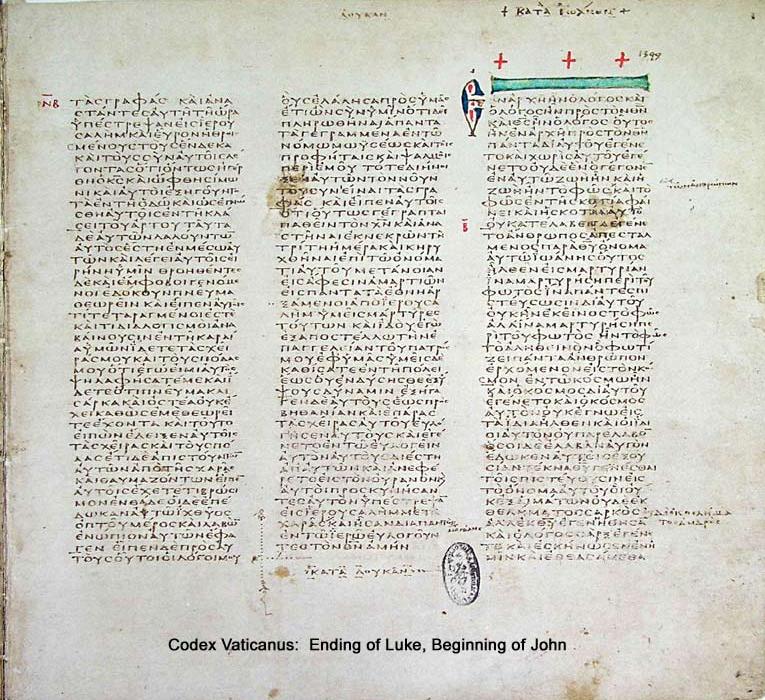

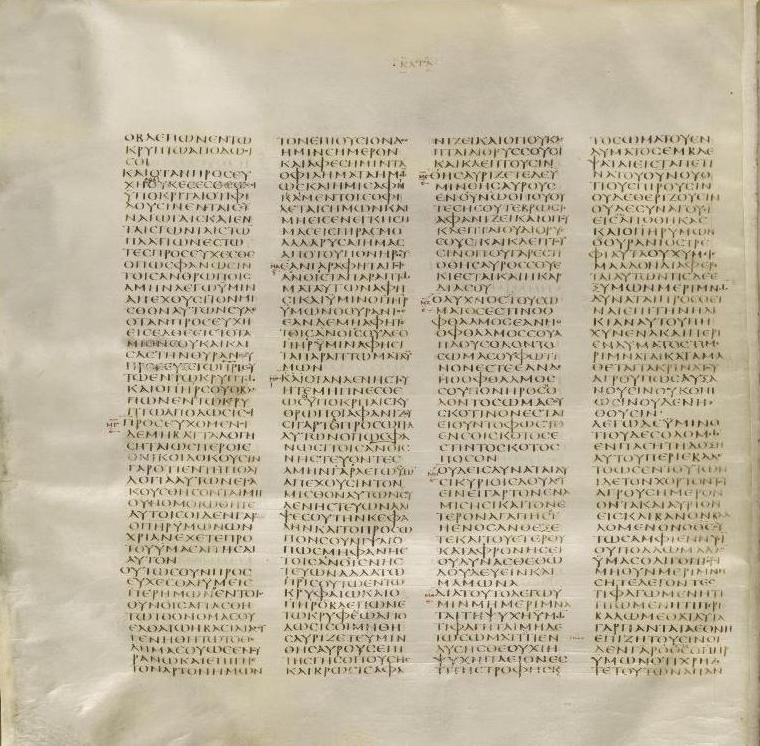
The two oldest complete (or near-complete) manuscripts of the New Testament are Codex Sinaiticus and Codex Vaticanus, both dated to the fourth century CE. Codex Sinaiticus, discovered at the Monastery of Saint Catherine on Mount Sinai and now held primarily at the British Library, contains the full text of all three synoptic Gospels.11 Codex Vaticanus, held at the Vatican Library, also contains all three synoptics, though a few leaves are missing.12 These two codices are the primary witnesses for the critical text of the synoptic Gospels as printed in the Nestle-Aland 28th edition.3
Where the synoptic Gospels contain parallel passages, the manuscript evidence occasionally shows scribal harmonization — instances where a copyist altered the text of one Gospel to match the wording of a parallel passage in another Gospel. In Mark 1:41, for example, the majority of manuscripts describe Jesus as "moved with pity" (splanchnistheis, σπλαγχνισθείς) when the leper approaches him. Codex Bezae (D, 5th century CE) and a few Old Latin manuscripts instead read "moved with anger" (orgistheis, ὀργισθείς). The reading "anger" is more difficult — a scribe is more likely to change "anger" to "pity" than the reverse — and some text critics regard orgistheis as the earlier reading, subsequently softened by copyists to match the expected portrayal of Jesus. Matthew's parallel (8:3) and Luke's parallel (5:13) both omit any reference to Jesus' emotional state at this point, neither reproducing "pity" nor "anger."3, 14, 16
Scribal harmonization is a well-documented phenomenon in the manuscript tradition of the Gospels. When a copyist was familiar with the wording of one Gospel, there was a natural tendency to adjust the text of another Gospel to conform to the more familiar version. The critical editions of the Greek New Testament note hundreds of such harmonizing variants in their apparatus, and awareness of this tendency is essential for evaluating the original wording of passages where the synoptics diverge.3, 14
Distinctive emphases in each Gospel
When the three synoptic Gospels narrate the same event, they frequently frame it with different emphases, additions, or omissions that reveal the theological concerns of each text. Examination of these modifications within parallel passages — a practice called redaction analysis — reveals patterns distinctive to each Gospel.15
The Gospel of Matthew frequently connects events in the narrative to passages from the Hebrew Bible. In describing the entry of Jesus into Jerusalem, Mark 11:7 states: "Then they brought the colt to Jesus and threw their cloaks on it; and he sat on it" (NRSV). Matthew 21:7 reads: "They brought the donkey and the colt, and put their cloaks on them, and he sat on them" (NRSV). Matthew introduces two animals (a donkey and a colt) where Mark mentions only one, and Matthew immediately quotes Zechariah 9:9: "Tell the daughter of Zion, Look, your king is coming to you, humble, and mounted on a donkey, and on a colt, the foal of a donkey" (Matthew 21:5, NRSV). The Zechariah passage uses Hebrew poetic parallelism, in which "a donkey" and "a colt, the foal of a donkey" refer to the same animal. Matthew's narrative includes both animals, apparently reading the prophetic parallelism as referring to two distinct animals.17
The Gospel of Mark presents Jesus' disciples in a consistently uncomprehending light. After the feeding of the five thousand (6:30–44) and the walking on the water (6:45–52), Mark comments: "they did not understand about the loaves, but their hearts were hardened" (6:52, NRSV). After the feeding of the four thousand, Jesus rebukes the disciples: "Do you still not perceive or understand? Are your hearts hardened? Do you have eyes, and fail to see? Do you have ears, and fail to hear?" (Mark 8:17–18, NRSV). Matthew's parallel (16:8–12) omits the references to hardened hearts and instead concludes with the disciples understanding: "Then they understood" (16:12, NRSV). The characterization of the disciples thus differs between the two Gospels, with Mark presenting persistent incomprehension and Matthew presenting eventual understanding.15, 16
The Gospel of Luke displays a consistent emphasis on prayer, the Holy Spirit, and the inclusion of marginalized groups. Luke alone mentions that Jesus was praying at the baptism (3:21), before choosing the twelve apostles (6:12), before Peter's confession (9:18), and at the transfiguration (9:28–29). Mark and Matthew do not include these references to prayer at the corresponding points. Luke's unique parables and narratives frequently feature women (the widow of Nain, 7:11–17; the woman with the ointment, 7:36–50; Martha and Mary, 10:38–42), Samaritans (the Good Samaritan, 10:25–37; the grateful Samaritan leper, 17:11–19), and the economically poor (the rich fool, 12:13–21; the rich man and Lazarus, 16:19–31).15, 18
These patterns — Matthew's fulfillment citations, Mark's emphasis on discipleship failure, Luke's attention to prayer and social reversal — are visible in the texts themselves without recourse to external sources. They emerge from placing the parallel passages side by side and observing what each Gospel adds, omits, or modifies in its treatment of shared material.15, 16, 17, 18