Overview
- The Bible contains numerous instances where the same event is narrated more than once, with the parallel versions differing in sequence, detail, emphasis, and sometimes in the basic facts of what occurred.
- Parallel accounts appear across both testaments — from the dual creation and flood narratives in Genesis, to the overlapping histories of Kings and Chronicles, to the four Gospel accounts of Jesus' life, death, and resurrection.
- Placing these accounts side by side, without harmonization or editorial commentary, reveals both the extent of their agreement and the specific points at which they diverge.
The Bible contains multiple instances in which the same event, the same period of history, or the same person's life is narrated more than once. These parallel accounts appear across both testaments: Genesis presents two creation narratives and an interwoven flood story, the books of Kings and Chronicles retell centuries of Israelite and Judean history with different numbers and different emphases, and the four Gospels narrate the life, death, and resurrection of Jesus with overlapping but non-identical details. In each case, the parallel versions agree on many points while diverging on others — sometimes in sequence, sometimes in specific facts, and sometimes in theological framing (Genesis 1:1–2:3; Genesis 2:4–25).2, 3
This article surveys the major categories of parallel material within the Bible, presenting representative examples from each. The full texts and detailed comparisons are available in the individual articles linked throughout. The approach in every case is the same: the texts are placed side by side, quoted at sufficient length to show both their agreements and their differences, and presented without harmonization or editorial judgment about which account is correct.2, 3
What parallel accounts are
A parallel account exists when two or more biblical texts narrate the same event, the same speech, or the same period of history. The parallel may be between two passages within the same book (as with the two creation accounts in Genesis 1–2), between different books covering the same historical period (as with Kings and Chronicles), or between different authors writing about the same figure (as with the four Gospels). Parallel accounts are distinct from allusions, in which a later text echoes an earlier one without retelling the same event, and from quotations, in which a later text cites an earlier text verbatim.1, 3
The existence of parallel accounts within the Bible is a textual fact, observable in any translation. The Gospel of Matthew and the Gospel of Luke both contain accounts of Jesus' birth, but the two accounts name different locations, different participants, and different sequences of events. The book of 2 Samuel and the book of 1 Chronicles both narrate David's census of Israel, but they attribute the instigation of the census to different agents. These are not matters of interpretation; they are features of the texts as written (2 Samuel 24:1; 1 Chronicles 21:1; Matthew 1:1–17; Luke 3:23–38).3
Parallel material appears throughout the Bible in several distinct forms. Doublets are two versions of the same event within a single book or continuous narrative, such as the two creation accounts in Genesis or the two accounts of how David entered Saul's service in 1 Samuel. Synoptic parallels are passages shared across two or more of the first three Gospels (Matthew, Mark, and Luke), which frequently reproduce the same episodes in the same order, sometimes with verbatim agreement and sometimes with significant variation. Cross-book parallels are retellings of the same history in separate books composed at different times, such as the overlap between Samuel-Kings and Chronicles.1, 3
Old Testament doublets
The Hebrew Bible contains a number of passages in which the same event appears to be narrated twice within a single book. These internal doublets are observable at the level of the text itself and do not require external evidence to identify.3
,_Creation_of_the_world,_and_Eve,_Walters_Manuscript_W.805,_fol._6v_detail.jpg)
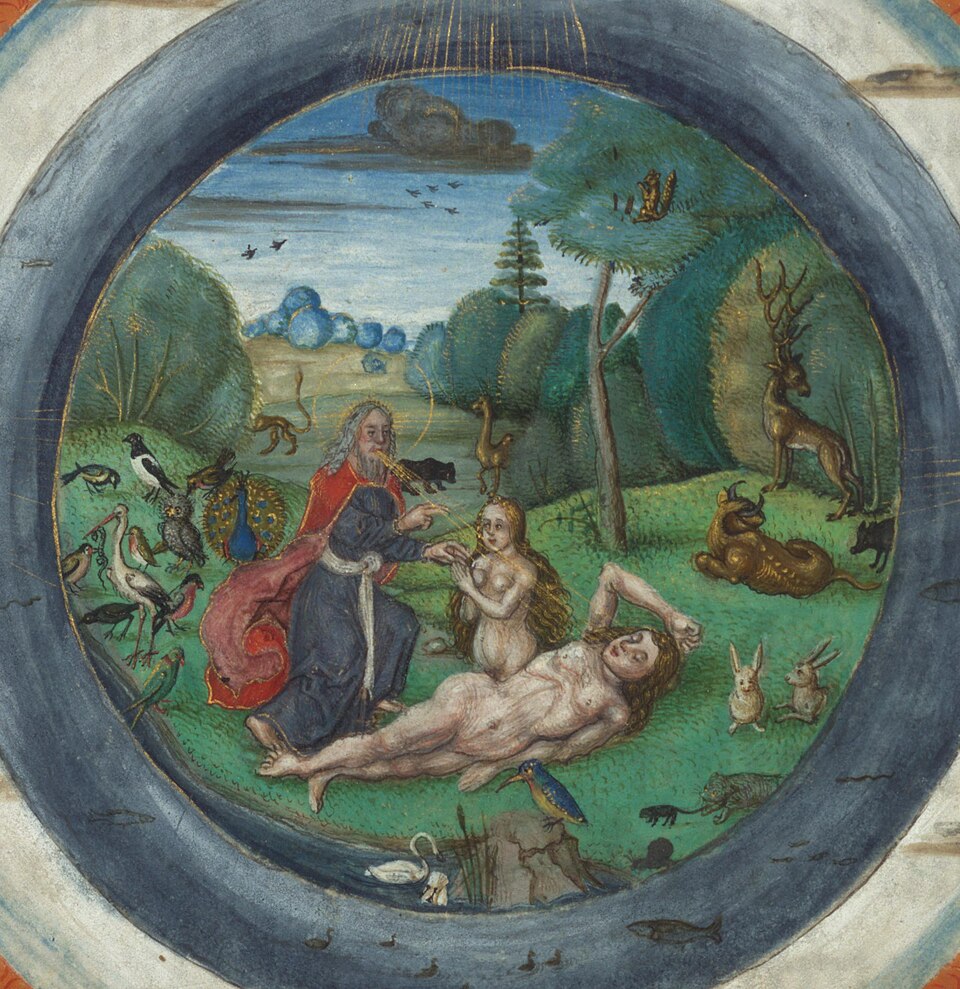
The most extensive example is the pair of creation narratives in Genesis. Genesis 1:1–2:3 presents creation as a structured seven-day sequence in which light, sky, land, vegetation, celestial bodies, sea creatures, land animals, and humankind are created in that order, with male and female humans created simultaneously as the final act. Genesis 2:4–25 presents creation beginning from a dry, barren earth, with the man formed first from dust, followed by vegetation, then animals, then the woman from the man's rib. The first account uses the divine name Elohim (אֱלֹהִים); the second uses YHWH Elohim (יהוה אֱלֹהִים). The first proceeds by verbal command; the second describes manual formation. The full comparison of these texts is presented in Creation accounts (Genesis 1:1–2:3; Genesis 2:4–25).4
The flood narrative in Genesis 6–9 presents another case.3 Two sets of instructions regarding the animals on the ark appear within the same continuous text. In Genesis 6:19–20, God instructs Noah: "And of every living thing, of all flesh, you shall bring two of every kind into the ark, to keep them alive with you; they shall be male and female. Of the birds according to their kinds, and of the animals according to their kinds, of every creeping thing of the ground according to its kind, two of every kind shall come in to you, to keep them alive" (NRSV). In Genesis 7:2–3, the LORD instructs Noah: "Take with you seven pairs of all clean animals, the male and its mate; and a pair of the animals that are not clean, the male and its mate; and seven pairs of the birds of the air also, male and female, to keep their kind alive on the face of all the earth" (NRSV). The first instruction specifies two of every kind without distinction. The second specifies seven pairs of clean animals and one pair of unclean animals (Genesis 6–9; Genesis 6:19–20; Genesis 7:2–3).3
In 1 Samuel, the text provides two accounts of how David came to Saul's attention.3 In 1 Samuel 16:14–23, Saul is tormented by an evil spirit and his servants recommend a skilled musician. David is identified, brought to Saul, and becomes Saul's armor-bearer: "So David came to Saul, and entered his service. Saul loved him greatly, and he became his armor-bearer" (1 Samuel 16:21, NRSV). In the following chapter, after David kills Goliath, Saul asks Abner: "Abner, whose son is this young man?" Abner replies: "As your soul lives, O king, I do not know." Saul then instructs: "Inquire whose son the stripling is" (1 Samuel 17:55–56, NRSV). In the first passage, David has entered Saul's household and become his armor-bearer. In the second, Saul does not know who David is (1 Samuel 16:14–23; 1 Samuel 17:55–58).3
Kings and Chronicles
The books of 1–2 Kings and 1–2 Chronicles cover much of the same historical period — from the reign of David through the Babylonian exile — but they present this history with different numbers, different theological emphases, and different selections of material. Kings is part of the Deuteronomistic History, a narrative stretching from Joshua through 2 Kings. Chronicles is a later retelling, generally dated to the fourth century BCE, that draws on Kings as a source while reshaping the narrative to emphasize the temple, the priesthood, and the Davidic line.6
Where the two histories narrate the same event, they sometimes provide different figures.6 The age of Jehoiachin at his accession illustrates this. 2 Kings 24:8 states: “Jehoiachin was eighteen years old when he began to reign; he reigned three months in Jerusalem” (NRSV). 2 Chronicles 36:9 states: “Jehoiachin was eight years old when he began to reign; he reigned three months and ten days in Jerusalem” (NRSV). The difference is ten years in the king’s age and ten days in the length of his reign (2 Kings 24:8; 2 Chronicles 36:9).6
The instigation of David's census provides another case. 2 Samuel 24:1 states: "Again the anger of the LORD was kindled against Israel, and he incited David against them, saying, 'Go, count the people of Israel and Judah'" (NRSV). 1 Chronicles 21:1 narrates the same event: "Satan stood up against Israel, and incited David to count the people of Israel" (NRSV). In the Samuel account, the LORD incites David to take the census. In the Chronicles account, Satan incites David. The Hebrew word satan (שָׂטָן) in 1 Chronicles 21:1 appears without the definite article, which has led to discussion about whether the term refers to a specific supernatural figure or to an adversary in a more general sense. In the parallel text of 2 Samuel, no such figure appears; the incitement comes from the LORD directly (2 Samuel 24:1; 1 Chronicles 21:1).4
The full comparison of Kings and Chronicles — including numerical differences, material unique to each book, and episodes that appear in one but are absent from the other — is presented in Kings and Chronicles.6
The synoptic Gospels
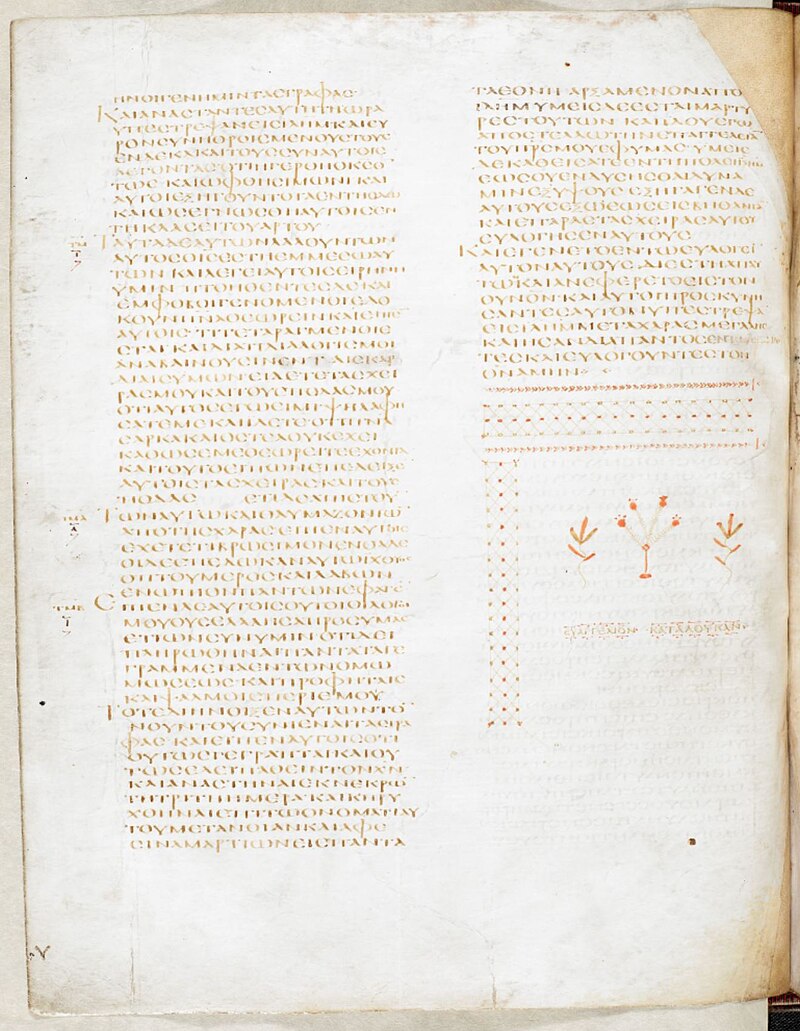

The first three Gospels — Matthew, Mark, and Luke — are called "synoptic" (from the Greek synoptikos, συνοπτικός, "seeing together") because they share a substantial body of material that can be arranged in parallel columns for side-by-side comparison. The degree of verbal overlap is extensive: of Mark's 661 verses, approximately 600 have parallels in Matthew, and approximately 350 have parallels in Luke. Matthew and Luke also share approximately 235 verses of material (primarily sayings of Jesus) that do not appear in Mark.1, 2
The agreement among the synoptic Gospels extends to the order of events: all three present the baptism of Jesus, a period of teaching and healing in Galilee, a journey southward, and a final week in Jerusalem culminating in the crucifixion and burial. Within this shared framework, the individual Gospels rearrange, expand, compress, and modify specific episodes. The Sermon on the Mount in Matthew 5–7, for example, is a sustained discourse delivered on a mountain. The parallel material in Luke is dispersed across multiple chapters and is introduced in Luke 6:17 as having been delivered "on a level place" rather than a mountain.1, 7
When the synoptic Gospels narrate the same episode, the parallels sometimes show verbatim agreement extending across multiple sentences and sometimes show significant differences in a single detail. Mark 15:25 states that Jesus was crucified at “the third hour” (approximately 9:00 a.m. in the Jewish reckoning of daytime hours from sunrise). The Gospel of John, narrating the same event, states that at “about the sixth hour” (approximately noon) Pilate was still presenting Jesus to the crowd and had not yet handed him over for crucifixion (Mark 15:25; John 19:14).5, 7
The detailed presentation of synoptic parallels, including the extent of verbatim agreement, the material unique to each Gospel, and the question of literary dependence among the three texts, is available in The synoptic Gospels.1
The genealogies of Jesus
Two of the four Gospels provide genealogies for Jesus: Matthew 1:1–17 and Luke 3:23–38. Both trace Jesus' lineage through Joseph, and both include David and Abraham. Between David and Joseph, however, the two lists name almost entirely different ancestors.5, 8
The Gospel of Matthew traces the lineage from Abraham forward to Jesus through forty-two generations (organized into three groups of fourteen). The line passes from David through Solomon and the subsequent kings of Judah. The Gospel of Luke traces the lineage backward from Jesus to Adam through seventy-seven generations. The line passes from David through Nathan, a different son of David who was not a king of Judah. From David to Joseph, the two genealogies share only two names: Shealtiel and Zerubbabel (Matthew 1:1–17; Luke 3:23–38).7
The following table shows the divergence from David to Joseph, presenting the names as they appear in each Gospel:
Genealogy of Jesus from David to Joseph: Matthew 1 and Luke 3 (Matthew 1:1–17; Luke 3:23–38)
| Matthew 1:6–16 (NRSV) | Luke 3:23–31 (NRSV) |
|---|---|
| David | David |
| Solomon | Nathan |
| Rehoboam | Mattatha |
| Abijah | Menna |
| Asaph | Melea |
| Jehoshaphat | Eliakim |
| Joram | Jonam |
| Uzziah | Joseph |
| Jotham | Judah |
| Ahaz | Simeon |
| Hezekiah | Levi |
| Manasseh | Matthat |
| Amos | Jorim |
| Josiah | Eliezer |
| Jechoniah | Joshua |
| Shealtiel | Er |
| Zerubbabel | Elmadam |
| Abiud | Cosam |
| Eliakim | Addi |
| Azor | Melchi |
| Zadok | Neri |
| Achim | Shealtiel |
| Eliud | Zerubbabel |
| Eleazar | Rhesa |
| Matthan | Joanan |
| Jacob | Joda |
| Joseph | Josech |
| — | Semein |
| — | Mattathias |
| — | Maath |
| — | Naggai |
| — | Hesli |
| — | Nahum |
| — | Amos |
| — | Mattathias |
| — | Joseph |
| — | Jannai |
| — | Melchi |
| — | Levi |
| — | Matthat |
| — | Heli |
| — | Joseph |
The father of Joseph is Jacob in Matthew 1:16 and Heli in Luke 3:23. Matthew’s genealogy contains twenty-seven generations from David to Jesus; Luke’s contains forty-two. Even where the two lists share the names Shealtiel and Zerubbabel, they place these figures at different positions in the sequence and name different fathers for Shealtiel: Jechoniah in Matthew, Neri in Luke. The full name-by-name comparison is presented in Genealogies of Jesus (Matthew 1:1–17; Luke 3:23–38).5, 7
Passion and resurrection narratives
All four Gospels narrate the arrest, trial, crucifixion, death, burial, and resurrection of Jesus. These passion and resurrection narratives share a common basic sequence — arrest, Jewish hearing, Roman trial, crucifixion, burial, empty tomb — while diverging on numerous specific details.2, 5
The death of Judas provides a compact example of how two New Testament texts narrate the same event differently.8 The Gospel of Matthew reports that after Jesus was condemned, Judas repented, returned the thirty pieces of silver to the chief priests, and hanged himself:
Matthew 27:3–8, NRSVWhen Judas, his betrayer, saw that Jesus was condemned, he repented and brought back the thirty pieces of silver to the chief priests and the elders. He said, "I have sinned by betraying innocent blood." But they said, "What is that to us? See to it yourself." Throwing down the pieces of silver in the temple, he departed; and he went and hanged himself. But the chief priests, taking the pieces of silver, said, "It is not lawful to put them into the treasury, since they are blood money." After conferring together, they used them to buy the potter's field as a place to bury foreigners. For this reason that field has been called the Field of Blood to this day.
The book of Acts provides a different account of Judas's death, placed in a speech attributed to Peter (Acts 1:18–19):
Acts 1:18–19, NRSVNow this man acquired a field with the reward of his wickedness; and falling headlong, he burst open in the middle and all his bowels gushed out. This became known to all the residents of Jerusalem, so that the field was called in their language Hakeldama, that is, Field of Blood.
In Matthew’s account, Judas returns the money to the priests, who buy the field; Judas dies by hanging. In Acts, Judas himself acquires the field with the money; he dies by falling and bursting open. Both accounts agree that a field was associated with Judas and with the name “Field of Blood,” but they differ on who purchased the field, what Judas did with the money, and how Judas died (Matthew 27:3–10; Acts 1:18–19).8
The resurrection narratives present a similar pattern of agreement on the central event — women discover an empty tomb on the first day of the week — alongside differences in the participants, the figures encountered at the tomb, the message delivered, and the sequence of subsequent appearances.5 The Gospel of Mark names three women (Mary Magdalene, Mary the mother of James, and Salome) and ends, in the earliest manuscripts, with the women fleeing the tomb in fear and telling no one. The Gospel of Matthew names two women and reports an earthquake, an angel rolling back the stone, and guards falling like dead men. The Gospel of Luke names at least five women and reports two men in dazzling clothes. The Gospel of John names only Mary Magdalene and describes her encountering the risen Jesus outside the tomb in a scene that appears in no other Gospel (Mark 16:1–8; Luke 24:1–12; Matthew 28:1–10; John 20:1–18).2, 5
The detailed comparison of all four resurrection accounts is available in Resurrection accounts. The trial, crucifixion, and death narratives are compared in Passion narratives.2
The conquest of Canaan
The books of Joshua and Judges present two different pictures of how the Israelites took possession of the land of Canaan. The book of Joshua describes a rapid, comprehensive military campaign under a single leader. The book of Judges describes a gradual, incomplete, and tribe-by-tribe process of settlement that continued long after Joshua's death.6
Joshua 10:40–42 summarizes the southern campaign:
Joshua 10:40–42, NRSVSo Joshua defeated the whole land, the hill country and the Negeb and the lowland and the slopes, and all their kings; he left no one remaining, but utterly destroyed all that breathed, as the LORD God of Israel commanded. And Joshua defeated them from Kadesh-barnea to Gaza, and all the country of Goshen, as far as Gibeon. Joshua took all these kings and their land at one time, because the LORD God of Israel fought for Israel.
Joshua 11:23 provides an even broader summary: "So Joshua took the whole land, according to all that the LORD had spoken to Moses; and Joshua gave it for an inheritance to Israel according to their tribal allotments. And the land had rest from war" (NRSV) (Joshua 11:23).
Yet even within the book of Joshua, a different picture emerges. Joshua 13:1 states: “Now Joshua was old and advanced in years; and the LORD said to him, ‘You are old and advanced in years, and very much of the land still remains to be possessed’” (NRSV). The text thus contains both a statement that Joshua took “the whole land” (11:23) and a statement that “very much of the land still remains to be possessed” (13:1) (Joshua 11:23; Joshua 13:1).6
The opening chapter of Judges describes a markedly different situation. Judges 1 catalogs the cities and regions that individual tribes failed to conquer:
Judges 1:19–33 (selected), NRSVJudah could not drive out the inhabitants of the plain, because they had chariots of iron. ... But the Benjaminites did not drive out the Jebusites who lived in Jerusalem; so the Jebusites have lived in Jerusalem among the Benjaminites to this day. ... Manasseh did not drive out the inhabitants of Beth-shean and its villages, or Taanach and its villages, or the inhabitants of Dor and its villages, or the inhabitants of Ibleam and its villages, or the inhabitants of Megiddo and its villages; but the Canaanites continued to live in that land. ... Ephraim did not drive out the Canaanites who lived in Gezer; so the Canaanites lived among them in Gezer. ... Zebulun did not drive out the inhabitants of Kitron, or the inhabitants of Nahalol; so the Canaanites lived among them. ... Asher did not drive out the inhabitants of Acco, or the inhabitants of Sidon. ... Naphtali did not drive out the inhabitants of Beth-shemesh, or the inhabitants of Beth-anath.
Joshua presents a completed conquest; Judges presents a land still largely in Canaanite hands (Joshua 10:40–42; Judges 1:19–33).6 The full comparison is available in Conquest narratives.
Patterns across parallel accounts
Several recurring features appear when the parallel accounts across the Bible are examined together. These patterns are descriptive, not explanatory — they describe what is observable in the texts without asserting a cause.1, 3
The first pattern is variation in specific numbers and names. Matthew's genealogy contains forty-two generations from Abraham to Jesus; Luke's contains seventy-seven from Jesus to Adam. Jehoiachin is eighteen years old in 2 Kings 24:8 and eight years old in 2 Chronicles 36:9. The duration of the flood is forty days in Genesis 7:17 and one hundred fifty days in Genesis 7:24. These numerical differences appear across both testaments and across different genres of biblical literature (Genesis 6–9; Matthew 1:1–17; Luke 3:23–38; 2 Kings 24:8; 2 Chronicles 36:9).6
The second pattern is variation in theological emphasis. The books of Kings evaluate monarchs primarily by their fidelity to exclusive worship of YHWH and their relationship to the Jerusalem temple. Chronicles retains this concern but adds an intensified focus on the Levitical priesthood, temple music, and cultic regulations, while omitting or condensing material about the northern kingdom of Israel. In the Gospels, each evangelist shapes shared material to fit a distinct theological framework: the Gospel of Matthew organizes Jesus' teaching into five major discourses, echoing the five books of Moses; the Gospel of Luke emphasizes Jesus' concern for the poor, women, and Gentiles; the Gospel of John presents extended theological discourses with no parallel in the synoptic Gospels.1, 5, 6
The third pattern is variation in what is included and what is omitted. Chronicles omits David's adultery with Bathsheba (narrated in 2 Samuel 11–12), Amnon's rape of Tamar (2 Samuel 13), and Absalom's rebellion (2 Samuel 15–18). The Gospel of Mark contains no birth narrative, no genealogy, and no resurrection appearances in its earliest manuscript form. The Gospel of John contains no account of Jesus' baptism by John the Baptist, no Gethsemane prayer scene, and no institution of the eucharist at the last supper. Each text selects from the available tradition according to its own purposes.2, 5, 6
The fourth pattern is variation in the causal or agentive framework of the same event. The LORD incites David's census in 2 Samuel 24:1; Satan incites it in 1 Chronicles 21:1. In Mark's account of the empty tomb, the women are told to inform the disciples that Jesus is going ahead of them to Galilee (Mark 16:7); in Luke's account, the message makes no mention of Galilee, and all subsequent appearances occur in or near Jerusalem (Luke 24). The event is the same; the agent, location, or mechanism differs (2 Samuel 24:1; 1 Chronicles 21:1; Mark 16:1–8; Luke 24:1–12).3, 6
The scope of agreement
The parallel accounts in the Bible are not defined solely by their differences. In every case, the parallel texts agree on the core event or claim while diverging on surrounding details. Both creation accounts present a single deity creating the world and its inhabitants. Both versions of the flood narrative describe a divinely caused deluge from which one family is preserved in an ark. All four Gospels report that Jesus of Nazareth was crucified under Pontius Pilate, was buried, and that his tomb was found empty by women on the first day of the week. Kings and Chronicles agree on the sequence of Judean monarchs and on the basic arc of Judah's history from David to exile (Genesis 1:1–2:3; Genesis 2:4–25; Genesis 6–9).2, 6
The synoptic Gospels in particular display a level of verbal agreement that goes beyond independent reporting of the same events. When Matthew, Mark, and Luke narrate the same episode, they frequently reproduce not just the same facts but the same sentences, sometimes in the same word order, across passages extending for multiple verses. This degree of verbal parallelism indicates a literary relationship among the texts — that is, one or more of the evangelists had access to one or more of the other Gospels or to a shared written source. The nature and direction of this literary dependence is the subject of the synoptic problem, which is examined in detail in The synoptic Gospels.1, 2
The following table summarizes the major categories of parallel material in the Bible, with representative examples of both agreement and divergence in each category:
Major parallel accounts in the Bible: agreement and divergence1, 2
| Parallel | Texts | Shared core | Point of divergence |
|---|---|---|---|
| Creation accounts | Genesis 1:1–2:3 / Genesis 2:4–25 | One God creates world and humanity | Order of creation; divine name; literary style |
| Flood narratives | Genesis 6–9 (interwoven) | God sends flood; Noah's family preserved | Number of animals; duration of flood; divine name |
| David's census | 2 Samuel 24 / 1 Chronicles 21 | David counts Israel; plague follows | Who incites the census (LORD vs. Satan) |
| Jehoiachin's age | 2 Kings 24:8 / 2 Chronicles 36:9 | Jehoiachin becomes king; reigns briefly | Age at accession (18 vs. 8) |
| Genealogies of Jesus | Matthew 1 / Luke 3 | Joseph descends from David and Abraham | Line of descent; number of generations; father of Joseph |
| Death of Judas | Matthew 27:3–10 / Acts 1:18–19 | Judas dies; field called "Field of Blood" | Manner of death; who buys the field |
| Empty tomb | Matthew 28 / Mark 16 / Luke 24 / John 20 | Women find tomb empty on first day | Number of women; figures at tomb; message given |
| Conquest of Canaan | Joshua 10–11 / Judges 1 | Israel enters Canaan after the exodus | Complete vs. incomplete conquest |
Approaches to reading parallel texts
The presence of parallel accounts within a single canonical collection raises questions about how these texts relate to one another. Several distinct approaches to reading parallel material exist, each rooted in different assumptions about the nature of the texts. This article does not advocate for any approach; it describes them so that the reader can identify the framework operative in any given discussion.1, 5
One approach treats the parallel accounts as complementary. On this reading, the differences between two accounts reflect different perspectives on the same event, each contributing information the other omits. Genesis 1 provides the cosmic view; Genesis 2 zooms in on the human story. Matthew's genealogy traces the royal line through Solomon; Luke's traces a collateral line through Nathan. The differences are real but not in tension because the two accounts are describing the same event from different angles. Proponents of this approach typically assume a unified authorial intent behind the final form of the text, whether attributed to a single human author or to divine inspiration.8
A second approach treats the parallel accounts as evidence of multiple sources. On this reading, the differences between two versions of the same story indicate that they originated independently and were later combined. The two creation accounts in Genesis reflect two distinct literary traditions, sometimes designated J (Yahwist) and P (Priestly), that a later editor placed side by side. The synoptic Gospels reflect literary dependence among three authors, each of whom adapted shared source material for a distinct audience. This approach focuses on the compositional history of the text and treats differences as clues to the process by which the text reached its present form.1, 3
A third approach focuses on the final form of the text without speculating about its compositional history. On this reading, the question is not where the parallel accounts came from but how they function together within the canonical text as it exists. The juxtaposition of two creation accounts in Genesis, whatever its historical origin, creates a literary effect: a cosmic panorama followed by an intimate portrait. The four Gospels, whatever their sources, present a multi-perspectival portrait of Jesus that is richer than any single account could provide. This approach sets aside questions of historical origin in favor of literary and theological analysis of the received text.5
Each of these approaches engages the same textual data — the same parallels, the same agreements, the same divergences. The articles in this section present that textual data without presupposing any one framework. The texts are quoted at length, placed side by side, and left to speak for themselves.2
Individual parallel account studies
Each of the major categories of parallel material in the Bible is examined in its own article, with full quotations, side-by-side tables, and attention to the original languages where relevant. The following articles present the detailed comparisons that this hub article has surveyed in summary.2, 3
Creation accounts compares Genesis 1:1–2:3 and Genesis 2:4–25, quoting both passages in full and examining differences in sequence, vocabulary, divine naming, literary style, and starting conditions.3
Flood narratives separates the interwoven strands of the Genesis flood story (chapters 6–9), comparing the instructions about animals, the duration of the flood, the mechanism of the flood, and the divine names used throughout.3
Kings and Chronicles places the overlapping histories of 1–2 Kings and 1–2 Chronicles side by side, documenting numerical differences, material unique to each book, and the distinct theological frameworks that shape each retelling.6
The synoptic Gospels examines the parallel material shared by Matthew, Mark, and Luke, including the extent of verbatim agreement, the order of episodes, material unique to each Gospel, and the literary relationship among the three texts.1, 2
Genealogies of Jesus compares the genealogies in Matthew 1 and Luke 3 name by name, documenting the divergence in the line of descent from David to Joseph, the different number of generations, and the different structural organization of each list.5, 7
Resurrection accounts presents all four Gospel accounts of the empty tomb and post-resurrection appearances in parallel, comparing the women named, the figures at the tomb, the message delivered, and the locations of subsequent appearances.2, 5
Passion narratives compares the trial, crucifixion, and death of Jesus across all four Gospels, examining the sequence of events, the words spoken from the cross, the timing of the crucifixion, and the details surrounding Jesus' death.2, 5
Conquest narratives places the account of Joshua's swift, total conquest alongside the account in Judges of a gradual, incomplete settlement, quoting the summary statements of each book and the specific cities and regions that each text describes.6