Overview
- Genesis contains two creation narratives (1:1–2:3 and 2:4–25) that differ in sequence, vocabulary, and literary structure
- The first account follows a seven-day framework using the name Elohim; the second begins with a barren earth and uses YHWH Elohim
- The order of creation differs: the first places humans last, after vegetation and animals; the second places the man first, before vegetation and animals
The opening chapters of Genesis contain two distinct accounts of creation. The first, spanning Genesis 1:1 through 2:3, presents creation as a structured sequence of divine acts spread across seven days, culminating in a day of rest. The second, beginning at Genesis 2:4 and continuing through 2:25, describes the formation of a single man from the ground, the planting of a garden, and the creation of animals and a woman as companions for the man. The two accounts differ in their sequence of creative events, in the name used for the deity, in their literary style, and in their starting conditions (Genesis 1:1–2:3; Genesis 2:4–25).
What follows is a presentation of both texts, quoted at length from the New Revised Standard Version, followed by a side-by-side comparison of their sequences and an examination of the vocabulary, literary structure, and ancient Near Eastern background of each account.4, 9
The first account (Genesis 1:1–2:3)
The first creation narrative opens with the creation of the heavens and the earth and proceeds through a series of divine commands, each introduced by the phrase "And God said." The deity is referred to throughout as Elohim (Hebrew: 'Elohim, אֱלֹהִים), a plural noun used with singular verbs when referring to the God of Israel.3, 12 Creation unfolds across six days, with a seventh day of rest. The full text of the account reads as follows:
Genesis 1:1–2:3, NRSVIn the beginning when God created the heavens and the earth, the earth was a formless void and darkness covered the face of the deep, while a wind from God swept over the face of the waters. Then God said, "Let there be light"; and there was light. And God saw that the light was good; and God separated the light from the darkness. God called the light Day, and the darkness he called Night. And there was evening and there was morning, the first day.
And God said, "Let there be a dome in the midst of the waters, and let it separate the waters from the waters." So God made the dome and separated the waters that were under the dome from the waters that were above the dome. And it was so. God called the dome Sky. And there was evening and there was morning, the second day.
And God said, "Let the waters under the sky be gathered together into one place, and let the dry land appear." And it was so. God called the dry land Earth, and the waters that were gathered together he called Seas. And God saw that it was good. Then God said, "Let the earth put forth vegetation: plants yielding seed, and fruit trees of every kind on earth that bear fruit with the seed in it." And it was so. The earth brought forth vegetation: plants yielding seed of every kind, and trees of every kind bearing fruit with the seed in it. And God saw that it was good. And there was evening and there was morning, the third day.
And God said, "Let there be lights in the dome of the sky to separate the day from the night; and let them be for signs and for seasons and for days and years, and let them be lights in the dome of the sky to give light upon the earth." And it was so. God made the two great lights — the greater light to rule the day and the lesser light to rule the night — and the stars. God set them in the dome of the sky to give light upon the earth, to rule over the day and over the night, and to separate the light from the darkness. And God saw that it was good. And there was evening and there was morning, the fourth day.
And God said, "Let the waters bring forth swarms of living creatures, and let birds fly above the earth across the dome of the sky." So God created the great sea monsters and every living creature that moves, of every kind, with which the waters swarm, and every winged bird of every kind. And God saw that it was good. God blessed them, saying, "Be fruitful and multiply and fill the waters in the seas, and let birds multiply on the earth." And there was evening and there was morning, the fifth day.
And God said, "Let the earth bring forth living creatures of every kind: cattle and creeping things and wild animals of the earth of every kind." And it was so. God made the wild animals of the earth of every kind, and the cattle of every kind, and everything that creeps upon the ground of every kind. And God saw that it was good.
Then God said, "Let us make humankind in our image, according to our likeness; and let them have dominion over the fish of the sea, and over the birds of the air, and over the cattle, and over all the wild animals of the earth, and over every creeping thing that creeps upon the earth." So God created humankind in his image, in the image of God he created them; male and female he created them. God blessed them, and God said to them, "Be fruitful and multiply, and fill the earth and subdue it; and have dominion over the fish of the sea and over the birds of the air and over every living thing that moves upon the earth." God said, "See, I have given you every plant yielding seed that is upon the face of all the earth, and every tree with seed in its fruit; you shall have them for food. And to every beast of the earth, and to every bird of the air, and to everything that creeps on the earth, everything that has the breath of life, I shall have given every green plant for food." And it was so. God saw everything that he had made, and indeed, it was very good. And there was evening and there was morning, the sixth day.
Thus the heavens and the earth were finished, and all their multitude. And on the seventh day God finished the work that he had done, and he rested on the seventh day from all the work that he had done. So God blessed the seventh day and hallowed it, because on it God rested from all the work that he had done in creation.
The account is organized by a strict formulaic pattern. Each day follows the same structure: a divine command ("And God said"), an execution report ("And it was so"), an evaluation ("And God saw that it was good"), and a day-closing formula ("And there was evening and there was morning, the nth day"). This structure occurs six times, with only the second day lacking the explicit evaluation of goodness.4, 7
The sequence of creation in this account proceeds as follows: on day one, light is separated from darkness. On day two, the dome (raqia', רָקִיעַ) divides the waters above from the waters below. On day three, dry land appears and vegetation grows. On day four, the sun, moon, and stars are placed in the dome. On day five, sea creatures and birds are created. On day six, land animals are made, followed by humankind — male and female together, created simultaneously in the image of God. On day seven, God rests (Genesis 1:1–2:3).4
The Hebrew term raqia' (רָקִיעַ), translated "dome" in the NRSV and "expanse" or "firmament" in other translations, derives from the root raqa' (רקע), meaning to beat or stamp out, as in hammering metal into a thin sheet.12 The text describes this structure as a solid barrier holding back waters above it — an understanding consistent with ancient Near Eastern cosmography, in which the sky was conceived as a physical vault separating the habitable world from celestial waters.10, 16
The text states that humankind ('adam, אָדָם, used here as a generic noun meaning "humanity") is created "male and female" in a single act, with no temporal gap between the creation of the man and the woman. Both are given dominion over the animals, and both receive the command to be fruitful and multiply (Genesis 1:1–2:3).4, 7
The second account (Genesis 2:4–25)
The second creation narrative begins with a different starting condition. Where the first account opens with a watery chaos ("the earth was a formless void and darkness covered the face of the deep"), the second opens with a dry, barren landscape in which no plants have yet grown because there is no rain and no one to till the ground. The deity is now referred to as YHWH Elohim (Hebrew: יהוה אֱלֹהִים), translated "the LORD God" in most English versions, combining the personal name of the God of Israel with the generic term for deity (Genesis 2:4–25).3 The full text reads:
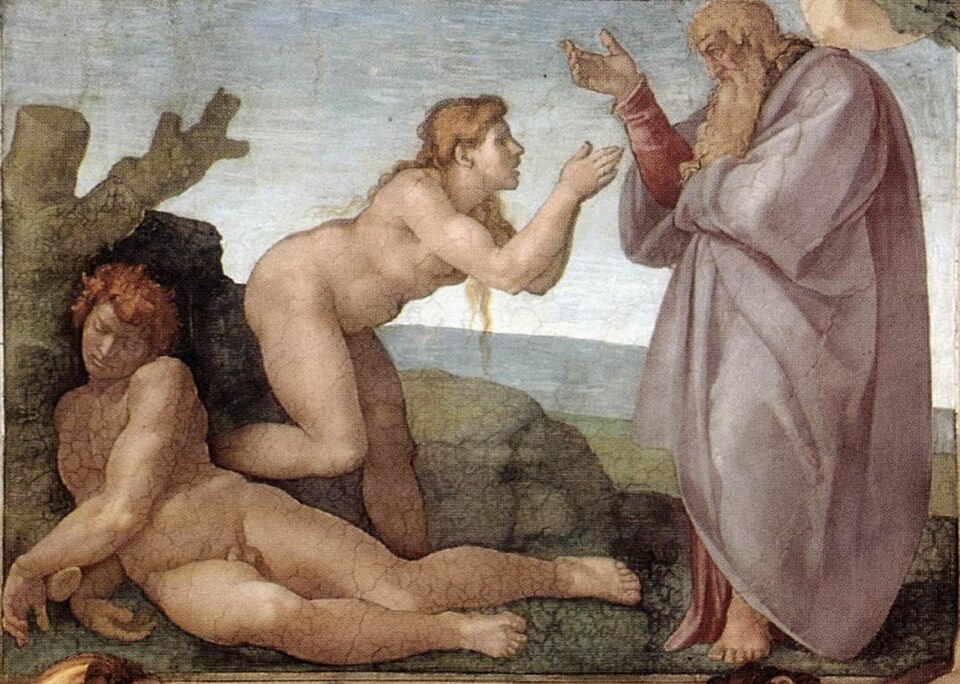

Genesis 2:4–25, NRSVThese are the generations of the heavens and the earth when they were created.
In the day that the LORD God made the earth and the heavens, when no plant of the field was yet in the earth and no herb of the field had yet sprung up — for the LORD God had not caused it to rain upon the earth, and there was no one to till the ground; but a stream would rise from the earth, and water the whole face of the ground — then the LORD God formed man from the dust of the ground, and breathed into his nostrils the breath of life; and the man became a living being.
And the LORD God planted a garden in Eden, in the east; and there he put the man whom he had formed. Out of the ground the LORD God made to grow every tree that is pleasant to the sight and good for food, the tree of life also in the midst of the garden, and the tree of the knowledge of good and evil.
A river flows out of Eden to water the garden, and from there it divides and becomes four branches. The name of the first is Pishon; it is the one that flows around the whole land of Havilah, where there is gold; and the gold of that land is good; bdellium and onyx stone are there. The name of the second river is Gihon; it is the one that flows around the whole land of Cush. The name of the third river is Tigris, which flows east of Assyria. And the fourth river is the Euphrates.
The LORD God took the man and put him in the garden of Eden to till it and keep it. And the LORD God commanded the man, "You may freely eat of every tree of the garden; but of the tree of the knowledge of good and evil you shall not eat, for in the day that you eat of it you shall die."
Then the LORD God said, "It is not good that the man should be alone; I will make him a helper as his partner." So out of the ground the LORD God formed every animal of the field and every bird of the air, and brought them to the man to see what he would call them; and whatever the man called every living creature, that was its name. The man gave names to all cattle, and to the birds of the air, and to every animal of the field; but for the man there was not found a helper as his partner.
So the LORD God caused a deep sleep to fall upon the man, and he slept; then he took one of his ribs and closed up its place with flesh. And the rib that the LORD God had taken from the man he made into a woman and brought her to the man. Then the man said, "This at last is bone of my bones and flesh of my flesh; this one shall be called Woman, for out of Man this one was taken." Therefore a man leaves his father and his mother and clings to his wife, and they become one flesh. And the man and his wife were both naked, and were not ashamed.
The sequence of creation in this account differs from that of the first. The starting condition is an arid landscape with no vegetation, rather than a watery void. The first creative act is the formation of the man ('adam, here used as an individual, formed from 'adamah, "ground" — a wordplay connecting the man to the soil from which he comes).12 After the man is formed, YHWH Elohim plants a garden and causes trees to grow. The man is placed in the garden and given a prohibition regarding one tree. Only then does the text state that YHWH Elohim forms animals "out of the ground" and brings them to the man for naming. When no suitable companion is found among the animals, the woman is created from the man's rib (Genesis 2:4–25).4, 18
The mode of creation also differs. In the first account, God creates by verbal command — "Let there be" — and the world responds. In the second, YHWH Elohim works with material: forming (yatsar, יָצַר, the verb used for a potter shaping clay) the man from dust, breathing into his nostrils, planting a garden, building (banah, בָּנָה) the woman from a rib.12, 18 The first account describes cosmic, transcendent action. The second describes manual, intimate action.
Sequence comparison
The following table presents the order of creative acts as they appear in each account. The left column lists the sequence from Genesis 1:1–2:3; the right column lists the sequence from Genesis 2:4–25. The table presents only what each text states, without commentary (Genesis 1:1–2:3; Genesis 2:4–25).
Order of creation in the two Genesis accounts
| Genesis 1:1–2:3 | Genesis 2:4–25 |
|---|---|
| Light (day 1) | Man, formed from dust |
| Dome separating waters (day 2) | Garden planted; trees grow |
| Dry land and vegetation (day 3) | Rivers described |
| Sun, moon, and stars (day 4) | Man placed in garden with prohibition |
| Sea creatures and birds (day 5) | Animals formed from ground, brought to man |
| Land animals (day 6a) | Man names animals; no helper found |
| Humankind, male and female together (day 6b) | Woman built from man's rib |
| God rests (day 7) | — |
In the first account, vegetation appears on day three, animals on days five and six, and humankind (male and female together) at the end of day six. In the second account, the man is formed first, before any vegetation has grown (2:5–7). Vegetation appears after the man (2:8–9). Animals are formed after the man and after the vegetation (2:19). The woman is created last (2:21–22) (Genesis 1:1–2:3; Genesis 2:4–25).4, 9
The relationship between humans and animals also differs in the two texts. In Genesis 1:24–27, land animals are created before humankind by a separate divine command. In Genesis 2:18–19, YHWH Elohim forms animals after the man, specifically in response to the observation that "it is not good that the man should be alone," and brings them to the man to see if any might serve as a suitable companion. The purpose of animal creation in the second account is thus presented as relational — oriented toward the man's need — rather than as an independent creative act (Genesis 2:4–25).4
Starting conditions
The two accounts begin from opposite initial states. The first opens with water and darkness: "the earth was a formless void and darkness covered the face of the deep, while a wind from God swept over the face of the waters" (Genesis 1:2, NRSV). The Hebrew tohu wabohu (תֹ֙הוּ֙ וָבֹ֔הוּ), translated "formless void," describes a state of primordial chaos — an undifferentiated watery expanse from which ordered creation is separated and structured through a series of divisions: light from darkness, waters above from waters below, sea from dry land.3, 16
The second account opens with the opposite condition. There is no water: "no plant of the field was yet in the earth and no herb of the field had yet sprung up — for the LORD God had not caused it to rain upon the earth, and there was no one to till the ground" (Genesis 2:5, NRSV). The problem to be solved in the first account is formless, watery chaos requiring structure. The problem to be solved in the second is dry, barren earth requiring moisture and cultivation. A subterranean stream ('ed, אֵד) rises to water the ground before the man is formed, providing the moisture necessary for the clay from which he is shaped (Genesis 2:4–25).12
The Hebrew term 'ed (אֵד) is rare, occurring only twice in the Hebrew Bible (Genesis 2:6 and Job 36:27). Its meaning is debated. The NRSV translates it as "stream"; other translations render it "mist" (KJV, NASB) or "springs" (NIV). The cognate Akkadian term edu refers to a subterranean freshwater source, which aligns with the narrative context of water rising from below ground to moisten arid soil.6, 12
Vocabulary and style
The two accounts employ different names for the deity.13 The first uses Elohim (אֱלֹהִים) exclusively — thirty-five times in thirty-four verses.3 Elohim is a generic Hebrew term for "god" or "gods," used in the Hebrew Bible both for the God of Israel and for foreign deities. The second account uses YHWH Elohim (יהוה אֱלֹהִים) — the compound designation translated "the LORD God" — eleven times.3 YHWH (יהוה) is the personal, covenantal name of the God of Israel, represented in English translations by "LORD" in small capitals. This compound form, YHWH Elohim, is concentrated almost entirely in Genesis 2–3 and is uncommon elsewhere in the Hebrew Bible.5, 13
The literary styles of the two accounts are distinct. The first account is structured by formal repetition. The phrases "And God said," "And it was so," "And God saw that it was good," and "And there was evening and there was morning" recur in a patterned cycle that gives the text a liturgical, almost hymnic quality. Events are reported in summary form; there is no dialogue, no narrative tension, no characterization of the deity beyond sovereign command. The creative acts proceed with measured regularity from cosmic elements (light, sky, sea) to living beings, culminating in humankind.4, 7
The second account reads as narrative prose. There is reported speech ("It is not good that the man should be alone"), dramatic action (the deep sleep, the building of the woman from the rib), the man's exclamation ("This at last is bone of my bones"), and an etiological conclusion explaining the institution of marriage ("Therefore a man leaves his father and his mother and clings to his wife"). The deity acts within the story: planting, forming, breathing, walking, speaking to the man. The literary register is concrete and anthropomorphic, in contrast to the abstract, transcendent register of the first account.8, 18
The vocabulary of the two accounts overlaps in some core terms but diverges in others. Both use bara' (בָּרָא, "to create") and 'asah (עָשָׂה, "to make"), but the first account uses bara' as its primary term for divine creation (appearing six times in Genesis 1:1–2:3), while the second account does not use bara' at all, preferring yatsar (יָצַר, "to form, shape") and banah (בָּנָה, "to build").3, 12 The word yatsar carries the connotation of a craftsman working with material — a potter molding clay — which corresponds to the description of YHWH Elohim forming the man from the dust of the ground. The word banah, used for the creation of the woman from the rib, is the standard Hebrew verb for constructing or building.12
Key vocabulary differences between the two accounts3, 12
| Feature | Genesis 1:1–2:3 | Genesis 2:4–25 |
|---|---|---|
| Divine name | Elohim (אֱלֹהִים) | YHWH Elohim (יהוה אֱלֹהִים) |
| Primary creation verb | bara' (בָּרָא) — "to create" | yatsar (יָצַר) — "to form" |
| Word for "humankind/man" | 'adam (אָדָם) — generic, "humankind" | ha-'adam (הָאָדָם) — specific, "the man" |
| Mode of creation | Verbal command ("Let there be") | Manual formation (shaping, breathing, building) |
| Literary form | Structured, repetitive, hymnic | Narrative prose with dialogue |
| Starting condition | Watery chaos (tohu wabohu) | Dry, barren earth (no rain) |
| Scope | Cosmic (heavens, earth, seas, all life) | Local (a garden, one man, specific animals) |
The creation of humankind
The two accounts describe the creation of human beings in different terms.4, 9 In Genesis 1:26–27, God speaks in the plural ("Let us make humankind in our image, according to our likeness") and creates 'adam (humankind) as male and female simultaneously: "So God created humankind in his image, in the image of God he created them; male and female he created them" (NRSV). The text uses the verb bara' three times in a single verse (1:27), underscoring the significance of this act. The creation of humanity is presented as the climax of the six-day sequence. Both male and female receive the divine blessing and the command to exercise dominion over the other living creatures (Genesis 1:1–2:3).4
In Genesis 2:7, YHWH Elohim forms a single man from the dust of the ground ('aphar min ha-'adamah, עָפָ֖ר מִן־הָ֣אֲדָמָ֑ה) and breathes into his nostrils the breath of life (nishmat hayyim, נִשְׁמַ֣ת חַיִּ֑ים). The text states: "and the man became a living being" (nephesh hayyah, נֶ֥פֶשׁ חַיָּֽה). The same phrase nephesh hayyah is used elsewhere in Genesis for animals (1:20, 1:24, 2:19), drawing a linguistic connection between the man and the other living creatures.3, 12
The woman's creation follows a different process. After the man has named all the animals without finding a suitable companion (2:20), YHWH Elohim causes a deep sleep (tardemah, תַּרְדֵּמָה) to fall upon the man, takes one of his ribs (tsela', צֵלָע), and builds it into a woman. The Hebrew tsela' is used elsewhere in the Hebrew Bible to refer to the side of a structure — the side of the ark of the covenant (Exodus 25:12), the side chamber of the temple (1 Kings 6:5) — and may indicate "side" rather than a single rib bone.5, 12 The man's response is the first direct human speech in Genesis: "This at last is bone of my bones and flesh of my flesh; this one shall be called Woman ('ishah, אִשָּׁה), for out of Man ('ish, אִישׁ) this one was taken" (2:23, NRSV). The wordplay between 'ish and 'ishah works in Hebrew but does not correspond to a shared etymological root; the two words derive from different roots, and the wordplay is phonetic rather than etymological.11, 12
The boundary between the accounts
The transition between the two accounts occurs at Genesis 2:4. This verse contains the phrase "These are the generations of" (elleh toledot, אֵ֣לֶּה תוֹלְד֧וֹת), which appears ten times in Genesis as a structural marker introducing a new section (Genesis 2:4, 5:1, 6:9, 10:1, 11:10, 11:27, 25:12, 25:19, 36:1, 37:2).4, 9 The appearance of this formula at 2:4 marks a clear literary seam. The material before 2:4 (the seven-day account) and the material after 2:4 (the garden narrative) display the differences in divine naming, vocabulary, literary style, and creation sequence documented above.
The verse itself reads: "These are the generations of the heavens and the earth when they were created, in the day that the LORD God made the earth and the heavens" (Genesis 2:4, NRSV). The first half of the verse uses Elohim ("[when God] created" — the Hebrew uses the Niphal infinitive of bara', בְּהִבָּ֣רְאָ֑ם) and the order "heavens and earth." The second half uses YHWH Elohim ("the LORD God made") and reverses the order to "earth and heavens." This single verse thus straddles the vocabulary and phrasing of both accounts, functioning as a hinge between the two texts.3, 9
The toledot formula elsewhere in Genesis consistently introduces what follows rather than summarizing what precedes. "These are the generations of Noah" (6:9) introduces the flood narrative, not a summary of what came before Noah. By this pattern, "These are the generations of the heavens and the earth" (2:4) introduces the narrative that follows — the garden account — rather than serving as a conclusion to the seven-day account.4, 5
The texts in their ancient Near Eastern context
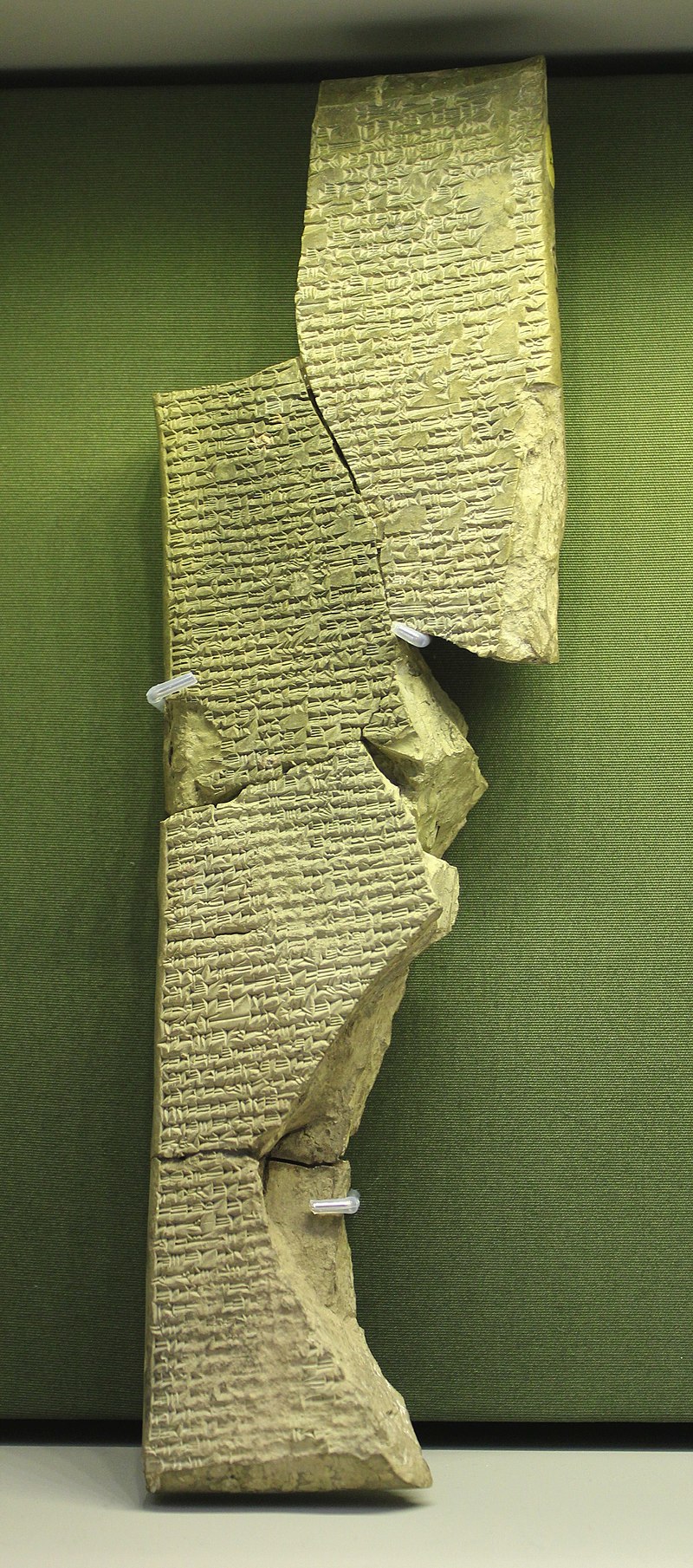

The Genesis creation accounts are not the only creation texts from the ancient Near East. Two Mesopotamian compositions — Enuma Elish and the Atrahasis epic — present creation narratives that share structural elements with the Genesis accounts while differing in significant respects.1, 2, 10
Enuma Elish, composed in Akkadian and preserved on seven clay tablets dating to approximately the twelfth century BCE (though likely reflecting earlier traditions), is a Babylonian theogony and cosmogony centered on the god Marduk.1 The text begins with a primordial state in which nothing has yet been named or formed — a motif that parallels the opening of both Genesis accounts, which describe what did not yet exist before creation began. In Enuma Elish, the primordial waters are personified as two deities: Apsu (fresh water) and Tiamat (salt water), whose mingling produces the first generation of gods. Marduk defeats Tiamat in combat and splits her body to form the sky and the earth:1, 17
He sliced her in half like a fish for drying:
Half of her he put up to roof the sky,
Drew a bolt across and made a guard hold it.
Her waters he arranged so that they could not escape.
(Enuma Elish, Tablet IV, lines 137–140; translation by Stephanie Dalley)
The division of a watery body to form the sky, with waters held above by a physical barrier, shares a structural parallel with Genesis 1:6–8, where God creates a raqia' ("dome" or "firmament") to separate the waters above from the waters below. In both texts, the sky is conceived as a structure that restrains an upper body of water.1, 10 The Genesis account contains no combat narrative and does not personify the waters; the Hebrew tehom (תְּהוֹם, "the deep") in Genesis 1:2 is linguistically related to the Akkadian Tiamat but appears in Genesis as an impersonal body of water, not a deity.12, 16
In Enuma Elish, humans are created from the blood of a slain god, Qingu, for the purpose of performing labor so that the gods may rest:1
Let me put blood together, and make bones too.
Let me set up primeval man: Man shall be his name.
Let me create a primeval man.
The work of the gods shall be imposed on him, and so they shall be at leisure.
(Enuma Elish, Tablet VI, lines 5–8; translation by Stephanie Dalley)
Both Enuma Elish and Genesis 1 conclude with a period of divine rest following the completion of creation. In the Babylonian text, the gods celebrate and decree Marduk's fifty names; in Genesis, God rests on the seventh day and hallows it.1, 10
The Atrahasis epic, an Akkadian text preserved in copies dating to approximately 1700 BCE, provides a different creation account. In Atrahasis, the lesser gods (the Igigi) are forced to perform heavy labor — digging canals and maintaining irrigation — for the senior gods (the Anunnaki). The Igigi revolt, and in response, the gods create humans from clay mixed with the blood and flesh of a slain god to take over the labor:2
Belet-ili the womb-goddess is present,
Let the womb-goddess create offspring,
And let man bear the load of the gods!
...They slaughtered Aw-ilu, who had the inspiration, in their assembly.
Nintu mixed clay with his flesh and blood.
(Atrahasis, Tablet I; translation by Stephanie Dalley)
The creation of a human being from clay (or earth) mixed with a divine element is a motif shared with Genesis 2:7, where YHWH Elohim forms the man from dust of the ground and breathes divine breath into his nostrils. The Atrahasis account, like Genesis 2 but unlike Genesis 1, describes creation as a hands-on, material process rather than a series of spoken commands.2, 10
The existence of these parallel traditions does not establish the direction of literary dependence. The Genesis texts may draw on a shared cultural milieu, may respond to or revise Mesopotamian traditions, or may represent independent developments within a common ancient Near Eastern framework of thought about origins. The primary texts of all three traditions are available for direct comparison.1, 2, 10
A note on Genesis 2:19 and verb tense
Genesis 2:19 is a verse that bears directly on the relationship between the two accounts. In the NRSV, it reads: "So out of the ground the LORD God formed every animal of the field and every bird of the air, and brought them to the man to see what he would call them" (NRSV). The Hebrew verb translated "formed" is wayyitser (וַיִּצֶר), a wayyiqtol (narrative imperfect) form of yatsar. In standard biblical Hebrew narrative, the wayyiqtol form expresses sequential past action: first this happened, then this happened.3, 11
Some English translations render the verb with a pluperfect sense ("had formed") to indicate that animal creation occurred prior to the narrative moment — that is, before the man needed a companion. The NIV (1984 and 2011 editions), for example, translates 2:19 as "Now the LORD God had formed out of the ground all the wild animals." This rendering treats the action as already completed, making 2:19 a retrospective reference to an earlier creation rather than a new creative act following the man's formation.5
The Hebrew wayyiqtol does not inherently encode a pluperfect meaning. While pluperfect readings of wayyiqtol forms occur in biblical Hebrew (e.g., Genesis 31:34, 1 Samuel 28:3), they are typically supported by clear contextual indicators. In Genesis 2:19, the surrounding narrative presents a sequence: YHWH Elohim observes that the man is alone (2:18), forms animals and brings them to the man (2:19), the man names them but finds no suitable partner (2:20), and YHWH Elohim creates the woman (2:21–22). The wayyiqtol chain presents these as sequential events.3, 4, 9
The question of verb tense in 2:19 is thus a question about the Hebrew grammar of the text. The standard wayyiqtol reading places animal creation after the man. The pluperfect reading places it before. Both renderings are represented in published English translations. The Hebrew text uses the same verbal form (wayyiqtol) for the formation of animals in 2:19 that it uses for the formation of the man in 2:7 (wayyitser), the planting of the garden in 2:8 (wayyitta'), and the placing of the man in the garden in 2:15 (wayyiqqah). All four actions are expressed in the same grammatical form within the same narrative sequence.3, 11
Scope and theological perspective
The two accounts present creation from different vantage points.8 The first account is cosmic in scope. It begins with the heavens and the earth, proceeds through the formation of celestial bodies, seas, and continents, and populates the world with every category of living creature before creating humankind as the culminating act. The perspective is panoramic, as if viewed from outside creation looking in. The deity stands apart from the created order, commanding it into existence by speech.7, 8
The second account is local in scope. It begins with a patch of dry ground, a single man, a garden, and a handful of trees. The geography is specific: four named rivers, identifiable regions (Havilah, Cush, Assyria), and particular resources (gold, bdellium, onyx). The perspective is ground-level, centered on the man and his immediate environment. The deity is present within the scene — planting, forming, bringing animals, performing surgery, speaking directly to the man.8, 18
The first account presents humanity as the apex of a structured cosmos. The key terms are "image" (tselem, צֶ֫לֶם) and "likeness" (demut, דְּמוּת), and the key function is "dominion" (radah, רָדָה) over the other creatures. The second account presents the man as a cultivator. The key terms are "till" ('abad, עָבַד, which also means "to serve") and "keep" (shamar, שָׁמַר, "to guard, watch over"), and the key relationship is between the man and the ground from which he was formed.8, 12, 18
The first account uses the word "good" (tov, טוֹב) seven times to evaluate the created order, culminating in "very good" (tov me'od) at the end of day six. The second account contains the only occurrence in the creation narratives of something being declared "not good" (lo'-tov, לֹא־טוֹב): "It is not good that the man should be alone" (2:18, NRSV). In the first account, the cosmos is complete and good. In the second, the narrative generates tension by presenting an incomplete situation — a solitary man — that requires resolution through the creation of a companion (Genesis 1:1–2:3; Genesis 2:4–25).8
These differences in scope, vocabulary, literary form, creation sequence, starting conditions, and divine naming are features of the texts as they appear in the Hebrew Bible. They are observable in any translation that renders the Hebrew with reasonable fidelity, and they are present in the oldest available manuscript witnesses of Genesis, including the Qumran scrolls.3, 13
References
The Book of Genesis, Chapters 1–17 (New International Commentary on the Old Testament)
A Dictionary of the Targumim, the Talmud Babli and Yerushalmi, and the Midrashic Literature