Overview
- Physical evidence for symbolic behavior in Homo sapiens extends back at least 100,000 years in Africa, with ochre-engraved artifacts from Blombos Cave dated to approximately 77,000 years ago and perforated Nassarius shell beads from sites in Morocco and Israel dated to roughly 82,000–135,000 years ago.
- The question of whether symbolic capacity emerged gradually across the Middle Stone Age or appeared suddenly in a “human revolution” around 40,000–45,000 years ago remains one of the most debated topics in paleoanthropology; current evidence favors a mosaic, gradual accumulation of symbolic behaviors across Africa before their apparent proliferation in Europe.
- Some of the oldest known figurative cave art—including warty pigs from Sulawesi, Indonesia, dated to at least 51,200 years ago by laser-ablation uranium-series methods—substantially predates the earliest European examples, demonstrating that artistic capacity accompanied Homo sapiens during the dispersal out of Africa.
Among the most compelling questions in the study of human origins is when, where, and in what manner the human capacity for symbolic thought first arose. Symbolic behavior—the ability to use one object, image, or sound to stand for something else entirely, and to share that convention with others—is widely considered a defining feature of the modern human mind. It underlies language, art, ritual, and all forms of cultural transmission that do not rely solely on direct imitation. The material traces of symbolic behavior in the archaeological record include pigments used as cosmetics or in painting, ornaments worn on the body, geometrically engraved objects, musical instruments, and figurative imagery. Tracking the earliest appearances of these categories of evidence allows researchers to reconstruct, with increasing precision, the deep history of the human imagination.23
The study of early symbolic behavior sits at the intersection of archaeology, cognitive science, and evolutionary biology. Researchers must navigate the inherent difficulty that symbols, by definition, carry meaning assigned by communities of minds—meaning that is not directly visible in the physical record. An ochre-stained stone could be a cosmetic, a utilitarian adhesive component, a ritual object, or all three simultaneously. Distinguishing symbolic from non-symbolic uses of materials therefore requires attention to context, patterning, and analogy with ethnographically documented practices.6 Despite these interpretive challenges, the cumulative weight of archaeological finds from Africa, Europe, and Southeast Asia now supports the conclusion that fully modern symbolic capacity was present in Homo sapiens before the dispersal out of Africa, and possibly—though more controversially—in Neanderthals as well.23, 10
Defining symbolic behavior
In the theoretical literature of paleoanthropology, symbolic behavior is typically defined as the capacity to assign arbitrary meaning to an object, image, or action, and to communicate that meaning reliably to others within a social group. This definition distinguishes symbolism from more immediate forms of signaling found across the animal kingdom: a red coloration that signals toxicity has a direct, evolved relationship between signal and meaning, whereas a red pigment worn as personal ornament acquires its significance only through social convention.23 The philosopher's term for this property is arbitrariness, and it is widely held to be a prerequisite for true language as well as for the representational arts.
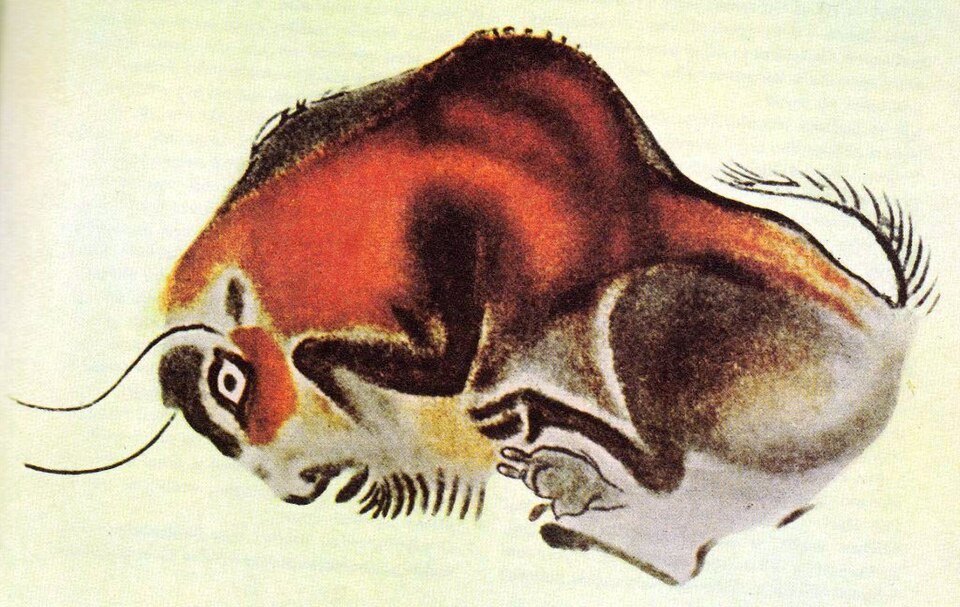

Archaeologists operationalize this concept by identifying classes of material culture that plausibly require symbolic thought for their production or use. Personal ornaments—beads, pendants, and perforated teeth worn on the body—are particularly valuable indicators because they communicate information about the wearer’s identity, group membership, or status to other individuals; this communicative function presupposes shared symbolic conventions.5 Pigments, particularly ochre (iron oxide), are another key category: while ochre has non-symbolic uses as a hide preservative and adhesive component, its association with body painting in ethnographic contexts and its often elaborately processed condition in archaeological assemblages suggests symbolic as well as practical use.1, 6 Engravings and figurative imagery are the most unambiguous symbolic artifacts, requiring the prior concept of representation itself.2
McBrearty and Brooks, in a landmark 2000 review, catalogued the African Middle Stone Age (MSA) evidence for modern behavioral complexity and argued forcefully against the notion that symbolic behavior appeared suddenly in Europe around 40,000 years ago. Their survey showed instead that virtually every category of behavior once considered uniquely modern and European had African antecedents stretching back 200,000 years or more, appearing sporadically and accumulating gradually rather than erupting in a single creative revolution.23
The African Middle Stone Age record
The oldest unambiguous evidence for symbolic behavior in Homo sapiens comes from sites in southern and northern Africa dated to the period between roughly 100,000 and 60,000 years ago, collectively associated with the Middle Stone Age (MSA) technocomplex. Blombos Cave, situated on the southern Cape coast of South Africa approximately 300 kilometers east of Cape Town, has produced an exceptional sequence of MSA deposits that has transformed understanding of the deep history of human cognition.2
Excavations led by Christopher Henshilwood and colleagues have recovered two categories of symbolic material from Blombos Cave that are of particular importance. First, several pieces of ochre bearing deliberately engraved geometric designs have been found in levels dated by thermoluminescence and optically stimulated luminescence to approximately 75,000–80,000 years ago.2 The most notable of these, catalog number AA8938, bears a design consisting of parallel oblique lines crossed by a longer line, creating a pattern of triangular and diamond-shaped segments. The regularity of the incisions, the evidence of prior preparation of the surface by grinding, and the absence of any utilitarian explanation for the pattern all suggest intentional geometric composition rather than accidental marking.2 A second, even more elaborate ochre engraving from the same site, described by Henshilwood and colleagues in 2009, bears a cross-hatched design of such precision that it has been compared to modern graphic design conventions.2
The second major category of symbolic material from Blombos Cave consists of perforated marine gastropod shells of the species Nassarius kraussianus, recovered from MSA levels dated to approximately 75,000 years ago.3, 5 Vanhaeren and colleagues demonstrated through detailed analysis that the shells had been perforated in a consistent manner, showed wear patterns consistent with suspension on a cord or thong, and bore traces of ochre, suggesting they had been worn as beads and may have been in contact with ochred body parts or other ochred items.5 The consistent perforation method and the fact that the shells were transported to the cave from a coastal source at least 20 kilometers distant indicate deliberate collection and preparation rather than accidental accumulation.5
Related evidence for pigment use and symbolic behavior has been recovered from Blombos Cave in the form of two ochre-processing kits, reported by Henshilwood and colleagues in 2011, dated to approximately 100,000 years ago. The kits include abalone shells used as mixing containers, ochre, charcoal, crushed bone, and stone grinders. The kits contain evidence of a multi-step manufacturing process in which ochre was ground, mixed with liquid, bone grease, and charcoal to produce a compound that may have been used for body or surface painting.1 The deliberate, multi-component nature of the recipe implies planning, knowledge transmission, and conceivably symbolic intent, though the ultimate use of the compound cannot be directly verified.1
Outside of Blombos Cave, additional MSA evidence for early symbolic behavior in Africa comes from several sites. At Pinnacle Point Site 13B on the South African coast, Marean and colleagues documented large quantities of ochre in assemblages dated to approximately 164,000 years ago, making this among the oldest evidence of systematic pigment use by anatomically modern humans.21 Border Cave in KwaZulu-Natal has produced a sequence of symbolic artifacts spanning from approximately 44,000 to 227,000 years ago, including a notched bone, a drilled and decorated marine shell pendant, and dozens of pieces of worked ochre; Wadley and colleagues have described recently discovered pigment-processing debris from levels dated to approximately 170,000 years ago.25, 26 D’Errico and colleagues have further identified personal ornaments at Border Cave, including Conus shell beads and ostrich eggshell beads, whose morphological characteristics closely resemble those made by contemporary San peoples, suggesting a continuity of symbolic traditions extending to the present.26
North African evidence is equally compelling. At Grotte des Pigeons in Taforalt, Morocco, Bouzouggar and colleagues reported the discovery of perforated Nassarius shells bearing traces of red ochre in levels dated by ESR and uranium-series methods to approximately 82,000 years ago, making these among the oldest known personal ornaments in the world.4 Related finds of perforated Nassarius shells from Skhul Cave in Israel, dated to approximately 100,000–135,000 years ago and described by Bar-Yosef Mayer and colleagues, extend the geographic range of early ornament use and suggest that symbolic behavior was widespread in early Homo sapiens populations across Africa and the Near East well before the major dispersal events of the Late Pleistocene.9
The Makapansgat pebble: earliest symbolic interest?
Considerably older, and far more ambiguous, is the so-called Makapansgat pebble, a water-worn jasperite cobble approximately 260 millimeters long recovered from cave deposits in the Makapansgat Valley of South Africa. The deposits in which it was found are associated with Australopithecus africanus and dated to approximately 3 million years ago. The significance of the pebble lies not in any modification—it bears no human-made markings—but in its naturally occurring facial appearance: two large ferruginous dimples on one face, two on the reverse, together with a groove that suggests a mouth, combine to give the pebble a face-like appearance that has been noted by many observers.22
The pebble was transported to the site from a source at least 32 kilometers away, implying intentional collection and carrying by an early hominin. Bednarik, who described the specimen in detail, cautiously interpreted it as a manuport—an unmodified natural object transported by hominins—and raised the possibility that its face-like appearance was the reason for its collection, which would make it the earliest known example of aesthetic or proto-symbolic interest in the natural world.22 Most researchers treat the Makapansgat pebble as suggestive but inconclusive: the absence of any modification makes it impossible to confirm that its facial appearance was recognized or meaningful to its carrier, and the argument relies entirely on the improbability of the transport distance as evidence of purposeful collection.
The "human revolution" debate
The question of whether the emergence of symbolic behavior was gradual or abrupt has been a central controversy in paleoanthropology since the 1980s. The "human revolution" model, associated particularly with Paul Mellars and Chris Stringer, proposed that a package of distinctively modern behaviors—including blade technology, personal ornaments, figurative art, and long-distance exchange networks—appeared rapidly in Europe approximately 40,000–45,000 years ago with the arrival of anatomically modern humans, replacing the simpler technologies of the Neanderthals who had previously occupied the continent.7 On this model, the behavioral modernity associated with the Upper Paleolithic represented a qualitative transformation in cognitive capacity, possibly related to the evolution of language.7
The McBrearty and Brooks critique of this model, published in 2000, challenged it on empirical grounds by demonstrating that the African MSA record contained precursors to every component of the supposed European revolution, scattered across a timeframe two to three times longer.23 The implication of their review was not that behavioral modernity is ancient throughout the world, but that its ingredients accumulated gradually in Africa over many tens of thousands of years before being exported as a more integrated package during the dispersals of the Late Pleistocene. Subsequent work has largely vindicated the gradualist position for Africa while leaving open the question of why the European record appears more abrupt: whether this reflects a genuine cognitive or demographic threshold, taphonomic biases in the visibility of earlier European evidence, or the effects of population size and network connectivity on cultural accumulation and transmission.8, 23
A related debate concerns the extent to which symbolic behaviors represent genuine cognitive novelty versus culturally transmitted variations on older, more widespread capacities. Wynn and Coolidge have argued on the basis of cognitive archaeology that working memory and long-term memory organization in Neanderthals may have differed from those of Homo sapiens in ways that limited cultural innovation even in the absence of obvious anatomical differences.24 Others contend that Neanderthal symbolic behavior, while perhaps less elaborate than that of contemporaneous Homo sapiens, was qualitatively comparable, and that differences in the archaeological record reflect ecological circumstances and demographic scale rather than cognitive ceiling.10
Neanderthal symbolism
Among the most contentious issues in the archaeology of symbolic behavior is the question of whether Neanderthals were capable of symbolic thought independently of contact with or influence from Homo sapiens. For much of the twentieth century, the consensus held that Neanderthals lacked the cognitive capacity for symbolic behavior, and that any Neanderthal "art" either reflected acculturation through contact with modern humans or resulted from misidentification of the archaeological context.7 This view has been substantially revised in recent decades by a series of finds that suggest Neanderthal symbolic behavior predating any plausible contact with modern humans.
Zilhão and colleagues reported in 2010 the excavation of two Spanish cave sites, Cueva de los Aviones and Cueva Antón, containing perforated and pigment-stained marine shells in stratigraphic contexts attributed to Neanderthals on the basis of the associated lithic assemblages, dated by uranium-series methods to approximately 50,000 years ago, a date approximately 10,000 years before the arrival of modern humans in Iberia.10 The shells—including Spondylus gaederopus, Pecten maximus, and Acanthicardia tuberculata—contained residues of pigment mixtures including yellow and red iron compounds, manganese dioxide, hematite, and pyrite. The complexity and deliberate mixing of these pigments, combined with their presence in shells that were likely worn as containers or ornaments, led the authors to conclude that Neanderthals were engaging in body decoration and personal ornamentation independent of any modern human influence.10
Cave paintings attributed to Neanderthals by uranium-series dating represent an even more dramatic claim. Pike and colleagues in 2012 applied uranium-thorium dating to calcite crusts overlying cave art at 11 sites in Spain, obtaining minimum ages for the underlying pigment. Several panels at sites including El Castillo, Altamira, Tiòs de la Penya, and others yielded dates greater than 40,000 years, with one scallop-shaped red disk at El Castillo dated to at least 40,800 years ago—making it the oldest known directly dated cave painting at that time.11 Hoffmann and colleagues pushed this finding further in a 2018 study applying updated uranium-series dating methodology to cave art at La Pasiega, Ardales, and Maltravieso caves in Spain, obtaining minimum ages of 65,000 years for red pigment panels—a date predating the arrival of anatomically modern humans in Europe by approximately 25,000 years and therefore attributable to Neanderthals.12
These dating results remain the subject of active debate. Critics have raised concerns about whether the uranium-series dates accurately reflect the age of the underlying art rather than the age of secondary calcite deposition, and whether the attributed cave art represents intentional symbolic marking or natural pigmentation. The Hoffmann et al. results in particular have been challenged on methodological grounds. Nevertheless, the convergence of evidence from pigment use, personal ornaments, and potentially cave art across multiple Iberian sites has shifted the burden of proof toward those who deny Neanderthal symbolic capacity.
Cave art in Sulawesi and Southeast Asia
Until relatively recently, the narrative of early symbolic behavior was dominated by European evidence, and the painted caves of France and Spain were widely regarded as the cradle of artistic expression. The discovery and subsequent dating of cave art in the island of Sulawesi, Indonesia, has fundamentally altered this Eurocentric picture by demonstrating that figurative art of comparable antiquity and sophistication existed simultaneously on the other side of the world.
A series of rock art sites in the Maros-Pangkep karst region of southern Sulawesi had been known to archaeologists since the 1950s but were assumed to be relatively recent on the basis of stylistic comparisons. In 2014, Aubert and colleagues applied uranium-series dating to speleothem (mineral deposit) formations that had grown over the painted surfaces, establishing minimum ages for the underlying paintings. A hand stencil at Leang Timpuseng was dated to at least 39,900 years ago and a figurative depiction of a babirusa (pig-deer) at the same site to at least 35,400 years ago, placing them among the oldest known representational images in the world at that time.15
Subsequent work by Brumm, Aubert, and colleagues, applying the same uranium-series methodology to additional sites in the Maros-Pangkep region, produced even older dates. In 2021, Brumm and colleagues reported a minimum age of 45,500 years for a naturalistic depiction of a warty pig (Sus celebensis) at Leang Tedongnge.13 A separate panel at Leang Bulu’ Sipong 4, described by Aubert and colleagues in 2019, depicts a complex hunting scene in which therianthropic figures (part-human, part-animal) appear to pursue large animals, initially dated to at least 43,900 years ago.14 Subsequent laser-ablation uranium-series dating by Oktaviana and colleagues in 2024 revised these ages substantially upward, placing the narrative scene at Leang Karampuang at a minimum of 51,200 years ago — the oldest known figurative narrative in the world — and the therianthropic imagery implies a capacity for mythological thinking at least as sophisticated as anything in the European Paleolithic.
The Sulawesi findings demonstrate that the creative and symbolic capacities associated with figurative art were present in at least one branch of the Homo sapiens population that dispersed into Southeast Asia, and that the visual traditions of the European Upper Paleolithic were not a unique European invention but one regional expression of a species-wide capacity that may have deep African roots.13, 15
The European Upper Paleolithic
The cultural transformations associated with the arrival of anatomically modern Homo sapiens in Europe approximately 40,000–45,000 years ago are among the most intensively studied episodes in prehistoric archaeology. The period designated the Upper Paleolithic (approximately 40,000–12,000 years ago) is characterized by a dramatic elaboration of symbolic material culture: blade and bladelet technologies, bone and antler tools, a proliferation of personal ornaments including perforated teeth and marine shells, and—most famously—an explosion of cave painting, engraving, and portable sculpture that constitutes the first sustained tradition of figurative art in the European record.
Chauvet Cave in the Ardèche region of southern France, discovered in 1994, contains what are among the oldest well-dated cave paintings in Europe. Radiocarbon dates on charcoal drawings of rhinoceroses, mammoths, and lions cluster around 32,000–36,000 years ago, with some measurements suggesting ages approaching 36,000 years before present.16 The paintings display a mastery of perspective, shading, and dynamic movement that confounded initial expectations: early researchers had assumed artistic skill would improve monotonically through the Upper Paleolithic, but Chauvet’s complex polychrome images, clearly among the oldest in Europe, challenged that progressive narrative.16 The caves of Lascaux in the Dordogne, dated to approximately 17,000 years ago, and Altamira in northern Spain, with polychrome bison panels dated to approximately 14,000–22,000 years ago, represent the culminating tradition of this painting practice in its most elaborate form, combining naturalistic animal figures, geometric signs, and hand stencils in complex compositions that almost certainly carried ritual or mythological significance.11
The prevalence of hand stencils across cave art traditions worldwide—from Sulawesi to Patagonia to France—is particularly striking. Created by placing a hand against a rock surface and blowing pigment around it through a tube or directly from the mouth, hand stencils are among the simplest forms of representational mark-making: the image is the outline of a specific individual’s body part, creating a direct indexical connection between the mark and its maker. The ubiquity of this technique across independently developed traditions on multiple continents suggests it taps into something fundamental about human self-representation and the desire to leave a visible trace of the self in the world.11
Chronology of major symbolic finds in the archaeological record1, 4, 9, 12, 13, 15, 18, 19
| Age (approx.) | Site / Region | Find | Category |
|---|---|---|---|
| ~164,000 ya | Pinnacle Point, South Africa | Systematic ochre use | Pigment |
| ~100,000 ya | Blombos Cave, South Africa | Ochre-processing kits | Pigment / compound |
| ~100,000–135,000 ya | Skhul Cave, Israel | Perforated Nassarius shells | Personal ornament |
| ~82,000 ya | Taforalt, Morocco | Perforated ochre-stained shells | Personal ornament |
| ~77,000 ya | Blombos Cave, South Africa | Cross-hatched ochre engravings | Geometric engraving |
| ~75,000 ya | Blombos Cave, South Africa | Nassarius shell beads | Personal ornament |
| ≥65,000 ya | Iberian caves, Spain | Red pigment panels (Neanderthal-attributed) | Cave art (contested) |
| ~45,500 ya | Leang Tedongnge, Sulawesi | Figurative warty pig painting | Figurative cave art |
| ~43,900 ya | Leang Bulu’ Sipong 4, Sulawesi | Therianthropic hunting scene | Narrative cave art |
| ~40,000 ya | Hohle Fels, Germany | Venus figurine (mammoth ivory) | Portable sculpture |
| ~40,000 ya | Hohlenstein-Stadel, Germany | Lion-Man figurine (mammoth ivory) | Portable sculpture |
| ~40,000 ya | Geissenkösterle, Germany | Bone and ivory flutes | Musical instrument |
| ~36,000 ya | Chauvet Cave, France | Polychrome animal paintings | Figurative cave art |
| ~17,000 ya | Lascaux, France | Polychrome animal compositions | Figurative cave art |
Portable art and figurines

Alongside cave painting, the European Upper Paleolithic is distinguished by a rich tradition of portable art objects—small sculptures and engravings that could be carried, displayed, and exchanged. Among the most iconic are the so-called Venus figurines: small statuettes, typically 5–25 centimeters tall, depicting female figures with exaggerated anatomical features including prominent breasts, buttocks, and abdomens, and often lacking individuated facial features. These figurines are distributed across a broad geographic range from the Atlantic coast of France to Siberia, and are dated to approximately 28,000–22,000 years ago in their main phase of production, with some specimens considerably older.17
The oldest securely dated Venus figurine was recovered by Nicholas Conard and colleagues from the basal Aurignacian deposits of Hohle Fels Cave in the Swabian Jura of southwestern Germany, dated to approximately 35,000–40,000 years ago. Carved from mammoth ivory, the figurine depicts a female form with a pronounced vulva, large pendant breasts, and broad hips; a ring in place of a head suggests it was worn as a pendant.18 Conard argued that the figurine’s emphasis on reproductive anatomy and its ornamental function imply a complex symbolic system linking female fertility, bodily adornment, and social identity in the earliest Aurignacian culture of Central Europe.18
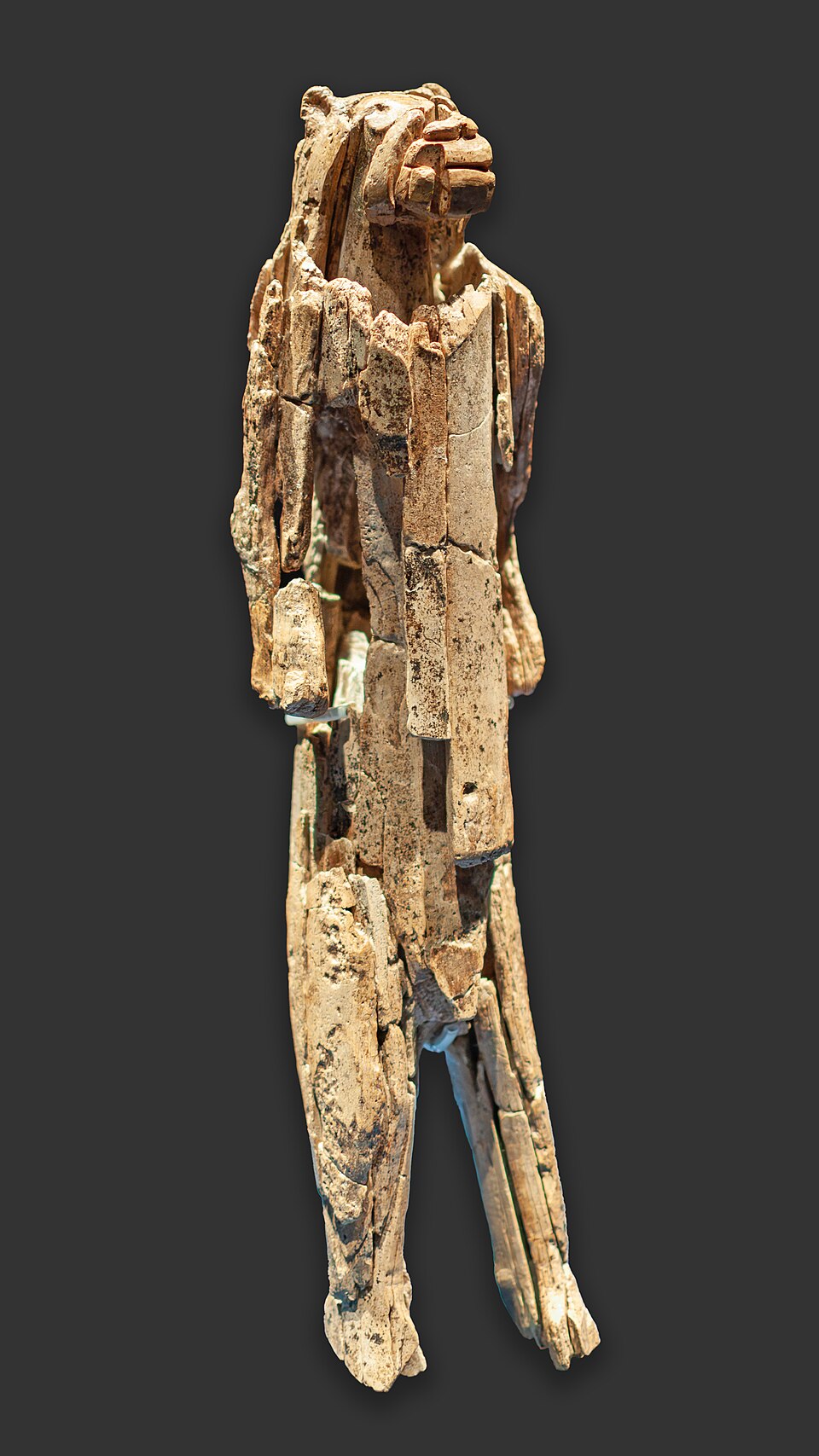
Equally significant is the Lion-Man of Hohlenstein-Stadel, a figurine carved from a mammoth tusk and found in the Swabian Jura of Baden-Württemberg, Germany. The figure stands approximately 31 centimeters tall and depicts a being with the upright stance and body proportions of a human combined with the head of a cave lion. Dated to approximately 40,000 years ago, it represents the oldest known depiction of a therianthrope—a composite creature that is part human and part animal—and constitutes perhaps the most direct material evidence for mythological or religious imagination in the early archaeological record.20 The sophistication required to conceive of and execute such a figure implies not only artistic skill but the capacity for counterfactual and analogical thought: the ability to mentally combine categories (human and lion) that do not exist as a natural unity.20
Musical instruments
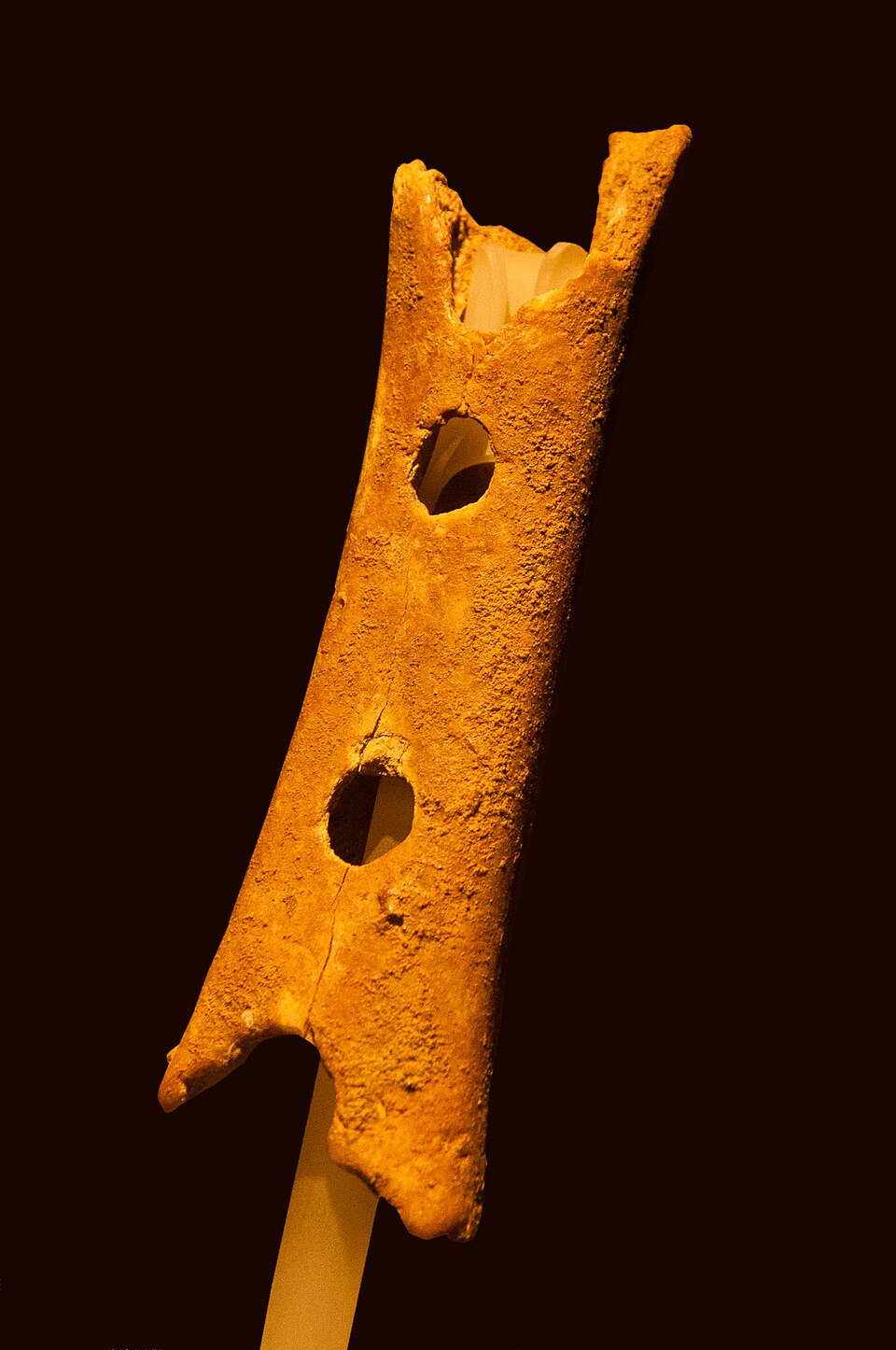

The archaeological evidence for music in the Upper Paleolithic centers primarily on a group of bone and ivory flutes from sites in the Swabian Jura of southwestern Germany, representing the oldest known musical instruments in the world by a considerable margin. Conard, Malina, and Münzel reported in 2009 the discovery of two new flutes from Geissenkösterle Cave—one carved from a vulture wing bone and one from mammoth ivory—dated to approximately 42,000–43,000 years ago, as well as a griffon vulture bone flute from Hohle Fels Cave of comparable age.19 These instruments join previously known examples from Vogelherd and Hohle Fels caves to form a corpus of at least five flutes from the Swabian Jura region, all dated to the earliest Aurignacian and all produced by the first anatomically modern human populations to occupy Central Europe.19
The vulture bone flutes are fashioned by cutting a section of wing bone to length and carving finger holes at regular intervals; the ivory flutes required the far more labor-intensive technique of splitting a mammoth tusk, hollowing the two halves, and rejoining them with a seal of plant resin. The existence of both bone and ivory manufacturing techniques at this early date suggests that flute-making was not an improvised novelty but a practiced tradition with established technical conventions.19 Experimental reproductions of the Swabian flutes have demonstrated that they are capable of producing a range of pitches spanning more than an octave, capable of executing the kind of melodic sequences found in folk music traditions worldwide.19
The appearance of musical instruments in the same cultural assemblages as Venus figurines, therianthropic sculptures, and cave paintings is significant. Music, like visual art, is a domain of behavior in which arbitrary acoustic patterns are given meaning through social convention and emotional association. The convergence of these different symbolic modalities in the earliest Aurignacian suggests not isolated inventions but the flowering of an integrated symbolic culture whose roots, as the African MSA evidence makes clear, extend far deeper in time.19, 23
Cognitive implications
The archaeological record of symbolic behavior has profound implications for understanding the evolution of human cognition. The capacity for symbolic representation is intimately connected to language: both require the assignment of arbitrary meaning to perceptible signals, and both depend on the social conventions that make shared meaning possible. Most researchers who have addressed the cognitive requirements of the earliest symbolic artifacts have concluded that their makers possessed, at minimum, the working memory, executive function, and social-cognitive abilities characteristic of modern humans, including theory of mind (the ability to represent the mental states of others), causal reasoning, and the capacity for analogical thought.24
The gradual accumulation of symbolic behaviors in the African MSA, as documented by McBrearty and Brooks, complicates any simple equation between symbolic culture and a single cognitive mutation or neurological threshold event.23 The evidence suggests instead that the cognitive prerequisites for symbolic behavior were assembled incrementally over a long period, possibly in association with the demographic expansions and contractions of the late Pleistocene that would have created selection pressures for sophisticated social communication and cultural innovation. Population size and network connectivity have been proposed as important variables: larger, more connected populations maintain and elaborate cultural traditions more effectively than smaller or more isolated ones, and the apparent efflorescence of symbolic culture in the Late Pleistocene may partly reflect demographic conditions as much as cognitive evolution per se.8
The question of Neanderthal symbolic capacity is ultimately a question about the distribution of the cognitive prerequisites for symbolism within the genus Homo. If Hoffmann and colleagues are correct that Iberian cave art predates the arrival of Homo sapiens by 25,000 years, then the capacity for symbolic representation is not unique to our species and may have deeper roots in the hominin lineage than previously supposed.12 Conversely, if the Neanderthal attribution of the Spanish cave art is rejected, the evidence from Zilhão and colleagues for Neanderthal personal ornament use and pigment mixing remains difficult to explain as anything other than independent symbolic behavior.10 Either way, the study of early human art and symbolism illuminates not a single moment of cognitive awakening but a long and geographically complex history of minds becoming, by degrees, recognizably modern.
References
82,000-year-old shell beads from North Africa and implications for the origins of modern human behavior
Nassarius kraussianus shell beads from Blombos Cave: evidence for symbolic behaviour in the Middle Stone Age
Symbolic or not? The role of natural objects, ornaments and pigments in the Middle Stone Age of southern Africa
The human revolution: behavioural and biological perspectives on the origins of modern humans
Rethinking the human revolution: new behavioural and biological perspectives on the origin and dispersal of modern humans
Radiocarbon dating of the Chauvet Cave: further results and implications for the origins of art in Europe
Palaeolithic ivory sculptures from southwestern Germany and the origins of figurative art
A female figurine from the basal Aurignacian of Hohle Fels Cave in southwestern Germany
Pigment use in the Middle Stone Age at Pinnacle Point Site 13B, Mossel Bay, South Africa
How similar are the cognitive architectures of Neanderthals and behaviourally modern humans?
Early evidence of San material culture represented by diverse personal ornaments from Border Cave, South Africa