Overview
- The Etruscans built a sophisticated urban civilization in central Italy (modern Tuscany, Umbria, and northern Lazio) between approximately 900 and 100 BCE, organized as a loose confederation of independent city-states whose mastery of metalworking, monumental architecture, and maritime trade made them the dominant power in the western Mediterranean before the rise of Rome.
- Etruscan influence on Roman civilization was pervasive and foundational: the Romans adopted Etruscan practices including the triumph, the toga praetexta, the fasces as symbols of authority, gladiatorial combat, temple architecture with frontal orientation, hydraulic engineering, and elements of religious practice including haruspicy (divination by reading animal entrails).
- Ancient DNA analysis published in 2021 demonstrated that the Etruscans were genetically indistinguishable from their Italic neighbors despite their linguistic distinctiveness, resolving a 2,500-year-old debate by refuting Herodotus's claim of Lydian (Anatolian) origin and confirming that the Etruscans descended from local Bronze Age populations who developed their unique language and culture in situ.
The Etruscans created one of the most accomplished pre-Roman civilizations in the ancient Mediterranean, flourishing in central Italy for more than eight centuries before their gradual absorption into the Roman state. At their height, between roughly 700 and 400 BCE, the Etruscans controlled a territory stretching from the Po Valley in the north to Campania in the south, organized as a confederation of powerful city-states whose wealth derived from rich mineral resources, productive agriculture, and extensive maritime trade with ancient Greece, Phoenicia, and the wider Mediterranean world.1, 4 Despite leaving a wealth of archaeological material — painted tombs, bronze sculptures, inscribed mirrors, and monumental temple foundations — the Etruscans remain in many respects enigmatic, largely because their non-Indo-European language, though partially understood, has no surviving literary texts, and most written accounts of Etruscan history come from Greek and Roman authors whose perspectives were colored by cultural rivalry and later political dominance.2, 4

Origins and the question of identity
The origins of the Etruscans have been debated since antiquity. Herodotus, writing in the 5th century BCE, claimed that the Etruscans were migrants from Lydia in western Anatolia who had crossed the sea to settle in Italy during a prolonged famine. Dionysius of Halicarnassus, writing four centuries later, countered that the Etruscans were indigenous to Italy and distinct from any eastern people.4, 1 This ancient disagreement persisted for 2,500 years, with scholars variously championing eastern migration, Aegean connections, or local Italian development as the key to Etruscan ethnogenesis.
The debate was substantially resolved by a landmark ancient DNA study published in 2021 by Posth and colleagues, who analyzed genomic data from 82 individuals spanning approximately 2,000 years (800 BCE to 1000 CE) from sites across Etruria and the broader Italian peninsula. The results demonstrated that the Etruscans were genetically indistinguishable from their Latin and other Italic neighbors, sharing a predominantly Steppe-ancestry and Neolithic European ancestry profile consistent with local Bronze Age populations.3 There was no detectable signal of recent Anatolian or eastern Mediterranean admixture in the Etruscan samples, effectively refuting Herodotus’s migration narrative. The study confirmed Pallottino’s earlier argument that the Etruscan civilization emerged through in situ cultural development from local Villanovan-period (c. 900-700 BCE) populations, with their distinctive language and cultural practices arising through internal processes rather than through population replacement from abroad.3, 4
The Etruscan language itself remains the most striking marker of their distinctiveness. Written in a Greek-derived alphabet that can be read phonetically, Etruscan is a linguistic isolate — unrelated to the Indo-European languages spoken by neighboring Italic, Celtic, and Greek populations.2 Although approximately 13,000 Etruscan inscriptions survive, the overwhelming majority are brief funerary formulas or dedicatory texts, and no extended literary, historical, or philosophical works have been preserved. The longest known text, the Liber Linteus (a linen book later cut into strips and reused as Egyptian mummy wrappings), appears to be a ritual calendar. Bonfante and Bonfante demonstrated that while the basic grammar and a working vocabulary of several hundred words have been established, many details of Etruscan syntax and lexicon remain uncertain, limiting the degree to which the Etruscans can speak for themselves through their own writings.2
City-states and political organization
Etruscan political life was centered on independent city-states, each controlling a surrounding agricultural territory. The major cities — including Veii, Cerveteri (Caere), Tarquinia, Vulci, Orvieto (Volsinii), Chiusi (Clusium), Arezzo (Arretium), and Perugia (Perusia) — were linked by cultural, religious, and linguistic bonds but maintained separate governments, foreign policies, and sometimes conflicting military interests.1, 7 A religious league of twelve cities, the duodecim populi Etruriae, met at the sanctuary of Fanum Voltumnae (probably near modern Orvieto), but this league appears to have been primarily ceremonial and was never able to coordinate effective collective military action, a weakness that the Romans later exploited by defeating Etruscan cities one at a time.7
Early Etruscan cities were ruled by kings (lucumones), but by the 5th century BCE, many had transitioned to oligarchic government controlled by wealthy aristocratic families, a political trajectory broadly parallel to developments in ancient Greece and in Rome itself.1, 5 Izzet emphasized that Etruscan political institutions should not be understood through a Roman lens, as the nature of Etruscan magistracies, the mechanisms of succession, and the relationship between political and religious authority remain poorly understood due to the absence of narrative historical sources in Etruscan.5
Economy, metalworking, and trade
The economic foundations of Etruscan prosperity were agricultural wealth and, critically, exceptional mineral resources. The Colline Metallifere (Metalliferous Hills) of central Tuscany and the island of Elba provided abundant deposits of iron, copper, tin, lead, and silver, making Etruria one of the richest metal-producing regions in the ancient Mediterranean.1, 13 Etruscan metalworkers achieved extraordinary skill in bronze-casting, iron-forging, gold granulation, and filigree work, producing objects that were exported throughout the Mediterranean and that demonstrate technical mastery rivaling or exceeding contemporary Greek and Near Eastern traditions.13, 6
The importance of metallurgy to the Etruscan economy is reflected in the archaeological record of major production centers such as Populonia, the only Etruscan city built directly on the coast, whose beaches accumulated enormous slag heaps from centuries of iron smelting — deposits so extensive that they were re-smelted for their residual iron content during the two World Wars.1, 13 Etruscan maritime trade extended from the western Mediterranean coasts of Gaul and Iberia to the eastern Mediterranean, with Etruscan bronze vessels, bucchero pottery, and wine amphorae appearing in archaeological contexts from southern France to the Levant.11 Camporeale documented that the Etruscans were major participants in the trade networks linking Greece, Phoenicia, and the western Mediterranean, serving not merely as consumers of Greek goods but as active producers and exporters in their own right.11
Religion, burial practices, and tomb art
Etruscan religious practice was elaborate and highly formalized, centered on divination — the interpretation of divine will through the reading of natural signs. The most distinctive Etruscan divinatory practice was haruspicy, the examination of the livers and entrails of sacrificed animals, a tradition that the Romans later adopted wholesale.10 The Piacenza Liver, a bronze model of a sheep’s liver inscribed with the names of Etruscan deities arranged in sectors, served as an instructional device for haruspices and provides invaluable evidence for the structure of Etruscan cosmology and theology.10 The Etruscans also practiced augury (reading the flight of birds), fulguriature (interpreting lightning), and maintained a body of sacred texts known collectively as the Etrusca disciplina, which Roman authors describe as comprising books on haruspicy, lightning, and ritual procedure.10, 4
The Etruscans are best known archaeologically for their monumental tombs, which have survived in far greater numbers than their domestic or public buildings. The great necropoleis of Cerveteri and Tarquinia, both UNESCO World Heritage Sites, contain thousands of rock-cut and built chamber tombs dating from the 7th to the 2nd centuries BCE.1, 15 At Cerveteri, the Banditaccia necropolis preserves tombs carved to replicate the interiors of Etruscan houses, with rooms, doorways, furniture, and household objects rendered in stone — providing the most detailed evidence available for the domestic architecture of a civilization whose actual houses, built of perishable materials on stone foundations, have largely vanished.1, 5
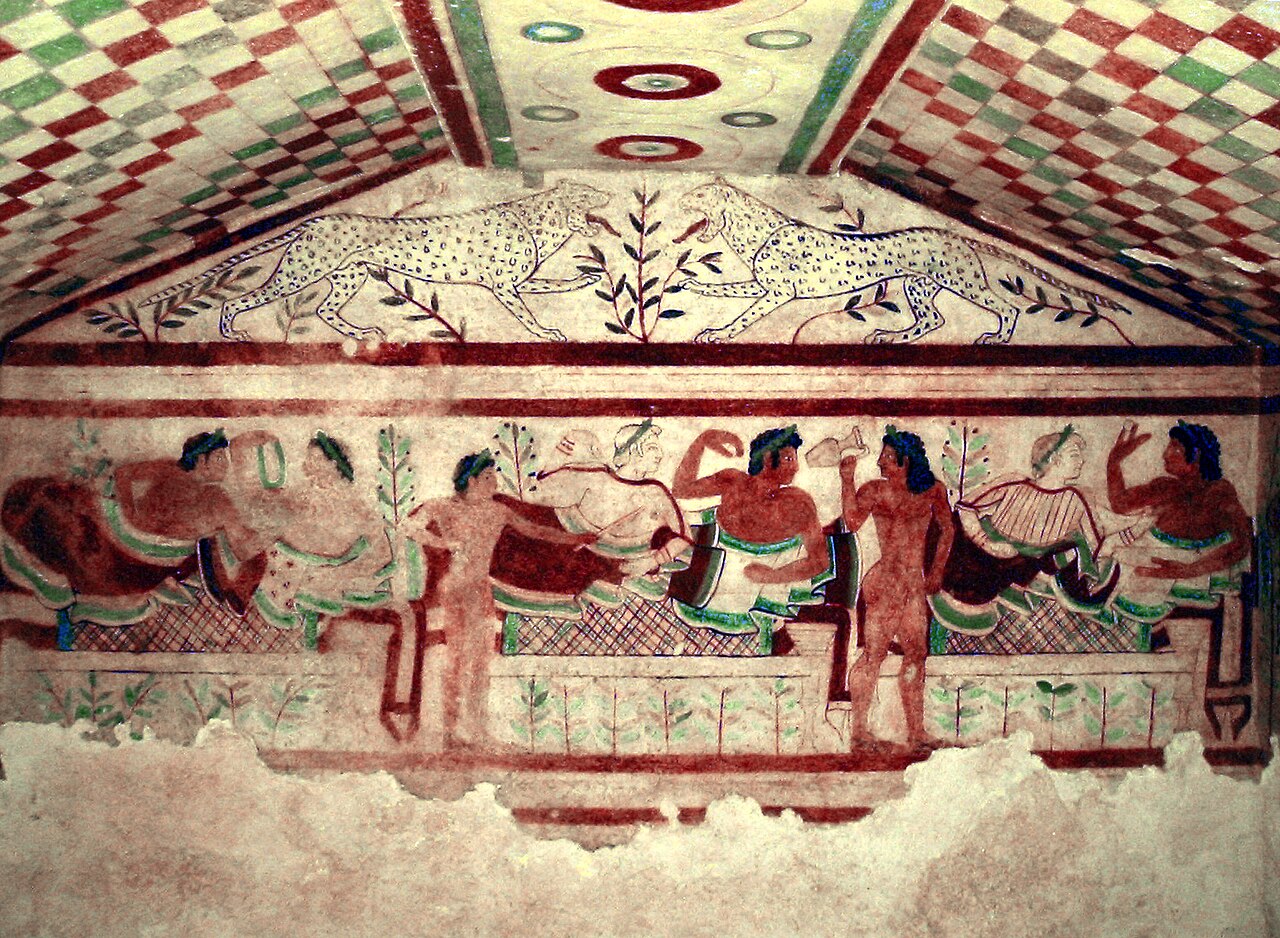
The painted tombs of Tarquinia constitute the richest body of pre-Roman painting in the ancient Mediterranean. Dating primarily from the 6th to the 4th centuries BCE, these frescoes depict banqueting scenes, athletic competitions, dancing, music, hunting, fishing, and funerary rituals in vivid polychrome compositions that reveal a society that celebrated sensory pleasures and communal festivities.15 Steingraber noted that earlier tomb paintings (6th century) tend to show joyful, celebratory scenes emphasizing the good life, while later paintings (4th century) increasingly depict demonic figures and underworld imagery, suggesting a shift in Etruscan attitudes toward death and the afterlife that may reflect the political and military pressures of the era.15
One striking feature of Etruscan funerary art is the prominence of women. Sarcophagus lids frequently depict married couples reclining together in attitudes of equal dignity, and inscriptions routinely record matronymic (mother’s name) alongside or instead of patronymic identification — practices that astonished Greek and Roman observers, who interpreted the visible social prominence of Etruscan women as evidence of moral laxity.12, 6 Bonfante argued that Etruscan women enjoyed a significantly higher social status than their Greek or Roman counterparts, attending public banquets alongside men, possessing independent legal identities, and being commemorated with individualized tomb portraits — though the precise nature and limits of Etruscan women’s autonomy remain debated.12
Influence on Rome
The debt of Roman civilization to the Etruscans was profound, pervasive, and acknowledged — sometimes grudgingly — by the Romans themselves. Roman tradition held that the city was ruled by Etruscan kings (the Tarquins) during the 6th century BCE, and the archaeological evidence confirms intensive Etruscan cultural influence on Rome during this period, including the construction of the first monumental temple on the Capitoline Hill, the drainage of the Forum through the Cloaca Maxima, and the introduction of Etruscan-style urban planning.7, 1
The list of Roman practices with Etruscan origins is extensive. The Roman triumph — the ceremonial procession of a victorious general through the city — derived from Etruscan models, as did the purple-bordered toga praetexta worn by magistrates, the fasces (bundled rods with an axe) carried by lictors as symbols of authority, the curule chair used by senior officials, and gladiatorial combat, which originated as a funerary ritual in Etruscan practice.7, 8 Roman temple architecture, with its distinctive frontal orientation, deep porch, and raised podium, followed Etruscan rather than Greek models, and Etruscan divinatory practices — particularly haruspicy — remained central to Roman state religion throughout the Republic and into the Empire.10, 4
Scullard documented that many of Rome’s most prominent families during the Republic, including the Caecinae of Volterra and the Cilnii of Arezzo (from whom the emperor Augustus’s patron Maecenas descended), were of Etruscan origin, maintaining their ancestral Etruscan cultural practices even as they participated fully in Roman political life.7
Decline and Roman absorption
The decline of Etruscan independence was a protracted process spanning roughly three centuries, from Rome’s capture of the Etruscan city of Veii in 396 BCE to the grant of Roman citizenship to all Italians following the Social War in 90-88 BCE. Rome’s conquest of Etruria proceeded city by city, with each Etruscan community negotiating or suffering its own terms of submission, and the process was neither uniform nor linear — some cities allied with Rome voluntarily, while others resisted fiercely.14, 7
Harris traced the “Romanization” of Etruria through multiple dimensions: political absorption through the extension of Roman citizenship and the imposition of Roman administrative structures; linguistic displacement as Latin gradually replaced Etruscan in public life, with the latest known Etruscan inscriptions dating to the 1st century BCE; and cultural assimilation as Etruscan aristocrats adopted Roman dress, naming conventions, and social practices while retaining elements of Etruscan religious tradition and family identity.14 The Etruscan language appears to have survived longest in religious contexts, where traditional formulas and ritual practices continued to be transmitted even after Latin had become the language of daily life. The emperor Claudius, an antiquarian scholar, reportedly wrote a twenty-volume history of the Etruscans in the 1st century CE — a work now entirely lost, and with it perhaps the most comprehensive ancient account of a civilization that profoundly shaped the trajectory of western Mediterranean history.4, 7
References
The origin and legacy of the Etruscans through a 2000-year archeogenomic time transect