Overview
- Great Zimbabwe was the largest stone-built settlement in sub-Saharan Africa south of the Sahara, constructed between the eleventh and fifteenth centuries CE by ancestors of the Shona people on the Zimbabwe Plateau. Its dry-stone masonry walls — assembled without mortar, reaching heights of eleven metres — represent one of the most sophisticated architectural achievements of the precolonial African world.
- The site served as the capital of a powerful state whose wealth derived from cattle herding, gold production, and participation in Indian Ocean trade networks linking the Zimbabwe Plateau to the Swahili coast, Kilwa, Arabia, Persia, India, and China. Excavated artifacts including glass beads, Chinese celadon ceramics, and Persian faience confirm these long-distance commercial connections.
- Great Zimbabwe's history has been deeply entangled with colonial politics: for nearly a century, European settlers and their governments denied that indigenous Africans built the site, attributing it instead to Phoenicians, Arabs, or other external civilizations. Gertrude Caton-Thompson's 1929 excavations definitively established its African origin, though the Rhodesian government continued to suppress this conclusion until independence in 1980.
Great Zimbabwe is the largest stone-built settlement in precolonial sub-Saharan Africa, located on the southern edge of the Zimbabwe Plateau near the modern town of Masvingo in southeastern Zimbabwe. Constructed by ancestors of the Shona people between the eleventh and fifteenth centuries CE, the site encompasses approximately 720 hectares of dry-stone walls, platforms, and enclosures spread across a granite hill and the surrounding valley.1, 2 The name derives from the Shona word dzimba-dza-mabwe ("houses of stone"), a term applied to more than two hundred stone-walled sites across the Zimbabwe Plateau, of which Great Zimbabwe is by far the largest and most architecturally elaborate.3 The site was inscribed as a UNESCO World Heritage Site in 1986 in recognition of its outstanding universal value as testimony to a uniquely African civilization.1
The site and its architecture
Great Zimbabwe is conventionally divided into three principal areas: the Hill Complex, the Great Enclosure, and the Valley Ruins. The Hill Complex occupies a steep granite kopje rising approximately eighty metres above the surrounding terrain and contains the oldest stone structures at the site, dating to the late eleventh or early twelfth century CE. Its walls follow the natural contours of the granite boulders, enclosing a series of platforms, passages, and enclosures that are interpreted as the seat of political and ritual authority.1, 5 The Hill Complex yielded six of the eight carved soapstone birds that have become the most recognizable artifacts associated with the site, and its commanding views of the surrounding landscape underscore its likely function as the residence of the ruling elite.11
The Great Enclosure, situated in the valley below the Hill Complex, is the most architecturally impressive structure at Great Zimbabwe and the largest single prehistoric structure in sub-Saharan Africa south of the Sahara. Its outer wall stretches approximately 250 metres in circumference, rises to a maximum height of eleven metres, and is as much as five metres thick at its base. The wall contains an estimated 15,000 tonnes of granite blocks, all laid without mortar using a technique of carefully shaped and coursed dry-stone masonry that represents the pinnacle of the Zimbabwe architectural tradition.1, 6 Within the Great Enclosure stands a solid conical tower approximately ten metres tall, whose function remains debated but which may have served as a symbolic granary or a marker of royal authority.3 Radiocarbon dating and Bayesian modelling suggest that the Great Enclosure was constructed primarily during the thirteenth and fourteenth centuries CE, representing the peak of Great Zimbabwe's architectural development.5
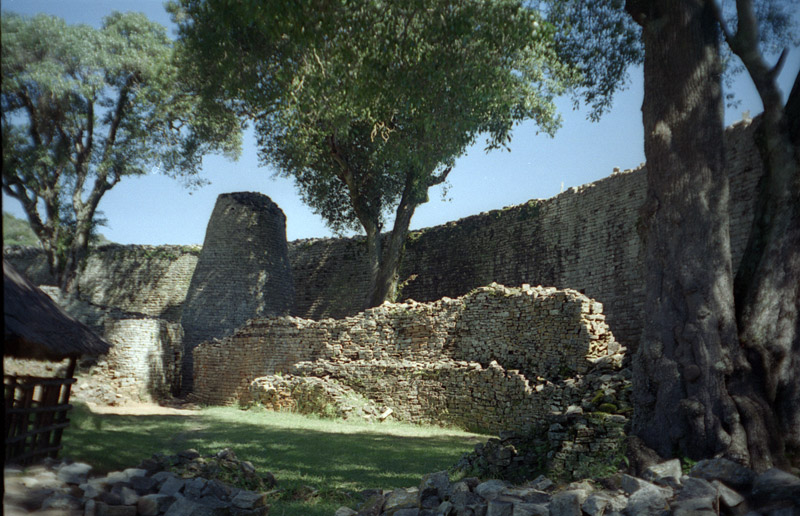

The Valley Ruins comprise a dispersed collection of stone-walled enclosures and house platforms extending across the valley floor between the Hill Complex and the Great Enclosure. These structures housed both elite and non-elite residents and contained evidence of craft production, including ironworking, gold processing, and textile manufacture.6, 7 Within and around the stone enclosures, the actual living structures were built of dhaka — a mixture of clay and gravel applied over pole frameworks to create plastered houses with thatched roofs. The stone walls served not as house walls but as enclosing screens that defined social space, channeled movement, and expressed the status of their inhabitants. The Valley Ruins demonstrate that Great Zimbabwe was not merely a royal compound but a functioning urban settlement with a substantial and socially differentiated resident population.7, 10
Dry-stone masonry
The engineering sophistication of Great Zimbabwe's walls has been a focus of sustained archaeological attention. The builders used locally quarried granite, exploiting the natural exfoliation of granite sheets from the surrounding kopjes to produce flat, brick-sized blocks that could be laid in regular courses. No mortar, cement, or binding material of any kind was used; the stability of the walls depends entirely on the precise shaping and careful placement of individual stones, with the weight of the upper courses holding the structure together through gravity and friction.1, 6 The construction process required sophisticated knowledge of stone selection, shaping by flaking and pecking, and the management of large labor forces over extended building campaigns spanning decades.10
Archaeologists have identified a clear evolution in masonry technique across the site's occupation span. The earliest walls, found in the Hill Complex, use irregularly shaped stones laid in rough courses (designated Period III in the archaeological sequence), while the later walls of the Great Enclosure display far more refined workmanship, with precisely trimmed blocks laid in even, horizontal courses and decorated with chevron, herringbone, and dentelle patterns along their upper edges.5, 10 This progression suggests the accumulation of technical knowledge and the increasing investment of labor and resources in monumental construction over several centuries. The skills required for this construction represent an indigenous African architectural tradition with no parallels in the stone-building techniques of other continents.6
The decorative patterning near the top of the outer wall of the Great Enclosure — a double chevron motif created by setting granite blocks at alternating angles — required particularly precise stone selection and placement. Similar decorative elements appear at other Zimbabwe culture sites across the Plateau, indicating the spread of a shared architectural vocabulary from Great Zimbabwe to satellite settlements. Two of the eight soapstone bird columns also carry the chevron motif, suggesting a symbolic link between the decorative programme of the walls and the ritual objects of the ruling elite.3, 11
The Zimbabwe culture and the Shona
Great Zimbabwe is the type site for what archaeologists call the Zimbabwe culture (also known as the Zimbabwe tradition), a constellation of related societies that shared common ceramic styles, settlement patterns, architectural practices, and political organization across the Zimbabwe Plateau and adjacent regions from approximately the eleventh to the seventeenth centuries CE.2, 3 These societies are ancestral to the modern Shona people, who remain the dominant population of the Zimbabwe Plateau and whose oral traditions, political structures, and religious practices provide valuable ethnographic parallels for interpreting the archaeological record.15
The Zimbabwe culture emerged from earlier farming communities on the Plateau, with the site of Mapungubwe in the Limpopo valley (occupied c. 1050–1270 CE) representing an important precursor. Mapungubwe was the first society in southern Africa to develop marked social stratification, stone-walled architecture, and participation in Indian Ocean trade, and its decline in the mid-thirteenth century roughly coincides with the rise of Great Zimbabwe as the dominant center on the Plateau.2, 8 Whether the transition involved population movement, political succession, or independent development remains debated, but the ceramic and architectural continuities between Mapungubwe and Great Zimbabwe indicate a shared cultural heritage.2
The political organization of Great Zimbabwe appears to have been hierarchical, with the ruling elite occupying the Hill Complex and the Great Enclosure while the broader population lived in the Valley Ruins and in unenclosed settlements beyond the stone walls. However, recent archaeological work has complicated the simple elite-commoner dichotomy, demonstrating that material distinctions between social classes at Great Zimbabwe were more fluid and situational than earlier models suggested. Access to imported goods such as glass beads and ceramics was not confined to elite areas, and locally produced items of high value — including iron tools and gold ornaments — appear across the site.7, 8 The ideology that underwrote political authority at Great Zimbabwe was rooted in a hierarchical triad of land, ancestors, and belief in a supreme deity (Mwari), which gave rulers custodial rights over territory and extractive powers over the productive activities of their subjects.8
Thomas Huffman's ethnographic analysis has emphasized the spatial symbolism built into the layout of Zimbabwe culture settlements, arguing that the physical arrangement of walls, enclosures, and activity areas reflected cosmological principles governing Shona social organization. In this reading, the Hill Complex functioned as a sacred space associated with rainmaking rituals and communication with ancestral spirits, while the Great Enclosure may have served as a royal court or initiation site. These interpretations, though influential, have been challenged by scholars who caution against projecting modern Shona ethnographic patterns too directly onto the medieval past.3, 7
Economy and trade
The economic foundations of Great Zimbabwe rested on a combination of agropastoralism, mineral extraction, and long-distance trade. Cattle were central to the economy and to social relations: faunal remains from the site are dominated by cattle bones, and ethnographic evidence from Shona societies indicates that cattle served as stores of wealth, mediums of exchange for bridewealth, and markers of social status.2, 8 Agricultural production, based on sorghum and millet cultivation in the surrounding savanna, supported the settled population, while the mixed woodland and grassland environment of the Zimbabwe Plateau provided adequate grazing for large herds. Recent scholarship has argued that the political economy of Great Zimbabwe was primarily rooted in these local, seasonally specific productive activities rather than in the redistribution of exotic imports, challenging older models that emphasized long-distance trade as the primary driver of state formation.8, 9
Gold production was nonetheless a significant economic activity at Great Zimbabwe. Archaeological excavations on the Upper Ridge of the Hill Complex have uncovered crucible fragments, gold wire, gold foil, and gold beads, indicating that gold was smelted, refined, and worked into finished objects on site. Chemical analysis of crucible residues suggests intensive gold production, with estimates indicating that a single production episode could yield substantial quantities of metal.13 Much of this gold entered long-distance trade networks linking the Zimbabwe Plateau to the Indian Ocean coast. Gold, ivory, and iron from the interior were transported eastward to Swahili coast trading towns — most notably Kilwa Kisiwani in present-day Tanzania — where they were exchanged for imported goods arriving from Arabia, Persia, India, and China.2, 8
The archaeological evidence for these long-distance connections is extensive. Excavations at Great Zimbabwe have recovered thousands of glass beads of Indian Ocean origin, fragments of Chinese celadon and blue-and-white porcelain dating to the thirteenth through fifteenth centuries, Persian faience, and coins from Kilwa.6, 10 Glass beads, which arrived in enormous quantities, served not only as ornaments but as a medium of exchange within the interior trade system. Bead typologies developed by archaeologists allow the classification of beads into chronological series — including the Zhizo, K2, Mapungubwe Oblate, and Zimbabwe series — that track shifts in trade networks and supply sources across the region's history.2, 6 These imports demonstrate that Great Zimbabwe was integrated into the same Indian Ocean commercial networks that connected the Silk Road overland routes to maritime trade spanning from East Africa to Southeast Asia. The volume of imported material at Great Zimbabwe is comparable to that found at Swahili coast port cities, confirming its status as a major node in the interior trade system.8
Chronology
Establishing a precise chronology for Great Zimbabwe has been complicated by the extensive disturbance of archaeological deposits during the colonial period, when early excavators stripped stratified layers in search of spectacular finds. Nevertheless, Bayesian modelling of available radiocarbon dates has produced a broadly accepted framework.5 Initial occupation of the site began around the late eleventh century CE, with the earliest stone construction on the Hill Complex dating to the late twelfth or early thirteenth century. The Great Enclosure and Valley Ruins were constructed primarily during the thirteenth and fourteenth centuries, representing the period of maximum population and political authority. The site reached its peak between approximately 1300 and 1450 CE, when it served as the capital of the largest polity on the Zimbabwe Plateau.5, 2
The chronological sequence at Great Zimbabwe was originally divided into periods by earlier excavators, but these frameworks were based on the now-compromised stratigraphic record. Chirikure and colleagues' 2013 Bayesian analysis combined the surviving radiocarbon dates with datable imports (particularly Chinese ceramics whose production dates are known from kiln site evidence) to re-thread the site's sequence. Their modelling confirmed that the major stone construction phases postdate 1200 CE and that the site's florescence was concentrated in a period of roughly two centuries before gradual decline set in during the mid-fifteenth century.5
Population estimates for Great Zimbabwe have been revised downward by recent research. Earlier scholars proposed populations of 10,000 to 18,000 inhabitants, but demographic modelling that integrates archaeological evidence with ethnographic and ecological data suggests that the peak population was more likely in the range of 5,000 to 10,000 people, with a realistic upper estimate around 10,000.9 Even at the lower end of this range, Great Zimbabwe was among the largest settlements in sub-Saharan Africa during the medieval period, comparable in scale to contemporary Swahili coast cities and exceeding the population of many European towns of the same era.9
Soapstone birds and key artifacts
The most iconic artifacts from Great Zimbabwe are eight carved soapstone birds, each mounted on a column approximately one metre tall. The birds themselves average about forty centimetres in height and combine avian and human features: some display human lips instead of beaks, five-toed feet instead of talons, and stylized plumage that suggests a fusion of natural and supernatural elements.11 Seven of the eight birds were recovered from the Hill Complex, while the eighth came from the Valley Enclosures. Edward Matenga's detailed catalogue of the birds has argued that they served as totemic emblems associated with the fish eagle (hungwe), linking them to Shona clan identity and royal authority. The Zimbabwe Bird has become the national emblem of modern Zimbabwe, appearing on the flag, coat of arms, and currency.11
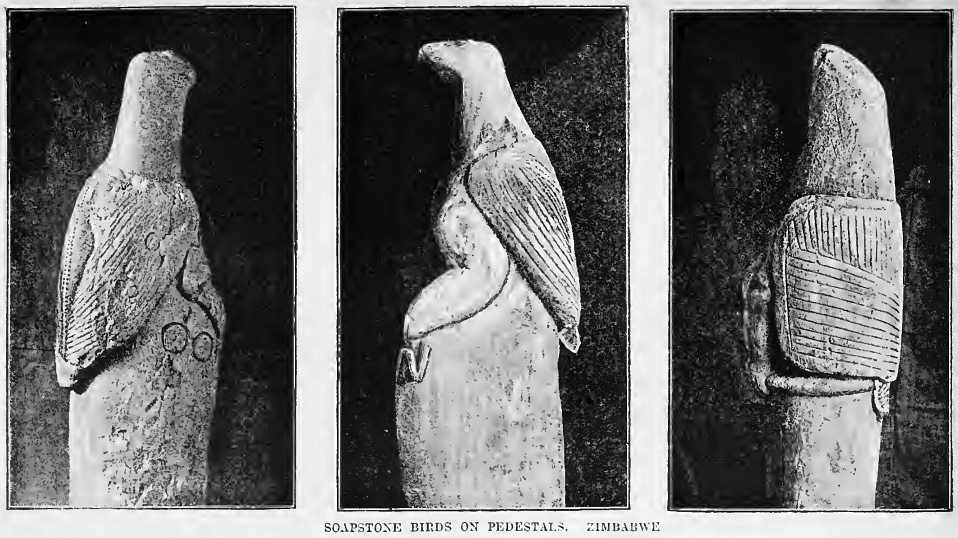

The birds are not naturalistic representations of any single species but rather composite sculptures that blend avian form with human attributes, a combination that has led some scholars to interpret them as representations of ancestral spirits or as intermediaries between the human and spiritual realms. Their placement on elevated columns within the Hill Complex — the most ritually significant area of the site — supports an interpretation linked to religious authority and the legitimation of political power through spiritual sanction.3, 11
Beyond the soapstone birds, the site has yielded a rich assemblage of both local and imported material culture. Locally produced items include iron tools (hoes, axes, arrowheads), copper and bronze ornaments, gold jewelry, spindle whorls for cotton textile production, and a distinctive ceramic tradition whose typology has been used to define the Zimbabwe culture across the broader region.6, 7 The imported artifacts — glass beads, Chinese ceramics, Persian glass, and Kilwa coins — are concentrated in but not limited to elite areas, suggesting that access to trade goods, while socially significant, was not monopolized by a single class.7 The Chinese ceramics include fragments of Longquan celadon ware and blue-and-white porcelain from the Yuan and early Ming dynasties, which provide important chronological anchors for the site's occupation sequence and confirm commercial contact — however indirect — between the Zimbabwe Plateau and East Asian production centers.5, 10
Colonial-era denial and the politics of archaeology
The history of Great Zimbabwe's interpretation is inseparable from the politics of European colonialism in southern Africa. When the ruins came to widespread European attention in the late nineteenth century, settlers and colonial administrators found it ideologically unacceptable that indigenous Africans could have built such a monumental site. J. Theodore Bent, commissioned by Cecil Rhodes in 1891 to conduct the first major excavation, concluded in his 1892 book The Ruined Cities of Mashonaland that the structures were built by Phoenicians or some other ancient "northern race," explicitly denying African authorship.14 Rhodes subsequently appointed the journalist Richard Hall as curator of the site; Hall systematically stripped archaeological deposits from the ruins, destroying stratified evidence in the process and removing artifacts that might have supported an African origin. The damage Hall inflicted on the archaeological record remains one of the most significant obstacles to reconstructing the site's chronology and is the reason Chirikure and colleagues later described Great Zimbabwe as a "vandalised monument."1, 5, 10
The decisive refutation of these colonial myths came from Gertrude Caton-Thompson, who led a rigorous archaeological expedition to Great Zimbabwe in 1929. Her stratigraphic excavations demonstrated conclusively that the site was built by indigenous African people during the medieval period, and she published her findings in The Zimbabwe Culture: Ruins and Reactions in 1931. Caton-Thompson's assertion that the ruins were "essentially African in every detail" provoked hostility from settler communities and some members of the archaeological establishment, but her methodology and conclusions have been confirmed by every subsequent excavation.4
Despite the scientific consensus established by Caton-Thompson and reinforced by Peter Garlake's landmark 1973 study, the colonial and Rhodesian governments continued to suppress acknowledgment of Great Zimbabwe's African origin. Garlake himself faced persecution for his stance: his public insistence that the site was built by indigenous Africans contributed to his departure from Rhodesia during the Ian Smith era.1 From 1965 until Zimbabwe's independence in 1980, the Rhodesian Front government censored publications affirming indigenous construction and pressured museum staff to present ambiguous or misleading interpretations to visitors. Guidebooks were rewritten to avoid attributing the ruins to Africans, and archaeologists who contradicted the official line faced professional consequences.1, 10
The site's interpretive history thus serves as one of the most striking examples of how archaeological evidence has been subordinated to political ideology. The reclamation of Great Zimbabwe by Zimbabwean scholars — particularly in the work of Shadreck Chirikure, Innocent Pikirayi, and their collaborators — represents an ongoing project of decolonizing both the site's interpretation and the discipline of African archaeology more broadly. Chirikure's 2020 monograph Great Zimbabwe: Reclaiming a 'Confiscated' Past explicitly frames the site's research history as a case study in how colonial appropriation and post-colonial neglect have distorted scientific understanding of African achievements.10
Decline and successor states
Great Zimbabwe's decline as a political and economic center began in the mid-fifteenth century CE, though the site was never entirely abandoned and continued to be occupied at reduced levels into the nineteenth century.12 The causes of decline remain debated, but likely involved a combination of environmental degradation (deforestation and overgrazing driven by centuries of concentrated settlement and cattle herding), shifts in Indian Ocean trade routes that redirected commerce away from the interior plateau, and internal political fragmentation. The carrying capacity of the local environment may have been strained by a population of several thousand people and their herds concentrated in one area over multiple centuries, necessitating the dispersal of population to less degraded regions.2, 12
The decline of Great Zimbabwe did not mark the end of the Zimbabwe culture but rather its dispersal into successor states. To the north, the Mutapa state (also known as the Munhumutapa or Monomotapa Empire) was established in the mid-fifteenth century when, according to Shona oral tradition, a prince named Nyatsimba Mutota led a migration from Great Zimbabwe to the Zambezi River valley in search of salt sources. The Mutapa state controlled much of the northern Zimbabwe Plateau and the Zambezi valley, maintained trade with the Portuguese after their arrival on the East African coast in the early sixteenth century, and persisted in attenuated form until the nineteenth century.2, 15 To the southwest, the Torwa state emerged at Khami as the dominant power on the western Zimbabwe Plateau, inheriting the architectural traditions and ceramic styles of Great Zimbabwe and maintaining them until the Torwa were displaced by the Rozvi Changamire dynasty in the late seventeenth century.2, 12
Pikirayi's reconceptualization of Great Zimbabwe's post-decline history has emphasized that "abandonment" is a misleading term for what was actually a gradual transformation: the site continued to function as a place of religious significance and periodic reoccupation long after its political centrality ended. Shona communities maintained ritual connections to the site through the Mwari cult and through oral traditions that preserved knowledge of its history across generations.12, 15
The successor states of Great Zimbabwe demonstrate the resilience and adaptability of the Zimbabwe cultural tradition. Although no subsequent settlement matched the scale of Great Zimbabwe itself, the political structures, religious practices, and economic networks that had sustained the site continued to shape southern African societies for centuries after the capital's decline. Great Zimbabwe's legacy endures not only in the archaeological record and in modern Zimbabwean national identity but as evidence that medieval Africa produced complex, urbanized, commercially connected civilizations fully comparable to those of other continents — a conclusion that parallels the achievements of the Aksumite Empire in the Horn of Africa and the kingdom of Kush in the Nile valley, and that reinforces broader understandings of the rise of urban civilizations as a global phenomenon.8, 10
References
A Bayesian chronology for Great Zimbabwe: re-threading the sequence of a vandalised monument
Inside and outside the dry stone walls: revisiting the material culture of Great Zimbabwe
Elites and commoners at Great Zimbabwe: archaeological and ethnographic insights on social power
Great Zimbabwe in Historical Archaeology: Reconceptualizing Decline, Abandonment, and Reoccupation of an Ancient Polity, A.D. 1450–1900