Overview
- The Hittites built one of the great powers of the Late Bronze Age (c. 1650-1178 BCE), ruling from their capital Hattusa in central Anatolia (modern Turkey) and at their height controlling territory from the Aegean coast to northern Syria, rivalling Egypt and Babylonia as one of the three dominant empires of the ancient Near East.
- The Hittites are notable for producing the earliest known Indo-European written language (Hittite cuneiform), developing sophisticated legal codes and vassal treaty systems that influenced later Near Eastern diplomacy, and fighting the Battle of Kadesh (c. 1274 BCE) against Ramesses II of Egypt, which led to the earliest known international peace treaty between two great powers.
- The Hittite Empire collapsed suddenly around 1178 BCE as part of the wider Bronze Age Collapse, and its very existence was forgotten until archaeological excavations at Bogazkoy (ancient Hattusa) in the early twentieth century recovered thousands of cuneiform tablets, revealing a civilisation that had been known previously only from scattered references in Egyptian and biblical texts.
The Hittite Empire was one of the great powers of the ancient Near East during the Late Bronze Age (c. 1650–1178 BCE), centred on their capital Hattusa (modern Bogazkoy) in the highlands of central Anatolia. At its greatest extent under kings such as Suppiluliuma I (r. c. 1344–1322 BCE) and Muwatalli II (r. c. 1295–1272 BCE), Hittite territory stretched from the Aegean coast of western Anatolia to the Euphrates and deep into northern Syria, making the Hittite state a peer competitor of New Kingdom Egypt and Kassite Babylonia.1 The Hittites developed the earliest known written Indo-European language, produced sophisticated legal codes and international treaties, and fought major military campaigns that shaped the political landscape of the ancient world for nearly five centuries before their sudden collapse during the Bronze Age Collapse around 1178 BCE.1, 2

Discovery and decipherment
The Hittite Empire was effectively lost to history for over three thousand years. Although the Hebrew Bible contains references to "Hittites" and Egyptian records mention the land of "Hatti," the existence of a major Anatolian empire was unknown to modern scholarship until the late nineteenth century. In 1834, the French traveller Charles Texier visited the ruins of Bogazkoy and recognised monumental architecture of unknown origin, but the site was not identified as the Hittite capital until Hugo Winckler began excavations there in 1906.8, 13
Winckler recovered approximately ten thousand cuneiform tablets from the royal archives at Hattusa, written in multiple languages including Akkadian (the diplomatic lingua franca of the Late Bronze Age) and an unknown language that proved to be Hittite. The Czech Assyriologist Bedrich Hrozny deciphered Hittite in 1915, demonstrating that it was an Indo-European language — the oldest attested member of that family — by identifying cognates with Latin, Greek, and other Indo-European languages in phrases such as nu NINDA-an ezzatteni watar-ma ekutteni ("now you will eat bread and drink water").15, 13
The Old Kingdom (c. 1650–1500 BCE)
The Hittite Old Kingdom was founded by Hattusili I (r. c. 1650–1620 BCE), who established Hattusa as the royal capital and began the military expansion that would eventually transform a regional Anatolian kingdom into an imperial power. Hattusili campaigned extensively in northern Syria, attacking the wealthy trading city of Aleppo (Halab) and establishing Hittite influence in the region that would become the primary arena of Hittite-Egyptian rivalry for the next four centuries.1
His successor Mursili I (r. c. 1620–1590 BCE) conducted the most ambitious campaign of the Old Kingdom period, marching an army approximately 1,500 kilometres down the Euphrates to sack Babylon in approximately 1595 BCE, toppling the dynasty of Hammurabi. This raid, though it did not result in permanent Hittite control of Mesopotamia, demonstrated the military reach of the early Hittite state and contributed to the geopolitical restructuring of the ancient Near East at the end of the Middle Bronze Age. The Old Kingdom subsequently entered a period of internal instability marked by palace intrigues and contested successions, a pattern that would recur throughout Hittite history.1, 2
The Empire period (c. 1430–1178 BCE)
The Hittite Empire reached its zenith during the New Kingdom or Empire period, beginning with the reign of Tudhaliya I/II (c. 1430 BCE) and culminating under Suppiluliuma I (r. c. 1344–1322 BCE), the most powerful of all Hittite kings. Suppiluliuma exploited the weakness of Mitanni (the Hurrian kingdom that had dominated northern Mesopotamia and Syria) to extend Hittite control across the entire northern Levant, installing his sons as vassal kings in Aleppo and Carchemish and reducing Mitanni to a buffer state between Hatti and the rising power of Assyria.1
The expansion of Hittite power brought the empire into direct conflict with Egypt, which under the Eighteenth and Nineteenth Dynasties maintained its own sphere of influence in the southern Levant. The Amarna Letters, a collection of diplomatic correspondence found at the Egyptian capital of Akhetaten (modern Tell el-Amarna), document the complex diplomatic relationships between the great powers of the fourteenth century BCE, including exchanges between the Hittite and Egyptian courts that reveal both diplomatic courtesy and underlying strategic rivalry.11
Timeline of major Hittite kings1
| King | Approximate reign | Key events |
|---|---|---|
| Hattusili I | c. 1650–1620 BCE | Founded Hattusa as capital; Syrian campaigns |
| Mursili I | c. 1620–1590 BCE | Sacked Babylon (c. 1595 BCE) |
| Suppiluliuma I | c. 1344–1322 BCE | Conquered Mitanni; dominated northern Syria |
| Muwatalli II | c. 1295–1272 BCE | Battle of Kadesh against Ramesses II |
| Hattusili III | c. 1267–1237 BCE | Egyptian peace treaty (c. 1259 BCE) |
| Suppiluliuma II | c. 1207–1178 BCE | Last known king; fall of Hattusa |
The Battle of Kadesh and the Egyptian treaty
The Battle of Kadesh (c. 1274 BCE), fought between Muwatalli II of Hatti and Ramesses II of Egypt near the Orontes River in modern Syria, was one of the largest chariot battles in ancient history and the best-documented military engagement of the Bronze Age. Both sides claimed victory: Egyptian temple inscriptions portray Ramesses as a heroic warrior who single-handedly routed the Hittite forces, while Hittite records indicate that the Egyptian army was surprised by a Hittite chariot ambush and suffered significant losses before being reinforced. Modern analysis suggests the battle was essentially a draw, with neither side achieving a decisive strategic advantage.4, 10
The stalemate at Kadesh was eventually resolved through diplomacy rather than further warfare. In approximately 1259 BCE, Hattusili III of Hatti and Ramesses II of Egypt concluded a formal peace treaty, preserved in both Hittite cuneiform and Egyptian hieroglyphic versions. This treaty — the earliest known international peace agreement between two great powers — established mutual non-aggression, provided for the extradition of political refugees, pledged mutual military assistance against third-party threats, and was sealed by a diplomatic marriage between Ramesses II and a Hittite princess. A replica of the treaty hangs in the United Nations headquarters in New York as a symbol of international diplomacy.5, 10
Law and government
The Hittite state was organised around the king, who served as supreme military commander, chief priest, and head judge, but Hittite kingship operated within a framework of customary law and institutional constraints that distinguished it from the more absolute monarchies of Egypt and Mesopotamia. The Hittite king ruled with the advice of a council of nobles (the panku), and succession disputes were regulated by formal proclamations and testamentary edicts that sought to prevent the civil conflicts that had plagued the Old Kingdom.1, 2
The Hittite Laws, preserved in two tablets dating to the sixteenth or fifteenth century BCE with later revisions, represent one of the most important legal collections from the ancient Near East. Unlike the Laws of Hammurabi, which prescribe harsh physical punishments including the death penalty for many offences, the Hittite Laws emphasise restitution and compensation: penalties for assault, theft, and property damage are typically expressed as fines in silver rather than corporal punishment, and the code explicitly records amendments in which older, harsher penalties were reduced by later kings. This emphasis on compensation over retribution has led scholars to characterise Hittite law as notably pragmatic and reform-minded for its time.7
Hittite diplomacy was conducted through an elaborate system of vassal treaties and international agreements. Beckman has identified distinct treaty forms: parity treaties between equal powers (such as the Egyptian peace treaty) and vassal treaties imposed on subordinate kingdoms. Vassal treaties followed a standard format including a historical preamble, stipulations of mutual obligation, lists of divine witnesses, and curse-and-blessing formulae for violation or observance. This treaty form has been compared by scholars to the structure of biblical covenant texts, particularly the Book of Deuteronomy, suggesting possible cultural transmission from Hittite diplomatic traditions to later Israelite literary forms.6
Religion and culture
Hittite religion was characterised by an extraordinary degree of syncretism, absorbing and incorporating the deities, rituals, and mythological traditions of the many peoples under Hittite rule. The Hittites themselves described their pantheon as "the thousand gods of Hatti," and their religious texts include prayers, hymns, rituals, and myths drawn from Hattic (the pre-Indo-European language of central Anatolia), Hurrian, Mesopotamian, and Luwian traditions. The storm god Tarhunna (identified with the Hurrian Teshub) and the sun goddess of Arinna were the principal deities of the state religion, but local and regional cults maintained considerable autonomy within the imperial religious framework.14, 2
The rock sanctuary of Yazilikaya, carved into an open-air rock chamber approximately 2 kilometres from Hattusa, provides the most vivid visual record of Hittite religious imagery. Its relief carvings depict two processions of deities — male gods approaching from the left and female goddesses from the right — converging on a central scene showing the storm god and sun goddess meeting in divine assembly. The site served as both a religious sanctuary and a funerary monument for the royal dynasty.14
Technology and economy
The Hittites have traditionally been credited with pioneering the production of iron, though this claim requires significant qualification. While iron artefacts from Hittite contexts are known, including a famous iron dagger blade found in the tomb of Tutankhamun that may have been a Hittite diplomatic gift, the large-scale smelting of iron for tools and weapons did not begin until after the fall of the Hittite Empire, during the Iron Age proper. The Hittite texts do reference iron as a precious material, and archaeological evidence from Anatolian sites suggests that Hittite smiths possessed knowledge of iron-working techniques, but iron remained rarer and more valuable than bronze throughout the Hittite period.9
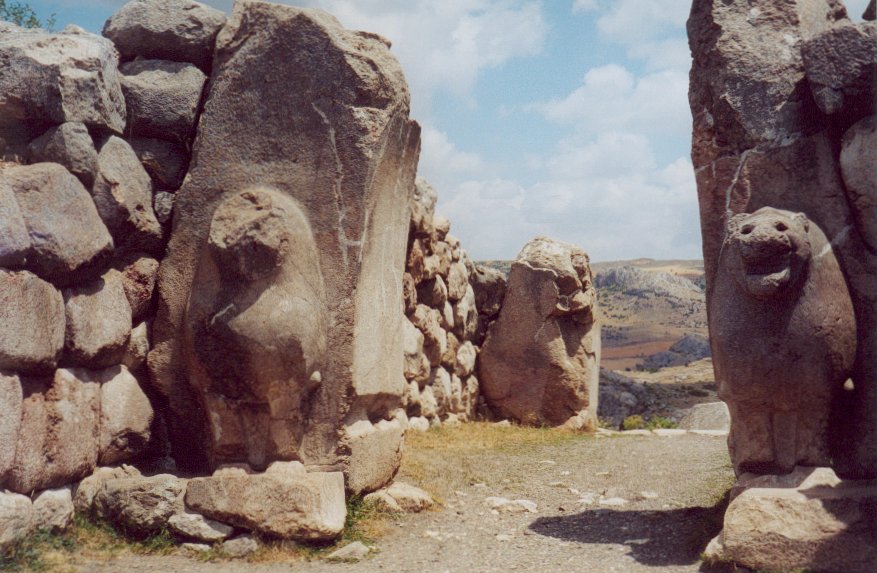
The Hittite economy was based on agriculture (particularly grain, grapes, and livestock) supplemented by control of major trade routes connecting Mesopotamia, the Levant, and the Aegean world. The Hittite capital Hattusa, located at an elevation of approximately 1,100 metres in the semi-arid central Anatolian plateau, was a massive fortified city with monumental stone walls extending over 8 kilometres, elaborate gate complexes decorated with carved lion and sphinx guardians, and multiple temple precincts that served as centres of both religious worship and economic redistribution.8
Collapse and legacy
The Hittite Empire collapsed suddenly around 1178 BCE as part of the wider Bronze Age Collapse that destroyed or severely disrupted virtually every major civilisation in the eastern Mediterranean within a span of approximately fifty years. The last known Hittite king, Suppiluliuma II, recorded naval victories off the coast of Cyprus in one of the final Hittite inscriptions, but Hattusa itself was destroyed by fire and abandoned, never to be reoccupied as a major settlement.1, 12
The causes of the Hittite collapse remain debated. Cline has argued that the Bronze Age Collapse resulted from a cascading systems failure in which multiple stressors — including climate change (a prolonged drought documented in pollen and isotopic records), disruption of international trade networks, internal political instability, and attacks by the enigmatic "Sea Peoples" mentioned in Egyptian records — combined to overwhelm the interconnected palace economies of the Late Bronze Age. The Hittite Empire, dependent on long-distance grain imports to feed its highland capital and on control of Syrian trade routes for revenue, was particularly vulnerable to these disruptions.12
Although the empire itself was destroyed, Hittite cultural and political traditions survived in the Neo-Hittite kingdoms of southeastern Anatolia and northern Syria (c. 1180–700 BCE), which preserved Luwian hieroglyphic writing and elements of Hittite religious practice for several centuries after the fall of Hattusa. These successor states eventually fell to the Neo-Assyrian Empire, but their existence ensured that Hittite cultural influence continued to shape the ancient Near East well into the first millennium BCE.1, 3