Overview
- The Islamic Golden Age, spanning roughly the eighth through fourteenth centuries CE, was a period of extraordinary intellectual achievement centered on the Abbasid caliphate, during which scholars working in Arabic translated, preserved, and substantially expanded the scientific and philosophical heritage of ancient Greece, ancient India, and Persia — producing foundational advances in mathematics, astronomy, medicine, optics, and philosophy that shaped the trajectory of global science.
- Institutions such as the Bayt al-Hikma (House of Wisdom) in Baghdad catalyzed a systematic translation movement that rendered Greek, Sanskrit, and Pahlavi texts into Arabic, while original contributions — including al-Khwarizmi's algebra, Ibn al-Haytham's experimental optics, Ibn Sina's medical synthesis, and Averroes's Aristotelian commentaries — went far beyond mere preservation to constitute genuinely new knowledge.
- The decline of this intellectual tradition, accelerated by the Mongol sack of Baghdad in 1258 and subsequent political fragmentation, coincided with the transmission of Arabic scientific texts into Latin through translation centers in Toledo and Sicily, providing the intellectual foundation for the European scholastic tradition and, ultimately, the Scientific Revolution.
The Islamic Golden Age designates the period from roughly the mid-eighth through the fourteenth century CE during which scholars working primarily in Arabic produced a body of scientific, philosophical, and literary achievement that ranks among the most consequential in human intellectual history. Centered on the Abbasid caliphate and its capital Baghdad, but extending across a vast geography from Iberia to Central Asia, this tradition translated and critically expanded the knowledge of ancient Greece, ancient India, and Sassanid Persia while making original contributions to mathematics, astronomy, medicine, optics, chemistry, and philosophy.1, 2 The resulting corpus of Arabic-language scholarship was subsequently transmitted to medieval Europe through Latin translation, providing much of the intellectual foundation for the European scholastic tradition and the Scientific Revolution.7, 12
Historical context
The Abbasid revolution of 750 CE overthrew the Umayyad caliphate and established a new dynasty that shifted the political center of the Islamic world from Damascus to the newly founded city of Baghdad, constructed beginning in 762 CE by the caliph al-Mansur on the banks of the Tigris River. Baghdad's location near the former Sassanid capital of Ctesiphon placed it at the intersection of trade routes linking the Mediterranean, Central Asia, India, and China via both overland Silk Road corridors and maritime routes through the Persian Gulf.1, 6 Within a century of its founding, Baghdad had grown into one of the world's largest cities, with a population estimated at several hundred thousand, and had become a cosmopolitan center where Arab, Persian, Syriac Christian, Jewish, Indian, and Central Asian scholarly traditions converged.1
The Abbasid caliphs, particularly Harun al-Rashid (r. 786–809) and his son al-Ma'mun (r. 813–833), actively patronized scholarship. Al-Ma'mun established the Bayt al-Hikma (House of Wisdom), an institution that combined the functions of a library, translation bureau, and academy. While the precise nature and scale of the Bayt al-Hikma remain debated among historians, its role as a catalyst for the translation movement is well attested.6 The institution brought together scholars of diverse religious and linguistic backgrounds to render Greek philosophical and scientific texts into Arabic, a project that Dimitri Gutas has argued was motivated not merely by intellectual curiosity but by the Abbasid court's political need to legitimate its authority through association with the universal rational tradition of Greek learning.6
The translation movement
The Graeco-Arabic translation movement of the eighth through tenth centuries was one of the most ambitious knowledge-transfer projects in history. Working primarily from Syriac intermediary translations and increasingly from Greek originals, translators rendered into Arabic the major works of Aristotle, Plato, Galen, Hippocrates, Euclid, Ptolemy, Archimedes, and Dioscorides, along with significant portions of Neoplatonic philosophy and late antique commentary traditions.6, 7 The most celebrated translator was Hunayn ibn Ishaq (809–873 CE), a Nestorian Christian physician who, along with his son Ishaq ibn Hunayn and nephew Hubaysh, translated over a hundred works of Galen into Arabic and Syriac, developing sophisticated translation methodologies that prioritized meaning over literal word-for-word rendering.6
The translation movement was not limited to Greek sources. Astronomical and mathematical texts from ancient India, including the Siddhanta tradition of Indian astronomy and the Indian decimal numeral system, were translated into Arabic during the late eighth century. Persian administrative and literary texts from the Sassanid tradition likewise entered the Arabic corpus. The result was a synthesis without precedent: Arabic became the lingua franca of a scholarly tradition that drew on and integrated the intellectual heritages of multiple civilizations.1, 3, 4 The material infrastructure that supported this activity depended substantially on the introduction of papermaking technology from China, which reached the Islamic world following the Battle of Talas in 751 CE and rapidly replaced papyrus and parchment as the primary writing medium, dramatically reducing the cost of book production.13
Mathematics
The mathematical achievements of the Islamic Golden Age transformed the discipline and provided the foundations for much of modern mathematics. The most consequential figure was Muhammad ibn Musa al-Khwarizmi (c. 780–850 CE), a scholar at the Bayt al-Hikma whose two major works reshaped European mathematics when they were translated into Latin in the twelfth century. His Kitab al-Jabr wa'l-Muqabala (c. 820 CE), from whose title the word "algebra" derives, presented systematic methods for solving linear and quadratic equations using both algorithmic procedures and geometric proofs. Unlike the Greek geometric algebra of Euclid, al-Khwarizmi's approach treated equations as abstract objects amenable to standardized manipulation — a conceptual shift that laid the groundwork for symbolic algebra.8, 1
Al-Khwarizmi's second major contribution was his treatise on the Indian numeral system, which introduced the Hindu-Arabic decimal positional notation (including the concept of zero as a placeholder) to the Arabic-speaking world. The Latin translation of this work, Algoritmi de numero Indorum, gave rise to the English word "algorithm," a direct Latinization of al-Khwarizmi's name.8, 2 Subsequent mathematicians extended this foundation considerably. Omar Khayyam (1048–1131 CE), better known in the West as a poet, produced a systematic classification and geometric solution of cubic equations and contributed to the development of non-Euclidean geometric ideas through his critical examination of Euclid's parallel postulate.5 Jamshid al-Kashi (c. 1380–1429 CE), working at the observatory of Ulugh Beg in Samarkand, calculated the value of pi to sixteen decimal places — a record of precision that would not be surpassed for nearly two centuries.2
Astronomy
Islamic astronomers inherited the Ptolemaic geocentric model and the observational traditions of both Greek and Indian astronomy, then subjected them to sustained empirical scrutiny and theoretical revision. Al-Battani (c. 858–929 CE), working in Raqqa (modern Syria), produced refined measurements of the solar year, the precession of the equinoxes, and the obliquity of the ecliptic that surpassed Ptolemy's values in accuracy. His Kitab al-Zij al-Sabi (Sabian Tables) was translated into Latin in the twelfth century and remained a standard astronomical reference in Europe through the Renaissance, cited by Copernicus, Kepler, and Tycho Brahe.15, 1
Abd al-Rahman al-Sufi (903–986 CE) produced the Book of Fixed Stars, a comprehensive star catalogue that combined Ptolemaic star positions with systematic naked-eye observations, correcting many of Ptolemy's stellar magnitudes and including the first recorded observation of the Andromeda Galaxy (described as a "nebulous smear").15 The most ambitious observational program of the Islamic tradition was undertaken at the Maragha observatory in northwestern Persia, established in 1259 CE under the patronage of the Mongol Ilkhanid ruler Hulagu Khan. The Maragha school, led by Nasir al-Din al-Tusi, developed mathematical models (notably the "Tusi couple," a geometric device for producing linear motion from circular components) that addressed known deficiencies in Ptolemaic planetary theory. Historians of science have demonstrated striking similarities between Maragha models and those later employed by Copernicus, suggesting a possible transmission pathway, though the precise mechanism remains debated.12, 15
The tradition culminated in the observatory of Ulugh Beg (1394–1449 CE) in Samarkand, which produced a star catalogue of over a thousand stars with positional accuracies unsurpassed until the telescopic observations of Tycho Brahe in the late sixteenth century.15, 2
Medicine
Islamic medicine built upon the Galenic and Hippocratic traditions transmitted through the translation movement, synthesizing them with Persian and Indian medical knowledge into a comprehensive clinical and theoretical system. Abu Bakr al-Razi (c. 854–925 CE), known in Latin as Rhazes, was among the most original clinical thinkers of the tradition. His Kitab al-Hawi (Liber Continens), a massive compendium of Greek, Indian, and Arabic medical knowledge organized by disease, remained a standard reference in European medical schools into the fifteenth century. Al-Razi's monograph on smallpox and measles (Kitab fi al-Jadari wa al-Hasbah) is regarded as the first clinical description to distinguish the two diseases systematically.2, 16
The most influential medical text produced in the Islamic world was the Qanun fi al-Tibb (Canon of Medicine) of Ibn Sina (980–1037 CE), known in Europe as Avicenna. This five-volume encyclopaedia systematized the entirety of Galenic medical theory, pharmacology, and clinical practice into a logically organized framework that served as the principal medical textbook in both Islamic and European medical education for over five centuries. The Canon was translated into Latin by Gerard of Cremona in the twelfth century and was still being printed in European editions in the seventeenth century.10, 7
A particularly striking discovery was made by Ibn al-Nafis (1213–1288 CE), a Syrian physician working in Cairo, who described the pulmonary circulation of blood — the passage of blood from the right ventricle of the heart through the lungs and back to the left ventricle — in his Commentary on the Anatomy of the Canon of Ibn Sina. This description, which directly contradicted Galen's theory that blood passed between the ventricles through invisible pores in the interventricular septum, anticipated the work of Michael Servetus and William Harvey by several centuries. Ibn al-Nafis's discovery was unknown in Europe until the manuscript was identified in 1924 by the Egyptian physician Muhyo al-Din al-Tatawi.11
Optics and the experimental method
Ibn al-Haytham (c. 965–1040 CE), known in Latin as Alhazen, produced what is widely regarded as the most important single work in the history of optics before Newton. His Kitab al-Manazir (Book of Optics), composed during a period of house arrest in Cairo, systematically dismantled the emission theory of vision (which held that the eye emits rays that perceive objects) and replaced it with an intromission theory in which light rays travel from objects to the eye, where they are refracted by the crystalline lens to form an image.9
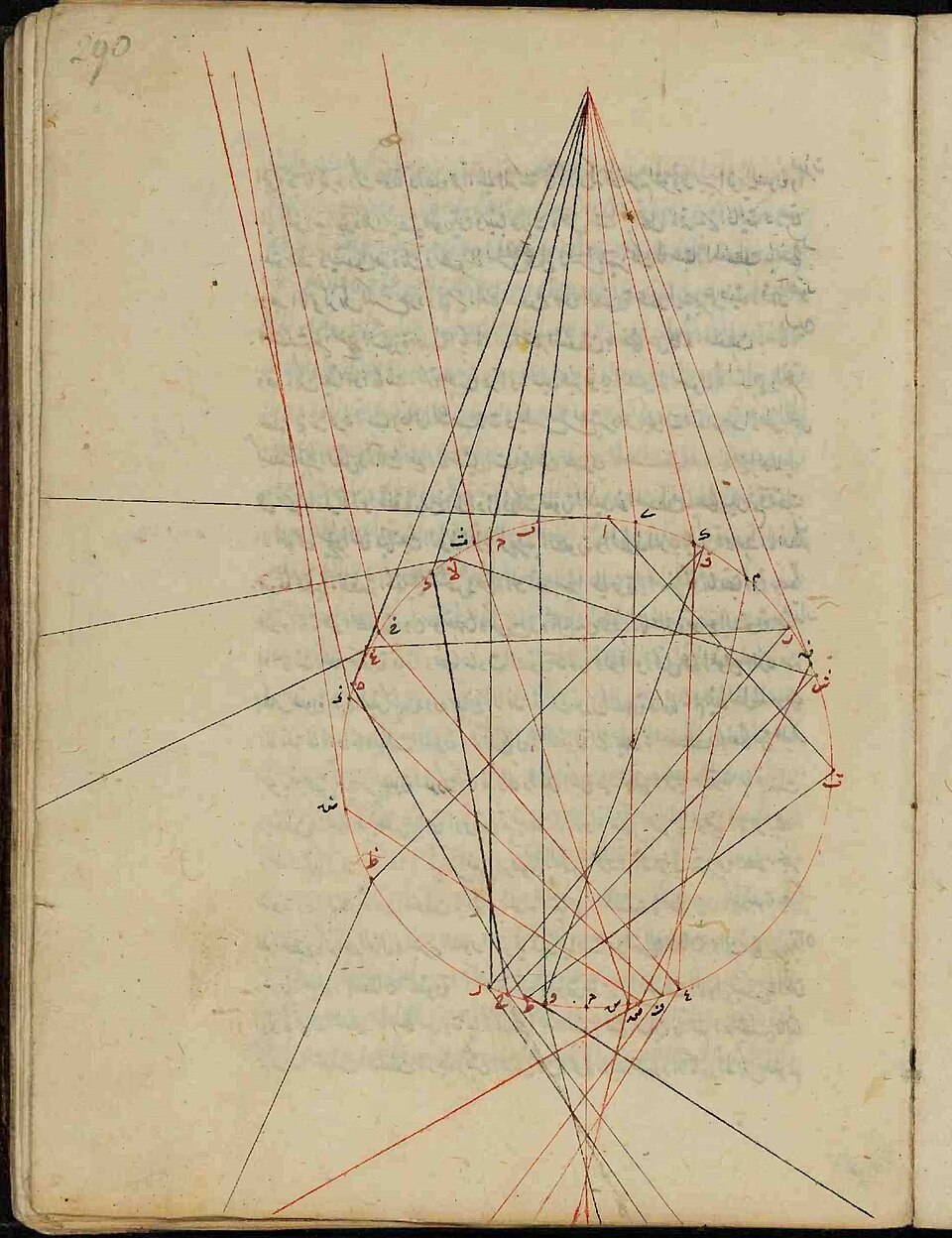

What distinguished Ibn al-Haytham's work was not merely his conclusions but his method. He insisted on the primacy of controlled experiment and mathematical demonstration over philosophical authority, designing and conducting experiments with darkened chambers (an early form of the camera obscura) to demonstrate that light travels in straight lines, that each point on an illuminated surface radiates light in all directions, and that the eye receives images through the refraction of these rays. A. I. Sabra, the foremost modern scholar of Ibn al-Haytham's optics, has argued that his methodological insistence on experimental verification and mathematical proof constitutes a genuine antecedent to the experimental method later formalized in the European Scientific Revolution.9, 5
The Kitab al-Manazir was translated into Latin as De Aspectibus or Perspectiva in the late twelfth or early thirteenth century and profoundly influenced European optical science, including the work of Roger Bacon, Witelo, and Johannes Kepler. Ibn al-Haytham's camera obscura experiments also laid the conceptual groundwork for the development of optical instruments, including, eventually, the telescope and the photographic camera.9, 7
Philosophy and the transmission of Greek thought
Islamic philosophy (falsafa) engaged deeply with the Aristotelian and Neoplatonic traditions received through translation, producing original syntheses that sought to reconcile Greek rational philosophy with Islamic theology. Al-Farabi (c. 872–950 CE), sometimes called the "Second Teacher" (after Aristotle), developed a political philosophy that adapted Plato's Republic to an Islamic context, arguing that the ideal state required a philosopher-prophet as ruler who combined rational knowledge with divine revelation. Al-Farabi also made significant contributions to logic, metaphysics, and music theory.3, 6
Ibn Sina (Avicenna), in addition to his medical work, produced a comprehensive philosophical system in his Kitab al-Shifa (Book of Healing) that synthesized Aristotelian natural philosophy with Neoplatonic emanation theory. His distinction between essence and existence — the argument that the existence of any contingent being is not necessitated by its essence and therefore requires an external cause, leading ultimately to a Necessary Existent (God) — became one of the most influential arguments in both Islamic and Christian scholastic theology.3, 7
Ibn Rushd (1126–1198 CE), known in Latin as Averroes, working in Cordoba and Marrakesh, produced the most systematic and extensive commentaries on Aristotle written in any language. His insistence on the autonomy of philosophical reasoning from theological authority, and his doctrine that philosophy and revelation represent two distinct but complementary paths to truth, provoked controversy in the Islamic world but had an even greater impact in Christian Europe, where "Latin Averroism" became a major intellectual movement in the thirteenth-century universities. Thomas Aquinas wrote his Summa contra Gentiles partly in response to Averroist positions, and Averroes's commentaries on Aristotle became standard university texts throughout medieval Europe.7, 12
Technology and engineering
The practical technologies of the Islamic world matched and in many areas exceeded those of contemporary civilizations. Agricultural innovation was particularly significant: the diffusion of crops including sugarcane, cotton, rice, citrus fruits, and eggplant across the Islamic world from India and Southeast Asia — a process the historian Andrew Watson termed the "Arab Agricultural Revolution" — was supported by sophisticated irrigation technologies, including underground canal systems (qanats), norias (water wheels), and engineered distribution networks that transformed arid landscapes into productive agricultural zones from Iran to Iberia.2, 1
The adoption and refinement of papermaking technology, acquired from Chinese artisans after the Battle of Talas in 751 CE, had consequences that extended far beyond the Islamic world. Paper mills were established in Samarkand, Baghdad, Damascus, Cairo, and Fez, and by the tenth century, paper had largely replaced papyrus and parchment throughout the Islamic world. The cheapness and abundance of paper facilitated the explosive growth of book culture, with Baghdad alone reported to have over a hundred booksellers in the tenth century. Paper production subsequently spread to Islamic Spain and Sicily, from which it entered Christian Europe, ultimately enabling the printing revolution of the fifteenth century.13
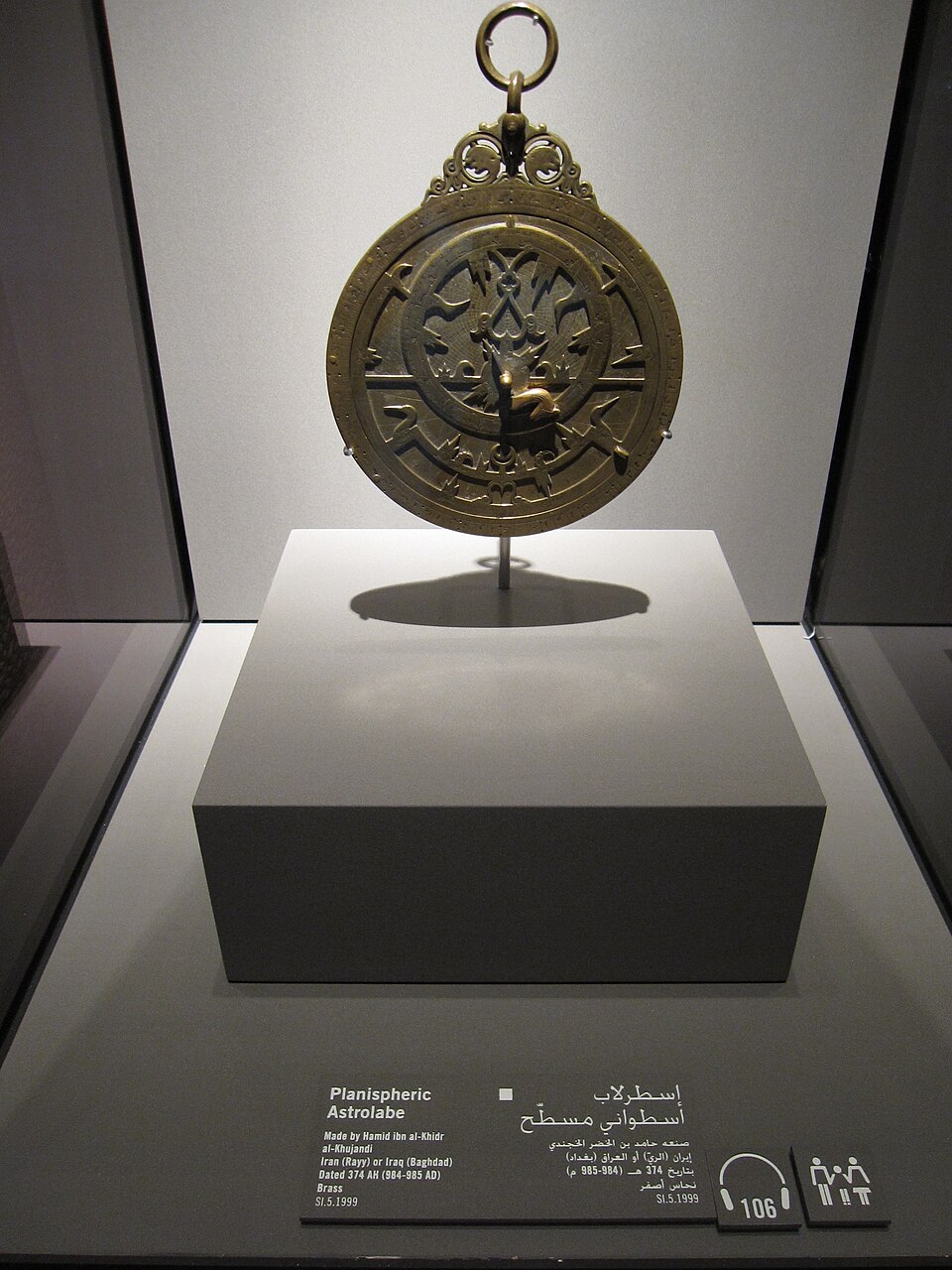
Navigational technology was advanced by Islamic contributions to cartography and instrument-making. The astrolabe, originally a Greek invention, was refined and elaborated by Islamic instrument-makers into a sophisticated tool for astronomical observation, timekeeping, and determining geographic latitude and the direction of Mecca (qibla) for prayer. Islamic cartographers produced world maps of considerable sophistication, most notably the Tabula Rogeriana (1154 CE) of al-Idrisi, commissioned by the Norman king Roger II of Sicily, which remained the most accurate world map for several centuries.2, 1

Decline and legacy
The causes of the Islamic Golden Age's decline were multiple, gradual, and remain debated among historians. Political fragmentation of the Abbasid caliphate, already well advanced by the tenth century as regional dynasties asserted effective independence, reduced the centralized patronage that had supported major scholarly institutions. The Mongol conquest of Baghdad in 1258, during which the last Abbasid caliph was executed and the city was sacked, destroyed libraries and irrigation infrastructure and has traditionally been regarded as a symbolic endpoint for the golden age, though recent scholarship has emphasized that significant scientific work continued in the post-Mongol Islamic world, particularly in Mamluk Egypt, Timurid Central Asia, and the Ottoman, Safavid, and Mughal empires.14, 12
Internal intellectual developments also played a role. The theologian al-Ghazali's (1058–1111 CE) influential critique of falsafa in his Tahafut al-Falasifa (Incoherence of the Philosophers), which attacked the claims of Aristotelian philosophy to achieve certainty on metaphysical questions, has sometimes been cited as a turning point that discouraged philosophical speculation in the Islamic world. However, this thesis is contested: al-Ghazali did not reject scientific inquiry per se, and significant philosophical and scientific work continued for centuries after his death.3, 5
The transmission of Arabic scientific knowledge to medieval Europe occurred primarily through two channels. The first was the translation movement centered in Toledo, Spain, where teams of scholars — including Christians, Jews, and Muslims — translated Arabic texts into Latin during the twelfth and thirteenth centuries. Gerard of Cremona alone translated over seventy works, including Ptolemy's Almagest, al-Khwarizmi's algebra, and Ibn Sina's Canon of Medicine. The second channel was Norman Sicily, where a multilingual court culture facilitated the exchange of Arabic, Greek, and Latin learning.7, 12
Key figures and contributions1, 2
| Scholar | Dates | Field | Major contribution |
|---|---|---|---|
| Al-Khwarizmi | c. 780–850 | Mathematics | Systematic algebra; Hindu-Arabic numeral transmission |
| Al-Razi (Rhazes) | c. 854–925 | Medicine | Clinical differentiation of smallpox and measles |
| Al-Battani | c. 858–929 | Astronomy | Refined solar year and star position measurements |
| Al-Farabi | c. 872–950 | Philosophy | Aristotelian-Neoplatonic synthesis; political philosophy |
| Al-Sufi | 903–986 | Astronomy | Book of Fixed Stars; first observation of Andromeda |
| Ibn Sina (Avicenna) | 980–1037 | Medicine, philosophy | Canon of Medicine; essence-existence distinction |
| Ibn al-Haytham (Alhazen) | c. 965–1040 | Optics | Experimental optics; intromission theory of vision |
| Omar Khayyam | 1048–1131 | Mathematics | Geometric solution of cubic equations |
| Ibn Rushd (Averroes) | 1126–1198 | Philosophy | Comprehensive Aristotelian commentaries |
| Ibn al-Nafis | 1213–1288 | Medicine | Discovery of pulmonary circulation |
| Ulugh Beg | 1394–1449 | Astronomy | Star catalogue of over 1,000 stars |
The impact of Islamic Golden Age scholarship on global intellectual history is difficult to overstate. The Arabic translations preserved Greek texts that would otherwise have been lost — significant portions of Aristotle, Galen, and Euclid survived only through their Arabic versions until Greek manuscripts were rediscovered. More fundamentally, Islamic scholars did not merely transmit inherited knowledge but transformed it: algebra, the experimental method in optics, pulmonary circulation theory, and the astronomical models of the Maragha school were original contributions that advanced human understanding beyond the achievements of the ancient world. The channels of transmission through which this knowledge reached Europe — primarily the translation centers of Toledo and Sicily, and later through direct contact during the Crusades and through Italian maritime commerce — constituted one of the most consequential episodes of cross-cultural intellectual exchange in history.7, 12, 5
References
The House of Wisdom: How Arabic Science Saved Ancient Knowledge and Gave Us the Renaissance
Greek Thought, Arabic Culture: The Graeco-Arabic Translation Movement in Baghdad and Early Abbasid Society
The Beginnings of Western Science: The European Scientific Tradition in Philosophical, Religious, and Institutional Context, Prehistory to A.D. 1450
Avicenna's Medicine: A New Translation of the 11th-Century Canon with Practical Applications