Overview
- The Minoan civilization, centered on the island of Crete from approximately 2700 to 1450 BCE, was the first literate, urban society in Europe, producing monumental palatial complexes at Knossos, Phaistos, and Malia that served as administrative, economic, and ceremonial centers without evident fortification walls.
- Minoan material culture is distinguished by vibrant fresco painting, technically sophisticated pottery, a still-undeciphered hieroglyphic script and Linear A writing system, and extensive maritime trade networks that connected Crete with Egypt, the Levant, Anatolia, and the Cycladic islands.
- The civilization experienced a sudden decline around 1450 BCE, with most palatial centers destroyed and subsequently occupied by Mycenaean Greek speakers who adapted Minoan administrative practices and script technology to produce Linear B, the earliest known form of written Greek.
The Minoan civilization, named by archaeologist Arthur Evans after the mythological King Minos, was a Bronze Age culture that flourished on the island of Crete and surrounding Aegean islands from approximately 2700 to 1450 BCE.2, 5 It represents the earliest complex, literate society in Europe, predating the Mycenaean Greek civilization by several centuries and developing independently of the Near Eastern urban traditions that had emerged along the Nile and in Mesopotamia millennia earlier.3 The Minoans constructed elaborate multi-story palatial complexes, developed two distinct writing systems, maintained extensive maritime trade networks spanning the eastern Mediterranean, and produced art of remarkable naturalism and sophistication.1, 10
Archaeological investigation of Minoan Crete began with Evans's excavations at Knossos in 1900 and has continued for over a century, revealing a society whose political organization, religious practices, and ultimate fate remain subjects of active scholarly debate.2, 12 The decipherment of Linear B by Michael Ventris in 1952 demonstrated that the final phase of palatial culture at Knossos was administered in an early form of Greek, confirming a Mycenaean takeover, while the earlier Linear A script remains undeciphered, leaving the Minoan language itself unknown.8

Discovery and chronology
Arthur Evans, keeper of the Ashmolean Museum at Oxford, began systematic excavation of the Knossos site in 1900 after acquiring the property from its Cretan owners.2 Over four decades, Evans uncovered a palatial complex of more than 1,300 rooms, which he named the "Palace of Minos" and interpreted as evidence of a powerful prehistoric civilization that he termed "Minoan" after the legendary king of Cretan mythology.2, 12 His extensive reconstructions of the palace, including reinforced concrete restorations and repainted frescoes, proved controversial among later archaeologists but established the basic framework for understanding Cretan Bronze Age culture.12
The chronological framework for Minoan civilization has undergone significant revision since Evans's initial pottery-based periodization. Evans divided Minoan history into Early Minoan (EM, c. 3100–2100 BCE), Middle Minoan (MM, c. 2100–1700 BCE), and Late Minoan (LM, c. 1700–1100 BCE), each with three sub-phases.2 Modern scholarship increasingly uses a palace-centered scheme: Prepalatial (before c. 1900 BCE), Protopalatial or Old Palace period (c. 1900–1700 BCE), Neopalatial or New Palace period (c. 1700–1450 BCE), and Final Palatial/Postpalatial (c. 1450–1100 BCE).14 Radiocarbon dating and dendrochronology have refined absolute dates, though the precise dating of the Theran eruption—a key chronological anchor—remains debated, with dates ranging from approximately 1628 to 1530 BCE depending on methodology.6, 7
Genetic analysis of ancient DNA from Minoan burial sites has established that the Bronze Age Cretans derived the majority of their ancestry from Neolithic Anatolian farming populations who had colonized the Aegean during the seventh millennium BCE, with additional gene flow from Caucasus-related and Iranian-related sources.9 This population was genetically similar to the later Mycenaeans, who carried additional ancestry from Eastern European steppe populations, suggesting broad demographic continuity in the Aegean region with gradual admixture over time.9
Palatial architecture
The defining feature of Minoan civilization is the palatial complex, a type of monumental architecture without clear precedent in the Aegean. The major palaces at Knossos, Phaistos, Malia, and Zakros were constructed during the Protopalatial period (c. 1900 BCE), destroyed around 1700 BCE by earthquakes, and rebuilt on a grander scale during the Neopalatial period.1, 5 Each palace was organized around a large rectangular central court, oriented roughly north–south, surrounded by multi-story wings containing storage magazines, workshops, reception halls, cultic areas, and residential quarters.12
Knossos, the largest palatial complex, covered approximately 20,000 square meters and may have risen to four or five stories in places, with an elaborate drainage system, light wells that illuminated interior rooms, and large storage magazines containing rows of pithoi (ceramic storage jars) that held olive oil, wine, and grain.2, 12 The absence of massive defensive walls around the major palaces—in contrast to contemporary Near Eastern and later Mycenaean citadels—has been interpreted by some scholars as evidence of a unified political authority across Crete that rendered internal fortification unnecessary, though others argue that the palaces themselves, with their controlled access points, served defensive functions.1, 15
Smaller palatial structures and elite residences, sometimes called "villas," are distributed across the Cretan landscape, suggesting a hierarchical settlement system in which the major palaces functioned as regional centers overseeing surrounding communities.1 The palace at Phaistos, situated on a ridge overlooking the fertile Mesara plain, controlled access to the most productive agricultural land in southern Crete, while Zakros on the eastern coast may have served primarily as a port mediating trade with the Levant and Egypt.5, 10
Writing systems
The Minoans developed at least three distinct writing systems over the course of the Bronze Age, making Crete one of the few places in the ancient world where writing appears to have been invented independently or at minimum developed with minimal external influence.8 Cretan Hieroglyphic, the earliest script, appeared around 2100 BCE and is attested primarily on seal stones and a few clay documents, with approximately 300 known inscriptions that remain undeciphered.8 Linear A, which supplanted Cretan Hieroglyphic during the Protopalatial period (c. 1800 BCE), was used more extensively for administrative documents, religious dedications on offering tables, and inscriptions on metal and stone objects.8, 5
Despite decades of scholarly effort, Linear A remains undeciphered. Approximately 1,400 inscriptions are known, most of which are brief administrative records on clay tablets from palace archives, recording quantities of commodities with numerical notations and ideograms that can be partially interpreted through comparison with Linear B.8 The underlying language of Linear A has been identified as non-Greek and possibly non-Indo-European, though proposed connections to Luwian, Semitic, and other language families remain undemonstrated.8
Linear B, which emerged at Knossos around 1450 BCE following the Mycenaean takeover, adapted many Linear A signs to write an early form of Greek. Michael Ventris's decipherment in 1952, confirmed by John Chadwick's philological analysis, revealed that the Linear B tablets recorded detailed administrative inventories: livestock counts, grain allocations, textile production, personnel lists, and religious offerings.8, 5 The content of these tablets, overwhelmingly bureaucratic in nature, provides invaluable evidence for the economic organization of the late palatial period but tells comparatively little about Minoan literature, law, or historical narrative.8
Art and material culture
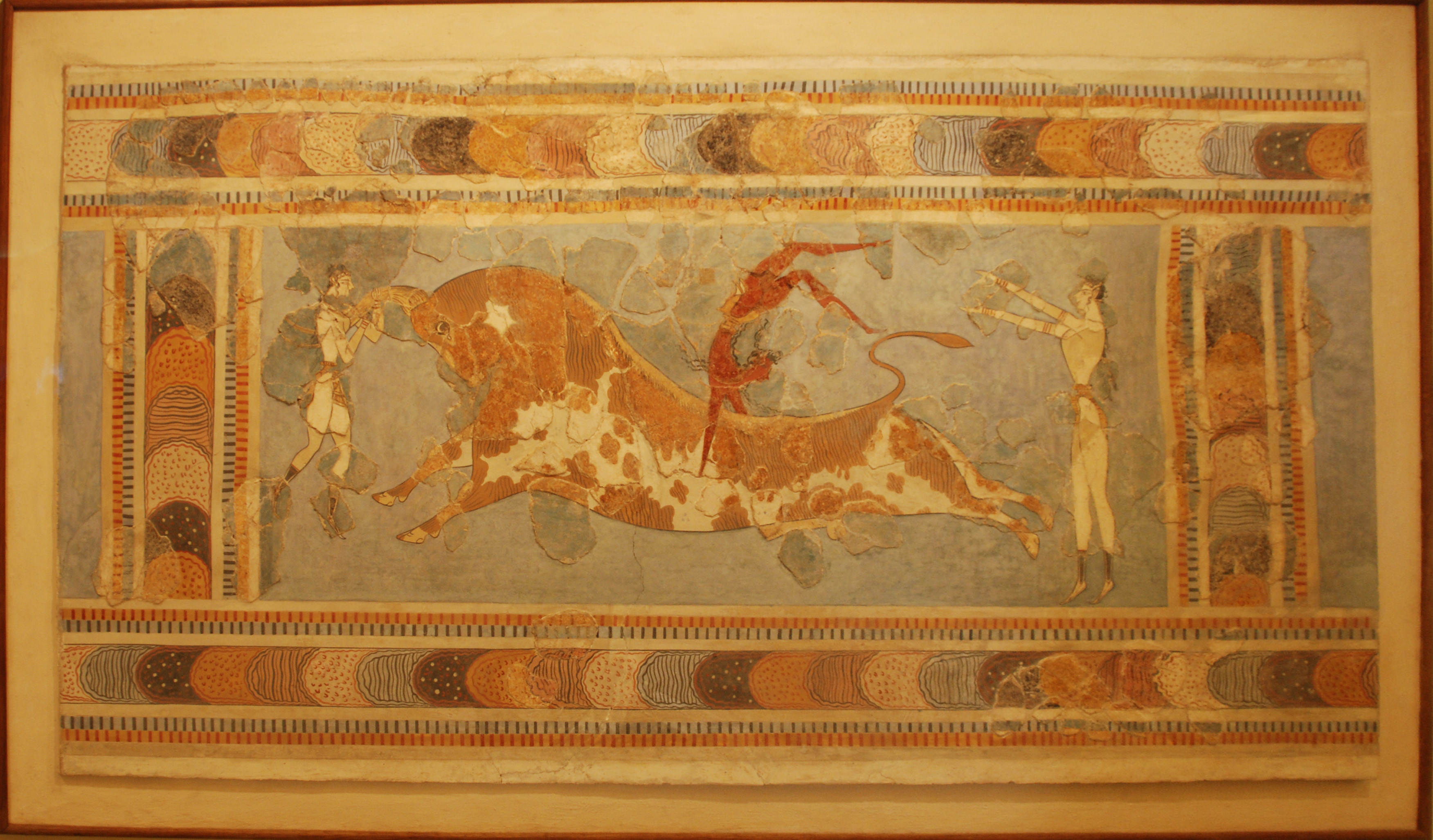
Minoan art is distinguished by its naturalism, dynamism, and preference for curvilinear forms, setting it apart from the more rigid conventions of contemporary Egyptian and Near Eastern artistic traditions.11 Wall paintings, or frescoes, constitute the most celebrated surviving art form, depicting scenes of nature (dolphins, birds, lilies, crocuses), religious rituals (processions, bull-leaping), and social gatherings with a vivid palette of reds, blues, yellows, and whites applied to wet plaster.11, 16 The frescoes from Akrotiri on Thera, preserved under volcanic ash from the Santorini eruption, are among the best-preserved Bronze Age paintings in the world and depict miniature fleet processions, boxing youths, and elaborate landscapes that provide direct evidence for Minoan artistic conventions and social practices.16
Minoan pottery underwent a series of stylistic developments that serve as the primary basis for archaeological chronology. Early Minoan vessels in the Vasiliki and Myrtos traditions feature mottled dark-on-light surfaces, while Middle Minoan Kamares ware introduced polychrome decoration with white and red motifs on dark backgrounds, including spirals, rosettes, and marine organisms.11, 1 Late Minoan Marine Style pottery, with its naturalistic depictions of octopuses, nautiluses, and starfish wrapping around vessel surfaces, represents the culmination of Minoan ceramic artistry.11
Minoan craftspeople also excelled in metalwork, gem engraving, faience production, and stone vessel carving. Gold jewelry from the Chrysolakkos burial complex near Malia and the Aegina Treasure demonstrates mastery of granulation and filigree techniques.11 Seal stones carved from semi-precious materials such as cornelian, agate, and rock crystal bear miniature scenes of animals, ritual activities, and mythological creatures with extraordinary precision, and circulated widely throughout the Aegean as markers of administrative authority and personal identity.11, 10
Maritime trade
Crete's position at the crossroads of the eastern Mediterranean enabled the Minoans to develop extensive maritime trade networks connecting the Aegean with Egypt, the Levant, Cyprus, and the central Mediterranean.13, 15 Archaeological evidence for these connections includes Egyptian objects (stone vessels, scarabs, faience) found in Cretan contexts, Minoan pottery and metalwork recovered from sites in Egypt, Syria, and Anatolia, and Cretan-style frescoes painted at the Egyptian site of Tell el-Dab'a (ancient Avaris) and the Levantine palace of Alalakh.10, 13
The Uluburun shipwreck, discovered off the southern coast of Turkey and dated to the late fourteenth century BCE, provides the most detailed snapshot of Late Bronze Age maritime commerce. The vessel carried approximately ten tons of Cypriot copper ingots, one ton of tin (likely from Afghanistan via Mesopotamia), Canaanite amphorae containing resin, glass ingots of Egyptian or Mesopotamian origin, African ebony, ivory, and Mycenaean and Cypriot pottery.10 While postdating the main period of Minoan independence, the Uluburun cargo reflects the trade patterns that the Minoans had helped establish centuries earlier.13
The concept of a Minoan "thalassocracy"—a maritime empire exercising political control over the Aegean islands—derives from later Greek literary traditions, particularly Thucydides's account of King Minos clearing the seas of piracy.15 Archaeological evidence supports extensive Minoan cultural influence in the Cycladic islands, where Cretan-style architecture, pottery, frescoes, and administrative practices appeared during the Neopalatial period, but whether this influence reflects political domination, commercial networks, or cultural emulation remains debated.13, 15
Religion and ritual
Minoan religious practices, reconstructed from iconographic evidence, architectural remains, and ritual deposits, appear to have centered on female deities associated with nature, fertility, and animal mastery, though the absence of deciphered texts makes theological interpretation uncertain.1, 10 Figurines and seal impressions depict female figures flanked by animals, holding snakes, or standing atop mountain peaks, leading scholars to identify goddesses of varying aspects rather than a single "Great Goddess" as Evans originally proposed.2, 1
Peak sanctuaries, located on prominent hilltops visible from surrounding settlements, served as important open-air cult sites where worshippers deposited terracotta figurines of humans and animals, bronze objects, and stone offering tables inscribed in Linear A.1, 5 Over 25 peak sanctuaries have been identified across Crete, with the best-studied examples at Juktas (visible from Knossos) and Petsophas near the town of Palaikastro.1 Cave sanctuaries, including the Kamares cave on Mount Ida and the Dictaean cave at Psychro, similarly functioned as places of worship and votive deposition over many centuries.5
Bull-leaping, depicted in frescoes, seal impressions, and the famous bronze figurine of a leaper vaulting over a bull's back, represents one of the most distinctive and debated aspects of Minoan ritual practice.11 Whether the activity was a genuine acrobatic performance, a symbolic ritual, or an artistic convention remains unclear, but its frequent representation across multiple media and sites indicates that it held deep cultural significance.10 The double axe (labrys), one of the most ubiquitous Minoan symbols, appears in both ritual and administrative contexts and may have served as a marker of sacred authority.2, 12
Economy and administration
The Minoan economy was based on a combination of Mediterranean agriculture—cereals, olives, grapes, and pulses—supplemented by pastoralism, fishing, and craft specialization, all coordinated through a redistributive system centered on the palaces.1, 4 The large storage magazines at Knossos and Phaistos, with their rows of pithoi capable of holding thousands of liters of olive oil and wine, point to a system in which agricultural surpluses were collected, processed, and redistributed by palatial administrators.12 Organic residue analysis of Minoan vessels has identified traces of olive oil, wine, beer, and various herbs and spices, confirming the diversity of agricultural products managed by the palatial economy.4
Administrative documents in both Linear A and Linear B record detailed inventories of commodities, livestock, and personnel, using standardized systems of weights and measures that facilitated economic accounting across the island.8 Seal stones and clay sealings, found in large quantities at palatial archives, functioned as administrative devices for securing containers and authorizing transactions, with individual seal designs serving as markers of personal or institutional authority.5
Estimated palace complex areas1, 12
The Theran eruption and its consequences
The volcanic eruption of Thera (modern Santorini), located approximately 110 kilometers north of Crete, was one of the largest volcanic events in recorded human history, ejecting an estimated 60 cubic kilometers of magma and generating tsunamis, ash fall, and atmospheric disruption across the eastern Mediterranean.6 Radiocarbon dating of an olive branch buried by tephra yielded a date of 1627–1600 BCE, while some archaeological synchronisms with Egyptian chronology suggest a date closer to 1530–1500 BCE, creating an ongoing debate about the absolute chronology of the eruption and its relationship to Minoan palatial history.6, 7
The eruption buried the Minoan settlement of Akrotiri under meters of volcanic ash, preserving its multi-story buildings, elaborate frescoes, and material culture in extraordinary detail but apparently without casualties—no human remains have been found, suggesting the population evacuated before the final catastrophic phase.16 On Crete, the immediate effects of the eruption included ash fall (a thin tephra layer is found at several eastern Cretan sites), potential tsunami damage to coastal settlements, and possible disruption of agricultural production.7
The relationship between the Theran eruption and the end of Minoan civilization is more complex than early "catastrophist" theories suggested. The palaces were not destroyed at the time of the eruption itself but continued to function for at least several decades afterward during the Late Minoan IB period.14 The widespread destructions that ended the Neopalatial period around 1450 BCE are now attributed to a combination of factors, potentially including the long-term ecological and economic consequences of the eruption compounded by Mycenaean military intervention.1, 5
Decline and Mycenaean succession
Around 1450 BCE, all major Minoan palatial centers on Crete were destroyed by fire, with the notable exception of Knossos, which continued to function as an administrative center under new management.1, 5 The pattern of destruction—simultaneous, violent, and comprehensive—has been interpreted as evidence of conquest, possibly by Mycenaean warriors from the Greek mainland, though internal conflict and social upheaval cannot be ruled out.10 The appearance of Linear B at Knossos after the destructions, recording administrative transactions in Mycenaean Greek, provides the strongest evidence for a political takeover by Greek-speaking elites who adopted and adapted existing Minoan administrative infrastructure.8
The final destruction of the palace at Knossos is conventionally dated to around 1375–1350 BCE, after which no major palatial administration is attested on Crete, though settlement continued at reduced scale throughout the Late Bronze Age and into the Early Iron Age.14 Minoan cultural traditions, including artistic motifs, religious practices, and craft techniques, persisted in attenuated form during the subsequent centuries, influencing Mycenaean and later Greek cultural development.5, 10 The Greek myths of Minos, the Minotaur, and the labyrinth may preserve distorted memories of the imposing Knossian palace and its bull-related rituals, transmitted orally across the centuries between the Bronze Age collapse and the emergence of Greek literary culture.12
Legacy and significance
The Minoan civilization holds a singular position in the history of European cultural development as the first literate, urban society on the continent, demonstrating that complex administrative states could emerge in the Aegean independently of—though in contact with—the older civilizations of the Near East.3, 10 The transmission of Minoan script technology to the Mycenaeans, who adapted Linear A to create Linear B for writing Greek, represents a critical link in the chain of literacy that would eventually lead to the Greek alphabet and, through it, to all subsequent European writing systems.8
Archaeological study of Minoan Crete continues to produce new discoveries and reinterpretations. Recent genetic studies have clarified the population history of Bronze Age Crete, demonstrating continuity from Neolithic farmers with incremental admixture from eastern populations.9 Ongoing excavations at sites such as Zominthos, Sissi, and Petras are expanding understanding of non-palatial settlement and the relationship between palaces and their surrounding communities.1 The Minoan world remains a compelling case study in how complex societies emerge, flourish, interact with their neighbors, and ultimately transform under the pressures of environmental change, political competition, and cultural encounter.10